Teaching Hospital Advantage in China: How University Affiliation Delivers Cutting-Edge Care
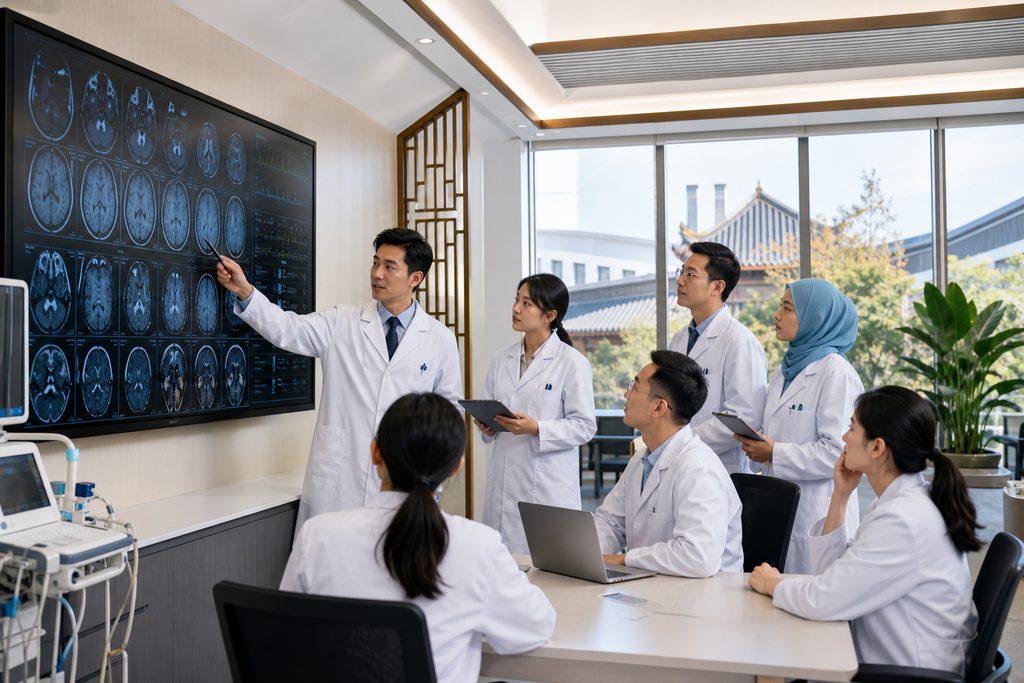
Have you ever sat in a specialist’s office and felt the options presented were somehow already outdated? That quiet suspicion that a newer technique, a different device, or a fresher clinical trial might exist just beyond the walls of your local hospital is often correct. The gap between research discovery and routine clinical practice can stretch for an agonizing 17 years, according to a well-known Institute of Medicine report. That lag is a problem you do not have to accept.
At China Medical Services, our team spends every working day inside the ecosystem this article describes. We do not provide medical advice. What we do is connect international patients with China’s most research-active university hospitals—the places where the 17-year gap shrinks dramatically. This article explains the structural reasons why a teaching hospital in China operates differently, how that translates into concrete advantages for you as a patient, and what it practically means for your treatment plan and budget.
Key Takeaways
- China’s top university-affiliated hospitals perform surgical volumes that are often 5-10 times higher than a typical Western center, directly correlating with better outcomes.
- The structural link between research labs, clinical trials, and patient wards means patients at teaching hospitals gain access to techniques and therapies years before they become standard abroad.
- The language barrier and complex internal systems at a Chinese public hospital are formidable; having a bilingual case manager is not a luxury but a practical necessity for navigating them.
- You should see the “teaching hospital advantage” not as a single selling point, but as a bundle: high-volume expertise, early research access, multidisciplinary review, and a significant cost differential all operating together.
The Problem: When Standard Medicine Moves Too Slowly
A cancer diagnosis is a terrifying race against time. But for many patients, the race slows to a crawl not because of the disease, but because of the system. In the UK’s NHS, the target for a first cancer treatment after an urgent GP referral is 62 days. In parts of Canada, the median wait time between specialist referral and treatment can stretch to 27.4 weeks, according to the Fraser Institute. These are averages. Individual cases can take much longer.
Waiting is not just psychologically agonizing. For aggressive malignancies, a delay of even four weeks can mean the difference between a curative surgical window and a disease that has progressed. This timeline problem is compounded by a technology access problem. A new immunotherapy combination might show remarkable Phase III trial results in a major journal, but its approval and funding for routine use in your home country could be years away. You are left hoping the standard protocol, designed for the average patient five years ago, will be enough.
This is the harsh reality that pushes roughly 14 million people worldwide to cross borders for medical care each year, a figure cited by Patients Beyond Borders. They are not just seeking lower prices. They are seeking a temporal advantage—access to the right therapy, right now.
Why the Teaching Hospital Model in China Delivers Results
The term “teaching hospital” can sound academic and slow. In China’s top-tier institutions, the reality is the opposite. These are massive, high-throughput clinical engines where education, research, and patient care are not separate departments but a single continuous loop. A professor who spends the morning editing a research paper on a novel CAR-T cell therapy will spend the afternoon reviewing the scans of a patient on that exact protocol. This structural integration creates three distinct advantages.
Clinical Volume That Rewires Surgical Expertise
There is a blunt, unassailable truth in surgery: you want the doctor who does your procedure several times a week, not several times a year. The volume-outcome relationship is one of the most robust findings in medical literature. A 2017 study in The Lancet Oncology found that for complex cancer surgery, moving from a low-volume to a high-volume hospital could reduce postoperative mortality by a third or more.
China’s university hospitals operate on a scale that resets expectations. Fuwai Hospital, the cardiovascular teaching hospital of Peking Union Medical College in Beijing, performs over 14,000 cardiac surgeries annually—the highest volume of any cardiac center on the planet. A thoracic surgeon at Shanghai Pulmonary Hospital, affiliated with Tongji University, might perform upwards of 1,000 lung cancer resections in a single year. Compare that to a busy surgeon at a respected US academic medical center, who might perform 50 to 100. The muscle memory, the intraoperative judgment, the pattern recognition for rare complications—these are not abstract concepts. They are forged through sheer, relentless repetition.
From Bench to Bedside Without the Wait
How do teaching hospitals in China stay current with medical research? The answer is that in many cases, they are the ones generating it. When you walk into the oncology department of Fudan University Shanghai Cancer Center, you are not just receiving today’s standard of care. You are entering an institution that is actively writing tomorrow’s protocols.
These hospitals run hundreds of concurrent clinical trials. A patient with a treatment-resistant form of lymphoma might be offered a spot on a trial for a bispecific antibody that has not yet been submitted for FDA approval. A man with prostate cancer might receive a PSMA-targeted radioligand therapy that is still considered “investigational” in Europe. This is not experimental medicine in a risky sense; it is early-access medicine, conducted under rigorous ethical and regulatory oversight. The advantage is temporal. You are accessing the 2028 standard of care in 2025.
Multidisciplinary Teams Built Into the System
In many Western hospitals, a “multidisciplinary team” (MDT) meeting is a scheduled weekly event where busy specialists squeeze in reviews of complex cases. In a top Chinese teaching hospital, the MDT is often the default operating system. Because these are large, salaried physician groups within a single university system, the barriers to collaboration are lower. A hepatobiliary surgeon, an interventional radiologist, and a medical oncologist are not competitors in private practice; they are colleagues in the same department complex.
This has a tangible impact on treatment planning. A patient with a large liver tumor might be reviewed simultaneously by the surgeon who can resect it, the radiologist who can ablate it, and the oncologist who can treat it systemically. The decision is not a linear sequence of referrals but a single, coordinated strategy session. For international patients, this can compress what would be a month-long consultation process at home into a single visit.
What This Means for Minimally Invasive and Robotic Surgery
The question of whether minimally invasive surgery is better at teaching hospitals in China is not a matter of opinion. It is a matter of institutional priority and capital investment. Chinese university hospitals have aggressively adopted robotic surgery platforms, and the scale of their experience is now unmatched globally.
Is minimally invasive surgery better at teaching hospitals in China? The data suggests that the sheer procedural volume leads to shorter operative times and lower complication rates compared to lower-volume centers. A surgeon who has performed 2,000 robotic prostatectomies has simply seen and solved more intraoperative challenges than one who has done 200. The technology itself—the da Vinci Xi system, for instance—is identical to what you would find at Johns Hopkins or Charité in Berlin. The difference is the human at the console and the number of times they have been in that seat.
| Procedure | Avg. US Cash Price (USD) | China Univ. Hospital Range (USD) | Typical Volume/Surgeon/Year (China) |
|---|---|---|---|
| Robotic Prostatectomy | $35,000 – $55,000 | $15,000 – $22,000 | 200 – 400 |
| Robotic Lung Lobectomy | $40,000 – $60,000 | $16,000 – $24,000 | 300 – 600 |
| Robotic Gastrectomy | $45,000 – $70,000 | $18,000 – $26,000 | 150 – 300 |
The cost of robotic surgery at university hospital China reflects a structural economic advantage, not a quality discount. Hospital operating costs, physician salaries, and device supply chain expenses are simply lower. The robot is the same. The training is internationally benchmarked. The cost is a fraction, typically 30-50% of the US cash price, and that is before any insurance reimbursement you might pursue at home.
Choosing a Specific Center: The Shanghai Cancer Example
Let’s move from the general to the specific. A common search we see is for the best university-affiliated hospital Shanghai for cancer treatment. While “best” is always an individualized judgment, the objective metrics point overwhelmingly to one institution: Fudan University Shanghai Cancer Center (FUSCC).
FUSCC is not merely “a” teaching hospital. It is the teaching hospital for oncology within the Fudan University system, a university consistently ranked among China’s top three. The center treats over 80,000 cancer inpatients annually and runs more than 400 active clinical trials at any given time. Its pathology department reviews over 150,000 specimens per year, a volume that breeds diagnostic accuracy for rare tumors that a smaller center might see once a decade. For a patient with a complex or refractory cancer, the question is not whether FUSCC is “good.” The question is whether there is a more concentrated pool of oncology expertise anywhere in the world. The answer is, quite possibly, no.
What are the advantages of a teaching hospital in China for international patients specifically at a place like FUSCC? First, the international department is accustomed to receiving foreign records, arranging interpreter services, and structuring condensed evaluation schedules for patients traveling on an S2 visa. Second, the research mission means the hospital is actively seeking patients with diverse genetic backgrounds and rare mutation profiles for its expanding trial portfolio. You are not a burden on the system; you are a potential candidate for the next breakthrough.
Medical Tourism Packages and the Coordination Reality
The term “medical tourism packages China university hospital” suggests a tidy, all-inclusive product. The reality is more nuanced and, frankly, more serious. A top-tier Chinese university hospital is not a hotel. It does not sell a “cancer treatment package” on a website. What exists instead is a coordination service that assembles the necessary components into a seamless experience.
A well-structured coordination pathway includes: the translation and digitization of your existing medical records into a format Chinese specialists can rapidly review; a pre-arrival video consultation with the relevant department chair or senior specialist (typically $500–$800); a defined schedule of diagnostic tests upon arrival to confirm the pathology and staging; a scheduled MDT review; and a treatment proposal with a clear timeline and cost estimate. The treatment itself—the surgery, the chemotherapy cycles, the radiation fractions—is billed directly by the hospital. The coordination service, which can range from $5,000 to $8,000 for comprehensive end-to-end support, is what ensures you do not get lost in a 5,000-patient-per-day system where all directional signage is in Chinese characters.
This is not a package holiday. It is a serious medical undertaking with a professional navigator. The distinction matters.
Practical Considerations: Visa, Payment, and Follow-Up
You cannot simply book a flight and walk into a professor’s clinic. The logistics require careful planning, and understanding them upfront prevents disastrous assumptions.
Visa Reality: Medical treatment in China falls under the S2 short-term private affairs visa category, or the S1 for stays exceeding 180 days. The hospital’s international department will issue a formal invitation letter and treatment confirmation document, which you submit with your visa application. The M visa is for commercial and trade activities and is not applicable to medical travel. Processing times vary by embassy, but you should budget at least 3-4 weeks. Do not book a non-refundable flight until the visa is in your passport.
Payment Architecture: Chinese public hospitals, including their international VIP departments, operate on a pre-payment deposit model. You will be asked to place a deposit upon admission, which is drawn down as services are rendered. The hospital will provide a detailed, itemized invoice and official medical records suitable for insurance reimbursement. Your insurance company may reimburse you directly; the hospital will not typically bill them for you. The cost of robotic surgery at university hospital China, as outlined above, is a cash outflow you must be prepared to front. Reimbursement comes later.
Follow-Up and Continuity: The most common failure point in cross-border care is the handoff back home. Before you leave, obtain a complete discharge summary, a full set of DICOM-format imaging on a disc, a detailed pathology report, and a written follow-up plan from your Chinese physician. This is not optional. Your home oncologist or surgeon needs this data to continue your care safely. A competent coordination service will have a protocol for assembling this “continuity packet” before you depart.
Frequently Asked Questions
Yes. The da Vinci surgical systems, linear accelerators for radiation, PET-CT scanners, and implantable devices are the same FDA- or CE-marked equipment you would encounter at a major US or European center. Top university hospitals in China use the latest-generation technology. The difference is not the machine; it is the volume of cases run on it.
This is a serious question that deserves a direct answer. Chinese medical malpractice law is different from Western tort systems, and pursuing a legal claim as a foreign national is extraordinarily difficult and rarely successful. Your primary protection is not the legal system; it is the selection of an elite institution with a global reputation to protect. These hospitals have rigorous internal quality control and a strong incentive to avoid adverse outcomes in their international patient population. All patients are asked to sign informed consent documents, translated into English, that outline the risks. You should read them carefully and ask questions before signing.
All legitimate clinical trials at Chinese university hospitals are registered with the Chinese Clinical Trial Registry (ChiCTR) or ClinicalTrials.gov, and they must receive approval from the hospital’s Institutional Review Board (IRB). You can ask for the trial’s registration number and verify it online. The informed consent document for the trial will detail the known risks, the investigational nature of the therapy, and your right to withdraw at any time without affecting your standard care. Do not participate in any trial that cannot produce these documents.
Some will. Some will not. The reaction often depends on the ego and open-mindedness of your local physician, not the quality of the Chinese plan. Before you travel, it is wise to have a candid conversation with your home doctor. Explain you are seeking a second opinion and possible treatment at a high-volume research center. A written second opinion from a Fudan or Peking Union specialist, carrying the weight of their institution’s data, is often persuasive. But you should anticipate the possibility of resistance and have a plan for finding a local physician who is willing to collaborate with an international team. We have seen this dynamic many times, and it is a social challenge as much as a medical one.
Your Next Step
The teaching hospital advantage in China is not a marketing slogan. It is a structural reality rooted in surgical volume, research integration, and relentless clinical focus. For a patient facing a serious diagnosis, it represents a legitimate parallel pathway to care—one that may offer techniques not yet available at home, delivered by teams whose experience is measured in the thousands of cases, at a cost that makes the financial burden far lighter. Our team at China Medical Services exists to bridge the logistical and linguistic gap between you and these institutions. We handle the coordination so you can focus on the treatment decision itself. If you would like to understand which specific hospital and specialist team is most appropriate for your case, you can request a free, no-obligation consultation through our patient companion page. The first conversation is simply about mapping your options. The decisions remain entirely yours.
For more medical information and treatment options in China, visit chinamedservices.com (China Medical Services).
