Vascular Surgery in China: How to Arrange It and What It Costs
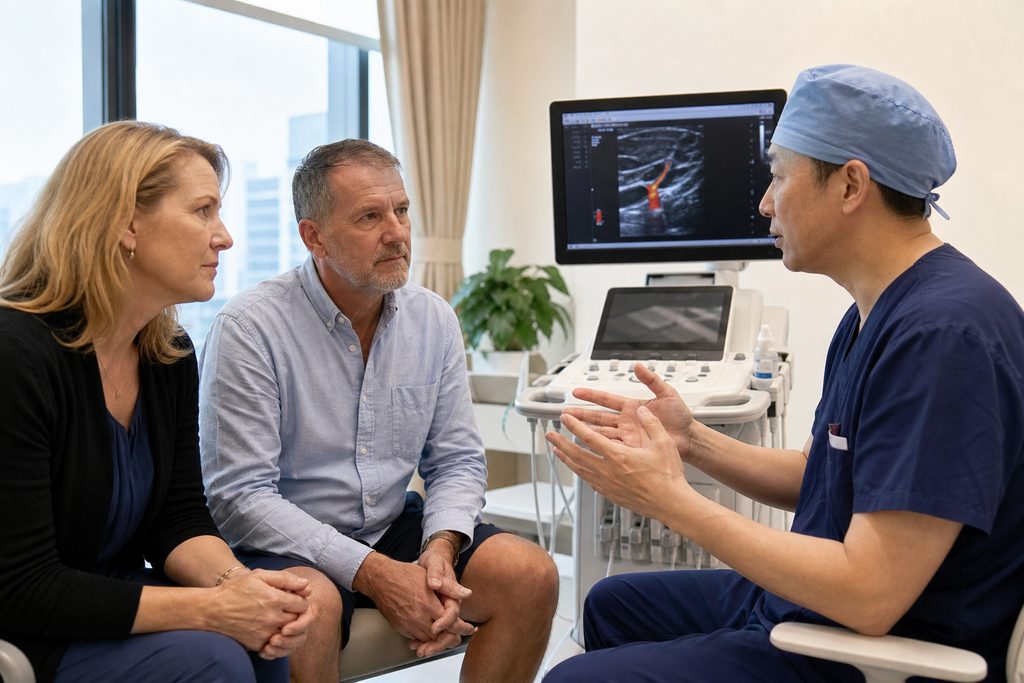
Key Takeaways
- Complex open and endovascular procedures at top Chinese hospitals typically run $8,000 to $35,000, against $80,000 to $200,000 or more in the United States for comparable work.
- China’s highest-volume vascular centers in Beijing and Shanghai perform thousands of aortic and peripheral interventions each year, which is exactly the kind of repetition that sharpens outcomes.
- You cannot book a public-hospital surgery slot from overseas by email. A face-to-face outpatient visit comes first, and that rule trips up a lot of first-time medical travelers.
- Anyone promising a guaranteed surgery date or a specific surgeon before you’ve been examined is selling you something that doesn’t exist.
The Problem: The Wait, the Bill, and the Runaround
You need a carotid endarterectomy, or a stent for a narrowed leg artery, or an aortic repair. In Canada, the median wait from specialist referral to vascular surgery has stretched past 10 weeks in several provinces, according to annual Fraser Institute wait-time reporting. In the UK, National Health Service vascular referral-to-treatment figures have repeatedly breached the 18-week standard. And in the US? The clinical problem is solved quickly — if your insurance covers it. A single fenestrated aortic stent graft can list above $50,000 before surgeon and facility fees are added.
So patients start searching. They find that vascular surgery cost China is often a fifth of American pricing. They find Chinese hospitals publishing aortic case volumes that rival anything in Europe. Then they hit the wall: nobody explains how a foreigner actually gets through the door.
That gap — between “this looks promising” and “here is the sequence of steps” — is where most medical travel plans die.
Why China’s Vascular Centers Deliver Real Results
Volume Is Not a Marketing Word
Fuwai Hospital in Beijing is the highest-volume cardiac surgical center in the world, performing more than 14,000 heart operations annually. Vascular and endovascular teams at China’s top-tier hospitals operate at similar scale. When a department performs several hundred complex aortic interventions a year, the entire team — anesthesiologists, perfusionists, ICU nurses, interventional radiologists — moves through the same choreography repeatedly. That institutional muscle memory matters.
A 2021 analysis in the Journal of Vascular Surgery found that hospitals in the highest volume quartile for open abdominal aortic aneurysm repair had significantly lower mortality than the lowest quartile. Practice counts.
Technology Deployed at Scale, Not as a Showcase
Hybrid operating theaters, intravascular ultrasound, drug-coated balloons, and fenestrated/branched stent grafts are standard inventory at major Chinese vascular departments — not premium add-ons. The difference from many Western systems is throughput. A Chinese tertiary hospital may schedule 20 to 40 catheter-lab cases in a single day. Equipment sits in use rather than in a brochure.
Why the Price Gap Exists
Lower cost does not automatically mean lower quality, and it’s worth understanding why. Physician salaries in China’s public system are a fraction of US levels. Stent grafts and devices are procured through national centralized purchasing, which has cut implant prices dramatically in recent years — in some cases by more than 80% on selected cardiovascular devices. Hospital overhead is lower. None of that changes the skill of the operator holding the wire.
| Procedure | Typical China Range (USD) | Typical US Range (USD) |
|---|---|---|
| Carotid endarterectomy | $8,000 – $15,000 | $40,000 – $80,000 |
| Peripheral angioplasty + stenting | $10,000 – $22,000 | $50,000 – $120,000 |
| Open abdominal aortic aneurysm repair | $18,000 – $35,000 | $90,000 – $200,000 |
| EVAR (standard stent graft) | $20,000 – $35,000 | $80,000 – $150,000 |
| Varicose vein endovenous ablation | $3,000 – $7,000 | $15,000 – $40,000 |
These are ranges. Final figures vary by hospital and case complexity — device choice alone can swing a quote by thousands. Treat any single number quoted before your imaging is reviewed with suspicion.
How to Arrange Vascular Surgery in China for Foreigners: The Actual Sequence
Here is the honest version, step by step. It is not complicated, but it is sequential, and skipping a step costs you weeks.
Step 1 — Records first. Gather your angiography, CT angiography, duplex ultrasound reports, medication list, and recent labs. English is fine for the initial review; a translation is arranged later if needed.
Step 2 — Written second opinion. A Chinese vascular department reviews your file and returns a written assessment: is intervention indicated, what approach, roughly what cost band. This is the cheapest way to find out whether China is even the right answer for your case. Sometimes it isn’t.
Step 3 — Video consultation. You speak with the specialty team directly. You describe symptoms and goals; they explain the plan and what they’d need on arrival.
Step 4 — Visa. This is where people get it wrong. Foreigners coming to China for medical treatment apply for the S2 visa, with a notation for medical treatment purposes, supported by hospital documentation. Stays beyond 180 days fall under S1. Accompanying family members apply for S2 as well. The M visa is a commercial and trade category and has nothing to do with medical care. Requirements shift, so confirm current specifics with the nearest Chinese embassy or consulate.
Step 5 — Arrival and outpatient visit. Public hospital general clinics cannot be pre-booked from abroad. You register on the day, queue, and see the physician in person. Surgery is scheduled only after that face-to-face assessment. Patients who want a pre-arranged appointment with a senior specialist typically go through a hospital’s international or VIP department instead — that route costs roughly 1.5 to 2 times the standard fee and includes English-language support.
Step 6 — Pre-operative workup and admission. Expect bloodwork, repeat imaging if the prior studies are dated, anesthesia clearance, and a payment deposit. Public hospitals require upfront payment; insurance reimbursement happens afterward, at home.
Choosing a Hospital and a Surgeon: What Actually Matters
Two searches dominate this decision: people look for the best vascular surgeon in Shanghai, or they want to book vascular surgery in Beijing. Both instincts are reasonable. Both can lead you astray if you fixate on a name.
Start with the department, not the individual. China’s Fudan University Hospital Rankings publish specialty reputation lists covering 45 disciplines, naming the top 10 hospitals in each. Vascular surgery sits within the broader surgery and cardiac surgery categories. A hospital ranked in the national top tier for cardiac and vascular work carries a system behind it — ICU capacity, blood bank depth, interventional backup — that a single brilliant operator cannot replicate alone.
Practical filters worth applying:
- Does the department handle your specific pathology at volume? Aortic dissection and varicose veins are not the same skill set.
- Is there a hybrid operating room on site? Complex endovascular work often needs open surgical backup mid-procedure.
- What does the international department actually provide — interpretation, insurance documentation, discharge summaries in English?
- Who manages you if a complication appears on day three after discharge?
Our specialty rankings by department let you filter hospitals by discipline and city before you commit to anything. For a broader view of how the tiers break down, the Fudan top 100 hospitals grouped by city shows where the concentration of high-tier centers actually sits — Beijing leads with 21 ranked hospitals, Shanghai follows with 18, Guangzhou with 10.
Practical Considerations: Visa, Payment, Language, Follow-Up
Money moves differently here. Public hospitals want prepayment by wire transfer or international card, and daily card transaction limits on foreign cards can be low — sometimes the equivalent of a few thousand dollars per day. Plan the transfer before you fly, not at the cashier window. Private international hospitals such as United Family, Jiahui, Parkway, and Raffles often bill insurance directly and accept international cards without drama, at higher prices.
Language is the harder problem. A top Chinese hospital may see 10,000 outpatient visits in a day. Signage, registration kiosks, and pharmacy queues assume Chinese. You can manage with translation apps for a clinic visit. You cannot manage a post-operative ward round with one.
Follow-up after you fly home deserves a plan. Ask for operative notes, implant documentation with device serial numbers, and imaging on disc before discharge. Your cardiologist or vascular surgeon at home will need all of it, and retrieving records from overseas later is slow.
Frequently Asked Questions
At accredited tertiary hospitals, yes — outcomes for common vascular procedures are broadly comparable to Western centers, and China’s top hospitals hold JCI accreditation or meet equivalent domestic standards. The variable that matters most is whether your particular case matches the department’s experience. A high-volume aortic center is not automatically the right place for a rare connective tissue disorder.
There is no official “package.” The S2 visa requires an invitation or supporting letter from the treating hospital plus your passport, application form, photo, and itinerary. Some facilitation services bundle visa guidance with appointment coordination and interpretation, but the visa itself is issued by Chinese consulates on their own criteria. No service can guarantee approval, and anyone who says otherwise is misrepresenting how consulates work.
Not through the standard public route — surgery follows an in-person consultation, and scheduling depends on the surgeon’s operating list and your workup results. International and VIP departments can arrange a confirmed specialist appointment in advance, which shortens the process considerably. Even then, the operating date is set after examination.
This is the question more patients should ask. Before traveling, confirm who at home will assume your follow-up care and get their agreement in writing if possible. Carry complete operative and implant records. Most post-vascular-surgery issues in the first 90 days — wound problems, access-site complications, medication adjustments — can be handled by your local physician with adequate documentation.
Your Next Step
Vascular surgery in China is genuinely accessible to foreign patients, but it rewards preparation over urgency. The sequence is fixed: records, remote review, visa, arrival, examination, then surgery. Rushing any link in that chain costs more than it saves.
We are a medical coordination service, not a hospital and not a provider of medical advice — we do not diagnose, and we do not perform procedures. What we do is review your records with the relevant Chinese specialty, arrange written opinions and video consultations, coordinate hospital appointments through official international departments, and provide bilingual accompaniment on the ground. If you’d like to know whether your case fits a Chinese center, start with a free consultation and send your imaging reports. You’ll get a straight answer, including “this isn’t the right fit” when that’s the truth.
This article is for general information only and does not constitute medical advice. Treatment decisions should be made with a qualified physician who has reviewed your individual case.
For more medical information and treatment options in China, visit chinamedservices.com (China Medical Services).
