Can I Get PRP for Hair Loss? Cost, Safety, and Top Clinics in China
When 34-year-old Daniel from Manchester noticed his hairline retreating in photos, he spent three weekends researching treatments. Minoxidil irritated his scalp. Finasteride worried him. Then he found platelet-rich plasma therapy—PRP—and a new question: could he travel somewhere for better pricing without sacrificing quality? That question led him to compare the PRP hair loss treatment cost China offers against clinics in London and Istanbul.
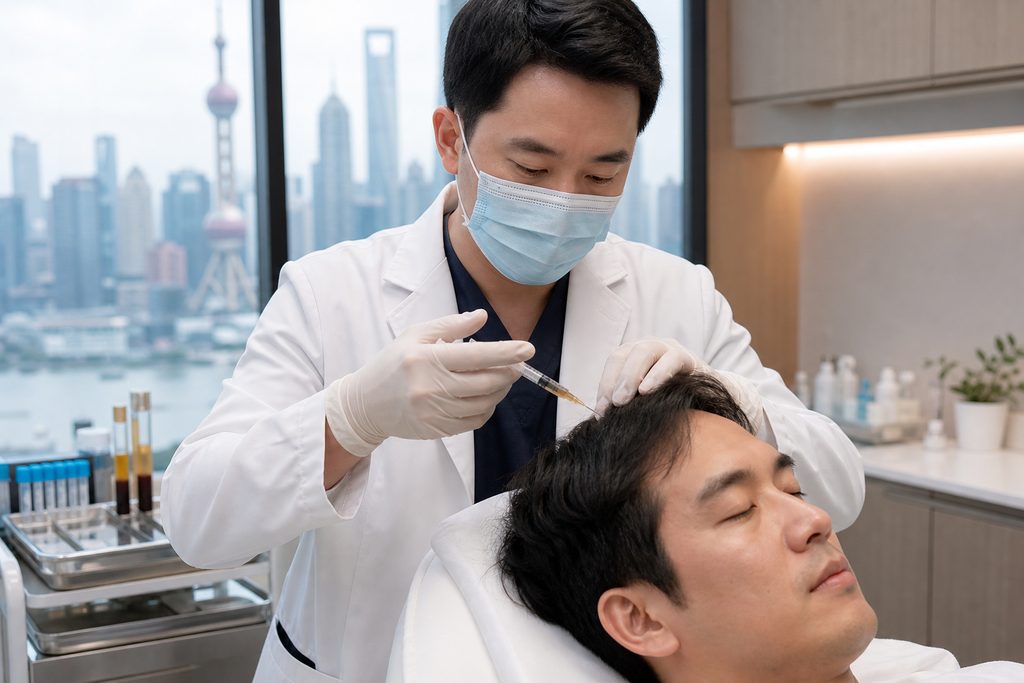
PRP therapy for hair loss has moved from experimental to mainstream. It involves drawing a small amount of your blood, spinning it in a centrifuge to concentrate platelets and growth factors, then injecting that concentrate into thinning areas of the scalp. The goal is to stimulate dormant hair follicles. No surgery. No synthetic drugs. Your own biology doing the work.
This article explains what PRP actually does for hair loss, what it costs in Chinese hospitals, where to find reputable providers in Beijing and Shanghai, and what the evidence says about effectiveness and safety. We work with international patients navigating China’s medical system every week. The information here reflects what we see in practice.
How This Actually Works, Step by Step
If you’re outside China and considering PRP here, the sequence is straightforward but has moving parts many people miss.
Step 1: You send your scalp photos and medical history. A dermatologist or hair specialist reviews your case. Not every thinning pattern responds well to PRP. If you have complete baldness in an area for over five years, the follicles may be gone. PRP works best on active thinning, not slick bald scalp. The review tells you whether you’re a plausible candidate.
Step 2: You get a written treatment plan. This includes the recommended number of sessions, spacing between them, and a cost estimate. Most protocols call for 3 initial sessions spaced 4 weeks apart, then maintenance every 4-6 months. Some clinics suggest combining PRP with low-level laser therapy or topical minoxidil. The plan should be specific to your Norwood stage and hair density.
Step 3: You arrange travel and visa. For medical treatment in China, the applicable short-stay category is the S2 visa, which covers private affairs including medical treatment. You’ll need an invitation letter or supporting documents from the hospital. Processing typically takes 5-10 business days after submission, depending on your home country’s Chinese embassy or consulate.
Step 4: You arrive and have your first session. A typical PRP session takes 45-60 minutes. Blood draw, centrifugation, scalp preparation, injections. Most patients describe the injections as uncomfortable but tolerable. Topical numbing cream helps. You can return to normal activities the same day, though your scalp may feel tender for 24-48 hours.
Step 5: You repeat sessions and track progress. PRP isn’t a one-and-done treatment. Results accumulate over months. Photos at baseline, month 3, and month 6 are essential for an honest assessment. Some patients see reduced shedding within 6-8 weeks. Visible density improvement usually takes 3-6 months.
What Does PRP Hair Loss Treatment Cost in China?
Let’s get to the number people actually search for. The PRP hair loss treatment cost China clinics charge varies by hospital tier, city, and whether you use a public hospital’s international department or a private clinic.
In Beijing and Shanghai, a single PRP session at a reputable dermatology department typically runs from $150 to $400. Private international clinics like United Family or Jiahui charge toward the higher end, sometimes $350-500 per session. Public hospital international departments land in the middle, around $200-350. A full initial course of three sessions therefore costs roughly $450 to $1,500, excluding travel and accommodation.
Compare that to the United States, where a single session commonly runs $600 to $1,200. In the UK, £400-700 per session. In Australia, AUD 500-900. Even after flights and a hotel, many patients find China’s pricing compelling—especially for a treatment requiring multiple sessions over several months.
| Country | Cost per PRP Session (USD) | Typical Initial Course (3 Sessions) |
|---|---|---|
| China (public hospital international dept.) | $150–$350 | $450–$1,050 |
| China (private international clinic) | $350–$500 | $1,050–$1,500 |
| United States | $600–$1,200 | $1,800–$3,600 |
| United Kingdom | $500–$900 | $1,500–$2,700 |
| Turkey | $200–$400 | $600–$1,200 |
These figures vary by hospital and case complexity. A patient with extensive thinning needs more injection sites and possibly more PRP volume, which affects cost. Always confirm pricing in writing before booking travel.
Is PRP Safe for Hair Loss in China?
The short answer is yes, with the usual caveats. PRP uses your own blood, which eliminates the risk of allergic reaction or immune rejection. The main risks are infection at injection sites, temporary scalp pain or swelling, and rare cases of nerve irritation. Serious complications are uncommon when a qualified clinician performs the procedure.
But safety depends heavily on the provider. Chinese hospitals vary enormously in quality. The top-tier institutions—those ranked in the Fudan hospital rankings or holding JCI accreditation—maintain strict sterilization protocols and use single-use, closed-system PRP kits. Lower-end beauty salons and unlicensed aesthetic studios sometimes offer “PRP” at suspiciously low prices without proper centrifuges or sterile technique. That’s where infections happen.
Our guidance to every patient asking about PRP safety in China: stick to dermatology departments at accredited hospitals or JCI-certified private clinics. The best PRP clinic for hair loss Shanghai offers will be attached to a hospital with a dermatology department that publishes research or trains residents. Avoid storefront “hair centers” with no hospital affiliation.
PRP is generally safe for most adults. It’s not recommended if you have active scalp infection, a bleeding disorder, severe anemia, or are on anticoagulant therapy that can’t be paused. Pregnant or breastfeeding women should defer treatment. A proper pre-treatment screening covers all of this.
How Effective Is PRP for Hair Loss?
Here’s where honesty matters. PRP helps many patients but not everyone. The evidence is encouraging but not overwhelming.
A 2019 meta-analysis in the Journal of Cosmetic Dermatology reviewed 11 randomized controlled trials and found PRP significantly increased hair density in androgenetic alopecia patients compared to placebo. A 2020 systematic review in Dermatologic Surgery reported similar findings, noting better results for early-stage thinning than advanced baldness. Most studies show improvement in hair count per square centimeter ranging from 15% to 35% after 3-4 sessions.
But those numbers hide wide individual variation. Roughly 20-30% of patients see minimal or no response. Why? Platelet concentration varies between individuals. The quality of the centrifuge and activation method matters. And some scalps simply don’t respond to growth factor stimulation. Anyone promising guaranteed regrowth is not being straight with you.
PRP works best for androgenetic alopecia (male or female pattern baldness) in its early to moderate stages. It’s less effective for alopecia areata, though some studies show benefit. It does not work for scarring alopecia. If your hair loss is caused by thyroid disease, iron deficiency, or autoimmune conditions, those need treatment first.
A Realistic Timeline
PRP is not a quick fix. Understanding the actual timeline prevents disappointment and wasted money.
| Stage | Timeframe | What Actually Happens |
|---|---|---|
| Initial inquiry and case review | Day 1–7 | You send photos and history. A dermatologist reviews. You receive a candid assessment and cost estimate. |
| Visa application | Day 7–21 | Hospital provides supporting documents. You apply for S2 visa. Processing takes 5–10 business days in most countries, longer in peak seasons. |
| First PRP session | Week 3–4 | 45–60 minute procedure. Mild scalp tenderness for 1–2 days. No downtime. |
| Second session | Week 7–8 | Four weeks after first. Some patients notice reduced shedding around this point. |
| Third session | Week 11–12 | Completes the initial course. Take progress photos. |
| Visible improvement | Month 4–6 | Hair density improvement becomes noticeable in photos. Not dramatic, but measurable. |
| Maintenance session | Month 6–12 | Most patients need a session every 4–6 months to maintain results. Without maintenance, gains fade over 12–18 months. |
People forget about document translation. If your medical records aren’t in English or Chinese, translation adds 2-3 days. And appointment lead times at top dermatology departments in Beijing or Shanghai can be 1-2 weeks for international patients, sometimes longer during Chinese holidays. Plan around that.
What Can Go Wrong — and What Happens Then
PRP is low-risk, but it’s not zero-risk. And the logistics of doing it abroad add failure modes most people don’t consider.
You arrive and the doctor says you’re not a good candidate. This happens. Photos can mislead. If the in-person exam reveals scarring alopecia or follicles that are too far gone, a responsible doctor will decline treatment. Your recourse: ask for a refund of any prepaid treatment fees (most reputable hospitals refund unused treatment costs), or pivot to an alternative like low-level laser therapy. This is why remote pre-screening matters—it reduces but never eliminates this risk.
You see no improvement after three sessions. Roughly one in five patients falls into this category. The honest response is to stop treatment rather than keep paying. Some clinics will suggest adjusting the protocol—higher platelet concentration, different injection depth, adding microneedling. But if three sessions produced nothing, a fourth rarely changes the trajectory. A reputable clinic will tell you this.
You get an infection. Rare in accredited hospitals, but possible anywhere. Signs: increasing pain, redness spreading beyond injection sites, fever. Treatment is antibiotics and local wound care. This is why we tell patients to avoid unlicensed aesthetic studios regardless of price.
Your results fade because you can’t return for maintenance. PRP gains are not permanent. If you can’t travel back every 4-6 months, results decline over a year or so. Some patients combine a China-based initial course with at-home maintenance using topical minoxidil or a laser cap. Discuss this with the treating physician before committing.
How to Choose a PRP Provider: What the Numbers Mean
Not all PRP is created equal. The difference between a good outcome and a waste of money often comes down to three technical factors.
Platelet concentration. Effective PRP typically contains 3-5 times the baseline platelet concentration of whole blood. Below 2x, results are weak. Above 7x, some studies suggest an inhibitory effect. A quality clinic can tell you their target concentration and how they verify it. If they look confused when you ask, walk away.
Centrifugation protocol. Single-spin vs. double-spin, speed, duration—these determine platelet yield and whether white blood cells are included. There’s no universal consensus on the “best” protocol, but a clinic should have a standardized, documented method. “We just spin it and inject” is not an answer.
Activation method. Some protocols activate platelets with calcium chloride before injection to trigger growth factor release. Others inject inactivated PRP and rely on natural activation. Both approaches have research support. What matters is that the clinic knows which they’re using and why.
When evaluating the best PRP clinic for hair loss Shanghai has to offer, look for dermatologists who publish on PRP or hair disorders, use closed-system sterile kits, and take standardized progress photos. Ask how many PRP procedures the clinic performs monthly. A busy hair clinic doing 50+ PRP sessions a month has more practical experience than a general dermatology practice doing one a week.
If you’re considering a PRP hair loss medical tourism package China agencies market, read the fine print. Some packages bundle hotel and airport transfer with treatment, which can be convenient. Others pad the price with unnecessary add-ons. Compare the per-session PRP cost against booking directly with the hospital. Sometimes the package is cheaper; often it isn’t. We’ve helped patients book PRP hair treatment Beijing clinics directly, and we’ve seen both scenarios.
Practical Considerations: Records, Visa, Payment, and Follow-Up
If you’re serious about traveling for PRP, here’s what actually matters on the logistics side.
Medical records. Bring any previous hair loss diagnosis, blood work (especially thyroid, iron, and hormone panels), and a list of medications. If you’ve tried minoxidil or finasteride, note the duration and response. This context helps the dermatologist calibrate expectations.
Visa. As noted, the S2 visa is the applicable short-stay category for medical treatment in China. Requirements vary by embassy, but you’ll typically need a passport valid for at least six months, a completed application form, a recent photo, and supporting documents from the hospital—usually an invitation letter or treatment confirmation. Apply at least 3-4 weeks before your intended travel date. Never book non-refundable flights before your visa is approved.
Payment. Chinese public hospitals generally require prepayment for services. International departments accept major credit cards, but confirm before arrival. Private international clinics like United Family or Jiahui often bill insurance directly if you have coverage. Most international health insurance plans do not cover PRP for cosmetic hair loss, so expect to pay out of pocket. Budget accordingly.
Language. Top-tier hospital international departments in Beijing and Shanghai have English-speaking staff. But navigating registration, payment windows, and pharmacy pickup without Chinese language skills is genuinely difficult in large public hospitals. A bilingual companion who handles queueing, translation, and wayfinding reduces friction substantially.
Follow-up at home. PRP requires maintenance. Before you leave, get a written summary of your protocol—platelet concentration, injection pattern, session dates. If you plan to continue PRP in your home country, that documentation helps your local provider match the approach. If not, discuss non-PRP maintenance options with the treating physician.
Frequently Asked Questions
Most protocols call for 3 initial sessions spaced 4 weeks apart, followed by maintenance every 4-6 months. Some patients see reduced shedding after 2 sessions, but visible density improvement typically requires the full initial course plus 3-6 months of waiting.
Most patients describe it as uncomfortable but tolerable. Topical numbing cream applied 30-45 minutes before injection helps significantly. The scalp may feel tender or slightly swollen for 24-48 hours afterward. Pain is rarely a reason patients discontinue treatment.
No. PRP stimulates existing follicles that are miniaturized but still alive. If an area has been completely bald for many years, the follicles are likely gone, and no amount of PRP will bring them back. This is why candid pre-screening matters.
A hospital dermatology department uses medical-grade centrifuges, sterile single-use kits, and licensed physicians. A beauty salon may use unsterile equipment, improperly trained staff, and unverified “PRP” that isn’t actually platelet-rich. The price difference reflects real differences in safety and quality.
Do I need a visa to get PRP in China?
Yes, most foreign nationals need a visa. The S2 visa covers short-term private affairs including medical treatment. You’ll need supporting documents from the hospital. Processing takes 5
For more medical information and treatment options in China, visit chinamedservices.com (China Medical Services).
