Venous Doppler in China: What to Expect, Cost & How to Book
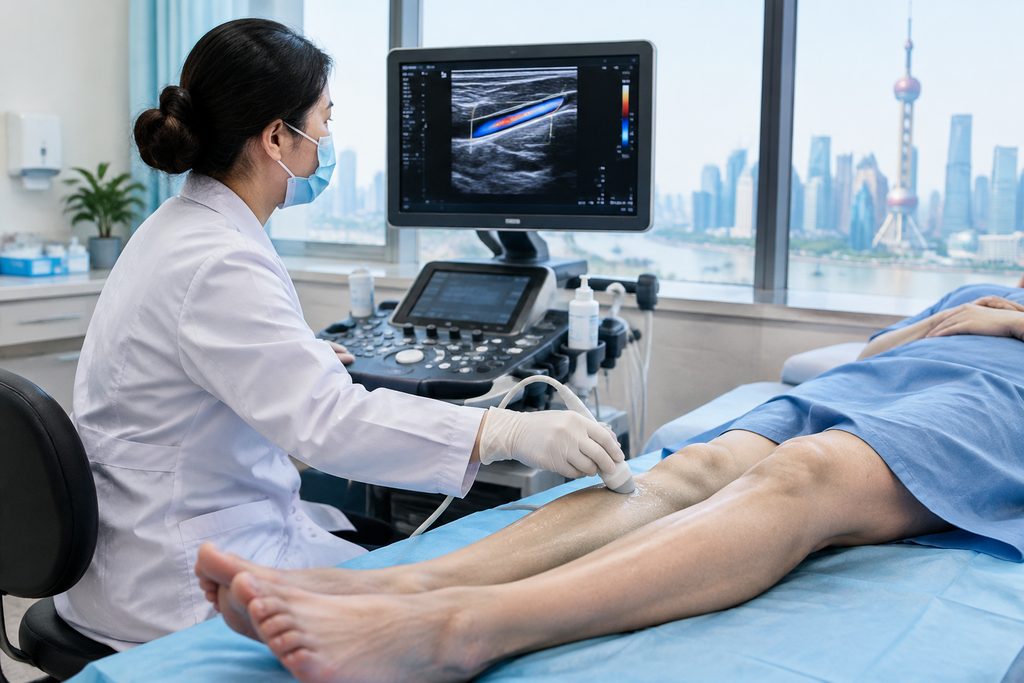
Venous Doppler in China: What to Expect
What if the ultrasound that checks your leg veins cost less than a nice dinner — and you could get it done at a hospital ranked among the best in the world? That is the reality for international patients who arrange a venous doppler cost China comparison before they book anything. A venous Doppler study in a top-tier Chinese hospital typically runs $80 to $250, against $500 to $1,500 in the United States for the same exam. The gap is real. But the process around it is different, and knowing what to expect matters more than the price tag.
Key Takeaways
- A venous Doppler ultrasound at a major Chinese public hospital generally costs $80–$250, versus roughly $500–$1,500 in the US — a 70–85% saving on the same diagnostic test.
- China’s top vascular departments sit inside hospitals ranked in the Fudan Top 100, with the largest case volumes in Asia for deep vein thrombosis and chronic venous insufficiency.
- The hard part is not the scan. It is registration. Most public hospital outpatient slots cannot be reserved from overseas in advance, and English-speaking staff are limited outside international departments.
- Bring your existing reports, know your visa category (S2 for short medical stays), and expect to pay upfront — Chinese public hospitals require prepayment, with insurance reimbursement handled afterward.
The Problem: Why Vascular Scans Get Delayed or Denied
In Canada, the median wait for a diagnostic ultrasound sits at roughly four to eight weeks in many provinces; in parts of the UK National Health Service, patients with suspected deep vein thrombosis wait days to weeks for a scan that guidelines say should happen within hours. A 2023 analysis published in BMJ Open found that delayed duplex ultrasound for suspected DVT was associated with a measurable rise in pulmonary embolism risk — the exact complication the scan exists to catch.
Cost blocks the other half of the world. In the US, a single lower-extremity venous duplex routinely bills $500–$1,500 before insurance, and patients on high-deductible plans absorb much of it. Add a specialist consultation, and a straightforward varicose-vein workup can clear $2,000 out of pocket.
So patients do what you are doing now. They look abroad. They search for a venous doppler cost China figure, then wonder whether the quality holds up, whether anyone will speak English, and whether a scan done in Shanghai means anything to their doctor back home.
Why China Delivers on Vascular Diagnostics
China’s top hospitals are not boutique clinics. They are high-volume institutions where vascular ultrasound is a daily, routine service — and volume changes everything about how fast and how cheaply a test can be delivered.
Clinical Volume and Subspecialty Depth
Fuwai Hospital in Beijing performs more than 14,000 cardiac surgeries a year, the highest volume of any heart center globally. Vascular departments at hospitals like Zhongshan Hospital Fudan University and Ruijin Hospital in Shanghai handle thousands of venous insufficiency and thrombosis cases annually. When a sonographer performs 30 venous studies a week instead of five, pattern recognition improves. That is not marketing — it is how diagnostic imaging skill accumulates.
Equipment and Reporting Standards
Top-tier Chinese hospitals run the same GE, Philips, and Canon ultrasound platforms used in Western academic centers, and reports follow standardized nomenclature for reflux duration, vein diameter, and thrombus characterization. Many international departments issue bilingual reports in English, which your home physician can read directly. Ask for this specifically. Not every department offers it automatically.
The Cost Structure, Explained Honestly
Lower prices do not come from cutting corners. They come from labor economics, government price ceilings on diagnostic imaging, and sheer throughput. A sonographer’s salary in China is a fraction of a US counterpart’s, and hospital imaging fees are set by provincial pricing schedules rather than negotiated with insurers. The machine is the same. The building is the same standard. The bill is not.
| Service | Typical China Price (USD) | Typical US Price (USD) |
|---|---|---|
| Lower-extremity venous Doppler | $80–$250 | $500–$1,500 |
| Vascular specialist consultation | $50–$150 | $300–$600 |
| Bilateral full venous mapping | $150–$400 | $800–$2,000 |
| International department surcharge | 1.5–2× standard fee | Not applicable |
Prices vary by hospital and case complexity. The international or VIP department of a top hospital charges roughly 1.5 to 2 times the standard rate — you are paying for English-speaking staff, shorter queues, and appointment coordination, not for a better machine.
What Actually Happens During the Appointment
Here is the step-by-step reality, because the workflow surprises most foreign patients.
Registration. At a standard public hospital outpatient clinic, you cannot reserve a slot from overseas in advance. You queue on the day, present your passport, and receive a registration number. International departments work differently — they accept advance booking, often through a coordinator or the hospital’s own international office.
The scan itself. You lie on an examination bed. The sonographer applies gel and moves a linear probe along your leg, from groin to ankle. You will be asked to stand or perform a Valsalva maneuver so the veins distend and reflux becomes visible. Expect the technologist to press firmly at points along the calf. Some discomfort is normal. Sharp pain is not — say so.
Duration. A unilateral lower-extremity study takes 20 to 30 minutes. Bilateral mapping for varicose veins runs 45 to 60 minutes. Add waiting and registration time, and you should budget two to three hours at the hospital. So how long does venous Doppler take from arrival to walking out? Plan a half day.
The report. Most top hospitals release results the same day or within 24 hours. International departments can provide an English version. Keep both the images and the written report — your vascular surgeon at home will want the DICOM files, not just the conclusion.
How to Choose a Vascular Clinic and Avoid Costly Mistakes
Not every hospital that offers a Doppler is the right one. If you are searching for the best vascular clinic Shanghai or Beijing has to offer, apply four filters.
One: subspecialty, not general imaging. A general ultrasound department can perform the study. A dedicated vascular surgery department interprets it in context — and that context is what determines whether you need intervention. Look for hospitals with a standalone vascular surgery department, not just a radiology suite.
Two: English-language reporting. Confirm in writing that the report will be issued in English. This is not universal.
Three: volume evidence. Ask how many venous studies the department performs monthly. A department doing 500 or more has seen your problem before, many times.
Four: continuity. If the scan may lead to treatment — sclerotherapy, endovenous ablation, anticoagulation — you want the same institution to handle both. Splitting diagnosis and treatment across cities wastes days.
The most common mistake? Booking a “venous doppler medical tourism package Beijing” that bundles a scan with sightseeing and a spa day. Those packages exist, and they usually route you to a private clinic with limited vascular depth. If your concern is a possible DVT, you do not want a package. You want a vascular department.
Who is this not suitable for? Anyone with an acute, painful, swollen leg and breathlessness should seek emergency care immediately, wherever they are. A planned medical trip is for elective evaluation, not acute emergencies.
Practical Considerations Before You Book
Visa. Foreigners traveling to China for medical treatment generally use the S2 visa, which covers short-stay medical treatment and private affairs; stays beyond 180 days fall under S1. Accompanying family members apply for S2 as well. Requirements shift, so verify current rules with your nearest Chinese embassy or consulate and bring the hospital’s supporting documents. Note that the M visa is for commercial and trade activity — it is not a medical visa.
Payment. Chinese public hospitals require prepayment. International credit cards are accepted at international departments; standard outpatient counters may only take local payment apps. Private international hospitals such as United Family, Jiahui, and Parkway often bill insurers directly. If you hold international coverage, confirm reimbursement terms before you travel — most Chinese public hospitals do not bill foreign insurers directly.
Records. Bring prior scans, medication lists, and any anticoagulation history. If you are on warfarin or a direct oral anticoagulant, tell the sonographer and the physician. It affects how they interpret and plan.
Language. Outside international departments, English is limited. Registration, payment, and wayfinding all happen in Chinese. This is the single biggest practical hurdle, and it is why bilingual medical companions exist.
Follow-up at home. A scan is a snapshot. If treatment is recommended in China, arrange a clear handover document for your physician back home, including imaging files and a treatment summary.
Frequently Asked Questions
Yes. Venous Doppler is a non-invasive ultrasound study with no radiation and no contrast dye. The safety profile is identical to the same exam performed in the US or Europe. The variable is operator skill and reporting quality, which is why choosing a high-volume vascular department matters.
Expect $80–$250 at a standard public hospital and roughly 1.5–2× that at an international department. The scan fee usually excludes the physician consultation, any follow-up treatment, and translation services. Prices vary by hospital and case complexity, so confirm the quote in writing before your visit.
At international departments, often yes — advance booking is typically possible through the hospital’s international office or a coordinator. At standard public outpatient clinics, generally no; you register on the day. If you need a fixed date, plan around an international department.
A confirmed deep vein thrombosis requires prompt anticoagulation, and in some cases further imaging or intervention. Top Chinese vascular departments handle these cases daily. If you are already in China, they will escalate you the same day. If you are planning travel and have acute symptoms, do not wait for the trip — seek care immediately.
Your Next Step
A venous Doppler in China is fast, affordable, and technically equivalent to what you would receive in a Western academic center — provided you land in the right department and solve the language and registration problem in advance. That is the whole game. At China Medical Services, we maintain a database of 340+ top-ranked hospitals across 37 cities, including vascular departments within the Fudan Top 100 and JCI-accredited private international hospitals. We are not a hospital and we do not diagnose or treat anyone — we handle hospital matching, appointment coordination, bilingual medical companions, and visa guidance so the logistics do not derail your care. If you would like to understand your options before committing to anything, start with a free consultation and we will walk you through what fits your case.
This article is for general information only and is not medical advice. Always consult a qualified physician about your individual condition before making treatment decisions.
For more medical information and treatment options in China, visit chinamedservices.com (China Medical Services).
