Visa-Free Transit to China: How We Coordinate Your 240-Hour Entry
While patients in Canada wait a median 28.6 weeks for orthopedic surgery, surgeons at Beijing Jishuitan Hospital routinely perform over 300 joint replacements per month — with clinical outcomes that match or exceed Western benchmarks. The bottleneck is not medical expertise. It is access.
For many Western patients, the barrier to that access is not money or language. It is time. Specifically, the time it takes to secure a visa.
China’s 240-hour visa-free transit policy changes that calculus. Under this framework, citizens of 54 countries — including the United States, Canada, the United Kingdom, Australia, and most of the European Union — can enter designated Chinese cities without a pre-arranged visa, provided they are transiting to a third country or region. The policy covers 37 cities, including Beijing, Shanghai, Guangzhou, Shenzhen, Chengdu, and Hangzhou.
Our team at China Medical Services coordinates medical evaluations, consultations, and even certain procedures within this window. We handle the hospital communication, the documentation, and the on-the-ground logistics so that your 240 hours are used for medical care — not bureaucratic navigation.
What the Medical Visa China 240 Hour Transit Policy Actually Means
The short answer: you can enter China without a visa for up to 240 hours (10 days) if you are transiting through a designated port to a third destination. You can use that time for medical consultations, diagnostic procedures, and in some cases, same-day or short-stay treatments.
But here is the nuance that most online guides miss. The 240-hour policy is a transit arrangement, not a formal medical visa. Chinese immigration authorities do not issue a document called a “medical visa” under this scheme. What you receive is a temporary entry permit stamped in your passport at the port of entry. For longer medical stays — anything beyond 10 days — you need an S2 visa, which is the short-stay category used for medical treatment and private affairs.
That distinction matters because it shapes what you can realistically accomplish. A comprehensive surgical procedure with multi-day hospital admission and post-operative observation typically requires more time than the transit window allows. But a written second opinion, a video consultation with a top specialist, a diagnostic workup, or an in-person evaluation at a hospital’s international department is entirely feasible within 240 hours.
Our team has coordinated hundreds of these short-stay medical visits. The pattern is consistent: patients arrive with a clear objective, we have pre-arranged the appointments, and the medical work gets done in two to three days. The remaining time is buffer.
Can I Get Surgery During a China Layover?
This is the question we hear most often, and the answer requires honesty. Minor procedures — dermatological excisions, certain endoscopic evaluations, dental surgery, some ophthalmic interventions — can sometimes be completed within the 240-hour window. But major surgery is generally not advisable on a transit entry.
Why? Three reasons.
First, surgical recovery timelines do not respect immigration deadlines. A cardiac bypass, a joint replacement, or an oncologic resection requires days of inpatient monitoring and weeks of follow-up. Attempting to compress that into 10 days is medically irresponsible, and no reputable Chinese hospital would agree to it.
Second, hospitals in China require pre-operative evaluation before scheduling surgery. You cannot book a surgical slot from overseas. The surgeon must see you in person, review your imaging, and confirm the diagnosis before the operating room is reserved. That evaluation itself can take one to two days.
Third, the transit policy requires you to depart China for a third country or region. If a complication extends your hospital stay, you face an immigration overstay — a serious matter with fines, detention, and future entry bans as possible consequences.
That said, the 240-hour window is ideal for the pre-surgical phase. Many patients use it to meet the surgeon, complete the pre-operative workup, finalize the surgical plan, and then return on an S2 visa for the procedure itself. This staged approach reduces uncertainty and lets you build trust with the medical team before committing to a longer stay.
China 240 Hour Visa Free Medical Treatment Rules: What the Policy Covers
The rules are specific, and misunderstanding them can derail your entire trip. Let us walk through the actual requirements.
Eligible nationalities: 54 countries are covered, including the United States, Canada, the United Kingdom, Australia, New Zealand, Japan, South Korea, and most Schengen-area states. If your passport is from one of these countries, you qualify for visa-free transit. The full list is published by China’s National Immigration Administration.
The transit requirement: you must arrive from one country (or region) and depart to a third country or region. Hong Kong, Macau, and Taiwan count as third regions for this purpose. So a routing like Los Angeles → Shanghai → Hong Kong qualifies. A routing like Los Angeles → Shanghai → Los Angeles does not.
The entry ports: 37 cities participate in the policy, but not every city has every entry point. Beijing Capital International Airport, Shanghai Pudong, Shanghai Hongqiao, Guangzhou Baiyun, Shenzhen Bao’an, and Chengdu Tianfu are among the major participating ports. You must enter and exit through designated ports in the covered cities.
The stay limit: 240 hours, calculated from 00:00 on the day after entry. That gives you effectively 10 full days.
The activity restriction: visa-free transit permits tourism, business visits, family visits, and — critically for our purposes — short-term medical treatment. The policy does not explicitly list “medical treatment” as a prohibited activity, and Chinese immigration authorities have consistently permitted hospital visits and consultations under transit entry.
What the policy does not permit: employment, study, journalism, or any activity requiring a residence permit. Medical treatment falls outside those restrictions for short stays.
Best Hospitals in Shanghai for International Patients
Shanghai is the most common entry point for medical travelers using the 240-hour transit policy. The city has 18 hospitals on the Fudan University hospital rankings Top 100 list, second only to Beijing. Its international airport connections and English-speaking medical infrastructure make it the natural choice for a first visit.
For international patients, three hospital categories matter.
The first is the public top-tier hospitals with dedicated international departments. Zhongshan Hospital Fudan University operates one of the strongest cardiac surgery programs in Asia, with over 14,000 cardiac procedures annually at its affiliated Fuwai Hospital network. Its international department provides English-speaking coordination, expedited scheduling, and private consultation rooms. Ruijin Hospital, affiliated with Shanghai Jiao Tong University School of Medicine, runs a similarly robust international service, particularly strong in endocrinology and hematology.
The second category is private international hospitals. United Family Healthcare’s Shanghai campus, Jiahui International Hospital, and ParkwayHealth all offer Western-style care with English-speaking physicians, JCI accreditation, and direct insurance billing. These facilities are more expensive than public hospitals but eliminate language friction entirely.
The third category is specialty centers. Shanghai East Hospital, for example, has developed a strong reputation in orthopedic surgery and sports medicine. Shanghai Proton and Heavy Ion Center is one of only a handful of facilities in the world offering proton therapy for certain cancers.
For a 240-hour visit, we typically recommend starting with a public hospital’s international department for the initial consultation and diagnostics, then using a private facility if the patient prefers a more familiar care environment. The choice depends on the medical condition, the patient’s insurance coverage, and their comfort level with navigating a large Chinese hospital.
| Hospital Type | Cost for Initial Consultation | English Support | Best For |
|---|---|---|---|
| Public Top-Tier International Department | $100–300 | Dedicated English coordinators | Complex cases, top specialists |
| Private International Hospital | $150–400 | Native English-speaking staff | Comfort, continuity, insurance billing |
| Public Standard Outpatient | $10–50 | Limited | Budget-conscious, simple needs |
For most international patients, the public international department is the sweet spot. You get access to the same senior specialists who staff the standard outpatient clinics, but with English coordination and shorter wait times. The cost is roughly 1.5 to 2 times the standard outpatient fee — still dramatically lower than Western private care.
How to Arrange Surgery in China Without a Visa: The Staged Approach
Let us be direct: you cannot arrange surgery in China without a visa. The 240-hour transit entry is a visa-free arrangement, but it is not designed for surgical admissions. Any hospital performing a major procedure will require you to be in the country legally for the full treatment and recovery period.
What you can do is use the transit window to complete everything that comes before surgery. That is the staged approach, and it works like this.
Step one: you send us your existing medical records — imaging, pathology reports, blood work, prior surgical notes. We translate them into Chinese and forward them to the relevant specialty department at your target hospital. The specialists review your case and provide a written assessment. This is the written second opinion, priced from $300 to $500.
Step two: if the assessment is positive, you schedule a video consultation with the surgical team. This costs $500 to $800 for a top specialist and lets you ask questions directly. You discuss the surgical plan, the expected outcomes, and the recovery timeline.
Step three: you fly to China on the 240-hour transit entry. We coordinate your in-person consultation, any additional diagnostics, and the pre-operative evaluation. You meet the surgeon who would operate on you. You see the hospital. You make an informed decision.
Step four: you return home, apply for an S2 visa with the hospital’s supporting documentation, and come back for the surgery itself. The S2 visa is the short-stay category used for medical treatment and private affairs. It is not the M visa, which is for commercial and trade activities.
This staged approach means you never commit to surgery sight unseen. And if the in-person evaluation reveals something different from the remote assessment, you have lost nothing but a few days of travel.
What a 240-Hour Medical Visit Costs
Transparency on pricing matters. Here are the realistic figures for a coordinated 240-hour medical visit, based on our current service rates.
The hospital charges are separate from our coordination fees. A consultation with a senior specialist at a public hospital’s international department typically runs $100 to $300. Diagnostic imaging — MRI, CT, ultrasound — ranges from $100 to $500 depending on the modality and the body region. Blood work is usually under $100 for a comprehensive panel.
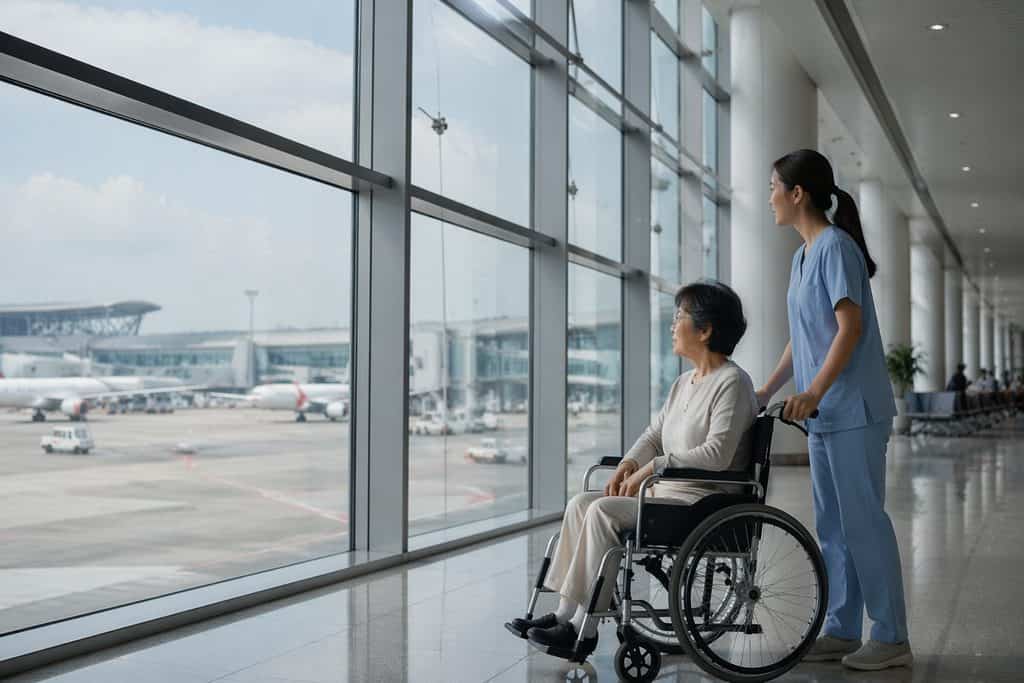
Our coordination services include the bilingual medical companion at $300 per day. This person handles registration, queue management, payment processing, translation during consultations, and navigation between departments. For a three-day medical visit, that is $900.
Airport transfer is $200 round-trip. Hospital appointment coordination starts at $300. If you need a video consultation before traveling, that is $100 to $300 for a general specialist or $500 to $800 for a top specialist.
The total for a well-coordinated 240-hour medical visit — including consultations, diagnostics, companion services, and logistics — typically lands between $2,000 and $4,000, excluding international airfare and accommodation. That is a fraction of what an equivalent diagnostic workup costs in the United States, where a single specialist consultation can exceed $500 and an MRI can run $1,000 to $3,000.
Practical Considerations: Documents, Timing, and What to Bring
The 240-hour transit policy requires specific documentation at the port of entry. You need a passport valid for at least six months, an onward ticket to a third country or region departing within 240 hours, and — for medical visits — supporting documents from the hospital you plan to visit.
That last point is where our team adds the most value. Chinese immigration officers at the transit desk may ask why you are entering. Having a letter from a recognized Chinese hospital confirming your appointment, along with your medical records and our coordination documents, makes the entry process smoother. We prepare this documentation package for every patient.
Payment is another consideration. Chinese hospitals generally require pre-payment for services, and international credit cards are not universally accepted. We advise patients to carry a combination of cash, a UnionPay-compatible card, and a major credit card. Some private international hospitals accept direct insurance billing, but public hospitals — even international departments — typically require out-of-pocket payment with reimbursement claimed later from your insurer.
Language is the third practical hurdle. Even in Shanghai’s international departments, the registration desks, pharmacy windows, and diagnostic centers operate primarily in Chinese. Without a bilingual companion, a simple blood draw can become a two-hour ordeal. This is not an exaggeration — the large public hospitals see 10,000 or more outpatient visits per day, and the systems are optimized for volume, not for foreign patients.
Follow-up after you return home is the final consideration. The Chinese hospital will provide discharge summaries and recommendations in English if you request them. We can also coordinate remote follow-up consultations if the in-person visit identified issues requiring ongoing monitoring.
Medical Tourism Packages China with Transit Visa: What to Expect
Some agencies market “medical tourism packages” that bundle flights, hotels, hospital visits, and sightseeing under a transit visa arrangement. We do not offer these packages, and we advise caution when evaluating them.
The reason is simple: medical care should not be bundled with tourism. A package that includes a Great Wall tour and a cardiac consultation treats the medical component as an add-on. That is backwards. The medical objective should determine the itinerary, not the other way around.
What we do offer is coordination built around your specific medical needs. If you have time after your consultation to explore Shanghai or Beijing, we can suggest options. But the medical work comes first, and the schedule is built around hospital availability, not tourist attractions.
This distinction matters because the 240-hour window is finite. Every day spent on non-medical activities is a day that could have been used for diagnostics, second opinions, or recovery planning. Our role is to make the medical portion as efficient as possible so that if you want to see the Bund or the Forbidden City, you have the time to do it — not to sell you a tour.
Frequently Asked Questions
No, if you are a citizen of one of the 54 eligible countries and you are transiting to a third country or region. The 240-hour visa-free transit entry permits short-term medical consultations and treatments. For stays longer than 10 days, or for surgical admissions, you need an S2 visa.
You must leave China before the 240-hour window expires. Overstaying a transit entry results in fines, possible detention, and a record that can affect future Chinese visa applications. If your medical team determines you need more time, the correct path is to return home and apply for an S2 visa. We can help prepare the hospital documentation to support that application.
Yes, if your family member is also a citizen of an eligible country and holds an onward ticket to a third destination. They enter under the same visa-free transit arrangement. Note that they cannot work or study during the stay, and their 240-hour clock runs the same as yours.
Most international insurers reimburse for medically necessary care received abroad, regardless of the entry mechanism. But you should confirm with your insurer before traveling. Some policies require pre-authorization for overseas treatment. Private international hospitals in China often handle direct billing; public hospitals typically require you to pay upfront and claim reimbursement.
Chinese hospitals are legally required to provide emergency treatment regardless of visa status. If you experience a medical emergency, go to the nearest hospital emergency department. Our team can be reached to coordinate translation and communication with the treating physicians. Emergency care is billed separately and is not covered by our coordination fees.
Your Next Step
The 240-hour visa-free transit policy opens a practical door for international patients who want to evaluate Chinese medical options without committing to a long-stay visa. It is not a shortcut to surgery. It is a way to get answers — from top specialists, with real diagnostics, in a fraction of the time and cost of doing the same at home.
China Medical Services is a coordination team, not a hospital. We do not diagnose, we do not treat, and we do not promise outcomes. What we do is connect you with the right specialists at top-ranked Chinese hospitals, prepare your documentation, and put a bilingual medical companion at your side throughout your visit. If you are considering a medical trip to China, start with a conversation. Visit our consultation page and tell us what you need. We will tell you honestly whether the 240-hour window is the right fit — or whether a different approach makes more sense for your situation.
The hardest part of medical travel is not the flight. It is knowing where to start. Start with a conversation.
For more medical information and treatment options in China, visit chinamedservices.com (China Medical Services).
