What a Vitamin D Test Costs in China: Real Prices, Quality, and How to Book
Key Takeaways
- A vitamin D test in China typically costs $15 to $80 depending on the hospital tier — a fraction of the $50 to $250 you would pay in the United States for the same 25-hydroxyvitamin D assay.
- Results from top-tier Chinese hospitals are generated on the same automated immunoassay platforms used in Western labs, and many carry ISO 15189 or CAP accreditation.
- You cannot walk into a public hospital and expect English-language service at the lab counter. Language and registration logistics are the real obstacle, not price.
- Testing alone means little without interpretation. A single number does not tell you whether to supplement, how much, or what is causing an abnormal result.
The Problem: You Want a Simple Blood Test, But the System Is Not Built for You
Roughly 1 in 4 adults in the United States has insufficient vitamin D levels, according to data published in Nutrition Research. In northern China, where winters are long and sun exposure drops sharply, studies have found deficiency rates exceeding 50% in some urban populations. So the demand for testing is real.
The trouble starts when you try to actually get one. In the US or UK, you book online, walk into a lab, pay $50 to $250, and get results in a portal within 48 hours. In China, the same test costs a fraction — but the pathway is different. Public hospitals do not accept overseas pre-booking for routine outpatient labs. You register in person, on the day, in Chinese, at a counter that may open at 7:00 AM and have a queue by 7:15.
That gap between low price and high friction is exactly where international patients get stuck.
Why Vitamin D Testing in China Is Worth Considering
The case is not about exotic technology. It is about volume, cost structure, and access to specialists who see hundreds of these cases a month.
Cost Advantage Without a Quality Trade-Off
Chinese public hospitals run laboratory testing at a scale that Western hospitals rarely match. A single tertiary hospital may process 10,000 or more outpatient blood samples a day. That volume drives down per-test cost through reagent purchasing power and automated throughput. The assay itself — usually a chemiluminescent immunoassay for 25(OH)D — is the same method used by Quest Diagnostics and LabCorp.
Speed That Surprises Most Foreigners
At a major hospital, a vitamin D result often comes back the same day or the next morning. Not because corners are cut, but because the lab runs continuously. Compare that to the 3 to 7 business days common with some Western mail-in test kits.
Access to the Specialist Who Interprets It
Here is the part most price-focused articles skip. A vitamin D number between 20 and 30 ng/mL is a gray zone. Whether you need treatment depends on your calcium, PTH, kidney function, symptoms, and history. In China, you can often see an endocrinologist the same day for $10 to $40 — something that can take weeks to arrange in the UK or Canada.
What a Vitamin D Test Actually Costs in China
Prices vary by hospital tier and city. The table below reflects typical ranges for a standalone 25-hydroxyvitamin D test at the time of writing. Treat these as reference points, not quotes.
| Facility Type | Typical Price (USD) | Turnaround | English Support |
|---|---|---|---|
| Community clinic (public) | $8 – $15 | 1–2 days | Rare |
| Secondary public hospital | $15 – $30 | Same day–1 day | Limited |
| Top-tier public hospital (Tier 3A) | $25 – $45 | Same day | International dept. available |
| Private international hospital | $50 – $80 | Same day–2 days | Full English service |
| US reference lab (for comparison) | $50 – $250 | 1–5 days | Full English service |
A blood test price at a Shanghai hospital sits in the middle of that range — roughly $25 to $45 at a major public institution, more at a private international facility. Beijing is similar. The difference between the cheapest and most expensive option is not the assay. It is the service layer around it.
How the Process Actually Works, Step by Step
This is the part that trips people up. Here is the realistic sequence at a public hospital.
- Registration. You present your passport at the outpatient hall and obtain a hospital card. This is done in person, on the day.
- Department visit. You see a physician (endocrinology, general internal medicine, or a health management center) who writes the lab order.
- Payment. You pay at a cashier window or self-service kiosk. Foreign cards are accepted at some hospitals, not all.
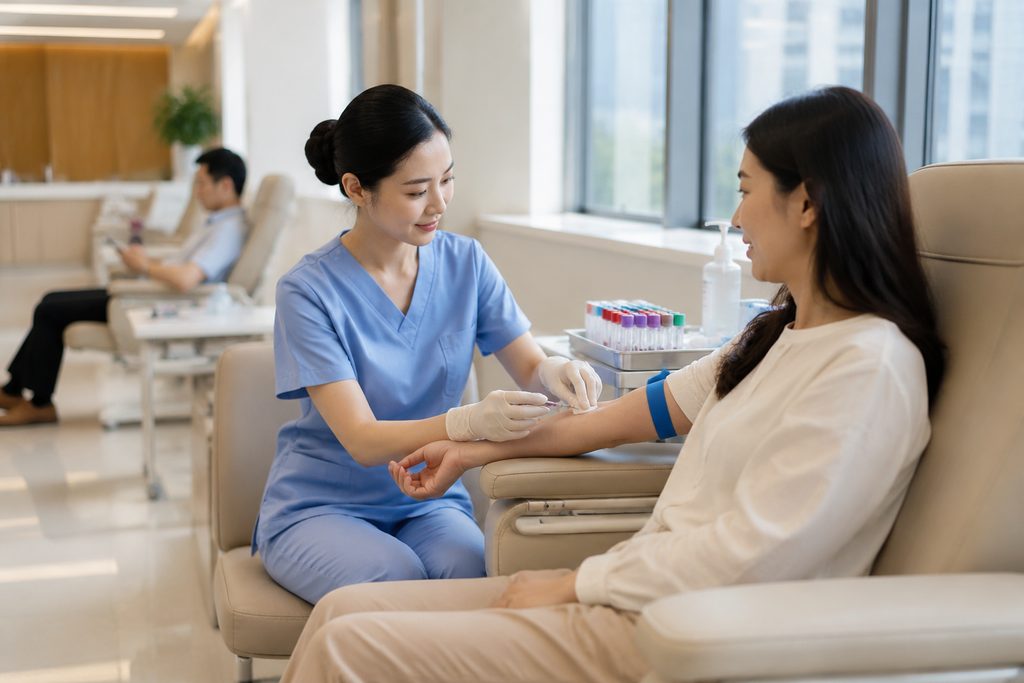
- Phlebotomy. You go to the collection area, take a queue number, and wait. Morning is busiest.
- Results. You collect a printed report or retrieve it via the hospital’s app or WeChat mini-program — which requires a Chinese phone number in many cases.
None of this is difficult if you speak Mandarin and know the layout. It is genuinely difficult if you do not. That is a logistics problem, not a medical one.
Is Vitamin D Testing in China Reliable?
Yes, with caveats. The question of whether vitamin D testing in China is reliable comes down to which lab you use, not the country.
China’s top hospitals participate in external quality assessment programs, and many clinical laboratories hold ISO 15189 accreditation. Some are also CAP-accredited, meaning they meet the same peer-review standards as major US labs. The 25(OH)D immunoassay is a mature, standardized method with international reference preparation, so results are directly comparable to those you would get at home.
Where reliability drops is at small, unregulated clinics and some cosmetic or wellness centers that offer “health packages” without clear lab accreditation. If a facility cannot tell you which platform it uses or whether it participates in proficiency testing, walk away.
Practical Considerations Before You Book
A few things matter more than price.
Documentation. Bring your passport. If you have prior vitamin D results, bring them — trends matter more than a single reading. If you take supplements, note the dose and how long you have taken them.
Visa. If you are traveling to China specifically for medical evaluation or treatment, the applicable short-stay category is the S2 visa, which covers medical treatment and private affairs. Accompanying family members apply under the same category. Note that the M visa is for commercial and trade activities and has nothing to do with medical care. Requirements change, so confirm current rules with your nearest Chinese embassy or consulate and with the hospital’s international department.
Payment. Public hospitals generally require prepayment, and international insurance is usually reimbursed after the fact rather than billed directly. Private international hospitals often bill insurers directly. Check before you go.
Language. This is the single biggest practical barrier. Registration, payment, and result collection all happen in Chinese. A bilingual companion who handles the queue, the payment window, and the report pickup turns a half-day ordeal into a manageable appointment.
Follow-up. If you return home with a result, your own physician can interpret it. Ask for a printed report with units and reference range clearly stated — this avoids confusion later.
Frequently Asked Questions
Expect $25 to $45 at a top-tier public hospital and $50 to $80 at a private international facility. The price does not change based on nationality — foreigners pay the same lab fee as locals. What differs is whether you need paid language and coordination support, which is a separate service cost.
Not directly at a public hospital. Routine outpatient labs require in-person registration on the day. What can be arranged in advance is a coordinated appointment through a hospital’s international department or through a service that handles registration, payment, and accompaniment. If you want to book a vitamin D test at a Beijing clinic with English support, the private international hospitals are the most straightforward route.
In most Chinese hospitals, yes — a physician writes the lab order during a brief consultation. Some private international clinics will draw the sample on request without a separate consultation, but they typically charge more. Either way, having a clinician review the result is worth the small extra cost.
An abnormal vitamin D level is common and usually manageable, but it should be interpreted alongside calcium, phosphate, PTH, and kidney function. Do not self-prescribe high-dose supplements based on one number. If you are still in China, an endocrinology follow-up is inexpensive and fast. If you have already left, share the printed report with your home physician.
Your Next Step
Getting a vitamin D test in China is inexpensive and fast — the hard part is navigating a system that was not designed for non-Chinese speakers. Know the price range, confirm the lab’s accreditation, and plan for the language layer before you go.
We are China Medical Services. Our team helps international patients connect with accredited Chinese hospitals, coordinate appointments, and arrange bilingual support on the ground. We are not a hospital and we do not provide diagnoses or medical advice. If you would like help identifying the right facility or planning the logistics, you can start with a free consultation — no obligation, just a conversation about what you need.
For more medical information and treatment options in China, visit chinamedservices.com (China Medical Services).
