OCT Scan in China: Cost and Booking for International Patients
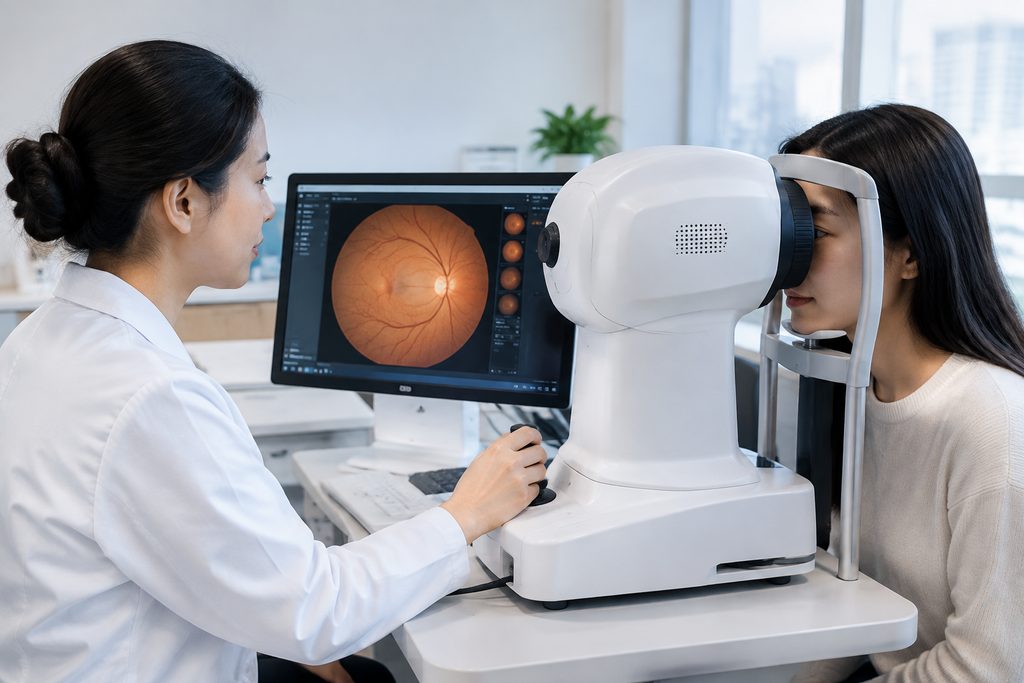
How This Actually Works, Step by Step
According to the World Health Organization, more than 2.2 billion people worldwide live with some form of vision impairment — and a meaningful share of those cases could be caught earlier with better diagnostic imaging. That is exactly where optical coherence tomography, or OCT, earns its place. It is one of the most common, most useful eye scans in modern ophthalmology, and it is one of the reasons international patients increasingly ask about OCT scan cost China pricing before they book anything.
Here is the honest sequence, from where you are now to a completed scan.
Step one: you send us your existing records. Old OCT printouts, fundus photos, a recent prescription, your doctor’s referral letter if you have one, and any injection or laser history. These go to the relevant Chinese ophthalmology department for review. Not to a call center — to the specialty team.
Step two: the department reviews and responds. Within a few working days, you get a written second opinion: whether an OCT is genuinely needed, which type (macular, optic nerve, anterior segment, or OCT angiography), and which hospital makes sense for your case. Sometimes the answer is “you don’t need to fly anywhere.” We say so.
Step three: appointment coordination. If a scan is warranted, we work through the hospital’s official international office or VIP channel to secure a slot. Public hospital general ophthalmology clinics in China do not accept overseas pre-booking — you queue on the day. The international and premium channels are the realistic route for a confirmed appointment before you fly.
Step four: you arrive, and a bilingual companion meets you. Registration, payment, navigation through a hospital that may see tens of thousands of outpatients daily, and live translation during the scan and the doctor’s explanation. This is the part most first-time visitors underestimate.
Step five: results and next steps. OCT images are usually available the same day. If treatment is indicated — an intravitreal injection, for example — the ophthalmologist will discuss it on the spot. Nothing is committed without your agreement.
What an OCT Scan Actually Costs in China
Let’s answer the question directly. A single OCT scan at a top-tier Chinese public hospital typically runs between $40 and $120, depending on the type of scan and the hospital tier. OCT angiography, which maps blood flow in the retina without dye, sits at the higher end of that range. At private international hospitals with English-speaking staff and JCI accreditation, expect $150 to $400 for the same study.
For comparison, a single OCT at a U.S. retina practice commonly bills between $200 and $500 before insurance, and OCT angiography can exceed $600. In the UK, private OCT scans frequently run £150–£350.
| Setting | Typical OCT Price (USD) | English Support | Pre-Booking from Abroad |
|---|---|---|---|
| Top public hospital — standard clinic | $40–$120 | Limited | Not available |
| Top public hospital — international/VIP channel | $80–$200 | Yes | Yes, via coordination |
| Private international hospital | $150–$400 | Yes, native-level | Yes, direct |
| United States (reference) | $200–$500+ | Yes | Yes |
Prices vary by hospital and case complexity. A scan bundled into a full retinal evaluation with dilation, fundus photography and a specialist consultation will cost more than a stand-alone image. Ask for the itemized breakdown before you commit.
A Realistic Timeline
Patients consistently underestimate how much of the total time is paperwork, not scanning. The scan itself takes under fifteen minutes.
| Stage | Realistic Duration | What Slows It Down |
|---|---|---|
| Records collection and translation | 3–7 days | Missing prior imaging; handwritten reports |
| Written second opinion from the department | 3–10 working days | Department workload; need for subspecialist review |
| Appointment coordination | 1–3 weeks | Popular specialists book out; holiday periods |
| S2 visa application | 1–3 weeks | Consulate processing times; document completeness |
| Travel and arrival | 1–3 days | Flight availability; jet lag before a morning appointment |
| Scan day itself | 2–4 hours on site | Queueing, dilation waiting time, payment steps |
| Results discussion | Same day, usually | Complex cases may need a second read |
Total, from first email to sitting in the scanning chair: roughly four to eight weeks if you are starting from scratch. If you already hold a valid visa and your records are digitized, three weeks is achievable.
What Can Go Wrong — and What Happens Then
We would rather you hear the failure modes from us than discover them at a registration desk.
The appointment doesn’t materialize. Public hospital general clinics genuinely cannot be pre-booked from overseas. If a coordinator promises you a guaranteed slot with a named professor at a standard clinic, be skeptical. Our own hospital appointment coordination is priced from $300, and if we cannot secure the appointment shown in your order, that fee is refunded in full.
You arrive and the doctor wants a different scan. This happens. A macular OCT ordered from abroad may be replaced by OCT angiography once the retina specialist examines you. That is good medicine, not a bait-and-switch — but it changes the price. Budget a margin.
Language breaks down at the worst moment. Chinese tertiary hospitals are enormous. Signage is often Chinese-only, and the ophthalmology floor may be split across buildings. Without a bilingual companion, patients routinely lose an entire day to navigation alone. This is the single most common complaint we hear.
Visa complications. Medical travel to China uses the S2 visa with a notation for medical treatment, subject to the latest embassy and consulate requirements and supporting hospital documents. Stays beyond 180 days fall under S1. Accompanying family members also apply for S2. The M visa is a commercial and trade category and has nothing to do with medical treatment — if anyone tells you otherwise, walk away.
The scan is normal, and you flew for nothing. It happens, and it is not a wasted trip if it rules out a serious problem. But a written second opinion beforehand is precisely the tool that prevents unnecessary travel. It costs $300–$500 and is credited in full toward on-the-ground coordination if you proceed within 90 days.
Choosing the Best Eye Hospital in China for an OCT Scan
China has over 35,000 hospitals. Our database covers 340+ top-ranked institutions across 37 cities, ranked by the Fudan Index and JCI accreditation — roughly the top 5% nationally. For ophthalmology specifically, the Fudan specialty reputation ranking names a clear top tier, and the geographic concentration matters for your planning.
Beijing and Shanghai hold the deepest bench of tertiary eye centers, with Guangzhou, Chengdu and Wenzhou also strong. If you are weighing Shanghai specifically, our Shanghai city page lists the major hospitals with English-capable international departments. For a specialty-level view across all 45 Fudan-ranked disciplines, including ophthalmology, see our departments directory.
Three practical selection criteria:
- Does the hospital have a dedicated retina or uveitis subspecialty? An OCT is only as useful as the person interpreting it.
- Is there an international office? This determines whether pre-booking is realistic.
- Can they issue the documentation your S2 visa application needs? Not every hospital does this smoothly.
Private international hospitals such as those listed on our private hospitals page offer direct insurance billing and Western-style service, at 1.5–2x the public international channel price. For a simple diagnostic scan, that premium is often hard to justify. For complex retinal disease requiring multiple visits, it can be worth every dollar.
Is OCT Scan Safe in China?
Yes — with context. OCT is a non-invasive imaging technique. It uses low-power near-infrared light, involves no radiation, no dye (unless you are having a dye-based angiography, which is a different test), and no contact with the eye. There is no known systemic risk. The main minor inconvenience is pupil dilation, which blurs your vision for three to four hours and makes driving inadvisable.
The real safety question is not the machine. It is the operator and the reading physician. China’s top tertiary eye hospitals perform OCT studies at very high volume — the leading centers conduct thousands of retinal imaging studies weekly — and their specialists read scans that Western general ophthalmologists may see only occasionally. Equipment at the top tier is current-generation. At smaller regional hospitals, it may not be.
Practical Considerations: Records, Visa, Payment, Follow-Up
Records. Bring prior OCT images on a USB drive or as DICOM files if you have them. Printed reports are acceptable but digital files let the new specialist compare progression properly. If your home clinic can export raw data, request it weeks in advance.
Visa. Apply for the S2 category with supporting documents from the receiving hospital. Processing typically takes one to three weeks depending on your consulate. Do not book flights before the visa is in hand.
Payment. Chinese public hospitals require prepayment. International insurance is generally reimbursed after the fact, not billed directly — with the exception of some private international hospitals that do settle directly with major insurers. Confirm this in writing before you travel.
Insurance. Many Western insurers cover medically necessary OCT abroad but require pre-authorization. Get the approval number in writing.
Follow-up at home. Ask for the scan exported in DICOM format plus a written report in English. Your home ophthalmologist will need both to track change over time. Without the raw files, comparison is guesswork.
Frequently Asked Questions
At a top Shanghai public hospital, a standard macular OCT typically runs $40–$120, with OCT angiography at the upper end. Through the hospital’s international department, expect $80–$200. Private international hospitals in the city charge $150–$400. Final pricing varies by hospital and case complexity, so request an itemized quote.
Not at a standard public clinic — those operate on same-day queueing and cannot be reserved from overseas. Pre-booking is realistic through a hospital’s international or VIP channel, or at a private international hospital. Coordination services exist for exactly this gap, and any reputable provider should refund the coordination fee if the appointment cannot be secured.
Honestly, for a routine screening OCT alone, the travel rarely justifies itself. Where it makes sense is when the scan is part of a broader evaluation — a second opinion on a macular condition, a treatment decision, or a procedure where Chinese pricing is dramatically lower. A written second opinion first, at $300–$500, is the sensible filter.
Yes. Medical travel uses the S2 visa with a notation for treatment, subject to current embassy and consulate requirements and supporting hospital documentation. Stays over 180 days use S1. Accompanying family members apply for S2 as well. The M visa is for commercial and trade activities and is not applicable to medical treatment.
Public hospitals generally require prepayment and provide documentation for later reimbursement. Some private international hospitals bill major international insurers directly. Confirm coverage and pre-authorization with your insurer before traveling, and get any approval in writing.
Your Next Step
An OCT scan in China is fast, safe, and inexpensive — the complexity lies entirely in the logistics around it. Records, appointment channels, visa category, language, and payment each have a way of going sideways for first-time visitors, and none of them have anything to do with the scan itself.
China Medical Services connects international patients with 340+ top-ranked hospitals across 37 cities. We are a coordination service, not a medical provider — we do not diagnose, treat, or promise clinical outcomes, and we never claim to buy priority access. What we do is translate your records, route them to the right specialty through official hospital channels, and put a bilingual companion beside you on the day.
If you are weighing whether a scan is worth the trip, start with a written second opinion. It is the cheapest way to find out, and it is credited in full toward coordination if you decide to come. Reach out for a free consultation whenever you are ready — no pressure, and no obligation to travel.
For more medical information and treatment options in China, visit chinamedservices.com (China Medical Services).
