Varicose Veins Without Surgery: Non Surgical Treatment Cost in China
Varicose Veins Without Surgery: The Short Answer
Yes — most varicose veins can now be removed or closed without traditional surgery. According to a 2023 analysis in the Journal of Vascular Surgery: Venous and Lymphatic Disorders, over 80% of patients with symptomatic varicose veins are candidates for endovenous thermal ablation or sclerotherapy rather than open vein stripping. The non surgical varicose vein treatment cost China typically runs from $800 to $3,500 per leg, depending on technique and hospital tier. That compares to $4,000–$15,000 in the United States for the same procedures.
But “without surgery” does not mean “without a procedure.” Most modern treatments still involve needles, catheters, or laser fibers inserted through tiny punctures. The distinction is that there is no large incision, no general anesthesia, and no overnight hospital stay. Recovery is measured in days, not weeks.
Who This Is Right For — and Who It Isn’t
Modern non-surgical techniques work well for the majority of patients, but candidacy depends on vein size, anatomy, and underlying venous insufficiency. A proper duplex ultrasound is non-negotiable before any treatment decision.
Typically good candidates:
- Patients with great saphenous vein (GSV) or small saphenous vein (SSV) reflux confirmed on ultrasound
- Vein diameters between 3 mm and 18 mm, which suit laser or radiofrequency ablation
- Smaller branch veins and spider veins, which respond well to sclerotherapy
- People with symptoms like aching, heaviness, night cramps, or swelling that improve with leg elevation
- Patients who cannot afford weeks off work for open surgery recovery
Who should not pursue this:
- Anyone with acute deep vein thrombosis (DVT) or superficial thrombophlebitis requiring anticoagulation first
- Patients with severe peripheral arterial disease, where compression and ablation may compromise circulation
- Pregnant women — treatment is almost always deferred until after delivery
- People with an active infection or open ulcer at the treatment site
- Patients whose primary problem is not venous reflux but lymphedema, heart failure, or renal disease
Being honest about exclusions matters. A clinic that promises treatment to everyone without an ultrasound is not one you should trust.
The Options, Compared
Doctors use several minimally invasive techniques to close or remove varicose veins. The right choice depends on vein size, reflux pattern, and the treating physician’s experience. Here is how the main options stack up.
| Technique | How It Works | Vein Size Suitability | Typical Recovery | Price Range in China (per leg, USD) |
|---|---|---|---|---|
| Endovenous Laser Ablation (EVLA) | Laser fiber inserted via a 2–3 mm puncture heats and seals the vein from inside | 3–18 mm trunk veins (GSV, SSV) | Walk immediately; return to work in 1–3 days | $1,200–$3,500 |
| Radiofrequency Ablation (RFA) | Similar to EVLA but uses radiofrequency energy; often less post-procedure pain | 3–15 mm trunk veins | Walk immediately; return to work in 1–2 days | $1,500–$3,800 |
| Ultrasound-Guided Foam Sclerotherapy | Foamed sclerosant injected into the vein under ultrasound guidance; vein collapses and scars shut | 2–10 mm, including tortuous veins and perforators | Walk immediately; compression stockings for 1–2 weeks | $800–$2,000 (often needs 2–3 sessions) |
| Mechanochemical Ablation (MOCA / ClariVein) | Rotating wire mechanically damages vein lining while sclerosant is delivered simultaneously | 3–12 mm trunk veins | Walk immediately; return to work in 1–2 days | $1,800–$3,200 |
| Cyanoacrylate Glue Closure (VenaSeal) | Medical glue injected via catheter seals the vein; no tumescent anesthesia needed | 3–12 mm trunk veins | Walk immediately; often no compression stockings required | $2,500–$4,500 |
| Phlebectomy (Ambulatory) | Tiny 1–2 mm nicks remove bulging veins with a hook; often combined with EVLA or RFA | Large, bulging branch veins near the skin surface | Walk immediately; bruising for 1–3 weeks | $600–$1,800 (often as an add-on) |
EVLA and RFA remain the most studied and widely available options in Chinese hospitals. Foam sclerotherapy is cheaper per session but often requires repeat visits. Glue closure is convenient but costs more and has less long-term data than thermal methods. Your ultrasound findings should drive the decision, not the price tag alone.
How Doctors Remove Varicose Veins Without Surgery: The Step-by-Step Reality
If you are asking “how do doctors remove varicose veins without surgery,” here is what actually happens in a treatment room. The process is remarkably consistent across techniques.
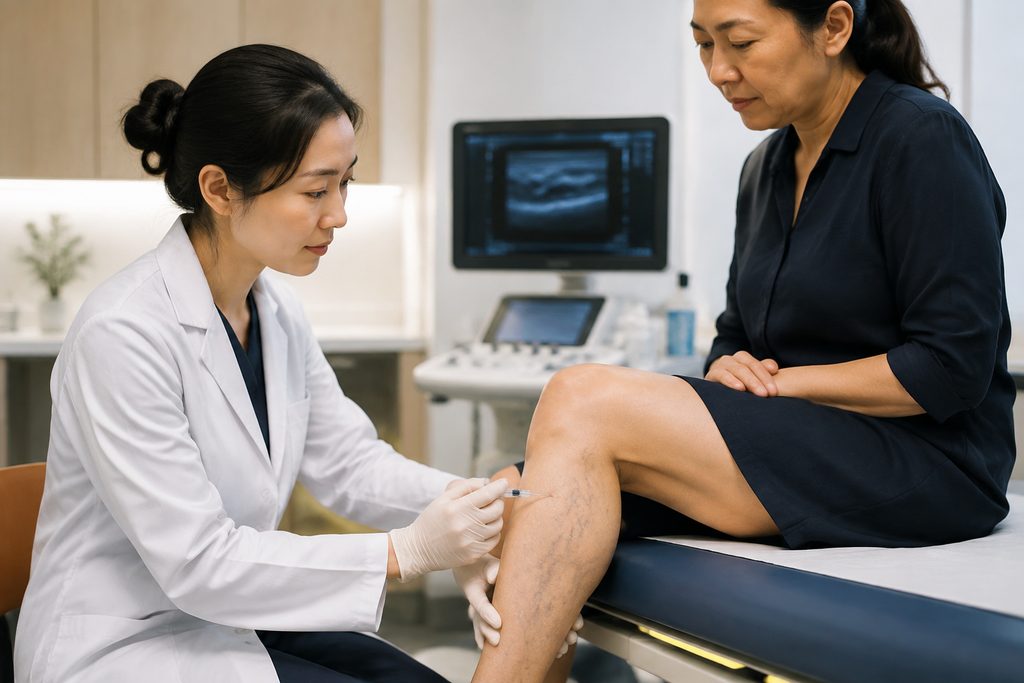
First, the doctor maps your veins with duplex ultrasound. They mark the refluxing segments on your skin with a pen. You lie on a treatment table, and the leg is cleaned and draped. Local anesthetic is injected along the vein — this is the tumescent anesthesia step for EVLA and RFA. It numbs the area, compresses the vein, and protects surrounding tissue from heat.
A needle puncture is made near the knee or ankle. Through it, the doctor threads a thin catheter or laser fiber up to the junction where the diseased vein meets the deep system. Then the device is activated and slowly withdrawn. The vein wall heats, collapses, and seals shut. Your body absorbs the closed vein over the following months. Blood flow reroutes to healthy veins automatically.
For sclerotherapy, the process is simpler: a fine needle injects foam into the vein under ultrasound guidance. The foam displaces blood and irritates the vein lining, causing it to stick together. Over 6–12 weeks, the treated vein turns into scar tissue and fades.
The whole session takes 45–90 minutes. You walk out of the clinic on your own feet. Compression stockings are usually worn for one to two weeks, and a follow-up ultrasound at 1–4 weeks confirms the vein is closed.
Nothing about this is magic. The skill of the operator determines most of the outcome. A poorly placed fiber can cause nerve injury, skin burns, or incomplete closure. That is why choosing an experienced vascular team matters more than choosing a specific brand of laser.
What Non Surgical Varicose Vein Treatment Cost in China Actually Includes
Let’s be concrete about money. The non surgical varicose vein treatment cost China depends on four variables: technique, hospital tier, whether one or both legs are treated, and whether you go through the standard public outpatient route or an international/VIP department.
Representative price ranges for international patients (USD):
- Initial consultation with vascular surgeon: $50–$150
- Duplex ultrasound of both legs: $100–$250
- EVLA or RFA, one leg, public top-tier hospital international department: $1,500–$2,800
- EVLA or RFA, one leg, private international hospital: $2,500–$4,000
- Foam sclerotherapy, per session: $250–$600 (expect 2–3 sessions for full results)
- Ambulatory phlebectomy add-on: $500–$1,200
- Compression stockings (medical grade, one pair): $60–$150
- Follow-up ultrasound at 1 month: $80–$180
These figures vary by hospital and case complexity. What is typically not included: flights, accommodation, visa fees, translation services, and treatment of complications if they arise. Some private hospitals bundle consultation, ultrasound, and treatment into a flat package, which can be simpler but not necessarily cheaper.
Compared to the US, where EVLA commonly bills at $3,000–$7,000 per leg before insurance, China’s top hospitals deliver the same technology at roughly one-third to one-half the cost. That price gap is the main reason international patients consider traveling for vein treatment.
Best Varicose Vein Clinic Shanghai Price: What to Expect
Shanghai has the densest concentration of vascular specialists in China outside Beijing. If you search for the best varicose vein clinic Shanghai price, you will find both public hospital international departments and private clinics offering these procedures.
Public options include the vascular surgery departments at Zhongshan Hospital Fudan University, Ruijin Hospital, and Shanghai Ninth People’s Hospital. These are large, high-volume centers. Their international or VIP departments can arrange English-speaking coordination, but the base price for EVLA still lands in the $1,500–$2,800 range per leg. Standard public departments are cheaper — sometimes under $1,200 — but you will face language barriers and longer queues unless you bring a bilingual companion.
Private international hospitals like United Family Shanghai, Jiahui, and Parkway charge $2,800–$4,500 per leg for the same EVLA or RFA procedure. You pay for English-speaking staff, faster scheduling, and direct insurance billing. Some patients find that worth it. Others prefer the cost savings of a public hospital with an interpreter.
The honest trade-off: public hospitals offer more experienced surgeons at lower prices, but with less hand-holding. Private clinics offer comfort and convenience, but the price climbs. A middle path is using a public hospital’s international department, which blends senior specialists with English coordination.
For context on hospital tiers, our guide to China’s top-ranked hospitals explains how Fudan rankings and JCI accreditation differ, and why both matter for international patients.
Minimally Invasive Varicose Vein Treatment Abroad: Packages and Practicalities
Some international patients look for minimally invasive varicose vein treatment abroad packages that bundle the procedure with logistics. These packages exist, but they vary widely in what they actually include. Before paying for anything, ask exactly what is covered.
A legitimate package should include: pre-arrival review of your medical records and ultrasound images, the consultation, the procedure itself, compression stockings, one follow-up ultrasound, and basic translation. It should not include flights, hotel, meals, or visa fees — those are always separate.
If you want to book laser varicose vein removal China, the sequence matters. You cannot simply arrive and expect same-day treatment. The standard flow is: submit prior ultrasound reports and a brief medical history, have a remote or in-person consultation, schedule the procedure for a later date, and plan at least 3–5 days in-country for the procedure plus initial follow-up. Some clinics can compress this to two visits if your ultrasound is recent and high quality.
Bring any previous duplex ultrasound images, a list of medications, and documentation of prior vein treatments. If you take blood thinners, you will need a plan for stopping them safely before the procedure — never do this without your prescribing doctor’s approval.
Practical Considerations: Records, Visa, Payment, and Follow-Up
Traveling for vein treatment is not complicated, but a few logistics deserve attention.
Medical records. A recent duplex ultrasound (within 3–6 months) is the single most valuable document. Without it, you will need a new ultrasound in China before any treatment decision. Bring a summary of your symptoms, prior treatments, allergies, and current medications. If possible, have key documents translated into English or bring a bilingual companion.
Visa. Foreign nationals traveling to China for medical treatment typically apply for an S2 visa, which covers short-term private affairs including medical care. The hospital or clinic can provide an invitation letter and treatment confirmation to support your application. Requirements change, so check with the Chinese embassy or consulate in your country before booking flights. We never guarantee visa approval, and no single visa category fits every case.
Payment. Public hospitals in China generally require prepayment or payment at each service point. Most accept international credit cards at their international departments, but confirm beforehand. Private international hospitals often bill insurance directly if they have an agreement with your insurer. If you plan to claim reimbursement later, request itemized receipts and a discharge summary before leaving.
Language. Public hospital vascular departments rarely have fluent English-speaking staff at every counter. Registration, payment, ultrasound, and pharmacy visits all involve Chinese-language interactions. A bilingual medical companion can handle these steps, which is why many international patients use one even for outpatient procedures. Our patient coordination service exists precisely for this purpose.
Follow-up after returning home. Vein closure is confirmed by ultrasound at 1–4 weeks post-procedure. If you fly home before that, arrange a follow-up ultrasound with a local vascular lab and send the images back to your treating team. Compression stockings are typically worn for 1–2 weeks, sometimes longer after sclerotherapy. Walking daily is encouraged; long-haul flights immediately after treatment should be discussed with your doctor.
Frequently Asked Questions
Endovenous ablation and sclerotherapy close the treated vein permanently. The treated vein does not come back. But varicose veins are a chronic condition — new veins can develop elsewhere over time. Around 20–30% of patients need additional treatment within five years, according to long-term follow-up studies. Compression stockings, weight management, and regular exercise reduce recurrence risk but do not eliminate it.
The procedures are done under local anesthesia, so you should not feel sharp pain during the laser or radiofrequency portion. You will feel needle pricks for the anesthetic injections, and some patients describe a pulling or tugging sensation as the catheter moves. Afterward, expect tightness, bruising, and mild aching for 3–10 days. Most people manage with over-the-counter pain relief and return to desk work within two days.
Incomplete closure happens in roughly 2–5% of thermal ablation cases, depending on the study and the operator’s experience. If a follow-up ultrasound shows the vein is still open, options include repeating the ablation, switching to foam sclerotherapy, or, rarely, proceeding to surgical removal. This is why the post-procedure ultrasound matters — skipping it means you will not know whether the treatment worked. Reputable clinics in China include this follow-up in their protocol, not as an optional extra.
Plan for a minimum of 3–5 days. Day one: consultation and ultrasound. Day two or three: the procedure itself. Day four or five: initial follow-up and dressing check. If you have both legs treated or need multiple sclerotherapy sessions, extend to 7–10 days. Some patients do the consultation and procedure on consecutive days if their records are complete, but do not book a return flight within 48 hours of treatment.
Long flights within 48–72 hours after vein treatment carry a small but real risk of blood clots, especially after sclerotherapy or if you have other risk factors. Most vascular surgeons recommend waiting at least 2–3 days before a flight over four hours, wearing compression stockings during the flight, and walking every hour. If you have a history of DVT or a clotting disorder, discuss this with the treating physician before booking travel.
Your Next Step
The evidence is clear: most varicose veins can be treated without traditional surgery, and China’s top vascular centers offer those treatments at a fraction of Western prices. The key is getting a proper ultrasound first and choosing a technique based on your anatomy, not on marketing.
We are China Medical Services, a coordination team that connects international patients with top-ranked Chinese hospitals. We are not a hospital, and we do not diagnose or treat. What we do is handle the practical layer — hospital matching, appointment coordination, bilingual accompaniment, and visa guidance — so you can focus on the medical decision itself. If you are considering vein treatment in China, a free consultation is the lowest-pressure way to understand your options. Reach out through our For more medical information and treatment options in China, visit chinamedservices.com (China Medical Services).
