MRI Without Contrast Cost China: Who Qualifies and What to Expect
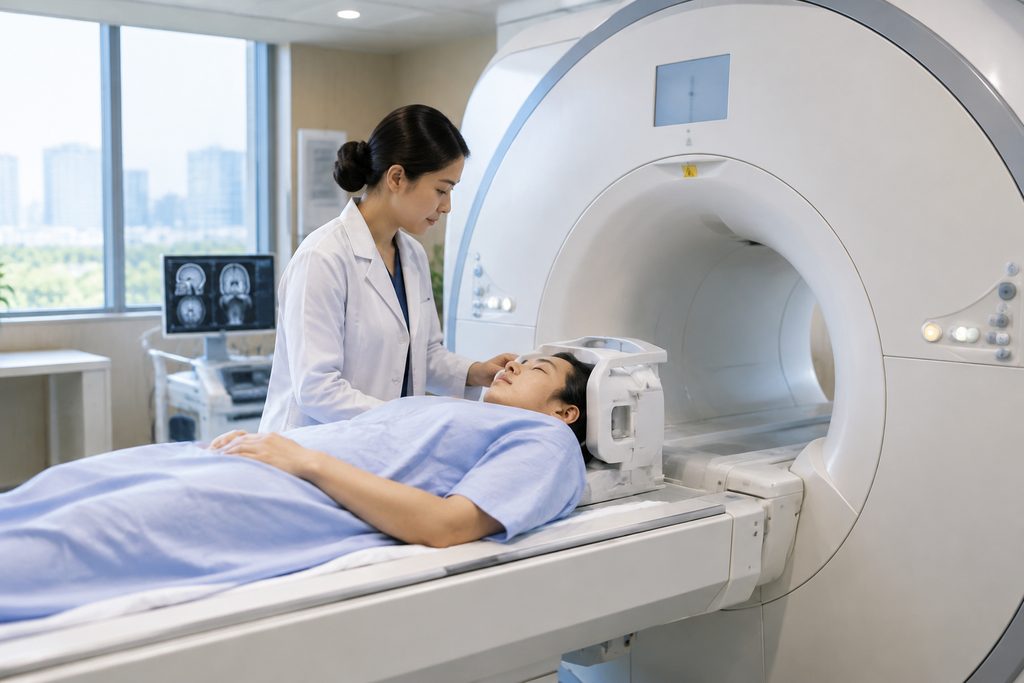
MRI Without Contrast in China: Who Qualifies
Key Takeaways
- An MRI without contrast in China typically runs $80–$400 depending on the body part and hospital tier — a fraction of the $1,000–$3,000 billed in the US.
- Most patients who need a non-contrast scan qualify for one; contrast is added only when a radiologist needs to see blood vessels, tumors, or inflammation more clearly.
- The real barrier is not the scan itself. It is scheduling, language, and getting your images into the hands of a specialist who can read them.
- You can request a written second opinion on your existing MRI before deciding whether to travel at all.
The Problem: Why “Just Get an MRI” Is Never Simple Abroad
You’ve probably heard that medical imaging in China is cheap but chaotic. The reality is more nuanced — and more useful.
In the United States, a single brain MRI without contrast averages around $1,400, and a knee MRI can exceed $2,000 before insurance adjustments. In the UK, NHS waiting lists for non-urgent MRI scans stretched past 12 weeks in many regions by 2024. For a patient in Canada or Australia, the wait can feel endless, and going private means paying out of pocket at Western prices.
So people start searching. They find that China performs more MRI scans annually than any country except the United States, and that a top-tier hospital in Shanghai or Beijing can often fit a self-paying patient within days, not months. That’s when the questions start piling up. Do I need contrast? Will they understand my referral? Can I even book this without speaking Mandarin?
Why China Delivers Results for Non-Contrast Imaging
Top-ranked Chinese hospitals operate 3.0T and even 7.0T MRI machines as standard, and they run them at high utilization. A single large tertiary hospital may complete 300–600 MRI studies per day across multiple scanners. That throughput means shorter appointment gaps, faster reporting, and radiologists who have seen thousands of similar cases.
For a non-contrast scan — which requires no IV setup, no contrast injection monitoring, and no post-injection wait — the workflow is even faster. Many hospitals can scan and release a preliminary report within 24 to 48 hours.
Cost Structure Without Quality Compromise
Lower prices do not mean older machines or less qualified readers. The cost difference comes from labor economics, high equipment utilization, and a public hospital pricing framework that caps imaging fees. A 3.0T brain MRI at a major Shanghai hospital might cost $150–$250. The same scan at a private international hospital could be $400–$700 — still well below Western rates, and with English-speaking staff and direct insurance billing.
| Scan Type | China (Public Tertiary) | China (Private International) | United States |
|---|---|---|---|
| Brain MRI without contrast | $100–$250 | $400–$700 | $1,000–$2,500 |
| Knee MRI without contrast | $120–$280 | $450–$750 | $1,200–$3,000 |
| Spine MRI without contrast | $130–$300 | $500–$800 | $1,500–$3,500 |
| Abdomen MRI without contrast | $150–$350 | $550–$900 | $1,800–$4,000 |
Prices are estimates and vary by hospital, city, and case complexity. They do not include physician consultation or report translation.
Who Actually Qualifies for a Non-Contrast MRI
This is the question most patients really want answered. And the honest answer is: most people who need an MRI can get one without contrast. Contrast is a tool, not a default.
You are likely a candidate for a non-contrast MRI if your referring physician wants to evaluate:
- Joint structures — ligaments, cartilage, meniscus, rotator cuff tears
- Spinal disc herniation, stenosis, or nerve compression
- Brain anatomy for headaches, suspected structural abnormalities, or follow-up of known lesions
- Liver, kidney, or pelvic organ morphology without vascular detail
- Bone marrow signal changes or occult fractures
Contrast becomes necessary when the clinical question involves blood vessels, tumor vascularity, infection, or active inflammation. A radiologist may also recommend contrast mid-scan if the non-contrast images reveal something that needs clarification. That decision is made by the medical team, not by the patient.
If you have chronic kidney disease, a history of allergic reaction to gadolinium, or are pregnant, non-contrast imaging is often the safer and preferred route. That is a clinical judgment your physician must make.
Safety and Practical Questions Patients Ask
Is an MRI without contrast safe in China? Yes. MRI itself uses no ionizing radiation, and skipping contrast removes the small risks associated with gadolinium-based agents — allergic reactions, rare nephrogenic systemic fibrosis in patients with severe kidney impairment, and concerns about gadolinium deposition. Chinese tertiary hospitals follow standard safety protocols, screen for implants and metal foreign bodies, and provide ear protection and communication devices.
What about the scan report? This is where many international patients hit a wall. Reports are typically issued in Chinese. A good hospital international department can provide an English summary, but quality varies. If you need your images reviewed by a specialist in your home country, you will need the DICOM files on a CD or USB drive, plus a translated report.
How to Book an MRI Without Contrast at a China Hospital
Booking an MRI as a foreign patient is possible, but the path differs depending on the hospital type.
At a public tertiary hospital, you generally cannot book an MRI directly from overseas. You need a physician consultation first. The typical flow is: register at the international department or a specialty clinic, see a doctor, get an imaging order, then schedule the scan. Walk-in registration is possible on the day, but queues at top hospitals can be long, and without Mandarin or a bilingual companion, navigation is difficult.
At a private international hospital — such as United Family, Jiahui, or Parkway — you can often book an MRI appointment directly with English-speaking staff, and many accept international insurance with direct billing. The trade-off is a higher price.
For patients who want a specific top-tier public hospital, the practical route is to work through the hospital’s international office or a coordination service that handles registration, payment, and scheduling. This is where China Medical Services fits — we are not a hospital and do not provide diagnoses, but we coordinate the logistics so you arrive with an appointment, not a queue number.
What a Medical Tourism Package for MRI Actually Includes
The phrase “MRI without contrast medical tourism package China” gets searched a lot, but the term is loose. There is no single product. What exists is a set of services you can combine.
A realistic package might include: hospital selection based on your clinical question, appointment coordination, airport transfer, bilingual medical companion for the hospital visit, report translation, and follow-up video consultation with a specialist to discuss findings. Costs vary. A bilingual companion runs from $300 per day. Appointment coordination starts from $300. A written second opinion from a top-hospital specialist ranges $300–$500.
What it should not include is any promise of a specific diagnosis, a guaranteed appointment with a named professor, or a treatment outcome. Any provider who promises those things is not being honest with you.
Frequently Asked Questions
Can I get an MRI without contrast in China as a foreigner?
Yes. Foreign patients can access MRI services at both public tertiary hospitals and private international hospitals. At public hospitals, you typically need a physician consultation first to obtain an imaging order. Private international hospitals often allow direct booking. No special visa category is required for the scan itself — standard entry rules apply.
Is MRI without contrast safe in China?
Yes. Non-contrast MRI avoids gadolinium exposure entirely and uses no radiation. Chinese tertiary hospitals follow standard safety screening for metal implants, pacemakers, and foreign bodies. The main practical risk is not the scan — it is miscommunication about your history if you do not have language support.
How much does an MRI without contrast cost in China?
Expect $80–$400 at a public tertiary hospital, depending on the body part and city. Private international hospitals range $400–$900. These are self-pay estimates. Final pricing varies by hospital and case complexity, and does not include consultation or translation fees.
Which is the best hospital in Shanghai for MRI without contrast?
Several Shanghai hospitals have strong imaging departments, including Zhongshan Hospital Fudan University and Ruijin Hospital. The “best” choice depends on what body part needs imaging and whether you need an English-speaking environment. Our specialty rankings can help you compare by department.
Do I need a visa for medical imaging in China?
For a short imaging visit, most foreign nationals use a standard tourist or business visa depending on nationality and purpose. If your trip is specifically for medical treatment, the S2 visa category is the appropriate short-stay option, subject to the latest embassy or consulate requirements and supporting hospital documents. Rules change, so verify with your local Chinese embassy before applying.
Your Next Step
An MRI without contrast in China is affordable, fast, and safe — but the scan is only useful if the right specialist reads it and you understand what comes next. If you already have imaging from home, a written second opinion from a Chinese specialist can tell you whether travel is even necessary. If you need a scan, we can help you choose a hospital, coordinate the appointment, and arrange bilingual support. Start with a free consultation at our companion services page — no pressure, just a conversation about your options.
This article is for general information only and does not constitute medical advice. Always consult a qualified physician regarding your individual condition and imaging needs.
For more medical information and treatment options in China, visit chinamedservices.com (China Medical Services).
