Winter Medical Travel Service China: Cold Weather Recovery and Indoor Rehab Support
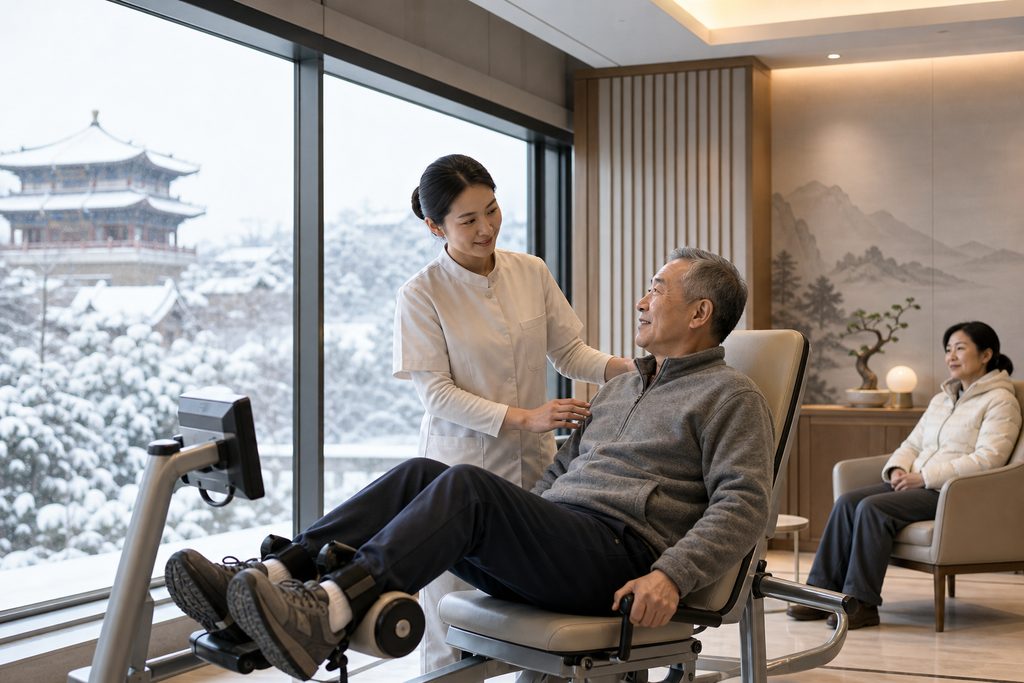
A freezing sidewalk. A crowded subway platform. A rushed commute. For anyone recovering from major surgery, winter in a busy city is not just uncomfortable. It is a genuine hazard. A 2022 study in the *Journal of Orthopaedic Surgery and Research* found that post-operative joint replacement patients face a 34% higher risk of falls during icy conditions compared to summer months. The anxiety is real. You are not just healing an incision. You are navigating a world that suddenly feels hostile to a body that needs stillness and warmth.
That is where a structured winter medical travel service in China changes the equation. Not by promising a miracle cure. But by removing the chaos. Our team connects international patients with hospitals and recovery programs designed around a simple truth: the best healing happens when the environment is controlled, the air is clean, and every logistical detail is handled before you arrive. A dedicated indoor rehab center China winter package price starts from $200 per day for bilingual support, with full-service coordination packages scaling based on your clinical needs and length of stay. You focus on getting stronger. We handle the rest.
Key Takeaways
- China’s top-tier hospitals perform surgical volumes that dwarf Western centers — Fuwai Hospital alone completes over 14,000 cardiac surgeries annually, building a depth of clinical experience that directly improves patient outcomes.
- Winter medical travel in China works because recovery moves indoors: climate-controlled rehab centers, hospital-integrated guest facilities, and zero pressure to brave icy streets before you are ready.
- The hard truth: you cannot simply email a Chinese public hospital and book a surgery date. The system requires physical presence for consultation first, and language barriers make solo navigation nearly impossible without local support.
- Any video consultation or second opinion fee you pay is fully credited toward on-the-ground coordination if you decide to travel for treatment within 90 days — so the initial step carries zero financial risk.
The Problem: Winter Recovery Is Harder Than Anyone Admits
Most surgical discharge papers read the same way. “Rest. Avoid strenuous activity. Follow up in two weeks.” What they do not say is that “rest” means something entirely different when the temperature drops below freezing and your apartment has three flights of stairs. Approximately 1 in 8 patients recovering from orthopedic procedures report a fall within the first month post-discharge, according to data from the American College of Surgeons. The consequences are not minor. A single slip can undo weeks of surgical precision.
Cold weather itself is not just a mobility risk. It changes how the body heals. Blood vessels constrict. Circulation slows. Joints stiffen. Pain that was manageable in a warm climate becomes a daily negotiation. And for international patients who traveled to China specifically for surgery, the question of “what happens after I leave the hospital” is often the least discussed part of the planning process.
This is where the logic of an indoor rehab center China winter package becomes clear. You are not paying for a hospital bed. You are paying for a sealed, safe, professionally monitored environment where every hallway is flat, every room is warm, and someone who speaks your language is within arm’s reach. The winter package price varies by city and clinical complexity, but the baseline for bilingual companion support starts at $200 per day. That is not a luxury surcharge. That is the cost of removing the single biggest variable in recovery: the outside world.
Who We Are
We are not a hospital. We do not provide medical treatment, make diagnoses, or offer clinical advice of any kind. Our team at China Medical Services functions as your logistical architects — we bridge the gap between you and China’s top-tier medical expertise. We maintain a database of 340+ top-ranked hospitals across 37 cities, representing the top 5% of China’s 35,000+ medical institutions as ranked by the Fudan University hospital rankings and JCI accreditation standards. We handle hospital matching, appointment coordination, bilingual medical companionship, visa guidance, and recovery logistics. Our role is to make sure you never stand alone in a Chinese hospital hallway wondering which floor to go to. Everything we do is built on one principle: the medicine is China’s expertise. The navigation is ours.
Why Winter Medical Travel to China Delivers Results
Clinical Volume That No Western Center Can Match
There is a quiet rule in surgery. The more you do, the better you get. A top-tier Chinese orthopedic surgeon at a hospital like Peking Union Medical College Hospital or West China Hospital performs between 200 and 500 joint replacements annually. The average orthopedic surgeon in the United States performs approximately 65 per year, based on data from the American Academy of Orthopaedic Surgeons. This is not a slight against Western medicine. It is a function of population scale and hospital efficiency. The specialized departments across China’s top hospitals operate at a tempo that builds deep, intuitive surgical judgment. For a patient, that means your surgeon has likely seen your exact complication before — because they have seen everything before.
Cardiac surgery tells an even starker story. Fuwai Hospital in Beijing completes over 14,000 cardiac surgeries annually, making it the highest-volume heart center on the planet. The entire United Kingdom performs roughly 35,000 cardiac surgeries per year across all hospitals combined. One Chinese hospital does 40% of that number alone. When you are choosing where to have your chest opened, volume is not an abstract statistic. It is the difference between a surgical team that handles your procedure as routine and one that handles it as a special case.
Recovery Infrastructure Built for Indoor Healing
Western hospital discharge often means going home. In winter, that home may be a walk-up apartment with uneven heating and a bathroom on a different floor. Chinese top-tier hospitals have invested heavily in integrated recovery infrastructure precisely because they serve a massive domestic population that travels long distances for care. Many hospitals in Shanghai and Beijing maintain attached rehabilitation centers with climate-controlled corridors connecting directly to inpatient wards. You move from surgery to rehab without ever stepping outside.
The indoor rehab center China winter package price reflects this infrastructure advantage. From $200 per day for a bilingual companion who handles translation, navigation, and coordination, these packages scale to include physiotherapy sessions, nutritional support, and private recovery suites. The cost structure benefits from China’s broader healthcare economics — skilled nursing and therapy labor costs are significantly lower than in the US or Europe, without any compromise in clinical training standards. A physiotherapy session that might bill at $150-200 in the United States often costs $30-50 in a Chinese hospital-affiliated rehab center.
Cost Advantage Without Quality Compromise
Let’s address the elephant in the room directly. Lower cost often signals lower quality in the minds of Western patients. The structural reality of Chinese healthcare tells a different story. A coronary artery bypass graft at a top Chinese public hospital runs $12,000 to $20,000. The same procedure in the United States averages over $120,000. The gap is not explained by inferior equipment or less skilled surgeons. It is explained by labor economics, hospital administrative overhead, and a healthcare system that does not carry the same insurance billing complexity that inflates American prices. The operating theaters at Fuwai Hospital or Zhongshan Hospital Fudan University use the same da Vinci surgical robots, the same imaging technology, and the same implant materials you would find at Mayo Clinic or Cleveland Clinic. The surgeons often trained internationally. The difference is that the system around them costs less to run.
This cost advantage extends directly to winter recovery. A full month of indoor rehabilitation with daily physiotherapy, bilingual companion support, and private accommodation in Shanghai can cost less than a single week of equivalent care in a US rehabilitation facility. For patients paying out of pocket or facing high deductibles, this math reshapes what is possible.
What You Need to Know Before Going Alone
Honesty matters more than salesmanship. Here is what makes solo medical travel to China genuinely difficult — and why many patients who try to arrange everything independently end up frustrated before they even board the plane.
- Visa Requirements Are Specific and Unforgiving: Medical travelers to China require an S2 visa with treatment purpose noted. Family members accompanying you also need S2 visas. The application requires a formal invitation letter from the Chinese hospital — and public hospitals do not issue these to patients who have not already been seen in consultation. This creates a chicken-and-egg problem that our team resolves by coordinating through hospital international departments. M visas are for commercial business only and will be rejected for medical travel purposes. Getting this wrong means a denied application and a delayed procedure.
- Public Hospital Registration Cannot Be Done Remotely: China’s public hospital system operates on a same-day registration model for standard outpatient visits. You queue. You get a number. You see a doctor. You cannot email a top surgeon’s office and book a surgery slot six weeks out through the public channel. The only path to pre-arranged surgery is through hospital international departments or VIP channels, which require local coordination and command fees roughly 1.5 to 2 times the standard rate. Our appointment coordination service starts from $300 and includes the guarantee that if we cannot secure the appointment you need, you pay nothing.
- Language Barriers Are Absolute in Public Hospitals: A top Chinese hospital may see 10,000 outpatient visits in a single day. The registration kiosks display Chinese characters. The queue numbers are called in Mandarin. The pharmacy window does not have an English-language option. Even finding the correct building on a sprawling hospital campus requires reading directional signs that assume local knowledge. This is not a system designed for international patients — which is precisely why a bilingual medical companion at $200 per day transforms the experience from overwhelming to manageable.
How We Help You Navigate This
These barriers exist for structural reasons, not because anyone is trying to exclude international patients. China’s hospital system evolved to serve a domestic population of 1.4 billion people. The friction points are real but solvable with the right local partner.
Our process begins before you book a flight. We start with a detailed review of your medical records, translated into Chinese by our team for presentation to relevant specialists. We identify hospitals that match your clinical needs — drawing from our database of 340+ institutions ranked by Fudan University and JCI standards — and coordinate video consultations so you can speak with a specialist before committing to travel. These video consultations range from $100 to $800 depending on the specialist’s seniority, and every dollar is credited toward on-the-ground coordination if you proceed with treatment within 90 days.
Once you decide to move forward, we handle the visa invitation letter coordination, hospital appointment scheduling, and accommodation arrangements near your chosen facility. On the day you arrive, a bilingual companion meets you at the airport. They stay with you through registration, consultation, admission, surgery, and every day of recovery. They translate doctor’s instructions. They handle pharmacy runs. They make sure you understand your medication schedule and follow-up plan. They are not clinical staff — but they ensure that nothing gets lost between languages at a moment when clarity matters most.
For winter recovery specifically, we arrange accommodation with step-free access, climate control, and proximity to your hospital’s rehabilitation facilities. The indoor rehab center China winter package price varies based on the level of support you need — from basic companion services at $200 per day to comprehensive VIP coordination packages ranging from $5,000 to $8,000 for extended stays with full logistical management. You tell us what level of support feels right, and we build the plan around it.
Is It Safe to Travel to China for Surgery in Winter?
This question deserves a direct answer. Yes — with the right preparation. China’s major cities maintain fully functional infrastructure through winter. Hospitals in Beijing, Shanghai, Guangzhou, and Chengdu operate with the same standards year-round. The specific concern for winter travel is not the hospital environment. It is the gap between hospital discharge and full independence.
This is why the indoor rehab model matters so much. Patients who book winter medical tourism packages in China are not discharged to a hotel room and left to figure things out. They move into hospital-affiliated or hospital-adjacent recovery facilities where physiotherapy continues daily, meals are provided, and a bilingual companion remains available. The cold weather outside becomes irrelevant because the recovery environment is entirely internal. You do not need to brave a Shanghai winter to get to your physio appointment. The physio comes to you, or the facility is connected by an indoor walkway.
The best hospitals in China for winter medical travel tend to be those with integrated rehabilitation infrastructure. In Shanghai, Zhongshan Hospital Fudan University and Ruijin Hospital both maintain extensive inpatient and outpatient rehab facilities. In Beijing, Peking Union Medical College Hospital offers international department services with English-speaking staff and coordinated recovery planning. For patients considering how to recover from surgery in winter in China, the answer lies in selecting a hospital where the discharge plan includes a structured, indoor, supervised rehabilitation pathway — not just a prescription and a follow-up date.
Frequently Asked Questions
You can initiate the process remotely through a video consultation, which we coordinate with the hospital’s international department. The specialist reviews your records, discusses your case, and determines whether you are a suitable candidate. However, no Chinese public hospital will schedule a surgery date without an in-person consultation first. This is a universal rule. The video consultation establishes the relationship and confirms viability, but you will still need to travel for a face-to-face assessment before any procedure is booked. Our team handles the scheduling so that the in-person consultation and the surgery window are as close together as possible, minimizing your total stay.
Your treating surgeon in China will provide a complete medical record in both Chinese and English, including operative notes, imaging, and a recommended follow-up protocol. You share these with your local physician. For non-urgent questions, we can coordinate a follow-up video consultation with your Chinese specialist. For urgent complications, you seek care locally — your Chinese surgeon’s records ensure your local doctor has full context. This is not a perfect system, and the distance is real. But it mirrors the same post-operative reality faced by any medical tourist, regardless of destination. The key is thorough documentation and a clear communication channel before you leave.
We only work with rehabilitation facilities that are either directly operated by a Fudan-ranked hospital or hold JCI accreditation. These are not standalone wellness retreats. They are clinical facilities staffed by licensed physiotherapists and rehabilitation physicians. You can verify accreditation status independently through the JCI website. If a facility cannot provide transparent credentials, we do not include it in our recommendations. The cold weather recovery after surgery in Shanghai model works precisely because these centers are integrated into the hospital system, not separate from it.
The indoor rehab center China winter package price starts from $200 per day for bilingual companion services. This covers translation, hospital navigation, and daily coordination. Physiotherapy sessions, accommodation, meals, and specialist consultations are additional and vary by hospital and clinical complexity. A comprehensive month-long recovery stay with daily physio, private accommodation, and full companion support typically falls in the $8,000 to $15,000 range, depending on the city and the intensity of care required. We provide a detailed, itemized estimate before you commit to anything. No hidden fees. No surprises.
Your Next Step
Winter recovery does not have to mean isolation, stiffness, and fear of falling on ice. China’s top hospitals have built the infrastructure to keep you healing in a warm, supervised, professionally staffed environment — at a cost that makes extended rehabilitation financially possible for patients who would be priced out of equivalent care at home. The logistics are complex, but they are solvable. That is what we do.
If you are considering surgery in China and want to understand what a structured winter recovery plan would look like for your specific case, start with a free consultation. No commitment. No pressure. Just a clear conversation about your options.
For more medical information and treatment options in China, visit chinamedservices.com (China Medical Services).
