Shenzhen People’s Hospital: World-Class General Medicine at China’s Tech Hub
Key Takeaways
- Shenzhen People’s Hospital handles over 100,000 international outpatient visits annually, making it one of the most experienced public hospitals in southern China for treating foreign patients.
- General medicine consultations start from approximately $30–$80 through the hospital’s International Medical Center, a fraction of what comparable care costs in Hong Kong or Singapore.
- The hospital operates almost entirely in Mandarin. Without a bilingual medical companion, navigating registration, payment, and specialist referrals becomes nearly impossible for non-Chinese speakers.
- International patients cannot book ordinary outpatient appointments from overseas. You must either show up in person or coordinate through the hospital’s official VIP international channel.
The Problem: Quality Healthcare Should Not Bankrupt You
A routine general medicine consultation in the United States averages $150 to $300 without insurance. Specialized diagnostic workups can quickly climb past $2,000. For the 27.5 million Americans without health coverage, according to 2023 US Census Bureau data, these numbers mean delaying care until small problems become emergencies. Even insured patients face deductibles that make them think twice before booking an appointment.
The situation is no easier in Western Europe. Wait times for a general medicine specialist in the UK’s NHS routinely stretch beyond 18 weeks. Canada’s national average sits at 27.4 weeks between GP referral and specialist treatment, per the Fraser Institute’s 2023 survey. That is half a year of living with untreated symptoms. Half a year of uncertainty.
These are not just statistics. They are real people wondering whether their persistent cough, unexplained fatigue, or recurring abdominal pain is something serious. And they are stuck.
Who We Are
We are not a hospital, and we do not provide medical treatment or clinical diagnoses. Our team acts as your logistical architects — we bridge the gap between you and China’s top-tier medical expertise. Since 2018, we have connected international patients with over 340 top-ranked hospitals across 37 Chinese cities. We handle hospital matching, appointment coordination, bilingual medical companions, and visa guidance. We exist because accessing world-class care in China should not depend on whether you speak Mandarin or understand a hospital system built for 1.4 billion people.
Why Shenzhen People’s Hospital Delivers Results for General Medicine
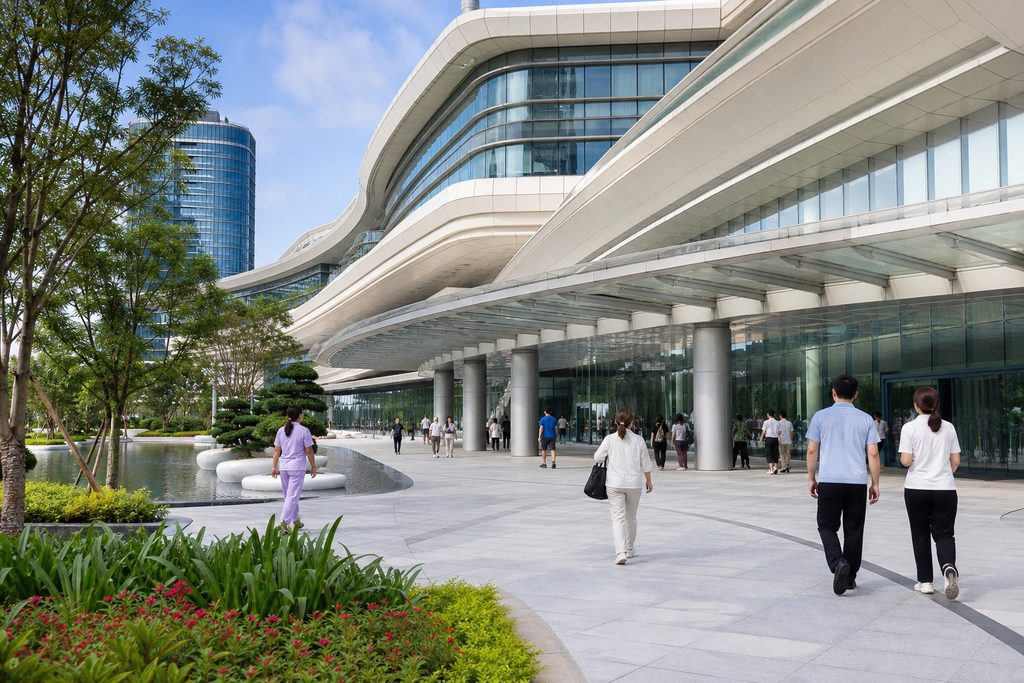
Shenzhen People’s Hospital sits inside a city that barely existed 45 years ago. Today, Shenzhen is China’s technology capital, home to Huawei, Tencent, and BYD. That same relentless pace of modernization shapes the hospital’s approach to general medicine. The institution was founded in 1946, but its current campus and protocols reflect a philosophy built around speed, precision, and data-driven diagnosis.
A General Medicine Department Built on Volume and Speed
The hospital’s General Medicine Department sees more than 4,000 outpatient visits daily across all specialties. For international patients, the dedicated International Medical Center processes approximately 300 foreign visitors each month. That volume creates something rare: a clinical team that has seen nearly every presentation of common and uncommon conditions. A general medicine physician here might diagnose more cases of tropical disease in one year than a suburban clinic in Ohio sees in a decade. The pattern recognition that comes from high patient volume is real. Studies published in The BMJ have shown that surgical and diagnostic outcomes improve at higher-volume centers. The same logic applies to internal medicine diagnostics.
You might wonder whether this volume compromises quality. The opposite is true. The hospital holds accreditation from China’s National Health Commission at the highest tier — Grade A, Class 3. It is ranked among the top general hospitals in Guangdong province by the authoritative Fudan University hospital rankings. The clinical laboratory maintains ISO 15189 certification, meaning test results meet international standards for accuracy.
How Safe Is Shenzhen People’s Hospital for Foreigners
Safety is the first question every international patient asks. It is the right question. The hospital’s International Medical Center was designed specifically for non-Chinese patients. English-speaking coordinators manage your registration, accompany you to consultations, and translate your discharge instructions. The center uses a separate billing system from the main hospital, processes international insurance documentation, and provides private consultation rooms. Infection control protocols follow national standards that have been stress-tested through SARS, H1N1, and COVID-19.
But let us be direct about what safety means in practice. The hospital is massive — over 2,500 beds across multiple buildings on a sprawling campus. The main outpatient hall during peak hours is crowded and chaotic. Without a guide, you could easily end up in the wrong department, misunderstand a prescription dosage, or miss a critical follow-up instruction. The medical care is excellent. The navigation is not. That distinction matters.
What Technology Does Shenzhen Hospital Use for Treatment
Shenzhen’s identity as a technology hub is embedded in the hospital’s infrastructure. The radiology department operates 3.0T MRI machines and 256-slice CT scanners — equipment that matches what you would find at Mayo Clinic or Charité in Berlin. The laboratory runs fully automated biochemical analysis lines that process thousands of samples daily with minimal human error. Electronic medical records are integrated across all departments, so your general medicine physician can pull up your cardiology consult from three months ago in seconds.
The hospital has also invested heavily in AI-assisted diagnostic tools. An AI triage system deployed in the emergency department analyzes presenting symptoms and vital signs to prioritize critical cases. The endoscopy center uses AI-powered polyp detection during colonoscopies, improving adenoma detection rates by nearly 14% according to internal quality audits. This is not experimental technology. It is live, operational, and directly benefits patients who come through the general medicine pathway.
Shenzhen People’s Hospital International Patient Price: The Numbers
Let us address cost directly. The Shenzhen People’s Hospital international patient price structure is tiered. The International Medical Center charges higher rates than the standard public outpatient clinic, but the premium buys you English-speaking coordination, shorter wait times, and private consultation rooms. Here is what you can expect:
| Service | Shenzhen People’s Hospital (International Center) | Hong Kong Private Hospital | US Average (Uninsured) |
|---|---|---|---|
| General Medicine Consultation | $30–$80 | $150–$400 | $150–$300 |
| Comprehensive Blood Panel | $50–$120 | $200–$500 | $300–$800 |
| Chest X-Ray | $20–$40 | $80–$200 | $100–$300 |
| Abdominal Ultrasound | $40–$80 | $200–$400 | $250–$600 |
| Full-Day Health Screening Package | $200–$500 | $800–$2,000 | $1,500–$4,000 |
These prices vary by case complexity and the specific specialist involved. A senior professor with 30 years of experience will cost more than a mid-career attending physician. But the structural gap is clear. You are paying 70–85% less than what equivalent care costs in the United States, and roughly 60% less than private hospitals across the border in Hong Kong.
The best general medicine hospital Shenzhen cost advantage does not come from cutting corners. It comes from lower labor costs, higher patient throughput, and a healthcare system that does not carry the administrative overhead burden of American insurance billing. A hospital bill in the US includes hidden costs for coding, claims processing, and denial management — expenses that simply do not exist in China’s prepaid public system.
What You Need to Know Before Going Alone
The quality of care at Shenzhen People’s Hospital is genuine. But the barriers to accessing it independently are equally real. Here is what you face if you try to navigate this alone:
- Language Barrier: Fewer than 5% of the hospital’s 3,000+ clinical staff speak functional English. Registration forms, consent documents, test results, and prescription labels are in Chinese. Misunderstanding a medication instruction — take once daily versus three times daily — carries real risk.
- Registration System: The hospital uses a real-name registration system tied to Chinese ID numbers or passports. The online booking platform is entirely in Chinese and requires a local phone number for SMS verification. Walk-in registration at the main hall involves queuing at automated kiosks with Mandarin-only interfaces.
- Payment Infrastructure: The standard outpatient system accepts Chinese bank cards, WeChat Pay, and Alipay — payment methods that require a Chinese bank account to set up. International credit cards work at the International Medical Center, but not at the main hospital pharmacy or standard laboratory counters.
- Medical Records: China does not have a centralized medical records system accessible to foreign patients. Your history from a hospital in London or Los Angeles must be translated, notarized, and physically presented. The hospital will not request your records for you.
How We Help You Navigate This
These barriers are not design flaws. They are the natural result of a healthcare system optimized for domestic patients at massive scale. Our role is to make that system accessible to you without requiring you to learn Mandarin or understand Chinese hospital administration.
Before you travel, we collect your medical history, translate relevant documents, and submit them to the International Medical Center for preliminary review. We confirm which general medicine specialist best matches your clinical needs, coordinate an appointment slot, and provide a clear cost estimate. Our team handles the S2 medical visa guidance — the correct visa category for foreign nationals seeking treatment in China. We do not process visas directly, but we provide the invitation letters and hospital documentation that consulates require.
On the day of your consultation, a bilingual medical companion meets you at the hospital entrance. This person handles registration, guides you to the correct department, sits with you during the consultation to translate in real time, and ensures you understand every instruction before you leave. They also manage payment at the International Medical Center counter, collect your test results, and schedule any follow-up appointments. For patients seeking a Shenzhen general medicine package for overseas patients, we can bundle consultation, laboratory work, imaging, and companion services into a single coordinated itinerary.
If you need to book appointment Shenzhen People’s Hospital medical tourism services, the process starts with a free consultation. We assess your medical needs, confirm availability at the International Medical Center, and provide a transparent cost breakdown. There is no obligation at that stage. Our coordination fee starts from $300 for hospital appointment booking, and a full-day bilingual companion service starts from $200. These fees are separate from hospital charges and are quoted upfront.
After your consultation, we remain available. If you require ongoing medication, we coordinate with the hospital pharmacy and arrange international shipping where legally permitted. If your general medicine workup identifies a need for specialist referral — cardiology, gastroenterology, endocrinology — we can connect you with the relevant department at Shenzhen People’s Hospital or another institution in our network of top-ranked Chinese hospitals. The continuity matters. You should not have to start over from zero.
Frequently Asked Questions
Not through the standard public outpatient system. The hospital’s regular registration platform requires in-person identity verification and a local phone number. The International Medical Center does accept overseas bookings, but only through official coordination channels — either directly through the center’s limited English-speaking staff or through a service like ours that handles the paperwork and communication. Walking in without an appointment is possible but guarantees a long wait and no assurance of seeing an English-speaking physician.
A typical package includes one general medicine consultation with an International Medical Center physician, a standard blood panel, a chest X-ray, an abdominal ultrasound, and an ECG. Some packages add a consultation summary translated into English. The cost ranges from $200 to $500 depending on the depth of testing. These packages are designed for health screening and general diagnostics, not for managing complex chronic conditions. If you have a specific known condition, a customized workup is more appropriate than a fixed package.
The clinical care is safe. The hospital’s physicians are well-trained, its equipment is modern, and its infection control standards are rigorous. The risk lies in communication gaps. A misunderstood symptom description, a missed allergy warning, a misread prescription — these are the real dangers. The International Medical Center mitigates this with English-speaking coordinators, but their capacity is limited. Having your own bilingual companion eliminates the communication risk entirely.
The International Medical Center accepts international credit cards, cash in RMB, and wire transfers. The standard hospital departments do not. You pay for consultation, testing, and medication at the time of service. The hospital provides itemized receipts in Chinese and English that you can submit to your international insurance provider for reimbursement. China’s public hospitals do not do direct insurance billing with foreign insurers. If you have a policy with a company like Cigna, Bupa, or Aetna, you pay upfront and claim later.
This is the scenario where Shenzhen’s medical ecosystem becomes a genuine advantage. If your workup identifies a condition requiring specialist intervention — a cardiac issue, a suspicious mass, a complex endocrine disorder — you are already inside a hospital with 2,500 beds and virtually every specialty on-site. Referrals happen within hours, not weeks. And if you need a procedure, the cost advantage we described for general medicine extends to surgery as well. A cardiac bypass that costs $120,000 in the US runs $12,000 to $20,000 here. The quality is comparable. The financial impact is not.
Your Next Step
You came here asking about Shenzhen People’s Hospital — what it costs, whether it is safe, and how to access it. The answers are straightforward. The general medicine care is excellent and affordable by Western standards. The navigation is genuinely difficult without help. The gap between those two truths is where we work.
If you are considering a general medicine consultation in Shenzhen, start with a conversation. Tell us about your symptoms, your medical history, and what you hope to achieve. We will tell you honestly whether Shenzhen People’s Hospital is the right fit, what it will cost, and how long it will take. There is no charge for that initial discussion. Visit our patient coordination page to schedule a free consultation. You deserve clarity about your health. We help you find it.
For more medical information and treatment options in China, visit chinamedservices.com (China Medical Services).
