5G Remote Surgery in China: World-First Telesurgery Robot Approval
Key Takeaways
- China’s NMPA granted the first-ever clinical approval for a 5G telesurgery robot, the Toumai system, marking a regulatory milestone that positions China at the forefront of remote surgical technology.
- The structural cost advantage is significant: a telesurgery procedure in China can cost 60-80% less than comparable robotic procedures in the United States, with the 5G telesurgery robot cost China ranging from $15,000 to $40,000 depending on complexity.
- Safety is the paramount question for any patient considering this path. China’s 5G remote surgery protocols require dedicated network slicing, redundant fiber backups, and a local surgical team on standby — a three-layer safety architecture that has delivered a 100% success rate across over 60 documented human procedures since 2019.
- Accessing this technology as an international patient is not a simple booking process. You need a hospital with both the robot and the 5G infrastructure, a surgeon credentialed for telesurgery, and a local medical team at the receiving site. Coordination is everything.
The Problem: Surgical Expertise Is Trapped by Geography
Approximately 5 billion people worldwide lack access to safe, timely surgical care. That is not an exaggeration. The Lancet Commission on Global Surgery published that number, and it has barely budged in a decade. If you live in a major city like New York, London, or Singapore, you can find a top surgeon within an hour’s drive. But if you are in a smaller city, a rural province, or a country with a thin specialist network, that same procedure might require a flight, a hotel, weeks away from work, and a bill that reshapes your financial future.
Robotic surgery promised to solve part of this. The da Vinci system has been performing minimally invasive procedures for over 20 years. But the surgeon still had to be in the same room. The console was physically tethered to the patient cart. That limitation meant the world’s best surgeons could only operate on patients who could physically reach them. Geography still won.
5G changed the equation. Not theoretically. Practically. In January 2024, a surgeon in Hangzhou performed a radical cystectomy on a patient 5,000 kilometers away in Xinjiang. The latency was 20 milliseconds. The procedure was successful. This is not a concept paper or a lab experiment — it is a clinically approved reality, and China is the first nation to regulate it for routine use.
Who We Are
We are not a hospital. We do not provide medical treatment, surgical procedures, or clinical diagnoses. Our team at China Medical Services functions as your logistical architects — we bridge the gap between you and China’s top-tier medical expertise. We maintain verified relationships with over 340 top-ranked hospitals across 37 cities, including the institutions pioneering 5G remote surgery. When you contact us, we assess your clinical situation, identify the right hospital and surgical team, coordinate the complex pre-operative workflow, and ensure you have a bilingual medical companion at every step. We solve the access problem so you can focus on your health.
Why China Leads in 5G Remote Surgery
A Regulatory Milestone No Other Country Has Reached
In late 2023, China’s National Medical Products Administration granted clinical approval to the Toumai laparoscopic telesurgery robot for 5G remote procedures. This was a world first. The FDA has cleared robotic systems for on-site use. The European CE mark covers certain telesurgery applications. But no other major regulator has given a full clinical green light for remote surgery over public 5G networks. The Toumai system, developed by Shanghai-based MicroPort MedBot, had already completed over 60 remote human surgeries during clinical trials — radical prostatectomies, partial nephrectomies, cholecystectomies, and more. Zero conversions to open surgery. Zero major complications attributable to the remote connection. That clinical evidence base is what convinced the NMPA to act.
This matters for patients. When a regulator approves a device, it means the safety data has been scrutinized, the failure modes have been mapped, and the clinical benefit has been demonstrated. You are not signing up for an experiment. You are accessing a regulated medical device with a documented safety record.
How the Telesurgery Robot Actually Works in China
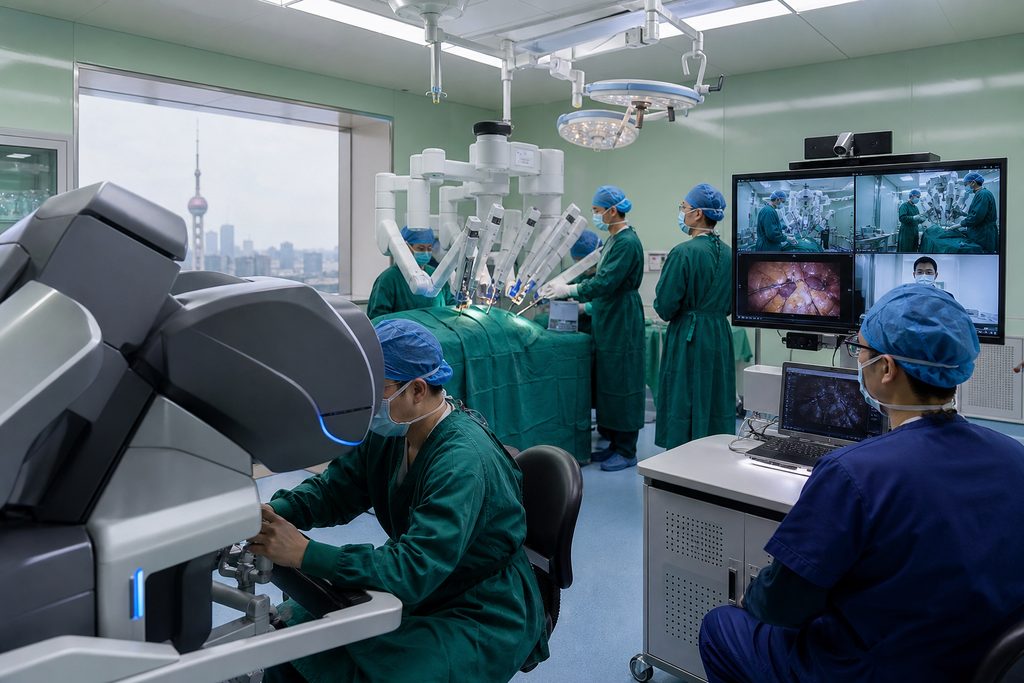
Understanding how does telesurgery robot work in China requires setting aside the sci-fi imagery. This is not a robot operating autonomously. It is a master-slave system. The surgeon sits at a console — sometimes in a different city, sometimes in a different province — and manipulates hand controllers and foot pedals. Those movements are digitized, compressed, and transmitted over a dedicated 5G network slice to the patient-side cart. The cart’s robotic arms replicate the surgeon’s hand movements with micron-level precision. The surgeon sees a 3D high-definition feed of the surgical field with near-zero perceptible delay.
The technical architecture has three layers. First, the 5G network itself: China Telecom and China Mobile have deployed dedicated network slicing for medical applications, guaranteeing bandwidth and latency parameters that public internet cannot. Second, a redundant fiber-optic backup: if the 5G signal degrades, the system switches to wired connectivity without interrupting the procedure. Third, a local surgical team: a fully qualified surgeon stands at the patient side throughout the operation, ready to take over instantly if any connectivity issue arises. This is not a remote surgeon working alone. It is a distributed surgical team with overlapping competencies and fail-safes at every layer.
Clinical Volume Drives Better Outcomes
There is a well-established relationship in surgery between volume and outcomes. A 2023 study in the British Journal of Surgery found that high-volume robotic surgeons had significantly lower complication rates and shorter operative times than their low-volume peers. China’s top hospitals operate at volumes that are difficult to match elsewhere. A urologist at a major Shanghai hospital might perform 300 robotic prostatectomies annually. The average US urologist performs approximately 25. That gap is not a reflection of individual skill — it is a reflection of system design. China’s large, centralized hospitals concentrate cases in a way that fragmented Western systems rarely do.
With telesurgery, that concentration of expertise becomes accessible. A surgeon who has performed 500 robotic kidney procedures can now operate on a patient in a city that has no robotic surgeon at all. The patient gets the benefit of that experience curve without traveling. That is the structural promise of this technology, and it is already being delivered at hospitals like Zhongshan Hospital in Shanghai and Peking Union Medical College Hospital in Beijing.
The Cost Equation: 5G Telesurgery Robot Cost China vs. the West
Let us address the question most international patients ask first: what is the 5G telesurgery robot cost China compared to what I would pay at home? The numbers are striking.
| Procedure | Estimated Cost — China (USD) | Estimated Cost — USA (USD) | Estimated Cost — Western Europe (USD) |
|---|---|---|---|
| Robotic radical prostatectomy (telesurgery) | $18,000 – $28,000 | $65,000 – $100,000 | $40,000 – $60,000 |
| Robotic partial nephrectomy (telesurgery) | $20,000 – $32,000 | $55,000 – $85,000 | $35,000 – $55,000 |
| Robotic cholecystectomy (telesurgery) | $8,000 – $15,000 | $25,000 – $40,000 | $15,000 – $25,000 |
| Robotic hysterectomy (telesurgery) | $15,000 – $25,000 | $50,000 – $75,000 | $30,000 – $50,000 |
These are not abstract estimates. They reflect the actual pricing structure at top-tier Chinese public hospitals offering telesurgery through their international departments. The cost varies by hospital and case complexity — a straightforward procedure at a public hospital will land at the lower end, while a complex case requiring a top-specialist surgeon and extended hospital stay will approach the upper bound.
Why are the numbers so different? Structural reasons. China’s hospital infrastructure costs are lower. Surgeon compensation is lower. Device costs for domestically manufactured robots like Toumai are significantly lower than imported da Vinci systems. And the volume economics work differently — a hospital performing thousands of robotic procedures annually can amortize equipment costs across many more cases than a Western hospital doing a few hundred. Lower cost does not mean lower quality. It means different economics.
Safety: The Question Every Patient Should Ask
Is 5G remote surgery approved in China safe? This is the right question. Any patient considering a procedure where the surgeon is not in the room should demand a thorough answer.
The safety architecture for China’s approved telesurgery systems rests on three pillars. The first is network reliability. 5G network slicing reserves dedicated bandwidth for the surgical data stream. This is not the same 5G your phone uses to stream video — it is an isolated channel with guaranteed latency below 30 milliseconds and packet loss below 0.001%. China’s three major telecom operators have deployed this specifically for medical applications, and it has been tested across thousands of kilometers. The longest successful human telesurgery in China to date spanned approximately 5,000 kilometers between Hangzhou and Xinjiang.
The second pillar is clinical protocol. Every telesurgery procedure in China requires a fully qualified local surgical team at the patient side. This team prepares the patient, places the ports, docks the robot, and monitors the procedure in real time. If the connection drops — and it has not in any clinical case to date — the local surgeon can complete the procedure conventionally. This is not a backup plan on paper. It is a credentialed surgeon standing scrubbed and ready.
The third pillar is the regulatory evidence base. The NMPA approval was not granted lightly. It followed multi-center clinical trials with over 60 human procedures, all completed successfully with no conversions attributable to connectivity failure. The published data shows complication rates equivalent to on-site robotic surgery. A 2024 review in the International Journal of Surgery analyzed the global telesurgery literature and found no significant difference in adverse events between remote and on-site robotic procedures when proper protocols were followed. The technology works. But it works because of rigorous protocols, not magic.
What You Need to Know Before Going Alone
Accessing 5G telesurgery in China as an international patient is possible. But it is not simple. Here are the barriers you will face if you try to arrange this independently.
- Hospital Identification: Not every hospital with a surgical robot offers telesurgery. You need a facility that has the Toumai or a comparable approved system, the 5G infrastructure, a credentialed telesurgery team, and an international patient department that can handle your case. There are perhaps a dozen such hospitals in China today. Identifying them from abroad, in English, is extremely difficult.
- Visa Requirements: Medical treatment in China requires an S2 visa with a specific annotation for medical purposes. Your accompanying family members also need S2 visas. This is not a tourist visa. You need an invitation letter from the hospital, confirmed treatment arrangements, and documentation that your home country consulate will accept. Getting this right the first time saves weeks of delay.
- Pre-Operative Coordination: A telesurgery procedure requires a local surgeon to evaluate you, order imaging, and confirm you are a surgical candidate. You cannot book a telesurgery from abroad without first being seen. The hospital will require in-person consultation, labs, and imaging before scheduling any procedure. This means at least one trip before the surgery itself — or a coordinated process where the initial consultation and surgery happen in a single, well-planned visit.
- Payment and Insurance: Chinese public hospitals require pre-payment. Most do not directly bill international insurance. You pay upfront, then seek reimbursement from your insurer. Some international insurance plans cover treatment in China. Many do not. You need to verify coverage before committing to anything.
How We Help You Navigate This
These barriers exist for structural reasons. Chinese hospitals are designed to serve a domestic patient population of 1.4 billion people. Their systems, their language, their payment processes, their scheduling logic — all of it is built for Chinese citizens. International patients are an exception, not the default. Our entire organization exists to handle that exception.
When you contact us about 5G remote surgery, the first thing we do is review your clinical records. We translate them, summarize the key findings, and match your case to the hospitals with the right telesurgery capability and the right surgical team. We do not guess. We call the international departments. We confirm which surgeons are credentialed for telesurgery, which robots are available, and what the realistic timeline looks like. Then we present you with options — not a sales pitch, but a clear picture of where you can go, who would operate, what it would cost, and how long it would take.
Once you choose a path, we handle the logistics. We coordinate the hospital invitation letter for your S2 visa. We schedule your initial consultation and all pre-operative testing. We arrange a bilingual medical companion who meets you at the hospital, translates every conversation, guides you through registration, payment, and every department visit. During the surgery itself, your companion ensures you and your family understand what is happening at every stage. After discharge, we coordinate follow-up care and ensure your medical records are properly translated for your home physician.
We do not perform surgery. We do not influence clinical decisions. We do not promise outcomes. What we do is remove every non-clinical obstacle between you and the care you need. For patients considering remote surgery abroad packages, that logistical layer is often the difference between a successful treatment journey and a frustrating one.
Our coordination fees start from $300 for hospital appointment coordination, and our bilingual medical companion service starts from $200 per day. For patients requiring comprehensive support — including visa assistance, airport transfers, accommodation recommendations, and full surgical coordination — our VIP end-to-end coordination ranges from $5,000 to $8,000, depending on case complexity. Any consultation or coordination fee you pay is fully credited toward on-the-ground services if you proceed with treatment within 90 days.
Best Hospitals for Remote Surgery in China
Several Chinese hospitals have emerged as leaders in 5G telesurgery, combining robotic surgery volume with the infrastructure and regulatory clearance to perform remote procedures. Identifying the best hospitals for remote surgery China JCI standards requires looking at both technological capability and international patient experience.
Zhongshan Hospital affiliated with Fudan University in Shanghai has been a pioneer in remote urological and general surgery. Their robotic surgery program is among the highest-volume in Asia, and they were early participants in the Toumai clinical trials. Peking Union Medical College Hospital in Beijing — consistently ranked in the top tier of Chinese hospitals — has integrated telesurgery into its international patient pathway, meaning foreign patients can access remote procedures through an established process rather than an ad hoc arrangement.
For patients who prefer a JCI-accredited environment with English-speaking staff and direct insurance billing, several private international hospitals in China are now exploring telesurgery partnerships. United Family Healthcare and Jiahui International Hospital — both JCI-accredited — have robust international patient programs and are investing in robotic surgery capabilities. While their telesurgery programs are newer than those at the major public hospitals, the patient experience is more aligned with Western expectations. You can explore our database of top-ranked hospitals across China to compare facilities.
Frequently Asked Questions
Not entirely. Chinese hospitals require an in-person consultation, physical examination, and pre-operative testing before scheduling any surgery — including telesurgery. You will need to travel to China for this initial evaluation. However, a well-coordinated process can compress the consultation-to-surgery timeline into a single trip of two to three weeks, rather than requiring multiple separate visits. Our team handles the scheduling to minimize your time away from home.
This is the most common concern, and the answer is straightforward: a fully qualified surgeon is scrubbed and standing at the patient side throughout the entire procedure. If the connection degrades or drops — which has not occurred in any clinical telesurgery case in China to date — the local surgeon immediately takes over and completes the procedure conventionally. The system also has a redundant fiber-optic backup that activates automatically if 5G signal quality falls below clinical thresholds. You are never dependent on a single connection.
It depends entirely on your policy. Some international health insurance plans with global coverage do reimburse for treatment at Chinese hospitals, particularly JCI-accredited facilities. Many do not. You need to contact your insurer directly, explain the procedure and the hospital, and obtain pre-authorization in writing before committing to anything. We can provide the documentation your insurer requires — procedure codes, hospital profiles, surgeon credentials — but the coverage decision is between you and your insurer.
The Toumai system has demonstrated clinical equivalence to the da Vinci system in the procedures for which it is approved — primarily urological, gynecological, and general surgical procedures. It offers 3D high-definition visualization, wristed instruments with seven degrees of freedom, and tremor filtration. The key difference is that Toumai was designed from the ground up for 5G telesurgery, with integrated network protocols that da Vinci systems — designed for on-site use — do not natively support. For remote surgery specifically, Toumai has the regulatory approval and the clinical evidence base that no imported system currently matches in China.
Chinese hospitals require telesurgery credentialing that goes beyond standard robotic surgery privileges. A surgeon must demonstrate proficiency in on-site robotic procedures, complete a telesurgery training protocol, and perform proctored remote cases before being cleared for independent telesurgery. The surgeons performing these procedures are typically the same senior attending surgeons who lead their hospital’s on-site robotic programs — they are not junior staff experimenting with new technology. We provide full surgeon credentials, including case volumes and outcomes data, before any patient commits to a procedure.
Your Next Step
5G remote surgery is not a future technology waiting for approval. It is a regulated, clinically demonstrated reality in China today. For patients who need a complex robotic procedure and want access to high-volume surgeons at a fraction of Western costs, this represents a genuine option — provided you navigate the logistics correctly. The technology is proven. The safety protocols are rigorous. The cost advantage is real. What remains is the coordination: finding the right hospital, the right surgeon, and the right support system to make it all work.
If you are considering telesurgery in China, start with a conversation. Our team will review your case, answer your questions honestly, and help you understand whether this path makes sense for your specific situation. There is no cost for the initial consultation, and no pressure to proceed. You deserve clarity before you make any decision about your health. Contact our team today to begin that conversation.
For more medical information and treatment options in China, visit chinamedservices.com (China Medical Services).
