Pakistani Patients Guide to China Hospitals: Full Service Pathways
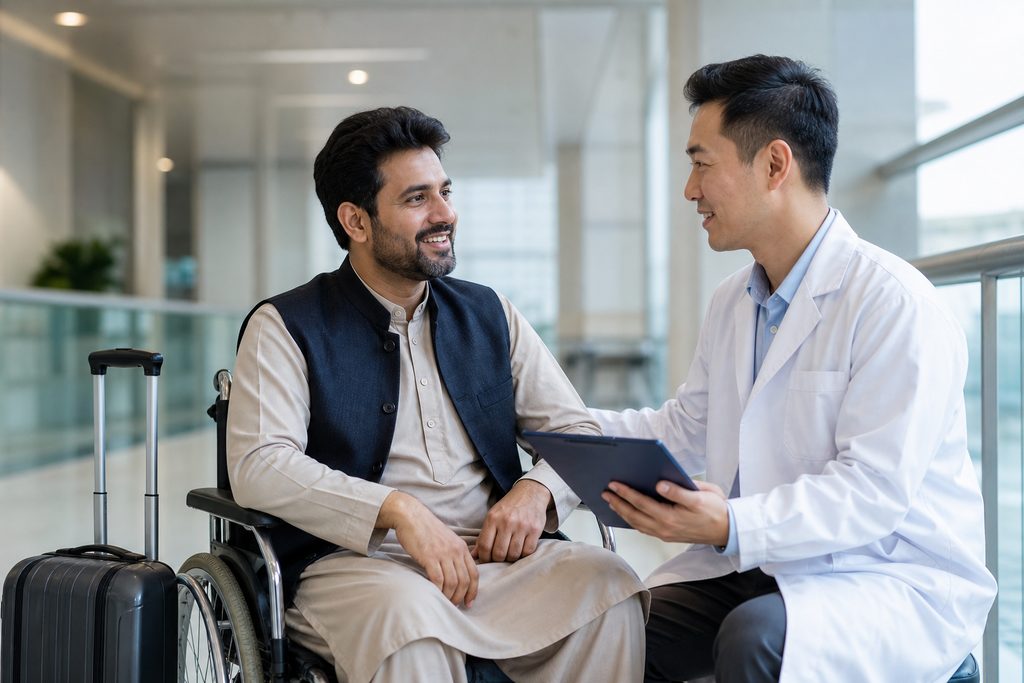
When 41-year-old Imran from Lahore received his father’s liver failure diagnosis, the first number he heard was staggering. A transplant in Pakistan’s private sector could run $45,000 to $70,000. In India, the quote was similar. But the waiting list stretched past eighteen months. His father did not have eighteen months. So Imran started searching for alternatives — and that search led him to a phrase he had never typed before: liver transplant cost China for Pakistani patients.
What he found changed the conversation entirely.
Key Takeaways
- China’s 340+ top-ranked hospitals include 23 cities hosting Fudan-ranked institutions, with Beijing alone home to 21 of the Top 100.
- Full-service coordination for Pakistani patients covers visa documentation, hospital matching, bilingual accompaniment, and post-discharge follow-up — not just a hospital bed.
- Public hospital outpatient departments cannot be pre-booked from overseas; surgery requires an in-person consultation first. Any promise otherwise is a red flag.
- Top-tier Chinese hospitals perform cardiac and oncology procedures at volumes that dwarf Western benchmarks, often at one-fifth to one-tenth of US pricing.
- Visa matters: medical travel to China uses an S2 visa, never an M visa. Getting this wrong can delay treatment for weeks.
The Problem: Waiting Lists, Escalating Costs, and a Narrowing Window
Pakistan’s healthcare system faces a hard math problem. The country has roughly 1,100 hospitals serving 240 million people. For complex procedures — liver transplantation, advanced cardiac surgery, precision oncology — the gap between need and capacity is severe. A 2023 report from the Pakistan Society of Gastroenterology noted that only a handful of centers nationwide perform adult liver transplants, and the combined annual volume remains under 500 cases. Demand is at least ten times that.
That bottleneck pushes families into difficult choices. Some travel to India, where medical visas for Pakistani citizens have grown increasingly unpredictable since 2019. Others look to Turkey, Thailand, or Singapore — all excellent systems, but with price tags that climb fast. A liver transplant in Singapore runs $250,000 or more. In Turkey, $70,000 to $120,000. For a family already stretched by diagnosis and caregiving, those numbers are crushing.
And the clock keeps ticking.
Why Chinese Hospitals Deliver Results for Pakistani Patients
China’s healthcare system operates on a scale that most Western patients struggle to imagine. The largest public hospitals see 10,000 outpatient visits in a single day. That is not chaos — it is infrastructure. And for international patients who understand how to navigate it, that infrastructure translates into shorter waits, higher surgical volumes, and costs that make treatment feasible. But here is the honest truth: without Chinese language ability and local coordination, that same system can feel impenetrable.
Clinical Volume Drives Better Outcomes
Fuwai Hospital in Beijing performs more than 14,000 cardiac surgeries every year — the highest volume of any heart center on earth. To put that in perspective, the busiest cardiac surgery program in the United States, Cleveland Clinic, performs around 4,000. A Pakistani patient asking how much does a heart bypass cost in Beijing will find a range of $12,000 to $20,000 at a top public hospital’s international department, compared to $120,000 or more in the US. The surgeon operating on you in Beijing has likely done your exact procedure hundreds of times that year.
Oncology follows a similar pattern. The best oncology hospital in Guangzhou for international patients — Sun Yat-sen University Cancer Center — sees over 400,000 outpatient visits annually and runs one of Asia’s largest clinical trial programs. That matters for Pakistani patients because many standard chemotherapy regimens and targeted therapies used in Pakistan are a generation behind what is available in Chinese academic centers.
Structural Cost Advantages Without Quality Compromise
Is cancer treatment in China safe for foreigners? The question deserves a straight answer. Safety is not a function of geography — it is a function of institutional standards, physician training, and regulatory oversight. China’s top 5% of hospitals — the 340+ institutions ranked by Fudan University or accredited by JCI — meet international benchmarks for infection control, surgical protocols, and patient safety. The cost difference comes from structural economics: lower labor costs, higher patient throughput, and government-subsidized infrastructure. A hospital bed in Shanghai costs a fraction of one in London or New York, and that saving passes to the patient.
For Pakistani families specifically, the math is compelling. A complex oncology surgery that costs $35,000 in Pakistan’s private sector might cost $18,000 to $25,000 at a top Chinese public hospital’s international wing. And the international wing adds English-speaking coordinators, faster scheduling, and private rooms — the things that make a foreign hospital stay bearable.
What Full-Service Coordination Actually Looks Like
Here is what most Pakistani patients do not know: Chinese public hospitals do not accept overseas bookings for ordinary outpatient clinics. You cannot email a hospital in Beijing and reserve a slot with a top oncologist. The system requires someone physically present — to register, to queue, to pay the deposit, to collect the medical card. That is why “full service” is not a luxury add-on. It is the difference between treatment happening and treatment stalling at the airport.
A full-service pathway for a Pakistani patient typically runs like this. Week one: the patient sends existing medical records — CT scans, biopsy reports, liver function tests, cardiac catheterization results — for review by the relevant Chinese department. The written second opinion costs $300 to $500 and comes from a top-tier specialist. Week two: if the medical team confirms a feasible treatment plan, the patient applies for an S2 visa with a hospital invitation letter and treatment confirmation as supporting documents. Week three: arrival in China. Airport transfer, hotel or hospital-adjacent accommodation, and a bilingual medical companion who handles registration, payment, queueing, and translation. Week four: the in-person consultation, diagnostic workup, and — if surgery is indicated — scheduling.
That timeline is realistic. It is not instant. Anyone promising a surgery date before the patient has been seen in person is not being honest about how Chinese hospitals work.
Choosing the Right Hospital: What Pakistani Patients Should Actually Compare
The question is not “which hospital is best” in the abstract. The question is which hospital is best for your specific diagnosis, your budget, and your tolerance for navigating a foreign system. That means comparing hospitals on three axes.
First, specialty ranking. The Fudan University hospital rankings — the most authoritative in China — publish a specialty reputation list covering 45 departments. A hospital ranked among China’s top 10 for oncology is a very different proposition from a hospital that is strong in orthopedics but average in cancer care. Check the specialty rankings before anything else.
Second, international patient infrastructure. Some hospitals have dedicated international departments with English-speaking staff, direct insurance billing, and streamlined admission. Others — even famous ones — operate almost entirely in Mandarin. For a Pakistani patient traveling alone or with family, that difference is decisive. The top JCI accredited hospitals in China for medical tourists include several private international facilities like United Family and Jiahui, which offer Western-style care and direct insurance settlement. They cost more than public hospitals, but for patients who need that infrastructure, the premium is justified.
Third, city logistics. Beijing and Shanghai have the most Fudan-ranked hospitals — 21 and 18 respectively. Guangzhou has 10. But Chengdu, Hangzhou, and Wuhan also host excellent institutions with lower living costs and shorter internal travel times. A liver transplant in Guangzhou might cost the same as one in Beijing, but the hotel, food, and local transport will be cheaper. Those differences add up over a six-week treatment stay.
| Procedure | China (Top Public, International Dept.) | Pakistan (Private Sector) | USA (Benchmark) |
|---|---|---|---|
| Heart bypass surgery | $12,000 – $20,000 | $8,000 – $15,000 | $120,000+ |
| Liver transplant | $60,000 – $100,000 | $45,000 – $70,000 | $500,000+ |
| Complex oncology surgery | $18,000 – $35,000 | $15,000 – $40,000 | $80,000 – $150,000 |
| Knee replacement | $10,000 – $18,000 | $6,000 – $12,000 | $35,000 – $50,000 |
Prices vary by hospital tier, case complexity, and length of stay. The China figures assume international department or VIP channel access, which runs 1.5 to 2 times the standard public rate. The Pakistan figures reflect private-sector pricing, not government-subsidized care.
Practical Considerations: Visas, Payments, and the Return Home
The medical visa China for Pakistani citizens hospital package question comes up constantly. Let us be precise. There is no “medical visa” category. Pakistani citizens traveling to China for treatment apply for an S2 visa, which covers short-term private affairs including medical treatment. The application requires a hospital invitation letter, treatment plan confirmation, and proof of sufficient funds. Processing time at the Chinese embassy in Islamabad or consulates in Karachi and Lahore typically runs 5 to 10 working days, but delays happen. Apply early. Accompanying family members apply for their own S2 visas with the patient’s documentation as supporting evidence.
Payments are another friction point. Chinese public hospitals require prepayment — often a deposit of several thousand dollars before admission. International credit cards are accepted at international departments, but Pakistani bank cards may face restrictions. We advise patients to arrange a multi-currency account or carry a combination of cash, international credit card, and a UnionPay card if available. Insurance is typically reimbursement-based: the patient pays the hospital, then claims from their insurer. Private international hospitals in China — the JCI-accredited ones — often bill insurers directly.
Follow-up after returning to Pakistan is the piece most families forget to plan. Chinese hospitals will provide discharge summaries, imaging files, and medication lists in English upon request. But the local oncologist or cardiologist in Lahore or Karachi needs to understand the treatment plan to continue care. Request a full English-language medical record before leaving China. It saves weeks of confusion later.
One caution: never travel to China for treatment without a confirmed hospital invitation letter and a clear written treatment plan from the receiving department. Showing up at a hospital’s international department without prior coordination does not work the way it might in private hospitals elsewhere. The system rewards preparation.
Frequently Asked Questions
The liver transplant cost China for Pakistani patients typically ranges from $60,000 to $100,000 at a top public hospital’s international department, including surgery, hospitalization, and immunosuppressant induction. Wait times vary significantly by blood type, disease severity, and hospital. Chinese transplant centers follow national organ allocation protocols, and we never promise a specific timeline. The honest answer: some patients are matched within weeks, others wait months. A written second opinion can clarify whether a patient is a suitable candidate before any travel commitment.
At top-ranked hospitals with international departments, yes. These departments employ English-speaking coordinators and physicians who regularly treat international patients. The clinical protocols follow international guidelines — NCCN, ESMO, or Chinese Society of Clinical Oncology standards, which are closely aligned. The safety risk is highest when patients navigate the standard public system alone without language support. That is why bilingual accompaniment matters more than most patients expect.
Chinese hospitals carry medical liability insurance, and top-tier institutions have formal complaint and review procedures for adverse events. International patients have the same legal rights as domestic patients under Chinese medical regulations. Realistically, the more important safeguard is choosing a hospital with strong international patient infrastructure and maintaining clear communication with the treating team. We help patients document everything in writing, which protects them in any dispute.
Yes. Accompanying family members apply for their own S2 visa using the patient’s hospital invitation letter and treatment confirmation as supporting documents. One or two companions are standard. They will need proof of relationship — a marriage certificate or birth certificate, translated into English or Chinese.
No. The written second opinion and video consultation fees are paid before travel. Hospital admission requires a deposit — typically 30% to 50% of the estimated treatment cost — paid upon admission. The balance is settled in stages as treatment progresses. This is different from some medical tourism destinations that require full package payment in advance.
Your Next Step
If you are a Pakistani patient or family member weighing treatment in China, the first move is not booking a flight. It is getting an honest medical assessment of whether a Chinese hospital can actually help your specific case. Our team at China Medical Services connects patients with 340+ top-ranked hospitals across 37 cities — not as a hospital, and not as a medical provider, but as a coordination layer that handles records review, hospital matching, visa documentation support, and on-the-ground bilingual accompaniment. Start with a free consultation to discuss your diagnosis and goals. No pressure, no obligation. Just a clear-eyed conversation about what is possible.
For more medical information and treatment options in China, visit chinamedservices.com (China Medical Services).
