Second Opinion for Revision Surgery in China: Re-Case Review
Second Opinion for Revision Surgery in China: A Complete Re-Case Review Guide
Have you ever been told your only option is to live with the result of a surgery that did not go as planned? That is a lonely place to be. A revision surgery second opinion China cost starts at $300 for a written review of your existing records — a fraction of what another in-person consultation would cost in the US or Europe, and often the fastest way to get an honest answer about whether a re-operation is even necessary.
Key Takeaways
- A written second opinion from a top Chinese hospital costs $300–500; a top-specialist video consultation runs $500–800 — both are credited toward in-person coordination if you proceed within 90 days.
- China’s top orthopedic and spine centers perform revision cases at volumes most Western surgeons rarely see — some handle 10–20 revision joint replacements weekly.
- Language, record translation, and hospital navigation are the biggest barriers for foreign patients; none of them require you to travel to China for the initial re-case review.
- Not every failed surgery needs a revision. A rigorous second opinion may confirm that your current hardware is fine or that a different, less invasive intervention is the right move.
The Problem: Living With a Failed Surgery While the Meter Keeps Running
Roughly 5–10% of primary total hip replacements will require revision within 10 years, according to registry data from the UK’s National Joint Registry. For spine fusion patients, the reoperation rate within four years can exceed 20%, per a 2021 analysis in Spine. Those numbers are not abstract — they represent people who went through a major operation, endured recovery, and then watched the pain return.
And the response from the original surgical team is often the hardest part. Many patients hear some version of “the imaging looks fine” or “give it more time.” Getting an independent review locally can mean waiting 3–6 months for a new consultation, paying $500–1,500 just to walk in the door, and still not knowing whether the reviewer has meaningful experience with your specific complication.
Meanwhile, the clock is running. Bone loss progresses. Scar tissue forms. Muscle atrophy worsens. The window for a successful revision — especially in infected joints or loose hardware — narrows with every month of delay.
Why a Re-Case Review in China Delivers Answers Faster
A re-case review is not a second guessing of your surgeon. It is a structured, independent reassessment of your complete file: original operative notes, implant labels, serial imaging, lab results, and your current functional status. Chinese tertiary hospitals have built enormous capacity for exactly this kind of review because their revision volumes are so high.
Volume That Western Surgeons Rarely Match
At a top Chinese orthopedic center, a senior joint surgeon may perform 300–500 primary replacements and 50–150 revision replacements per year. The average US orthopedic surgeon performs roughly 65 primary joints annually, with revision cases being a small fraction of that. This is not a knock on Western surgeons — it is a structural difference. China’s largest hospitals see thousands of patients daily, and complex revision cases are concentrated in a handful of high-volume centers.
That means the specialist reviewing your file has likely seen your exact complication — a loose acetabular component, a periprosthetic fracture, a failed interbody fusion at L5-S1 — dozens of times this year alone. Pattern recognition at that scale is hard to replicate.
Rapid Turnaround Without Travel
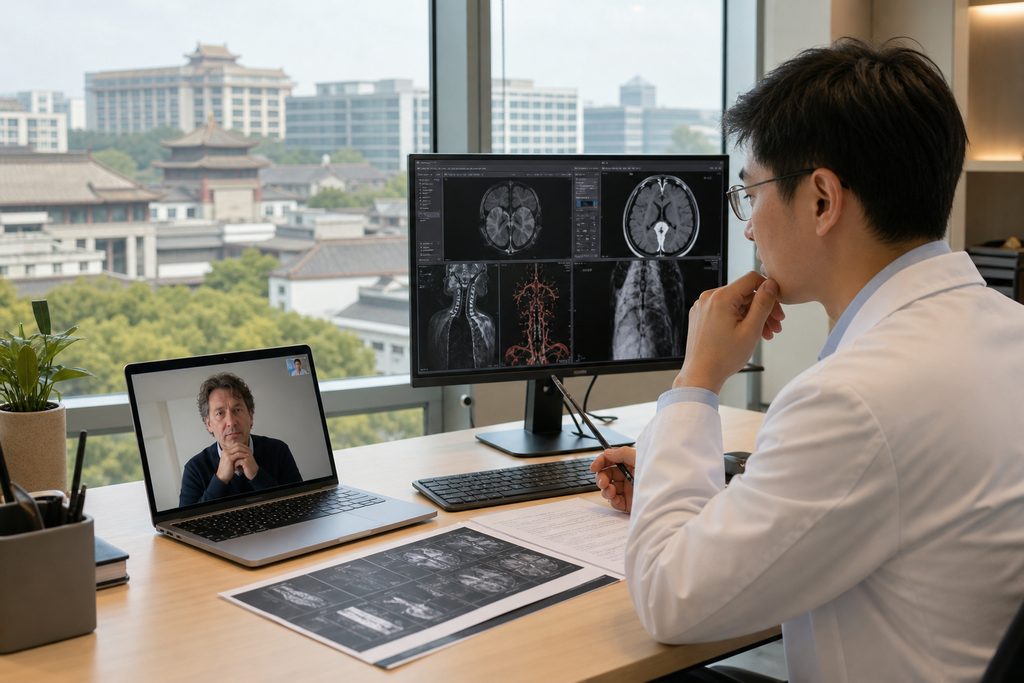
You do not need to fly to Shanghai to get an answer. The re-case review process starts remotely. You send your records — imaging files on a disc or via secure upload, operative reports, implant stickers if you have them — and the reviewing team at the relevant specialty department goes through the file systematically. A written second opinion typically takes 5–10 business days. A video consultation can be scheduled within 1–2 weeks.
Compare that to the alternative: booking a consultation with a revision specialist in the US often means a 4–8 week wait, followed by repeat imaging, followed by another 2–3 weeks before you get a definitive plan. The delay is not incompetence. It is system load.
Cost Structure That Makes the First Step Easy
Here is the honest math. A revision surgery second opinion China cost breaks down like this:
| Service | Typical Cost (USD) | What You Receive |
|---|---|---|
| Written second opinion (top hospital specialist) | $300–500 | Full review of your records, written analysis, treatment direction |
| Video consultation (general top-tier hospital) | $100–300 | Live discussion with the specialty team, Q&A on your case |
| Top-specialist video consultation | $500–800 | Live consultation with a named senior specialist |
| Multidisciplinary team (MDT) video review | $1,500–2,000 | Coordinated review by multiple specialties — e.g., orthopedics + infectious disease + radiology |
These are reference figures. Final pricing varies by hospital and case complexity. But the structural point stands: the cost of getting an independent answer from a high-volume Chinese revision specialist is often less than the copay on a single in-person consultation in the US.
What a Re-Case Review Actually Examines
When you submit your file for a medical second opinion online China re-case review, the reviewing team is not just reading your MRI. They are reconstructing the entire decision chain that led to your current situation.
The review typically covers four layers. First, the index surgery itself: was the original indication sound, was the implant choice appropriate for your anatomy, were there intraoperative findings that should have changed the plan? Second, the failure mechanism: is this aseptic loosening, infection, malposition, wear, or a combination? Third, the current state: what does your latest imaging actually show about bone stock, soft tissue envelope, and adjacent segments or joints? Fourth, the revision strategy: what are the realistic options, what are the risks of each, and what outcome should you reasonably expect?
This is fundamentally different from a quick look at one MRI. A proper re-case review reads the entire story.
How to Get a Second Opinion for Failed Surgery Abroad: The Practical Path
If you are asking how to get a second opinion for failed surgery abroad, the process is more straightforward than most people assume — but it requires disciplined record gathering. You cannot send a blurry phone photo of an X-ray and expect a meaningful answer.
Start by requesting your complete surgical file from the original hospital. You are legally entitled to your medical records in most countries, including the US under HIPAA and in the EU under GDPR. Specifically ask for: the operative report (not just the discharge summary), implant manufacturer and model numbers, all pre-operative and post-operative imaging in DICOM format, microbiology reports if infection was ever suspected, and your current medication list.
Then, organize the imaging chronologically. A series of X-rays over 12 months tells a reviewer far more than a single snapshot. If you have a CT or MRI, request the DICOM files on a disc, not just the radiologist’s written report. The written report reflects one radiologist’s interpretation; the raw images let the reviewing specialist form their own.
Once the file is complete, the review can happen entirely online. You do not need to board a plane to find out whether a revision is indicated, whether your hardware is actually fine, or whether a completely different approach — like a staged reconstruction or a non-operative strategy — is the better call.
Best Hospitals in China for Revision Orthopedic Surgery: What the Rankings Actually Tell You
Patients searching for the best hospitals in China for revision orthopedic surgery often expect a clean ranked list. The reality is more nuanced, and understanding it will serve you better than any “top 10” list.
China’s Fudan University hospital rankings — the country’s most authoritative — publish a general hospital list in tiers (A++++ through A) and a separate specialty reputation ranking that does name specific top-10 departments in 45 specialties. For orthopedics and spine surgery, the departments that consistently appear in the Fudan specialty top-10 include Peking Union Medical College Hospital in Beijing, West China Hospital in Chengdu, and Shanghai Sixth People’s Hospital — the latter being one of the highest-volume orthopedic centers in the world.
But here is what matters more than a ranking: does the department have a dedicated revision service? Revision surgery is not the same as primary surgery. It requires different instrumentation, different implants, often bone grafting capability, and close coordination with infectious disease specialists. A hospital can be excellent at primary joints and still not be the right place for a complex revision.
We maintain a database of 340+ top-ranked hospitals across 37 cities, including detailed profiles of orthopedic and spine departments. The key is matching your specific failure mechanism — infection, loosening, malalignment, adjacent segment disease — to a center that handles that exact problem at high volume.
Can Chinese Doctors Review My MRI Before Revision Surgery? Yes — Here Is What That Means
The question can Chinese doctors review my MRI before revision surgery comes up constantly, and the short answer is yes. But there is an important distinction between reviewing imaging and reviewing a case.
A radiologist can read your MRI and describe what they see: the position of the implant, the presence of fluid collections, the integrity of surrounding bone. That is useful, but it is only one slice of the picture. What a revision surgeon does with that MRI — in the context of your symptoms, your original operative report, and your serial imaging — is the actual second opinion.
So when you send your MRI for a re-case review in China, you should expect the imaging to be read in context, not in isolation. The reviewing specialist will correlate the MRI findings with your clinical story. That is the difference between a radiology report and a surgical second opinion. Both have value. Only the second one answers the question you actually care about: what should I do next?
Revision Spine Surgery Package Price Shanghai: What You Should Know Before Asking for a Quote
Searchers typing revision spine surgery package price Shanghai are usually trying to figure out whether they can afford the surgery itself, not just the opinion. The honest answer is that no responsible provider can quote a revision spine surgery package without first reviewing your case. Revision spine surgery is not a commodity.
That said, there are reference points. Primary spine fusion in a top Chinese public hospital typically ranges from $15,000–35,000 depending on the number of levels and instrumentation. Revision cases run higher — often 1.5–2 times the primary cost — because they involve hardware removal, possible deformity correction, bone grafting, and longer operative times. A complex revision with anterior and posterior approaches can exceed $60,000.
Compare that to the US, where a revision lumbar fusion routinely exceeds $100,000 in hospital charges, and the economic logic becomes clear. But the package price should never be the first question. The first question is whether the revision is indicated at all, and if so, what specific procedure gives you the best shot at a good outcome. That is precisely what the re-case review is designed to determine.
Some hospitals in Shanghai do offer international patient packages that bundle the surgical fee, hospital stay, and basic coordination. These are typically structured through the hospital’s international department and priced 1.5–2 times the standard public rate. The package price is real, but it is always case-specific.
Practical Considerations: Records, Visas, and Payment for a Re-Case Review
If you decide to pursue a re-case review in China — whether remotely or eventually in person — there are concrete logistics to handle. None of them are insurmountable, but ignoring them will slow you down.
Medical records and translation. Chinese reviewing specialists can read English-language operative reports and imaging, but the more your records are organized and annotated, the faster the review. If your records are in a language other than English, professional translation is strongly recommended. A 300-page disorganized file is worse than a 50-page well-curated one. Include a one-page summary: your original diagnosis, the date and type of surgery, your current symptoms, and the specific questions you want answered.
Visa category. If the review leads to a decision to travel for surgery, the applicable visa is the S2 visa — a short-stay visa for private affairs, including medical treatment. Accompanying family members also apply for S2. The hospital’s international department will provide supporting documentation, including an invitation letter and treatment plan. Processing times vary by embassy, but you should budget 2–4 weeks. The M visa is for commercial and trade activities and is not the appropriate category for medical travel.
Payment methods. Remote consultations are typically paid by international bank transfer or credit card before the review begins. If you proceed to in-person treatment, Chinese public hospitals generally require prepayment for scheduled procedures, with top-up payments as care progresses. Private international hospitals in Shanghai and Beijing — such as those in the United Family or Jiahui networks — often accept direct insurance billing from major international insurers. Public hospitals do not; you pay out of pocket and seek reimbursement from your insurer afterward.
Follow-up after returning home. A revision surgery is not over when you leave the hospital. You need a plan for wound checks, imaging at defined intervals, and communication with the surgical team. Chinese surgeons increasingly use WeChat for follow-up with international patients, but you should confirm the follow-up protocol before committing. Ask specifically: who do I contact at week 2, month 3, and month 12? What imaging should I get locally, and where do I send it?
Practical tip: Before you send any records for a re-case review, create a single PDF that lists every document and image file you are submitting, in chronological order. This one-page index saves the reviewing team hours and gets you an answer faster.
Frequently Asked Questions
It might. That is the point of an independent review. But a good re-case review does not set out to assign blame — it sets out to identify the failure mechanism and the best path forward. Sometimes the conclusion is that the original surgery was reasonable and the current problem is a known complication, not an error. Sometimes the conclusion is that a different approach would have been better. Either way, you get clarity you did not have before.
Then you have just saved yourself a major surgery, a long recovery, and tens of thousands of dollars. That is a successful second opinion, not a wasted one. A significant minority of re-case reviews conclude that the current hardware is stable, that the pain is coming from a different source, or that a non-operative strategy — targeted physical therapy, injection, or medication adjustment — is more appropriate than another operation.
Ask for the reviewing specialist’s department, title, and years of experience in revision cases specifically. A senior specialist at a Fudan-ranked department has typically completed 10+ years of training and handles revision cases weekly. You can also ask how many cases similar to yours the reviewer has managed in the past year. A legitimate reviewer will answer that question directly.
Yes, and that is the most common path. Patients start with a written review, escalate to a video consultation if the written opinion raises questions, and only then decide whether to travel. The video consultation lets you hear the specialist’s reasoning directly, ask about risks and recovery expectations, and gauge whether you trust the team. If you later proceed to in-person treatment, the consultation fees are credited toward the coordination service.
This is one of the most valuable outcomes of a rigorous re-case review. Occult infection — a low-grade infection that does not present with obvious symptoms — is a leading cause of “unexplained” implant loosening and failed fusions. If the review flags this possibility, the next step is specific testing: serum markers, joint aspiration, or advanced imaging. An infected revision requires a completely different surgical strategy — typically a two-stage procedure — and missing it is the single most common reason revision surgeries fail.
Your Next Step
A failed surgery does not have to be the end of your story. The first move is not booking a flight — it is getting an independent, high-volume specialist to look at your complete file and tell you the truth about your options. That is what a re-case review is for.
China Medical Services helps international patients connect with top Chinese hospitals for written second opinions, video consultations, and coordinated in-person treatment. We are not a hospital and we do not provide diagnoses. What we do
For more medical information and treatment options in China, visit chinamedservices.com (China Medical Services).
