Getting a Second Opinion Without Flying: Remote China Case Review
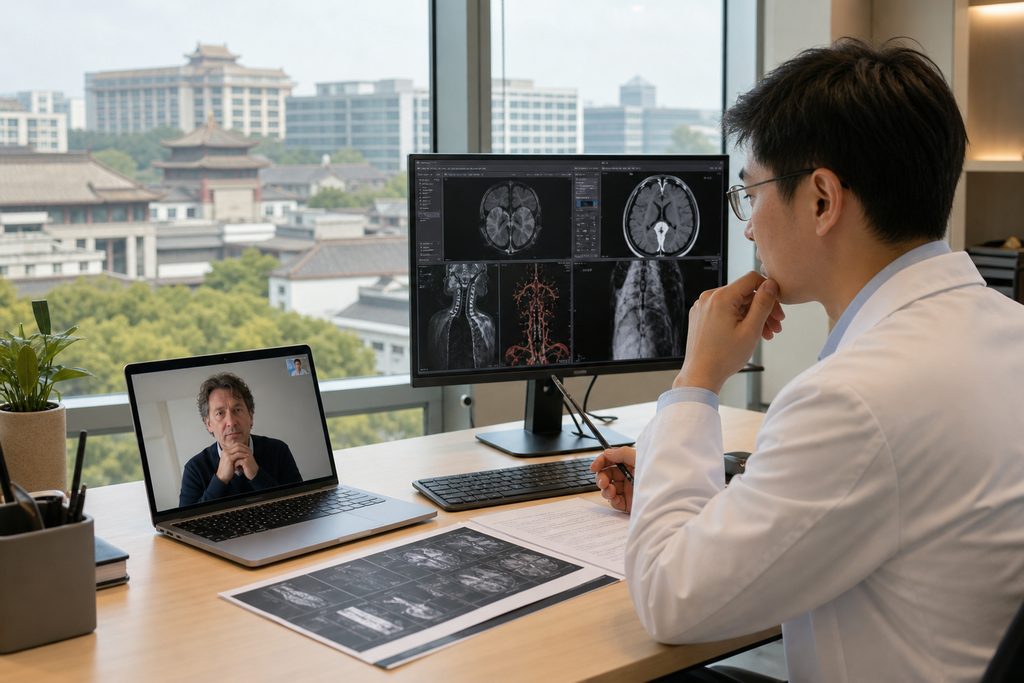
While patients in Canada wait a median 27.4 weeks between GP referral and orthopedic surgery, surgeons at Beijing Jishuitan Hospital perform more than 300 joint replacements monthly. Meanwhile, an American with a suspicious lung nodule might wait three weeks for a thoracic oncology appointment. A Shanghai chest specialist can often review those same CT images within five business days. The gap isn’t clinical skill. It’s logistics. And logistics can be solved.
A second opinion remote China specialist review means exactly what it sounds like: you send your existing scans, lab reports, and pathology slides to a Chinese hospital department. A senior physician reviews them. You get a written analysis back. No airport, no hotel, no visa interview. For many patients, this is the lowest-friction first step toward understanding whether a Chinese hospital actually offers something meaningfully different from what they can get at home.
How This Actually Works, Step by Step
The process is simpler than most patients expect, but it has specific requirements. Here’s the sequence.
First, you gather everything you already have. That means DICOM files from your MRI or CT — not just the radiologist’s written report, but the actual image files. Most hospitals and imaging centers will release these on a CD or via a secure download link. You also need the written reports, your blood work, any biopsy or pathology results, and a brief summary of your treatment history so far. Many patients have most of this scattered across their patient portals. Our team helps consolidate it.
Second, we translate the documents. This matters more than patients realize. A Chinese oncologist reviewing a pathology report written in English faces two problems: the language barrier and the formatting differences. We handle both. Medical translation isn’t word-for-word. It’s clinical context. Terms like “atypical ductal hyperplasia” need precise equivalents, not approximations.
Third, the right department receives your file. This is where hospital selection actually matters. A patient with a complex liver tumor shouldn’t have their case reviewed by a general surgeon. They need a hepatobiliary specialist at a center that handles high volumes of exactly that pathology. Our database covers 340+ top-ranked hospitals across 37 cities, which lets us match the case to the department that genuinely focuses on that condition.
Fourth, the specialist reviews the case. Depending on the department’s protocol, this may involve a single senior physician or a small group discussion. The review includes a written analysis of your diagnosis, comments on your current treatment plan, and suggestions for what might be done differently.
Fifth, you receive the written report. For most departments, this arrives within 5 to 10 business days after all documents are submitted. The report is in English. It’s a professional medical document — not a prescription, not a formal diagnosis, but a substantive clinical opinion.
What a Remote Case Review Can and Cannot Do
Let’s be direct about the limits. A remote review is not a substitute for an in-person examination. No competent Chinese physician will claim otherwise. They cannot palpate a mass, cannot hear a heart murmur through a video call, cannot assess your functional status by watching you walk across a room.
What they can do is review your imaging with fresh eyes. And in complex cases, fresh eyes matter. A radiologist at Fudan University-affiliated Zhongshan Hospital has likely seen more cases of early-stage hepatocellular carcinoma in a month than a general radiologist in a mid-sized American city sees in a year. That volume produces pattern recognition that no amount of individual brilliance can replicate.
The review can also assess whether your current treatment plan aligns with the protocols used at high-volume Chinese centers. Sometimes the answer is yes. Sometimes the answer is: “We would consider a different surgical approach” or “We would question whether surgery is indicated at all.” That second category is where the value lies.
So how do you get a Chinese doctor to review my MRI? You start with a written second opinion. Send the DICOM files. Get the report. Then decide whether a video consultation is worth adding.
A Realistic Timeline
Patients often underestimate the document-gathering phase. Here’s what the actual calendar looks like.
| Stage | What Happens | Realistic Duration |
|---|---|---|
| Days 1–5 | You request DICOM files from your imaging center and gather all reports | 3–5 business days, sometimes longer if the hospital is slow |
| Days 5–8 | Document translation and clinical summary preparation | 2–3 business days |
| Days 8–10 | Department matching and case submission | 1–2 business days |
| Days 10–20 | Specialist review and written report preparation | 5–10 business days, varies by department workload |
| Days 20–25 | Optional video consultation with the reviewing specialist | Scheduled within 3–5 days of report delivery |
The whole process from first contact to written report typically takes two to four weeks. If you need a video consultation added, add another week. If your documents are incomplete or the imaging files are corrupted, add more time. Rushing a review doesn’t improve its quality.
What Can Go Wrong — and What Happens Then
The honest failure modes deserve honest answers.
The DICOM files won’t upload. This happens constantly. Hospital imaging portals are not built for international file transfer. The fix: we provide a secure upload link, and if the files are too large, we coordinate with your imaging center directly. Sometimes the imaging center charges a fee for file retrieval. That’s normal.
The reviewing physician asks for additional images. A CT without contrast might not be sufficient for a definitive opinion on a liver lesion. The fix: you go back to your local provider and request the additional sequences. This adds a week or two. It’s not a rejection. It’s thoroughness.
The report disagrees with your local doctor. This is not a failure. It’s the entire point. You now have two professional opinions. Your job is to reconcile them. Sometimes that means a third opinion. Sometimes it means a video call where the two perspectives can be discussed directly.
The report is inconclusive. “Cannot exclude malignancy” is a frustrating phrase. But it’s an honest one. No remote review can guarantee certainty. The value is in the reasoning, not just the conclusion.
How to Choose the Right Hospital for a Remote Review
Not all Chinese hospitals are equally suited to remote case review. The best hospitals in China for remote case review share several characteristics.
They have dedicated international departments. These departments handle foreign patient inquiries, provide English-language reports, and understand the documentation requirements. A hospital without an international office may still provide excellent clinical care, but the remote review process will be slower and more error-prone.
They rank highly in the relevant specialty. The Fudan University hospital rankings are the most authoritative in China. For oncology, the top-ranked departments are concentrated in Beijing, Shanghai, and Guangzhou. For cardiac surgery, Fuwai Hospital in Beijing performs over 14,000 cardiac surgeries annually — more than any other center in the world. For orthopedics, Beijing Jishuitan Hospital and Shanghai Sixth People’s Hospital are reference centers. You can browse specialty rankings on our department pages to see which hospitals lead in your specific condition.
They have experience with international patients. This matters for the practical details: report formatting, communication norms, and follow-up scheduling. A hospital that regularly handles cases from the Middle East, Southeast Asia, and Russia will have smoother processes than one that rarely sees foreign patients.
The cost of online medical consultation China varies by hospital tier and specialist seniority. A written second opinion from a top-tier specialist typically runs $300–500. A video consultation with a senior specialist at a well-known hospital runs $500–800. A multidisciplinary team review runs $1,500–2,000. These are reference ranges, not fixed quotes. The final price depends on the hospital, the department, and the complexity of your case.
Practical Considerations: Records, Payment, and Follow-Up
Can a doctor in China review my scans remotely? Yes — provided the scans are complete, properly formatted, and accompanied by adequate clinical context. A DICOM file alone is not enough. The reviewing physician needs to know your age, your symptoms, your treatment history, and what specific question you’re asking. “Is this cancer?” is a different question from “Should this be resected now or watched?”
Payment is straightforward. Most international departments accept wire transfer or credit card. The fee covers the review, the written report, and basic coordination. It does not cover treatment, prescriptions, or any in-person services. If you later decide to travel to China for treatment, any consultation fee is credited in full toward the coordination service within 90 days.
Language is not a barrier. All reports are delivered in English. Video consultations include interpretation if needed. Your local records stay yours — we never share them beyond the reviewing department without your explicit consent.
One thing to understand clearly: the China medical second opinion online price is for the medical opinion itself. It is not an access fee. We are not selling priority. We are coordinating a professional review through official hospital channels. If we cannot arrange the review, you get a full refund. That’s the whole promise.
Frequently Asked Questions
Request the DICOM files from your imaging center, along with the written report. Send them to us through our secure portal. We translate the clinical summary, match your case to the appropriate specialty department, and submit it for review. The written report comes back in English within 5 to 10 business days.
No. A written second opinion from a Chinese hospital is a professional medical document for your information. It is not a prescription, not a formal diagnosis, and not a substitute for care from a physician licensed in your jurisdiction. You should share it with your local doctor and discuss it together.
That’s a common outcome. Some treatments available in China — certain minimally invasive procedures, specific TCM protocols, or high-volume surgical approaches — may not be offered where you live. At that point, you can decide whether traveling to China for in-person evaluation makes sense. The remote review gives you the information to make that decision without spending thousands on a speculative trip.
Written second opinions from top-tier specialists typically range from $300 to $500. Video consultations run $100 to $300 for standard international department physicians and $500 to $800 for senior specialists. Multidisciplinary reviews cost $1,500 to $2,000. All fees vary by hospital and case complexity. Any consultation fee is credited toward coordination services if you proceed to in-person treatment within 90 days.
Your Next Step
A remote case review is the lowest-cost way to find out whether a Chinese hospital offers something your local system doesn’t. It takes two to four weeks, costs a few hundred dollars, and gives you a document you can discuss with your own doctor. China Medical Services has spent years building relationships with the international departments at China’s top-ranked hospitals. We handle document translation, department matching, and communication — so you don’t have to navigate a healthcare system in a language you don’t speak.
If you have scans sitting in a patient portal and a question nobody has answered clearly, send them to us. We’ll tell you honestly whether a remote review makes sense for your case. Start with a free consultation at our patient services page. No pressure. No obligation. Just a clearer picture of your options.
This article is for informational purposes only and does not constitute medical advice. Always consult a qualified physician regarding any medical condition or treatment decision.
For more medical information and treatment options in China, visit chinamedservices.com (China Medical Services).
