Inside a Proxy Consultation Report: What You Actually Receive
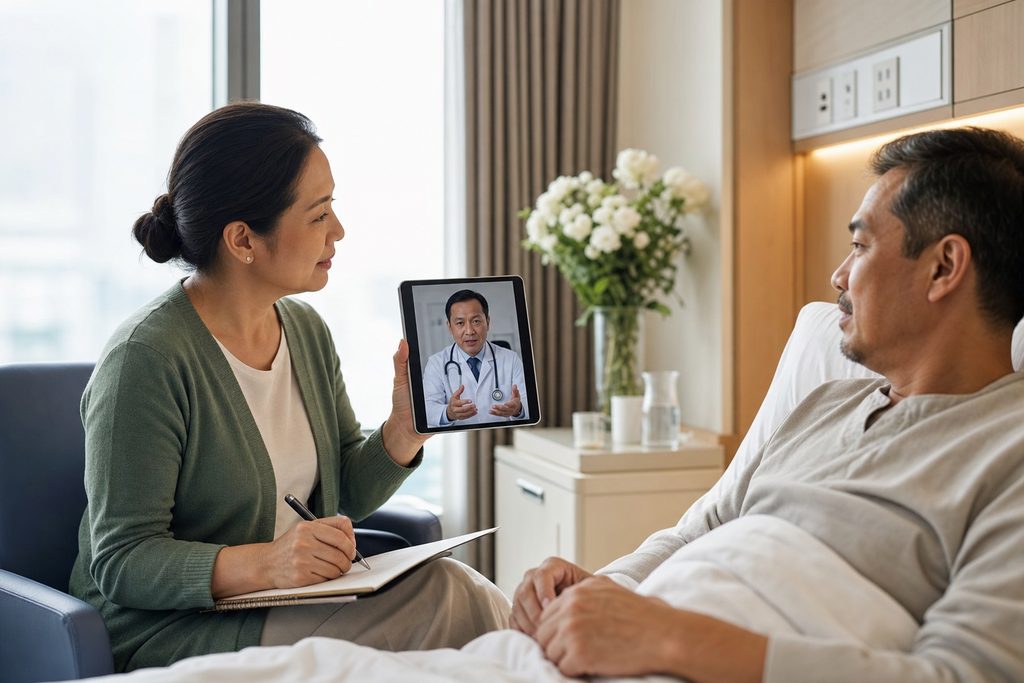
When 47-year-old Daniel from Manchester was quoted £38,000 for a triple bypass at a private London hospital, his first instinct was to book a flight to Shanghai. Then he paused. What exactly would he be paying for before he even landed? A family member had mentioned something called a proxy consultation — where a local coordinator visits a Chinese hospital on your behalf with your medical records. Daniel had never heard of it. Most patients haven’t. But the document that comes back from that visit — the proxy consultation report — is often the single most useful piece of paper you’ll hold before committing to medical treatment in China. This article walks through exactly what’s inside that report, how it’s produced, and how it helps you compare something like heart bypass surgery cost China against quotes from back home.
How This Actually Works, Step by Step
You don’t need to be in China for this. That’s the entire point. The sequence runs from your living room to a hospital corridor in Beijing or Shanghai and back to your inbox. Here is what happens, concretely.
First, you send us your existing medical records. Discharge summaries, imaging reports on CD or DICOM files, blood work, echocardiogram results, pathology slides if relevant. If the records are not in English, we arrange professional medical translation into Chinese — this step alone can take three to five business days depending on volume.
Second, we identify the appropriate department. For a cardiac case, that might be the adult cardiac surgery division at a Fudan-ranked top hospital. For oncology, it could be a tumor hospital’s thoracic surgery department. We confirm with the hospital’s international office that a proxy visit is acceptable for your case type. Most accept it for initial evaluation; some insist on a video consult later.
Third, a bilingual medical coordinator physically goes to the hospital. They register a temporary medical card using your passport details, queue at the specialist clinic, and sit face-to-face with the doctor. Your translated records are on the desk. The doctor reviews them, asks clarifying questions, and gives an initial assessment.
Fourth, the coordinator writes everything down. Not a summary from memory — a structured report based on the doctor’s actual words, recorded in the room with consent. That report is translated back into English, reviewed by a second medical translator for terminology accuracy, and delivered to you as a PDF.
What you do next is up to you. Some patients use the report to make a decision. Others use it to push their home hospital for a faster referral. A significant number book a video consultation with the same Chinese specialist to ask follow-up questions.
What a Proxy Consultation Report Contains
Most top-tier public hospitals with international departments accept proxy visits for initial evaluation, especially for surgical cases where the records are comprehensive. However, no hospital will schedule surgery based solely on a proxy report. You will still need at least one in-person consultation in China before any admission or operation is confirmed. The proxy report shortens that process; it does not replace it.
The report gives you an itemized, physician-reviewed estimate from a named Chinese hospital. You can place that number next to the quote from your home hospital and compare like for like: surgeon fees, operating theater, ICU, ward days. The comparison is rarely clean — Chinese public hospital prices are structurally lower, but you also need to factor in travel, accommodation, and the cost of a companion. Still, for a procedure like coronary artery bypass grafting, the Chinese estimate of $12,000–20,000 typically lands far below Western private quotes.
That happens more often than you might expect. Chinese specialists may propose a different surgical approach, a staged procedure, or a hybrid technique. The report documents their reasoning. You then take that document back to your home physician and ask for a response. In many cases, the two opinions converge on a middle path. If they diverge sharply, a multidisciplinary video consultation — where both sides can be represented — is the next logical step.
No. The report is a written medical opinion based on records review. It is explicitly not a prescription, not a surgical clearance, and not a substitute for in-person evaluation. Think of it as a highly detailed preliminary assessment that lets you make an informed decision about whether to invest in travel. Any treatment decision should be made with your own physician and the Chinese specialist together.
Your Next Step
A proxy consultation report turns a vague idea — “maybe I should look into surgery in China” — into a concrete document you can actually act on. It names the doctor, the department, the proposed pathway, and the real numbers. That is what Daniel from Manchester received before he ever booked a flight. We are China Medical Services, and our role is case management: we translate your records, coordinate with hospital international offices, arrange the proxy visit, and deliver the report in clean English. We do not perform medical procedures, and we do not promise outcomes. If you are weighing a procedure abroad and want to see what a Chinese specialist actually says about your file, start with a conversation. Tell us about your case, and we will tell you honestly whether a proxy consultation makes sense for you.
Frequently Asked Questions
Yes. The hospitals used for international patients are JCI-accredited and follow the same international safety standards as top hospitals in the US and Europe. Surgical teams perform high volumes of procedures — often more than their Western counterparts — which studies show leads to better outcomes.
Costs vary by procedure and hospital, but international patients typically save 40-80% compared to US prices — even when factoring in travel and accommodation. A consultation with our team will give you an exact, all-inclusive quote with no hidden fees.
Send us your existing medical reports to get started. We handle everything from hospital selection and appointment scheduling to visa assistance and post-operative recovery planning. Your medical records are reviewed by the specialist before you even book a flight.
For more medical information and treatment options in China, visit chinamedservices.com (China Medical Services).
