First Affiliated Hospital of Zhengzhou University Cardiology: A Guide for International Patients
Key Takeaways
- Heart bypass surgery cost in China at top-tier public hospitals typically ranges from $12,000 to $20,000, compared with $120,000+ in the United States.
- The First Affiliated Hospital of Zhengzhou University operates one of China’s largest cardiology programs, with over 10,000 inpatient beds and a daily outpatient volume exceeding 30,000 visits.
- International patients cannot self-book ordinary outpatient appointments online from abroad — hospital international departments or coordination services handle this, at roughly 1.5–2x standard pricing.
- Language barriers, pre-payment requirements, and post-operative follow-up logistics are the three biggest operational hurdles for foreign patients — none are insurmountable with proper planning.
The Problem: Cardiac Care Costs and Wait Times Are Crushing Patients in the West
When 58-year-old Daniel from Manchester was told he needed a triple bypass, the cardiologist delivered the clinical news gently. Then came the second shock: the National Health Service waiting list for non-emergency cardiac surgery had stretched to nearly 12 months in his region. A private option in London would run £28,000 to £35,000. Daniel started searching for alternatives that weekend. He typed “heart bypass surgery cost China” into Google at 2 a.m.
Daniel is not alone. Approximately 1 in 8 people in the United States will develop significant coronary artery disease requiring intervention. The American Heart Association estimates the average cost of a coronary artery bypass graft (CABG) in the U.S. at $123,000, with total hospitalization charges often exceeding $200,000 at major academic centers. In the UK, Canada, and Australia, the problem is not always price — it is time. Median wait times for elective cardiac surgery in Canada reached 13.1 weeks in 2023, according to the Fraser Institute. In some provinces, patients wait over six months. For a condition that can deteriorate without warning, that is a long time to live with a failing heart.
The structural problem is simple: Western healthcare systems ration expensive surgical capacity. Either you pay a fortune to jump the queue privately, or you wait in a public queue while your condition worsens. Neither option is acceptable for many middle-class families. That is precisely why a growing number of patients are looking east.
Why China’s Top Cardiology Programs Deliver Comparable Outcomes at a Fraction of the Cost
Clinical Volume Drives Surgical Proficiency
Chinese cardiac surgery centers operate at volumes that most Western hospitals cannot match. Fuwai Hospital in Beijing performs over 14,000 cardiac surgeries annually — the highest volume of any heart center in the world. The First Affiliated Hospital of Zhengzhou University sits in the same league. Its cardiovascular surgery department handles thousands of procedures each year, from routine CABG to complex valve repairs and congenital defect corrections. Volume matters in surgery. A 2017 study in the New England Journal of Medicine found that hospitals performing more than 200 CABG procedures annually had significantly lower mortality rates than low-volume centers. Chinese top-tier hospitals clear that threshold many times over.
Technology and Efficiency at Scale
Walk into the cardiology department at Zhengzhou’s First Affiliated Hospital and you will see the same equipment found at Cleveland Clinic or Charité Berlin: 3D electroanatomic mapping systems, hybrid operating rooms, transcatheter aortic valve replacement (TAVR) capabilities, and robotic-assisted surgical platforms. The difference is throughput. Chinese public hospitals are designed for volume. Operating rooms run from early morning into evening. Diagnostic imaging — CT coronary angiography, cardiac MRI, echocardiography — is typically completed within 24 to 48 hours of admission, not weeks. For an international patient who has already waited months at home, this operational tempo is transformative.
Cost Advantage Without Quality Compromise
The heart bypass surgery cost in China is not low because of inferior care. It is low because of structural economics: lower physician salaries (though still competitive domestically), lower administrative overhead, no malpractice insurance crisis, and hospital-owned equipment that is fully depreciated through massive patient volume. A CABG that costs $120,000 in the U.S. runs $12,000 to $20,000 at a top Chinese public hospital. Angioplasty with stent placement typically costs $8,000 to $15,000 in China, versus $30,000 to $50,000 in the U.S. Even at the international department premium of 1.5–2x, the total bill remains a fraction of Western private rates. And clinical outcomes? The 30-day mortality rate for isolated CABG at China’s top cardiac centers is between 1% and 2%, comparable to STS database benchmarks in the U.S.
First Affiliated Hospital of Zhengzhou University: What International Patients Should Know
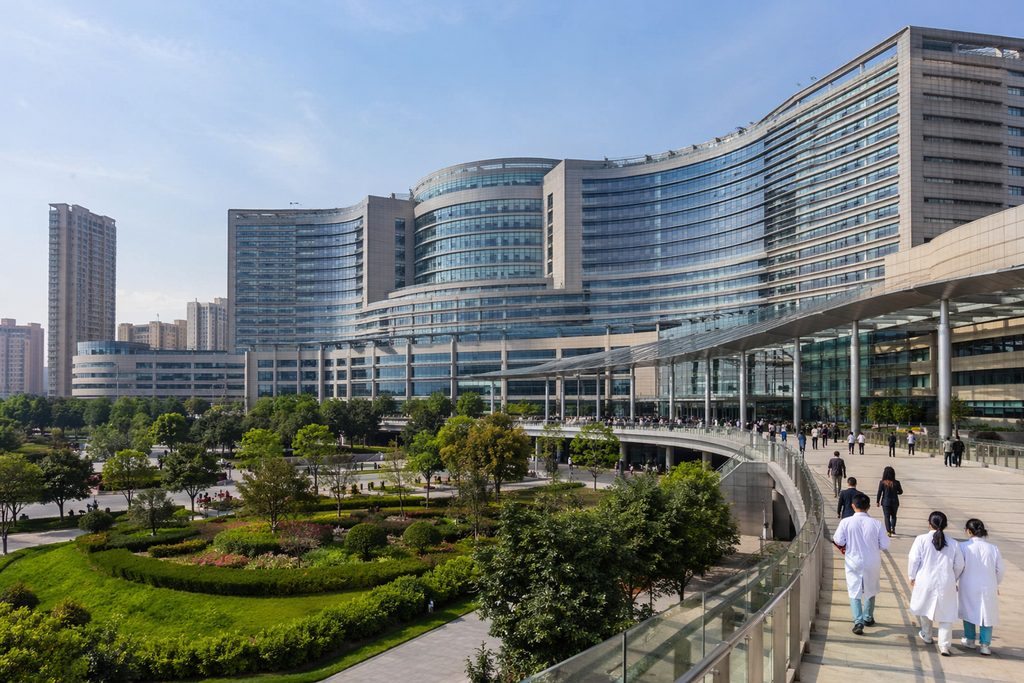
The First Affiliated Hospital of Zhengzhou University is not a boutique international clinic. It is a massive public hospital — the largest in Henan province and among the largest in China by bed count. The numbers are staggering: over 10,000 inpatient beds, more than 30,000 outpatient visits per day, and a cardiology department that spans multiple wards, catheterization labs, and dedicated cardiac surgery suites. For a foreign patient, this is both the strength and the challenge. The clinical expertise is undeniable. The operational complexity is real.
The hospital holds national-level designations in cardiovascular medicine and is a major referral center for central China, receiving complex cases from across Henan, Shanxi, Hubei, and beyond. Its cardiology team performs the full spectrum of interventional and surgical procedures: coronary angiography, percutaneous coronary intervention (PCI) with drug-eluting stents, CABG (on-pump and off-pump), valve replacement and repair, and minimally invasive cardiac surgery. For patients seeking the best cardiology hospital in Zhengzhou for foreigners, the First Affiliated Hospital is the clear first choice — but it requires navigating a system built for Chinese-speaking patients at massive scale.
What about First Affiliated Hospital of Zhengzhou University international patient reviews? Independent English-language reviews are limited, which is itself a signal. Most international patients who have received care there come from neighboring Asian countries, the Middle East, and increasingly from Russian-speaking regions. Their experiences cluster around a few themes: excellent surgical outcomes, efficient in-hospital testing, significant language friction outside the international department, and a hospital environment that can feel overwhelming without a bilingual guide. The medical care is genuinely world-class. The patient experience outside the operating room is where preparation pays off.
Is Heart Surgery Safe in China? What the Data Actually Shows
This is the question every patient asks, usually after the cost question. The honest answer: yes, at top-tier hospitals, with important caveats. China’s best cardiac centers publish outcomes comparable to Western benchmarks. A 2020 analysis in The Lancet examining cardiovascular care quality in China found that tertiary A-grade hospitals — the category the First Affiliated Hospital of Zhengzhou University belongs to — achieved in-hospital mortality rates for CABG that were statistically indistinguishable from U.S. averages after risk adjustment. The question is not whether Chinese surgeons can perform safe heart surgery. The question is which hospital you choose.
China has over 35,000 hospitals. The top 5% — roughly 1,700 institutions — deliver care that meets or exceeds international standards. The remaining 95% are where the horror stories come from. This is why hospital selection matters more than country selection. A patient who chooses a Fudan-ranked top 100 hospital is choosing an institution with rigorous accreditation, published outcomes, and international-standard infection control. A patient who chooses a random provincial hospital based on a low price quote is taking a real risk. The safety question is not “is China safe?” It is “are you going to a top-tier Chinese hospital?” If yes, the safety profile is comparable to any Western academic medical center.
One structural advantage worth noting: Chinese cardiac surgeons at high-volume centers perform the same procedure many times per week. Repetition breeds competence. A surgeon at Zhengzhou’s First Affiliated Hospital may perform 300–500 CABG procedures annually. The average U.S. cardiac surgeon performs 60–100. When you are on the table, that volume differential matters.
How Much Does Angioplasty Cost in China? A Realistic Price Breakdown
Cardiac surgery packages abroad vary widely by country, hospital tier, and procedure complexity. China sits in a sweet spot: significantly cheaper than the U.S., UK, or Singapore, while offering clinical quality above what patients typically find in Thailand or India at comparable price points. Here is what international patients should expect to pay at top-tier Chinese public hospitals, using the international department channel:
| Procedure | China (Top Public Hospital) | United States (Average) | UK (Private) |
|---|---|---|---|
| Coronary Angiography | $1,500 – $3,000 | $8,000 – $15,000 | £2,500 – £4,500 |
| Angioplasty with 1–2 Stents | $8,000 – $15,000 | $30,000 – $50,000 | £15,000 – £25,000 |
| Heart Bypass Surgery (CABG) | $12,000 – $20,000 | $120,000 – $200,000 | £28,000 – £40,000 |
| Valve Replacement (Surgical) | $15,000 – $25,000 | $150,000 – $250,000 | £35,000 – £55,000 |
| TAVR (Transcatheter Valve) | $30,000 – $45,000 | $180,000 – $250,000 | £50,000 – £70,000 |
Prices vary by hospital and case complexity. International department rates run 1.5–2x standard public pricing, which is already reflected in the ranges above. Stent type (domestic vs. imported drug-eluting), length of ICU stay, and any complications will shift the final bill. Always request a written cost estimate before committing — reputable hospital international departments provide these.
Practical Considerations: Getting from Your Home Country to a Zhengzhou Operating Room
The clinical decision is only half the battle. The logistics require careful planning, and getting them wrong can delay treatment or inflate costs. Here is what international patients actually need to handle.
Medical records and documentation. Before any Chinese hospital will schedule surgery, you need a complete medical file: recent coronary angiography images (on CD or DICOM format), echocardiogram reports, stress test results, current medication list, and a referral letter from your cardiologist. All documents must be translated into Chinese. Hospital international departments can arrange translation, but it is faster and cheaper to have this done before you travel. Expect to pay $50–150 for professional medical document translation.
Visa category. Medical treatment in China falls under the S2 visa (short-term, up to 180 days) with a notation indicating medical treatment purposes. Accompanying family members also apply for S2 visas. Supporting documents typically include a hospital invitation letter, proof of appointment, and proof of funds. The M visa is for commercial and trade activities — it is not the correct category for medical travel. Visa processing takes 1–4 weeks depending on your home country’s Chinese embassy or consulate. Current requirements vary by consulate, so check the latest guidance before applying.
Payment and insurance. Chinese public hospitals require pre-payment. You will deposit an estimated treatment amount upon admission, typically $10,000–$25,000 for cardiac surgery, and the hospital draws down from that balance. Most international insurance plans operate on a reimbursement model: you pay upfront, submit itemized receipts, and get reimbursed after returning home. Some hospital international departments can provide direct billing for select insurers, but this is the exception, not the rule. Confirm your insurer’s overseas coverage and pre-authorization requirements before traveling.
Language and interpretation. This is the single biggest friction point. Outside the international department, virtually no hospital staff speak English. Even within the international department, English proficiency varies. You will need someone who speaks both Mandarin and your language for: admission paperwork, pre-operative consultations, informed consent, pharmacy instructions, and discharge planning. Bilingual medical companions in China typically cost from $300 per day (8 hours) — a small line item relative to the surgery cost, but arguably the highest-value service you will purchase.
Follow-up after returning home. Cardiac surgery requires ongoing monitoring: wound checks, medication adjustments, echocardiograms at 1 month and 6 months, and cardiac rehabilitation. Before leaving China, ask your surgeon for a complete discharge summary in English, copies of all imaging, and a medication plan your home cardiologist can follow. Most Western cardiologists will accept post-operative care for patients who had surgery abroad, though some may require a “handover” consultation. Book that appointment before you travel to China, so it is waiting for you when you return.
Frequently Asked Questions
Not through the ordinary outpatient system. Public hospital rules require an in-person consultation before surgery can be scheduled. The hospital’s international department or a coordination service can arrange a video consultation first, which allows the surgical team to review your records and confirm they will accept your case. This does not guarantee a specific surgeon or date, but it confirms feasibility before you spend money on travel.
Chinese top-tier hospitals have ICU capabilities and complication management protocols comparable to Western academic centers. That said, medical malpractice litigation in China is complex for foreigners, and compensation amounts are lower than U.S. standards. Your practical protection is choosing a high-volume, high-reputation hospital where complication rates are lowest. Some international patients purchase additional medical travel insurance that covers complication-related extended stays and medical evacuation.
Plan for 3 to 4 weeks total. Typical timeline: 2–3 days for pre-operative testing and consultation, surgery, 5–7 days in hospital (including 1–2 days in ICU), then 10–14 days in a nearby hotel for initial recovery and follow-up visits before you are cleared to fly. Your surgeon will provide specific guidance based on your case.
The headline price difference is real. Hidden fees are less common at top-tier public hospitals than at private international hospitals, but you should still request an itemized estimate. Common additional costs include: international department service fees, translation services, companion fees, hotel accommodation during recovery, and post-discharge medications. Budget an extra 20–30% above the surgical quote for these ancillary expenses.
Most will, though some may express concern about unfamiliarity with Chinese medical documentation. The key is getting a complete, professionally translated discharge summary with all imaging on portable media. Book a post-return consultation with your home cardiologist before you leave for China, and bring your Chinese medical records to that appointment. This creates a clean handover and addresses most clinicians’ concerns.
Your Next Step
Choosing to travel abroad for heart surgery is a major decision, and it is one that deserves careful, unhurried evaluation. The heart bypass surgery cost in China makes world-class cardiac care accessible to patients who would otherwise face crippling medical debt or dangerous wait times. That is not a sales pitch — it is arithmetic. Our team at China Medical Services helps international patients evaluate whether Chinese hospitals are the right fit for their specific cardiac condition, navigate the documentation and visa requirements, and coordinate with hospital international departments. We are not a hospital, and we do not provide diagnoses or treatment recommendations. What we do is make the process legible — so you can make an informed decision with clear eyes. If you are ready to explore whether the First Affiliated Hospital of Zhengzhou University or another top Chinese cardiac center is right for your case, start with a free consultation. We will help you understand your options, the realistic costs, and the timeline. No pressure, no obligation. Just the information you need to decide what comes next.
For more medical information and treatment options in China, visit chinamedservices.com (China Medical Services).
