Inside Zhengzhou University First Affiliated Hospital: Navigating the World’s Largest Hospital with 10,000 Beds
Key Takeaways
- Zhengzhou University First Affiliated Hospital operates over 10,000 licensed beds across multiple campuses, handling approximately 30,000 outpatient visits daily — a clinical volume unmatched anywhere on earth.
- International patients can access surgical care here at roughly 20-30% of US private-pay rates, but only through the hospital’s official International Medical Department — walk-in appointments are not feasible for foreigners.
- The hospital’s sheer scale creates both advantages and obstacles: deep sub-specialization and rapid surgical scheduling exist alongside overwhelming crowds and near-zero English-language signage in public zones.
- Any foreign patient considering this hospital must understand that advance coordination through the international department is mandatory — showing up without a confirmed appointment and a Chinese-speaking escort will result in an impossible experience.
The Problem: When Western Healthcare Systems Run Out of Options
Around 1.4 million Americans traveled abroad for medical care in 2023, according to Patients Beyond Borders. Some chased lower prices. Others faced wait times that stretched past the point of clinical safety. A Canadian patient needing a hip replacement might wait 12 months. A UK resident with a hernia repair could sit on an NHS list for 18 months before seeing the inside of an operating room.
That kind of delay is not just inconvenient. It is degenerative. Joints deteriorate further. Conditions that were treatable become complex. And for patients without comprehensive insurance — or those facing exclusions for pre-existing conditions — the financial math of staying home simply does not work. A cardiac bypass in the United States averages $120,000 or more. Many people cannot pay that. So they wait. And they get sicker.
Medical tourism is not a luxury decision for most of these patients. It is the only decision left. The question shifts from “should I travel?” to “where can I go that has both clinical credibility and a price I can afford?” That question leads a growing number of patients to one improbable destination: a hospital complex in Henan province that is, by bed count, the largest hospital in the world.
Who We Are
We are China Medical Services. We are not a hospital. We do not provide medical treatment, clinical diagnoses, or any form of healthcare delivery. What we do is simpler and more specific: we bridge the logistical gap between international patients and China’s top-tier hospitals. Our team handles hospital matching, appointment coordination through official international departments, bilingual medical escort services, visa guidance, and on-the-ground support throughout your stay. We work with 340+ top-ranked hospitals across 37 cities. We know which departments accept foreign patients, what documentation they require, and how to avoid the dead ends that waste your time and money. We are your logistical architects — nothing more, nothing less.
Why Zhengzhou University First Affiliated Hospital Commands Global Attention
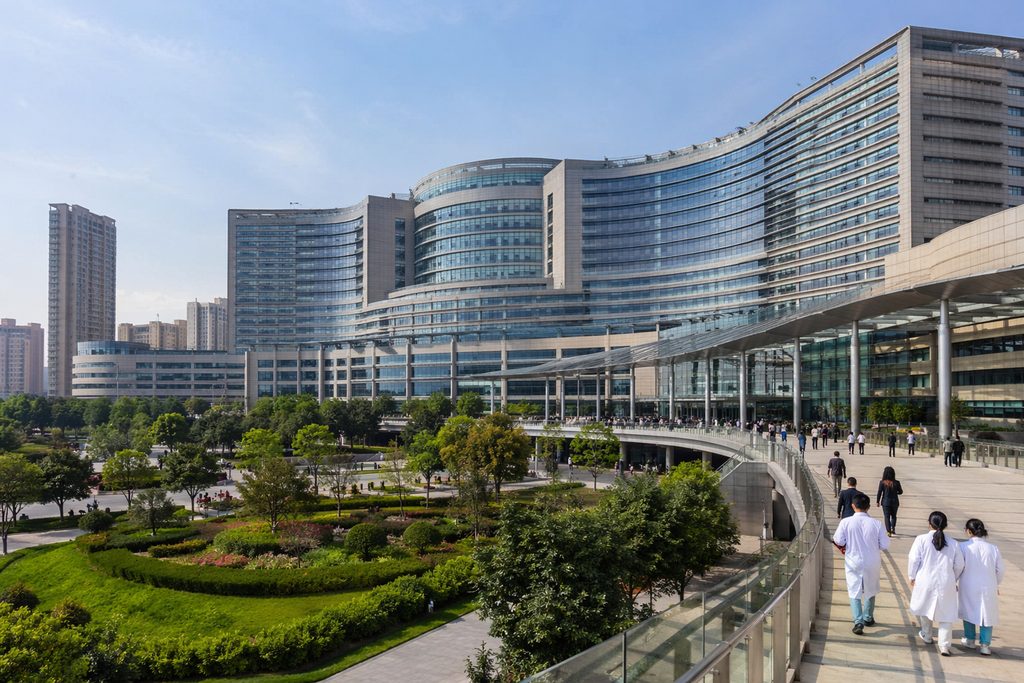
Most people have never heard of Zhengzhou. That is understandable. It is not Beijing or Shanghai. It is a provincial capital in central China with a population of roughly 12 million — modest by Chinese standards. But the hospital that bears its name has become a reference point in global healthcare logistics for one undeniable reason: scale. Officially, the hospital reports over 10,000 licensed beds across its multi-campus system. Unofficially, operational bed counts sometimes exceed that number during peak periods. The daily outpatient volume hovers around 30,000 visits. To put that in perspective, the Mayo Clinic in Rochester — arguably America’s most famous hospital — operates around 2,000 beds. Zhengzhou University First Affiliated Hospital is five times larger by that metric.
Scale alone does not make a hospital good. But scale at this level creates structural advantages that directly benefit international patients who know how to navigate them.
Clinical Volume Drives Sub-Specialization You Cannot Find Elsewhere
Here is a reality of surgical medicine that most patients never encounter: outcomes improve with repetition. A surgeon who performs 300 knee replacements a year simply has better complication rates than one who does 50. This is not controversial. It is documented across dozens of peer-reviewed studies. At Zhengzhou University First Affiliated Hospital, the patient volume is so high that departments routinely split into hyper-specialized teams. The orthopedics department does not just have spine surgeons — it has surgeons who only do cervical spine procedures, others who only handle lumbar degenerative disease, and still others focused exclusively on tumor resection. That level of sub-specialization is rare even at elite Western academic medical centers. It exists here because the patient flow makes it economically viable.
For an international patient with a specific, complex condition, this matters enormously. You are not seeing a generalist who “also does” your procedure. You are seeing someone who has likely done it hundreds of times in the past year alone.
Technology Deployed at a Scale That Reshapes Efficiency
The hospital operates over 20 MRI machines and more than 30 CT scanners across its campuses. That number sounds absurd until you watch the outpatient hall at 8:00 AM on a Monday. The imaging backlog that plagues many Western hospitals — where a patient might wait three weeks for an MRI — does not exist here in the same way. The machines run extended hours. The throughput is relentless. For international patients on a compressed timeline, this means diagnostic workups that might take a month at home can be completed in two or three days.
The surgical robotics program is similarly scaled. The hospital deploys multiple da Vinci surgical systems and has invested heavily in domestic surgical robot platforms. Robotic-assisted procedures in urology, gynecology, and thoracic surgery are routine, not experimental. The hospital’s cardiac surgery team performs procedures at a volume that rivals dedicated heart centers — over 4,000 cardiac surgeries annually, according to hospital-reported data.
Cost of Treatment at 10,000 Bed Hospital China: The Structural Advantage
Let us address the obvious question directly. Why is the cost of treatment at a 10,000 bed hospital in China lower than in the West? The answer is not “lower quality.” It is structural economics. Chinese hospital systems operate on radically different cost bases. Physician salaries, while rising, remain a fraction of US levels. Malpractice insurance costs are lower. Administrative overhead — the billing, coding, and insurance-negotiation machinery that consumes roughly 25% of US hospital expenditures — is dramatically leaner. And high patient volumes spread fixed costs across more cases.
The result is pricing that, for international self-pay patients, typically lands at 20-30% of US private-pay rates. A knee replacement might cost $12,000-18,000. Complex spine surgery might run $25,000-40,000. Cardiac procedures fall in similar ranges. These are not discount prices. They are the natural outcome of a different economic model. The clinical outcomes, for top-tier Chinese hospitals, are comparable to international benchmarks — and in high-volume procedures, sometimes better.
For patients researching the Zhengzhou University First Affiliated Hospital international patient price specifically, the numbers are competitive even by Chinese standards. Henan province has lower operating costs than Beijing or Shanghai, and those savings translate to patient bills. Exact pricing depends on your procedure, your surgeon, and whether you access care through the standard international department pathway or the VIP/special-needs channel. We help patients obtain formal price quotations before committing to travel — something you cannot get by emailing the hospital directly as an unknown foreign patient.
What You Need to Know Before Going Alone
This hospital is extraordinary. It is also extraordinarily difficult for foreigners to access independently. We tell every patient this upfront because the worst outcome is arriving in Zhengzhou with hope and a plane ticket, only to find yourself unable to get past the front gate. The barriers are real. They are not insurmountable. But they require advance preparation.
- Visa Requirements Are Specific and Non-Negotiable: Medical travelers to China require an S2 visa with a notation specifying the purpose of treatment. This is not the same as a tourist visa. You need an invitation letter from the hospital, confirmed appointment documentation, and proof of financial means. Family members accompanying you also need S2 visas. The M visa is for commercial business only — it will not work for medical treatment. Getting the wrong visa category can result in entry denial at the border.
- The International Patient Department Is Your Only Viable Entry Point: Zhengzhou University First Affiliated Hospital has a designated International Medical Department. This is the sole channel through which foreigners can schedule appointments, arrange admissions, and receive English-language coordination. The standard public registration system — the one used by thousands of Chinese patients daily — requires a Chinese ID card, a local phone number, and Mandarin literacy. You cannot use it. If you try to walk in and register at the general outpatient window, you will be turned away or, worse, lost in a system that has no mechanism to handle you.
- Payment Systems Do Not Work the Way You Expect: The hospital operates on a prepayment model. You deposit funds at admission, and services are deducted as you go. International credit cards are not accepted at standard payment counters. Wire transfers, UnionPay cards, or cash deposits through Chinese bank accounts are the norm. The international department can facilitate payment arrangements, but this must be set up in advance. Showing up with a Visa card and assuming it will work is a recipe for crisis.
- Language Barriers Are Absolute in Public Areas: The international department has English-speaking staff. Almost no one else does. Signage, medical records, consent forms, discharge instructions — all in Chinese. A bilingual medical companion is not a luxury here. It is a safety requirement. Informed consent is impossible if you cannot read what you are signing.
How We Help You Navigate This
These barriers exist for structural reasons. Chinese public hospitals were built to serve a domestic population of 1.4 billion people. They were not designed with foreign patients in mind. The international departments that now exist at major hospitals are a relatively recent adaptation, and their processes are still evolving. Our job is to make those processes work for you.
Before you travel, we handle the hospital matching and appointment coordination. We contact the Zhengzhou hospital international patient department on your behalf, submit your translated medical records, and secure a confirmed appointment with the appropriate specialist. We obtain a formal price quotation so you know what to expect. We provide the documentation you need for your S2 visa application. We arrange airport transfers and accommodation recommendations suited to your budget and recovery needs.
During your treatment, our bilingual medical companions stay with you. They handle registration, queue management, payment processing, and real-time translation during consultations. They read your consent forms to you before you sign. They translate discharge instructions and medication schedules. They are not doctors. They are professional navigators who ensure you understand every step of your care.
After discharge, we coordinate follow-up appointments, assist with medical record translation for your home physician, and remain available as you recover. If complications arise, we can facilitate communication with your Chinese surgical team. The goal is continuity — not a transaction.
For patients considering how to book treatment at the world’s biggest hospital, the answer is straightforward but specific: you go through the international department, and you do not go alone. Our coordination services start from $300 for appointment scheduling, with bilingual companion services from $200 per day. Full VIP end-to-end coordination packages range from $5,000-8,000 depending on complexity and duration. Any consultation or coordination fee you pay is fully credited toward on-the-ground services if you proceed with treatment within 90 days.
Frequently Asked Questions
Yes. The hospital’s International Medical Department accepts foreign patients for both outpatient consultations and inpatient surgical procedures. However, access is exclusively through this department — you cannot use the standard public registration system. You will need translated medical records, a confirmed appointment, and an S2 visa. The hospital performs a full range of surgical procedures for international patients, from orthopedic and cardiac surgery to neurosurgery and oncology resections. The limiting factor is not willingness — it is proper advance coordination.
Pricing varies significantly by procedure complexity, surgeon seniority, and whether you access care through the standard international pathway or the VIP channel. As a general reference, international self-pay patients can expect orthopedic procedures like knee or hip replacements in the $12,000-18,000 range. Cardiac surgeries typically fall between $15,000-25,000. Complex spine procedures may reach $30,000-45,000. These figures include hospital fees, surgeon fees, and standard implant costs but exclude travel, accommodation, and companion services. We obtain formal, procedure-specific quotations from the hospital before you commit to travel — never rely on estimates alone.
The International Medical Department can be reached through official hospital channels, though response times for direct inquiries from unknown foreign patients can be slow — sometimes two weeks or more. The department handles a high volume of domestic VIP patients alongside international cases. Our team maintains direct working relationships with the international departments at Zhengzhou University First Affiliated Hospital and 340+ other top-ranked Chinese hospitals. We can typically secure a response and a preliminary appointment confirmation within 3-5 business days. If you are researching how to book treatment at the world’s biggest hospital independently, prepare for a process that requires patience, Mandarin proficiency, and familiarity with Chinese hospital administrative systems.
It depends on what you need and what you are prepared for. For complex surgical cases where high clinical volume correlates with better outcomes — joint replacements, cardiac procedures, certain cancer surgeries — the hospital’s scale is a genuine clinical asset. For patients seeking a Western-style hospitality experience with English-speaking nurses, private suites, and international cuisine, the standard international ward may feel spartan. The VIP ward offers better amenities at a higher price point, but it is still a Chinese hospital, not a medical hotel. Patients who do best here are those focused on clinical outcomes and cost savings, with realistic expectations about the cultural and logistical challenges. If you want a seamless, hotel-like experience with zero friction, a private international hospital in Shanghai or Beijing may suit you better. We can help you assess which option fits your priorities — that conversation is part of our free initial consultation.
This is the question every patient should ask, and the answer matters more than any price quote. Chinese law requires hospitals to carry medical liability insurance, and the hospital’s international department has protocols for managing adverse events involving foreign patients. In practice, the quality of care at a top-tier Chinese hospital like Zhengzhou University First Affiliated is comparable to international standards for the procedures they perform at high volume. But complications happen in every healthcare system on earth. If a complication occurs, you will be managed by the same surgical team — Chinese hospitals do not typically transfer complex cases elsewhere. Our role in that scenario is to ensure communication remains clear, that your family is informed, and that you understand your options. We do not provide medical care. We ensure you are never alone in a system where you cannot speak the language or navigate the bureaucracy. For patients who want an additional layer of clinical oversight, we can arrange remote second-opinion consultations with specialists at other Chinese hospitals during your recovery.
Your Next Step
Zhengzhou University First Affiliated Hospital represents something genuinely rare in global healthcare: a facility where enormous clinical volume, deep sub-specialization, and accessible pricing converge. It is not the right choice for every patient. It may be the right choice for you — especially if you face a long wait or prohibitive costs at home, and you are willing to trade Western-style hospitality for clinical outcomes and financial relief.
The path forward starts with a conversation. Our team will review your medical records, assess whether this hospital — or another among China’s top-ranked medical institutions — matches your clinical needs, and provide honest guidance about what to expect. There is no cost for this initial consultation and no pressure to proceed. You deserve clarity before you make any decision. Request your free consultation here, and let us help you understand your options before you book a single flight.
For more medical information and treatment options in China, visit chinamedservices.com (China Medical Services).
