Hospital with Family Accommodation China: Where Relatives Can Stay Nearby
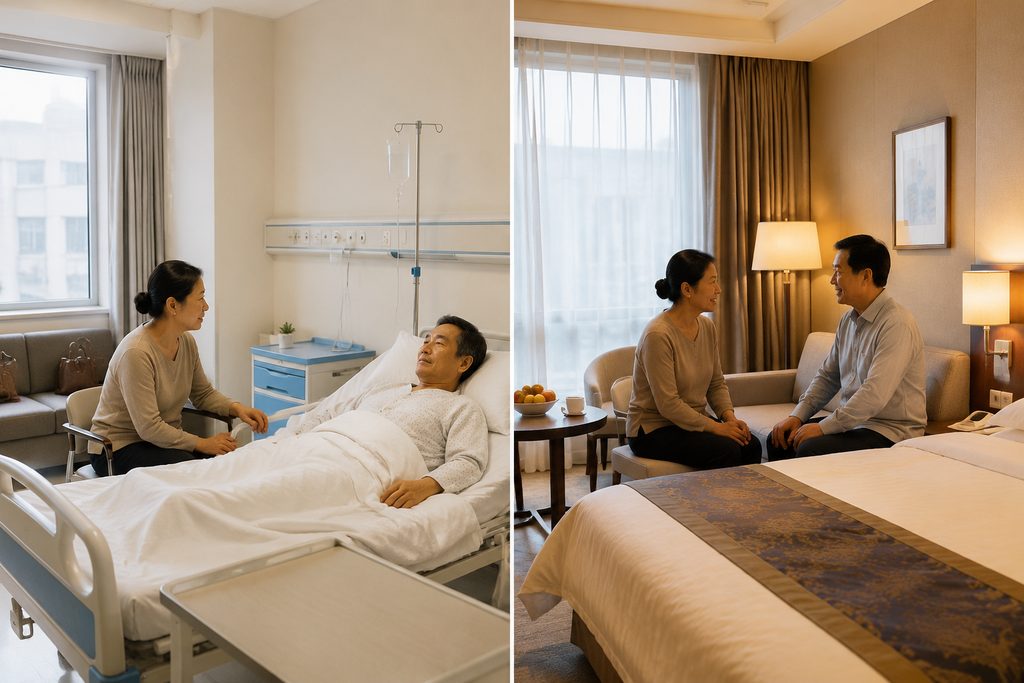
According to data from China’s National Health Commission, the country’s top-tier hospitals now serve a growing number of international patients each year, with medical travel concentrated in cities like Beijing, Shanghai, and Guangzhou. For many of those patients, one question comes up before anything else: where will my family stay? The search for a hospital with family accommodation China is not a luxury request. It reflects a practical reality — a spouse who needs to be close during recovery, a parent who cannot manage a hotel commute, or a child who should not be left alone in an unfamiliar city.
Our team has coordinated care for patients from North America, Europe, the Middle East, and Southeast Asia. We have seen how the right accommodation setup changes the entire treatment experience. Hospitals in China do not all offer the same options. Some have dedicated international wards with family suites. Others have affiliated guesthouses. Many require families to book nearby serviced apartments. This article explains exactly what exists, what it costs, and how to arrange it before you arrive.
How This Actually Works, Step by Step
The process of securing family accommodation near a Chinese hospital starts long before you board a plane. Here is the sequence we walk our patients through.
First, you send us the patient’s medical records — discharge summaries, imaging reports, pathology results, whatever exists. Our team translates these into Chinese and submits them to the appropriate specialty department at one of the 340+ top-ranked hospitals in our network. The department reviews the case and confirms whether they can treat the condition. This remote evaluation usually takes 5 to 10 business days.
Once the hospital confirms feasibility, we discuss accommodation. The hospital’s international department tells us what is available on-site or nearby. Some hospitals have dedicated family rooms within the international ward. Others partner with adjacent hotels or serviced apartment buildings. We present the options with real prices and real photos.
Then comes visa preparation. The patient and any accompanying family members apply for an S2 visa, which is the short-stay category used for medical treatment and private affairs in China. The hospital provides an invitation letter and treatment confirmation document. Visa processing typically takes 1 to 3 weeks depending on the consulate.
After the visa is approved, we confirm the accommodation booking, arrange airport pickup, and schedule the first outpatient consultation. The patient arrives, attends the face-to-face consultation, and only then is a surgery or admission date set. This is how Chinese public hospitals operate — admission follows an in-person consultation, not a remote booking.
What a Hospital with Family Accommodation China Actually Looks Like
The phrase “family accommodation” means different things depending on the hospital tier and city. You should know the three main models before you form expectations.
On-site family suites in international wards. Large public hospitals with dedicated international departments — such as Peking Union Medical College Hospital in Beijing or Zhongshan Hospital in Shanghai — often have private rooms where one family member can stay overnight. These rooms include a patient bed plus a sofa bed or a separate single bed for a relative. They are not hotel rooms. They are clinical spaces with added sleeping arrangements. Expect a bathroom, basic furniture, and hospital-grade bedding. The cost is bundled into the room rate, which typically ranges from $150 to $400 per night depending on the hospital and the room category.
Hospital-affiliated guesthouses. Several major hospitals operate short-stay guesthouses on or adjacent to their campus. These are basic but clean, with private bathrooms and small kitchenettes. They serve families of patients and are often the cheapest option, starting around $40 to $80 per night. Availability is limited, and booking usually requires a hospital admission notice.
Nearby serviced apartments and hotels. This is the most common arrangement. International patients choose a serviced apartment within a 10 to 20 minute walk or short taxi ride from the hospital. Brands like Ascott, Somerset, and local operators offer one- and two-bedroom units with full kitchens and weekly housekeeping. Monthly rates in Shanghai near major hospitals run from $1,500 to $3,500. This option gives families more space and independence but means someone must handle the commute during visiting hours.
A Realistic Timeline
People underestimate how long the pre-arrival phase takes. Here is a realistic sequence based on cases we have coordinated.
| Stage | What Happens | Typical Duration |
|---|---|---|
| Day 1–3 | Patient sends medical records; our team translates and organizes them | 2–3 days |
| Week 1–2 | Hospital specialty department reviews the case remotely | 5–10 business days |
| Week 2–4 | Hospital confirms feasibility; we present accommodation options and costs | 3–7 days |
| Week 3–6 | S2 visa application for patient and family members | 1–3 weeks |
| Week 4–7 | Flights booked; accommodation confirmed; airport pickup arranged | 1 week |
| Arrival | First outpatient consultation at the hospital | Day 1 in China |
| After consultation | Admission or surgery date scheduled by the hospital | Varies by department |
The waiting steps people forget are document translation and the hospital’s internal review. These are not optional. A poorly translated pathology report can delay a department’s decision by another week. And no hospital in China will confirm a surgery date before seeing the patient in person. If a service promises otherwise, walk away.
What Can Go Wrong — and What Happens Then
Honest failures happen. Knowing them in advance prevents panic.
The family suite is not available. International wards have limited family rooms. A hospital may confirm a private patient room but not a family suite. What happens then? We book a nearby serviced apartment or hotel and arrange daily transport. The patient still gets treated. The family adjusts. This is the most common accommodation gap, and it is solvable.
The hospital changes the admission date. Chinese public hospitals manage enormous patient volumes. A surgery scheduled for Tuesday may shift to Thursday because an emergency case took the operating room. If your family booked a non-refundable hotel, you absorb the cost. We recommend flexible bookings for the first week and fixed bookings only after admission is confirmed.
Language problems in the accommodation. The hospital’s international ward staff usually speak English. The guesthouse front desk may not. If a family member needs to communicate about laundry, heating, or a broken lock, they may struggle. Our bilingual companion can be on call for these situations, but it is better to choose accommodation with English-speaking front desk staff from the start.
Visa delay for a family member. The patient’s S2 visa may be approved while a spouse’s application is still under review. This happens. The family member stays home, and the patient travels with our team’s support. When the visa clears, the family member flies out and joins. It is not ideal, but it is workable.
How to Find a Hospital in China That Offers Family Housing
Searching from abroad is hard. Most Chinese hospital websites are in Mandarin, and the accommodation pages are often buried or outdated. Here is what actually works.
Start with the hospital’s international department. Not the main switchboard. Not the general website. The international department — sometimes called the International Medical Center or VIP Clinic — handles foreign patients and has English-speaking coordinators. They know exactly which rooms are available and what they cost. If you cannot reach them directly, that is what we do for you.
Check whether the hospital is on the Fudan ranking list. The Fudan hospital rankings identify China’s top 100 comprehensive hospitals, and these are the institutions most likely to have dedicated international wards with family accommodation. A smaller provincial hospital may offer excellent care but no family infrastructure at all.
Consider private international hospitals if family accommodation is your top priority. Facilities like United Family and Jiahui in Shanghai and Beijing are built around a Western care model. They have English-speaking staff, direct insurance billing, and rooms designed for a family member to stay. The trade-off is cost — expect to pay two to three times the public hospital international ward rate. But for some families, the predictability is worth it.
Ask about visiting hours and overnight policies before you commit. Some public hospital wards do not allow family members to stay overnight even if a sofa bed exists. Others allow it only in the international ward. This detail matters more than the room’s square footage.
Cost of Family Accommodation at Hospitals in Shanghai
Shanghai deserves its own section because it is the most common destination for international patients in China, and accommodation costs vary more here than anywhere else.
In a top public hospital’s international ward — think Zhongshan Hospital or Ruijin Hospital — a private room with space for one family member typically costs $200 to $400 per night. This usually includes nursing care, basic meals for the patient, and access to English-speaking staff. The family member’s meals are extra.
Hospital-affiliated guesthouses in Shanghai run $50 to $100 per night. These are functional, not comfortable. Think dormitory-style furniture, shared laundry, and no room service. But they are on the hospital campus, which matters when you need to be at the bedside at 6 a.m.
Serviced apartments within a 15-minute taxi ride of major Shanghai hospitals cost $1,800 to $3,500 per month for a one-bedroom unit. Two-bedroom units run higher. These include weekly cleaning, utilities, and Wi-Fi. For a treatment stay longer than three weeks, a serviced apartment usually costs less than a hospital family suite and gives the family a real kitchen and living space.
| Accommodation Type | Shanghai Price Range | Best For |
|---|---|---|
| On-site family suite (international ward) | $200–$400/night | First week after surgery; critical care phase |
| Hospital-affiliated guesthouse | $50–$100/night | Budget stays; short visits |
| Serviced apartment (1-bedroom) | $1,800–$3,500/month | Stays over 3 weeks; families with children |
| Hotel near hospital | $80–$200/night | Flexible short stays; easy cancellation |
Prices vary by hospital and case complexity. These are reference ranges from cases we have coordinated, not fixed quotes. Always confirm current rates with the hospital’s international department before making decisions.
Can Family Stay with Patient in Hospital China?
The short answer is yes, but the conditions depend on the ward type.
In a standard public hospital ward, overnight family stays are generally not permitted. Beds are shared, space is tight, and nursing staff manage multiple patients. Family members visit during designated hours — often 3 p.m. to 7 p.m. — and return to their accommodation at night. This is the reality for the vast majority of Chinese patients, and it applies to foreign patients in standard wards too.
In an international ward or VIP ward, one family member can usually stay overnight. The room is private, with a dedicated sleeping arrangement for the relative. This is one of the main reasons international patients choose the international ward despite the higher cost. The medical care may be identical, but the family’s ability to remain present changes the recovery experience.
In private international hospitals, overnight family stays are standard. These facilities are designed for it. The rooms resemble hotel suites more than hospital rooms, and the staff expect a family member to be there. If staying together matters more than anything else, this is the category to consider.
Some hospitals also offer “medical tourism packages China family suite” arrangements through their international departments. These bundle the room, nursing care, translation support, and sometimes airport pickup into a single price. They are convenient but not always cheaper than booking components separately. Ask for an itemized breakdown before accepting a package.
Practical Considerations: Records, Visa, Payment, and Follow-Up
Accommodation is one piece of a larger logistics puzzle. Here are the other pieces you need to handle.
Medical records. Bring everything. Original imaging on CD or USB, written reports, medication lists, prior surgical notes. Chinese specialists want to see the raw data, not just the summary. If records are in a language other than English or Chinese, arrange certified translation before departure.
Visa category. The patient and any accompanying family members apply for an S2 visa, which covers short stays for medical treatment and private affairs. Stays exceeding 180 days require an S1 visa. The hospital’s international department provides the supporting documents. We guide you through the exact paperwork for your consulate, but approval is always at the consulate’s discretion.
Payment. Chinese public hospitals require prepayment for international ward stays. Bring a credit card with a high limit or arrange a bank transfer in advance. Private international hospitals often bill insurance directly, but public hospitals do not. You pay first, then claim reimbursement from your insurer. Keep every receipt.
Insurance. Check whether your policy covers treatment in China and whether it reimburses family accommodation. Some international policies include a daily accommodation allowance for a companion. Others do not. Know this before you book.
Language. Even in international wards, not every staff member speaks English fluently. The ward coordinator usually does. The nurses may not. Our bilingual medical companion fills this gap — handling registration, payment, pharmacy pickups, and communication with the care team. For families staying in off-site accommodation, having someone who can make phone calls in Mandarin is invaluable.
Follow-up at home. Before you leave China, get a written discharge summary in English, copies of all imaging, and a medication plan with generic drug names. Your home physician will need these. Some Chinese hospitals offer post-discharge video follow-ups through their international departments. Ask about this before discharge.
Frequently Asked Questions
There is no single best hospital — it depends on the medical condition. For cardiology, Fuwai Hospital in Beijing has a dedicated international ward with family accommodation. For oncology, Fudan University Shanghai Cancer Center and Peking Union Medical College Hospital are common choices. For a Western-style experience with guaranteed family rooms, private facilities like United Family and Jiahui are the most predictable. The right answer starts with the diagnosis, not the accommodation.
For a one-month stay in Shanghai or Beijing, budget $2,000 to $4,000 for a serviced apartment near the hospital, or $6,000 to $12,000 for an on-site family suite in an international ward. Guesthouse options bring the lower end down to $1,500. These are ranges. Actual costs vary by hospital, city, and season.
No reputable hospital will guarantee a specific room before the patient is admitted. They can confirm availability and hold a reservation, but admission dates shift, and room assignments are finalized on the day of admission. We recommend booking flexible accommodation for the first week and confirming the family suite once admission is official.
Sometimes, but not always. A package that bundles the room, nursing, translation, and airport transfer is convenient, but the bundled price may exceed the sum of its parts. Ask for an itemized quote. If the hospital cannot provide one, that is a red flag. We help patients compare package pricing against component pricing before they commit.
In most international wards, only one family member may stay overnight. The second parent can visit during daytime hours and stay in nearby accommodation. Private international hospitals are more flexible and may allow both parents for pediatric cases, but this must be confirmed in advance. Pediatric wards in public hospitals often have stricter visitor limits than adult wards.
Your Next Step
Finding a hospital with family accommodation China is not a Google search away. It requires knowing which hospitals actually offer family rooms, what they cost right now, and how to coordinate the booking alongside the medical appointment and visa.
For more medical information and treatment options in China, visit chinamedservices.com (China Medical Services).
