SMILE Eye Surgery Cost in China: 2025 Price Guide for Foreign Patients
SMILE Eye Surgery Cost in China: What International Patients Actually Pay
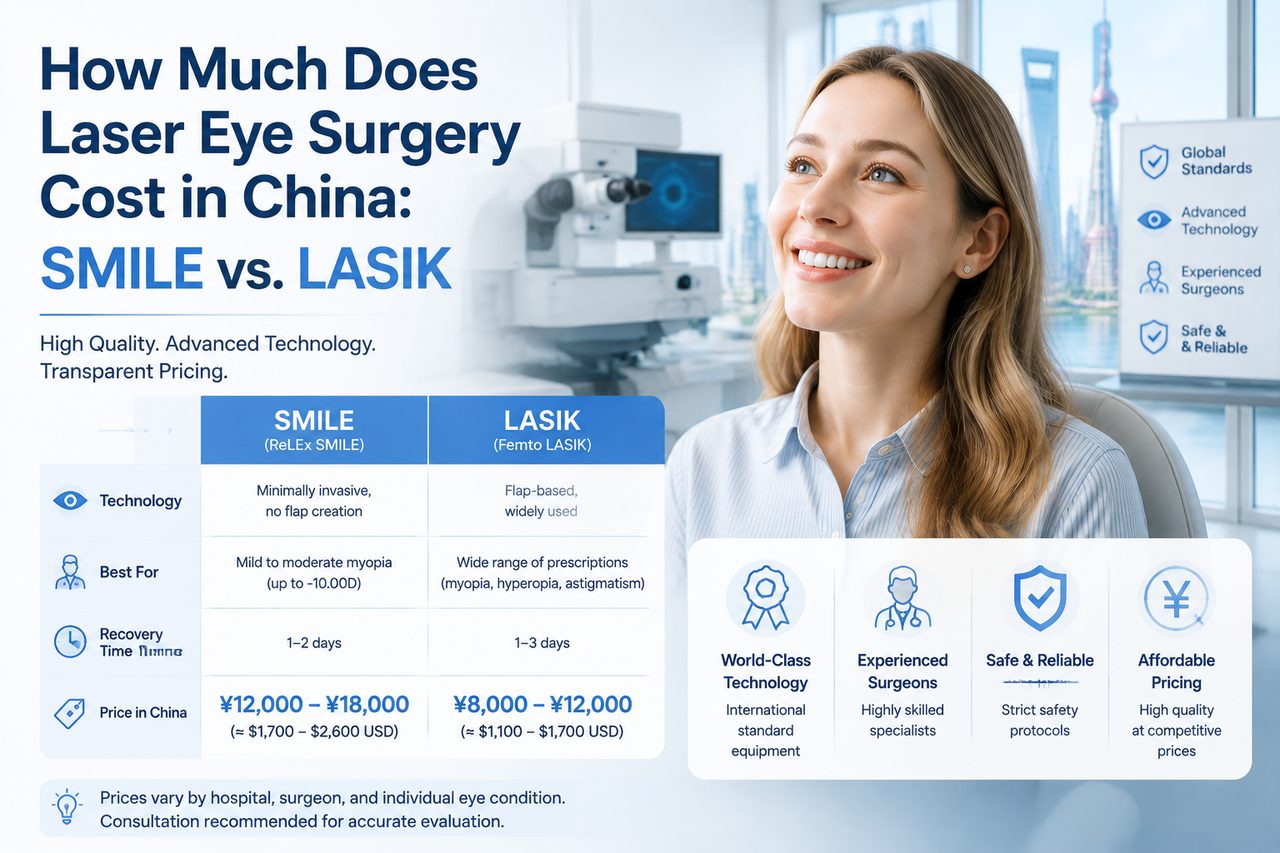
According to data from the International Society of Refractive Surgery, over 4 million SMILE procedures have been performed worldwide since 2016, with China accounting for a significant share of that volume. The SMILE eye surgery cost China hospitals quote typically lands between $2,200 and $4,500 per eye — roughly one-third to one-half of what clinics charge in the United States or Western Europe. That gap explains why patients from Australia, the UK, and the Middle East increasingly look east for refractive surgery.
But a price tag is not a plan. You need to know what drives that range, which hospitals actually perform the procedure at volume, and what happens when things don’t go as expected. Our team has coordinated care for international patients across 37 Chinese cities, and we have watched this procedure evolve from a niche offering to a mainstream option at top-tier ophthalmology departments. Here is the honest breakdown.
How This Actually Works, Step by Step
The process starts before you book a flight. You send us your existing eye exam records — corneal topography, pachymetry, refraction history, and any prior surgical notes. A Chinese ophthalmology team reviews those documents. Sometimes they ask for additional scans. Only after that review do you get a preliminary assessment of whether SMILE is even appropriate for your cornea.
Step two is a video consultation. You speak directly with the surgical team. They explain what they see in your scans, what correction range they can target, and whether your corneal thickness leaves enough tissue for a safe flap-free lenticule extraction. This is where unrealistic expectations get corrected. Not every myope is a SMILE candidate.
Step three is scheduling. Top hospitals do not let you book a surgery date from overseas without a face-to-face exam. You arrive, undergo a same-day comprehensive workup, and the surgeon confirms candidacy. Surgery typically happens one to three days later. You stay for follow-up visits at day one, day seven, and sometimes day thirty depending on your travel window.
We handle the registration, the hospital card creation, the queueing, and the interpretation. You handle showing up and following post-op instructions. That division of labor is what makes the whole thing feasible without speaking Mandarin.
What Determines the SMILE Eye Surgery Cost China Hospitals Quote
The headline number varies for reasons that have nothing to do with marketing. First, the hospital tier. A public Grade A tertiary hospital in Shanghai or Beijing prices differently from a private international clinic. Public hospital international departments typically quote between $2,200 and $3,200 per eye. Private JCI-accredited facilities like United Family or Jiahui run $3,500 to $4,500 per eye because they bundle English-speaking coordination, faster scheduling, and insurance-friendly billing.
Second, the surgeon. A professor who has performed 20,000 SMILE procedures commands a premium over a mid-career attending with 3,000 cases. That premium shows up as a separate “specialist coordination” line item, not as a different surgical fee. Third, the technology generation. Hospitals running the latest Zeiss VisuMax 800 with faster lenticule creation charge more than those still using the VisuMax 500. The newer platform shortens suction time and improves centration, which matters for patients with thinner corneas.
| Hospital Type | Price per Eye (USD) | Typical Inclusions |
|---|---|---|
| Public Grade A, international department | $2,200 – $3,200 | Surgery, standard follow-up, basic interpretation |
| Public Grade A, VIP/Green Channel | $3,000 – $4,000 | Senior surgeon, expedited scheduling, dedicated coordinator |
| Private international hospital (JCI) | $3,500 – $4,500 | English-speaking staff, insurance billing, premium aftercare |
These figures reflect what we have seen in 2025 for patients coming through our coordination service. They exclude travel, accommodation, and any pre-operative diagnostic workup done in your home country. Always confirm what “the package” includes before you wire a deposit.
A Realistic Timeline
People underestimate the lead time. Here is what a typical SMILE journey looks like for an international patient, assuming no complications and a responsive home ophthalmologist.
| Stage | Duration | What Happens |
|---|---|---|
| Remote pre-screening | 5–10 business days | You send records; Chinese team reviews and responds with candidacy assessment |
| Video consultation scheduling | 1–2 weeks | Matching your availability with the surgeon’s clinic hours; document translation if needed |
| Visa processing (S2) | 1–4 weeks | Hospital issues invitation letter; you apply at Chinese embassy or consulate in your country |
| Arrival and in-person exam | Day 1–2 | Comprehensive corneal workup at the hospital; surgeon confirms candidacy |
| Surgery | Day 3–5 | Procedure itself takes 10–15 minutes per eye; you rest for several hours after |
| Early follow-up | Day 7–10 | First post-op check; surgeon assesses flap-free healing and visual acuity |
| Late follow-up or departure | Day 14–30 | Second check or clearance to fly home; written summary for your local optometrist |
Total realistic window: three to six weeks from first email to flying home. Some patients compress this to two weeks by starting the visa process early and accepting a slightly less flexible surgical slot. Others extend it because they want a one-month follow-up before boarding a long-haul flight.
What Can Go Wrong — and What Happens Then
Dry eye. It is the most common post-SMILE complaint, affecting roughly 30% of patients in the first month. Most cases resolve with lubricating drops and time. A minority persist for six months or longer. Chinese ophthalmology departments treat this aggressively with punctal plugs, cyclosporine drops, and meibomian gland therapy — options that are sometimes cheaper and more accessible in China than in Western markets.
Undercorrection or overcorrection. SMILE outcomes cluster tightly, but no surgeon hits plano every time. If your residual refraction bothers you after six months, an enhancement procedure may be possible. That means either PRK on the corneal surface or a secondary lenticule extraction. Enhancement fees vary; some hospitals include one enhancement within the first year, others charge separately. Ask before surgery.
The candidacy rejection. This is the failure mode nobody talks about in marketing materials. You fly to Shanghai, the in-person exam reveals corneal irregularity that remote scans missed, and the surgeon says no. It happens in roughly 5–8% of our pre-screened cases. What then? You either pivot to a different procedure (PRK, ICL, or no surgery) or you go home. Your surgery deposit should be refundable in this scenario. Ours always is, because we coordinate through official hospital channels, not third-party brokers.
Is SMILE Eye Surgery Safe in China? What the Volume Data Shows
The question is fair. Foreign patients often assume that lower prices mean lower standards. The evidence points the other way. China’s top ophthalmology centers perform SMILE at volumes that dwarf most Western clinics. A single high-volume department in Shanghai may complete more SMILE procedures in a month than a typical European clinic does in a year.
That volume matters for two reasons. First, surgical skill is a volume game. The learning curve for SMILE is real — studies published in the Journal of Refractive Surgery show that complication rates drop significantly after a surgeon’s first 500 cases. At China’s busiest centers, senior surgeons have crossed 10,000 cases. Second, complication management is a volume game. When a rare event occurs — a suction loss, a lenticule tear — you want a team that has seen it dozens of times, not twice.
The safety question also hinges on equipment. The top-ranked hospitals in our database use the same Zeiss VisuMax platforms found in London, Sydney, and Singapore. The difference is throughput. Chinese hospitals amortize the equipment cost across far more patients, which is part of why the laser eye surgery price abroad undercuts Western rates without cutting corners.
Best Eye Hospital for SMILE in China: How to Choose Without Speaking Mandarin
There is no single “best” hospital for every patient. There is a best hospital for your cornea, your budget, and your tolerance for logistics. Here is how we help patients narrow the field.
Start with the Fudan University hospital rankings. The ophthalmology specialty list ranks China’s top ten eye departments. Shanghai’s Eye and ENT Hospital of Fudan University and Beijing’s Tongren Hospital both appear consistently. These are public institutions with enormous case volume and faculty who publish in international journals. They are also crowded, and the standard outpatient route requires navigating Chinese-language registration systems. The international department or VIP channel changes that equation — Shanghai and Beijing both have well-established international patient pathways for ophthalmology.
Then consider private options. Private international hospitals like United Family and Jiahui offer SMILE with English-speaking staff and Western-style consent processes. You pay more, but the friction drops. Some patients choose a hybrid: remote pre-screening at a public hospital, surgery at a private facility, follow-up wherever is convenient.
Practical Considerations: Records, Visa, Payment, and Follow-Up at Home
You need your medical records in order before you contact any Chinese hospital. That means a recent corneal topography (within three months), pachymetry, manifest refraction, and a statement of refractive stability. If your prescription changed in the last 12 months, most surgeons will ask you to wait. Bring everything in English; if your records are in another language, arrange translation before you travel.
The visa category matters. Medical travelers use an S2 visa — not an M visa, which is for commercial and trade activities. The hospital issues an invitation letter confirming your treatment plan. You apply with that letter at a Chinese embassy or consulate. Processing time varies by country; budget four weeks to be safe. Family members accompanying you apply for their own S2 visas.
Payment is almost always prepaid at public hospitals. International departments accept wire transfers and major credit cards. Private international hospitals may bill your insurer directly, but confirm this before you commit. Most foreign insurance plans do not cover elective refractive surgery, so expect to pay out of pocket regardless of hospital type.
Follow-up at home is underdiscussed. You need a local optometrist or ophthalmologist willing to see you at one week, one month, three months, and six months after surgery. The Chinese hospital will provide a written discharge summary and post-op protocol. Your home provider reviews it and manages any late complications. We have seen patients skip this step and regret it when a minor issue became a bigger one.
How Much Is SMILE Surgery in Shanghai Compared to Other Chinese Cities
Shanghai sits at the higher end of the Chinese pricing spectrum. That reflects concentration of top-ranked ophthalmology departments and the cost of operating in China’s most expensive city. Expect to pay $2,800 to $4,200 per eye at Shanghai’s public international departments, and $3,800 to $4,500 at private facilities. Chengdu and Hangzhou often price 10–20% lower for comparable surgical expertise, because overhead is cheaper. Guangzhou splits the difference.
The price difference is not a quality signal. It is a real estate and labor cost signal. A surgeon trained at Fudan who now practices in Chengdu does not suddenly become less skilled because the rent is lower. If budget is your primary constraint and you are flexible on city, you can save meaningful money without sacrificing outcomes.
That said, Shanghai’s advantage is infrastructure. More international flights, more English-speaking support staff, more hotels accustomed to post-surgical guests. For a first-time medical traveler, that convenience may justify the premium. For a repeat visitor or someone with family in China, the secondary cities make more sense.
Can You Book a SMILE Eye Surgery Package in China Before You Arrive?
You can book a coordination package. You cannot book a surgical slot without an in-person exam. Any provider that promises a confirmed surgery date before you land is cutting corners. The legitimate sequence is: remote pre-screening, video consultation, travel, in-person exam, surgery. The surgery date gets locked only after that exam.
What a package typically includes: hospital registration, medical card creation, appointment scheduling, bilingual companion for the exam and surgery day, interpretation during consent conversations, and coordination of follow-up visits. Our coordination service handles all of this. What it does not include: the surgical fee itself, which you pay directly to the hospital, and any pre-operative diagnostics performed in your home country.
Frequently Asked Questions
Plan on $4,400 to $9,000 for both eyes depending on hospital type and city. Public international departments sit at the lower end; private JCI facilities at the higher end. This excludes travel and accommodation. Some hospitals offer a small discount for bilateral same-day surgery, but not all do.
At top-ranked Chinese ophthalmology departments, safety profiles match international benchmarks. The key variables are surgeon volume, equipment generation, and pre-operative screening rigor. China’s busiest centers outperform many Western clinics on volume, which correlates with lower complication rates. Choose a Fudan-ranked department or a JCI-accredited private hospital, not a discount clinic.
You have options. The surgeon may recommend PRK, ICL, or no surgery. If you pre-screened remotely and the in-person exam contradicts that assessment, your surgery deposit should be refundable. Confirm this policy in writing before you travel. A good coordination service will have already discussed alternative procedures with you during the video consultation.
Yes. Medical travelers use an S2 visa, which covers short-term private affairs including medical treatment. The hospital provides an invitation letter confirming your treatment plan. Apply well in advance — processing takes one to four weeks depending on your country. Accompanying family members need their own S2 visas.
Your Next Step
The SMILE eye surgery cost China hospitals quote is only one part of a larger decision. The right surgeon, the right pre-screening, and the right post-op plan matter more than saving another $500. Our team at China Medical Services coordinates care across 340+ top-ranked hospitals in 37 cities — we handle records review, hospital matching, visa documentation, and bilingual accompaniment. We do not perform surgery, and we do not promise outcomes. What we offer is a clear-eyed path from “considering it” to “recovered and home.” Start with a free consultation; we will tell you honestly whether SMILE in China makes sense for your eyes.
For more medical information and treatment options in China, visit chinamedservices.com (China Medical Services).
