Medical Imaging in China: How Scans Work, What They Cost, and How to Book One
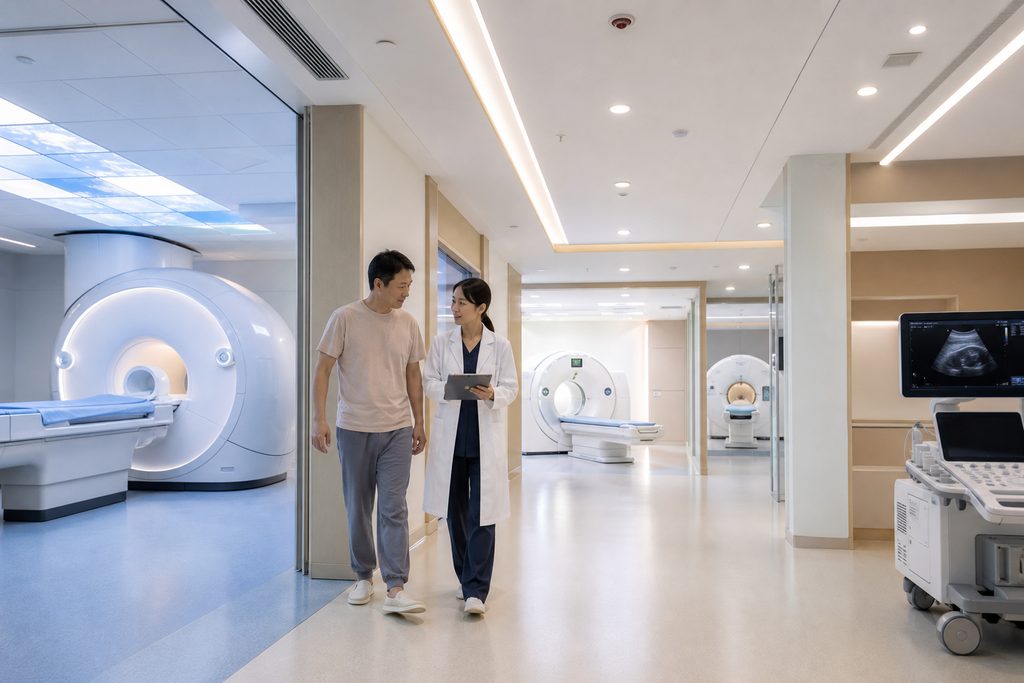
You have probably heard that getting an MRI or CT scan abroad means either waiting months in a public system or paying thousands of dollars out of pocket. The reality in China does not fit that picture. A top-tier MRI at a Fudan-ranked hospital in Shanghai often costs between $100 and $250, and you can typically schedule it within days, not months. The medical imaging cost China offers international patients is one of the most dramatic price differences in global healthcare, alongside high-volume clinical experience that Western radiologists rarely see.
But the process is not as simple as walking in and asking for a scan. Chinese public hospitals operate on a same-day registration system for outpatient visits. You cannot book most imaging appointments from overseas through a standard portal. You need a local strategy. Our team at China Medical Services coordinates imaging appointments for foreign patients every week, and this guide explains exactly how the system works from the inside.
How This Actually Works, Step by Step
Here is the real sequence for getting medical imaging done in China as an international patient. No abstractions, just the concrete path.
Step 1: You send us your existing records. If you have a referral letter, previous scans, or a doctor’s note describing what needs to be imaged, that goes to our coordination team. If you do not have a referral, you can still proceed — many Chinese hospitals accept self-referred imaging requests, though a clinical indication helps the radiology department protocol the scan correctly.
Step 2: We match you to a hospital. Not every facility suits every scan. A specialty-ranked hospital may be ideal for a cardiac CT but overkill for a routine knee MRI. We consider your scan type, your location preference, your budget, and whether you need English-speaking staff or direct insurance billing.
Step 3: The hospital reviews and confirms. The radiology department checks your records and confirms the scan can proceed. Some scans require pre-authorization — contrast-enhanced CT, for example, needs a kidney function test first. PET scans often require blood glucose screening on the day of the scan. These checks happen before you travel.
Step 4: You arrive and complete the scan. On the day, a bilingual medical companion meets you, handles registration and payment, guides you to the right department, and stays with you through the process. Most MRI scans take 20 to 45 minutes. CT scans are faster, usually 10 to 15 minutes.
Step 5: You receive the images and report. Chinese hospitals typically issue a written radiology report within 24 to 48 hours. You get the DICOM files on a disc or via digital transfer, plus a translated summary if you need it for your doctor back home.
How Does a CT Scan Work in China, and What Should You Expect?
How does a CT scan work in China compared to the US or Europe? The machine is the same. Siemens, GE, and Canon supply most Chinese hospitals with the same scanners you would find at Johns Hopkins or Charité. A 64-slice CT is now standard at tier-one hospitals, and many top centers run 256-slice or dual-source scanners. The difference is operational, not technological.
Chinese radiology departments run at extraordinary volume. A major Shanghai hospital might perform 800 to 1,200 CT scans per day. That volume means two things. First, technicians are exceptionally practiced — they position patients quickly and correctly. Second, the workflow is streamlined. You will not sit in a waiting room for three hours. You will be in and out, often within 45 minutes total.
What surprises most Western patients is the pace. You register, pay, change into a gown if needed, get scanned, and leave. The report follows later. If you need contrast, you will wait 15 to 20 minutes after the injection for observation. That is standard everywhere, not just China.
But that same volume creates friction if you do not speak Chinese. Signage is often bilingual in international departments, but the main public radiology floors are not. Queues move fast, numbers are called in Mandarin, and payment windows expect local payment apps. This is where a companion changes the experience from stressful to routine.
What Medical Imaging Actually Costs in China
Let us look at the numbers. These are reference ranges for self-pay international patients at top-tier public hospital international departments and JCI-accredited private hospitals. Prices vary by hospital tier, city, and case complexity.
| Imaging Type | China (Self-Pay, USD) | United States (USD) | United Kingdom Private (USD) |
|---|---|---|---|
| MRI (single region, no contrast) | $100 – $250 | $1,200 – $3,000 | $600 – $1,500 |
| CT scan (chest/abdomen, no contrast) | $80 – $200 | $800 – $2,500 | $500 – $1,200 |
| PET-CT (whole body) | $600 – $1,200 | $3,000 – $6,000 | $2,500 – $4,500 |
| Full body MRI screening | $800 – $2,000 | $3,500 – $8,000 | $2,000 – $5,000 |
| Ultrasound (abdominal) | $30 – $80 | $300 – $700 | $150 – $400 |
These figures explain why patients increasingly compare medical imaging prices abroad before booking locally. The savings on a single PET-CT can cover a round-trip flight from Europe or the Middle East, plus accommodation, several times over. The gap is widest for advanced modalities — PET-CT and full-body MRI — where Western prices have climbed sharply while Chinese hospital pricing has stayed relatively stable.
Best Hospital for MRI in Shanghai and Other Imaging Hubs
If you are searching for the best hospital for MRI in Shanghai, the answer depends on what you need imaged. Shanghai has 18 hospitals on the Fudan Top 100 list — the highest concentration after Beijing. For neuroimaging, Huashan Hospital is the reference center. For cardiac MRI, Zhongshan Hospital Fudan University runs one of the most experienced cardiac imaging programs in Asia. For oncology staging, Fudan University Shanghai Cancer Center handles enormous PET-CT and MRI volumes.
Beijing offers comparable depth. Can I get a PET scan in Beijing? Yes — and quickly. Peking Union Medical College Hospital (PUMCH) and Cancer Hospital Chinese Academy of Medical Sciences both operate PET-CT scanners with same-week availability for international patients in most cases. Beijing has 21 Fudan Top 100 hospitals, the most of any city.
Other cities worth considering: Guangzhou for hepatobiliary imaging, Chengdu for musculoskeletal MRI at West China Hospital, and Shenzhen for private international facilities with direct insurance billing. The full list of top-ranked hospitals by city gives you a clearer picture of geographic options.
For patients who want a Western-style experience from start to finish, JCI-accredited private hospitals like United Family and Jiahui offer English-speaking radiologists, direct billing with international insurers, and appointment booking by email or phone. You pay more — typically 1.5 to 2 times the international department rate — but the friction drops to near zero.
A Realistic Timeline
Here is what a typical imaging trip to China looks like, from first contact to walking out with results. These are realistic ranges based on what we coordinate regularly.
| Stage | What Happens | Realistic Duration |
|---|---|---|
| Day 1–2 | You send records and scan request; we confirm feasibility with the hospital | 1–2 days |
| Day 3–7 | Hospital reviews records, confirms protocol, sets appointment slot | 3–5 business days |
| Week 1–2 | Visa application (S2 visa for medical treatment) and travel booking | 5–10 business days for visa processing |
| Week 2–3 | Arrival in China; scan completed on appointment day | 1 day on-site |
| Day after scan | Preliminary report available; final report within 48 hours | 24–48 hours |
| Week 3–4 | Follow-up consultation (remote or on-site) to discuss findings | Within 1 week of scan |
The waiting steps people forget: document translation, appointment lead time at the specific hospital, and visa processing. China’s S2 visa is the correct category for short-term medical treatment and private affairs. It typically processes in 5 to 10 business days at most embassies, but that assumes your paperwork is complete. Hospital confirmation letters and appointment confirmations help. We guide patients through this every week.
One more thing. If you want a book full body scan China experience — a comprehensive screening MRI or PET-CT — the timeline stretches slightly. Full-body protocols need more scheduling coordination, and some hospitals require a preliminary consultation first. Budget two to three weeks from first contact to scan day for full-body screenings.
What Can Go Wrong — and What Happens Then
Honesty matters here. Things do go wrong, and you should know what that looks like before you book a flight.
The hospital rejects your scan request. This happens. A radiologist reviews your records and decides the scan is not clinically indicated, or that a different modality is more appropriate. What happens then: we relay the reasoning, suggest the alternative, and re-coordinate. You are not charged for the rejected scan. If we cannot secure the appointment, our coordination fee is refunded in full.
Your scan gets rescheduled. Public hospital radiology departments handle emergencies. An inpatient emergency can bump your outpatient slot. This is rare in international departments but not impossible. Recourse: we rebook for the next available slot, usually within 24 to 48 hours. This is one reason we recommend staying at least one buffer day in the city.
The report is in Chinese. Standard department reports are always in Chinese. International departments usually provide English summaries, but not always the full report. Recourse: we arrange translation through the hospital or a certified medical translator. Budget $50 to $150 for a full report translation, depending on length.
Your home doctor cannot read the DICOM files. Some Western clinics have proprietary systems that reject external discs. Recourse: we request digital transfer via secure link, or provide the images in a format your doctor can access. This is a known friction point, and it is solvable.
You need a follow-up scan after you go home. Chinese hospitals are generally willing to compare new scans with old ones if you send the new images back. But coordination across time zones takes patience. We handle this for patients who want continuity.
How to Evaluate a Hospital for Imaging: What the Numbers Actually Mean
Most patients look at price first. That is understandable, but it is the wrong starting point. Here is what actually matters when you compare imaging providers in China.
Scanner generation and field strength. For MRI, you want at least a 1.5T scanner for routine imaging and a 3T scanner for neuro, musculoskeletal, or prostate imaging. For CT, 64-slice is the minimum for diagnostic quality; 128-slice or higher is better for cardiac and vascular work. For PET-CT, look for time-of-flight (TOF) capability. These specifications are published, and we can confirm them for any hospital you are considering.
Radiologist subspecialty. A general radiologist reading a prostate MRI is not the same as a genitourinary radiologist reading it. Top Chinese hospitals assign subspecialists to complex cases. Fudan-ranked oncology and neurology centers have dedicated subspecialty teams. Ask who reads the scan, not just who performs it.
International department versus standard department. The scanner is often the same. The difference is the workflow around it: English-speaking staff, appointment management, report translation, and a less chaotic environment. For most international patients, the international department is worth the premium. For budget-conscious patients with language support, standard departments are viable.
Accreditation. JCI accreditation signals that a hospital meets international patient-safety standards. Fudan ranking signals clinical excellence within China. The two are not the same thing. A hospital can be Fudan-ranked but not JCI-accredited. For imaging specifically, both matter less than scanner specs and radiologist expertise, but they are useful proxies for overall quality.
And a note on medical imaging cost China comparisons: the cheapest option is not always the best value. A $60 CT at a small regional hospital may use an older scanner and a general radiologist. A $150 CT at a Fudan-ranked center uses a newer scanner and a subspecialist reader. The $90 difference is trivial compared to the cost of a missed finding.
Practical Considerations: Records, Visa, Payment, and Follow-Up
Here is what you actually need to handle before and after your scan.
Medical records. Bring any previous scans on disc, plus written reports if available. If your previous imaging is more than six months old for a progressive condition, the radiologist may recommend repeating it anyway. Bring your referral letter if you have one — it helps the radiology department protocol the correct sequences.
Visa. The S2 visa is the correct category for short-term medical treatment in China. You will need an invitation letter or supporting documents from the hospital, plus your passport and application forms. Processing takes 5 to 10 business days at most embassies. Apply early. Do not book non-refundable flights before your visa is approved.
Payment. Public hospital international departments generally require prepayment. Most accept international credit cards, but some only accept UnionPay or Chinese payment apps. We confirm payment methods before you travel. Private international hospitals usually accept major credit cards and direct insurance billing. If you plan to claim reimbursement from your insurer, get an itemized invoice and the report in English.
Insurance. Some international insurers cover imaging in China if the facility is JCI-accredited or on their approved list. Others require pre-authorization. Check before you book. We can provide the documentation insurers typically request.
Language. Without Chinese language ability, a bilingual companion is not a luxury. It is the difference between a 45-minute visit and a three-hour ordeal. Companions handle registration, payment, queueing, and translation. The cost is from $300 per day, and it is the single highest-value service we provide for imaging patients.
Follow-up at home. Chinese radiologists write reports in a structured format that Western doctors generally find readable. But terminology sometimes differs. If your home doctor has questions, we can arrange a follow-up video consultation with the Chinese radiologist or a relevant specialist. That consultation costs $100 to $300 for a standard international department physician.
Frequently Asked Questions
Yes, through a hospital’s international department or a coordination service like ours. Standard public departments do not accept overseas booking. International departments and private hospitals do. You send your records, the hospital confirms the scan is appropriate, and an appointment slot is reserved before you travel.
The equipment is the same — Siemens, GE, Philips, and Canon supply Chinese hospitals with current-generation scanners. Top-tier centers run 3T MRI, dual-source CT, and time-of-flight PET-CT machines. The bigger variable is radiologist subspecialization, which is strong at Fudan-ranked centers and more variable at smaller facilities.
What if my home doctor questions the Chinese radiology report?
This happens. The easiest resolution is a follow-up video consultation with the Chinese radiologist or a relevant specialist to clarify findings. We can also arrange a written
For more medical information and treatment options in China, visit chinamedservices.com (China Medical Services).
