Airport Pickup in China for Patients: How Hospital Transfers Actually Work
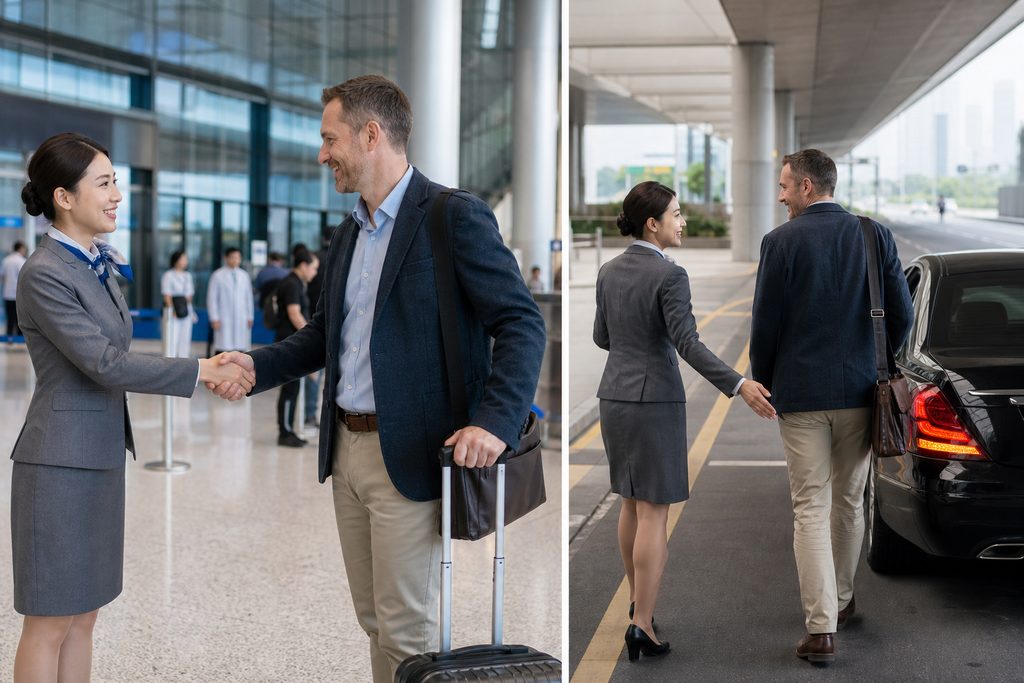
Airport Pickup for International Patients in China: What Actually Happens After You Land
According to data from China’s National Immigration Administration, over 35 million foreigners entered China in 2024 for various purposes, including medical treatment. When you land at Shanghai Pudong International Airport after a 14-hour flight, groggy and possibly in pain, the last thing you want is to navigate an unfamiliar transit system with medical documents in hand. Airport pickup for international patients China is not a luxury add-on. It is the first clinical logistics decision you will make, and getting it wrong can delay your first consultation by hours or even a full day.
This guide explains how airport pickup actually works for medical travelers in China, what it costs, whether hospitals include it in their packages, and how to evaluate your options without overpaying. We have coordinated arrivals for patients flying into Beijing, Shanghai, Guangzhou, and Chengdu, and the questions below are the ones every patient asks before booking a flight.
Key Takeaways
- Most Chinese public hospitals do not include airport pickup in standard treatment packages; it is typically arranged separately through the hospital’s international department or a third-party coordinator.
- A private airport transfer booked in advance costs approximately $200 round-trip in major cities, while ride-hailing apps like Didi cost $15–40 one-way but require a Chinese phone number and payment setup.
- Your pickup driver or coordinator is not a medical professional; if you need medical supervision during transit, a dedicated ambulance transfer must be arranged through the hospital, not a standard car service.
- Confirm the pickup point, vehicle type, and driver contact method at least 48 hours before departure; Chinese airports have multiple arrival halls and international exits that confuse even experienced travelers.
The Problem: Landing in an Unfamiliar Airport System While Managing a Medical Condition
Some top hospitals in Shanghai and Beijing do offer airport pickup through their international medical centers or VIP departments. Peking Union Medical College Hospital and Shanghai’s Zhongshan Hospital, for example, have international patient services that can arrange transfers for patients who have already confirmed an appointment through their international channels. The advantage is clear: the hospital knows your arrival time, your consultation schedule, and your mobility needs. The driver is usually familiar with the exact building entrance where your department is located.
But the limitation is equally clear. Hospital-arranged transfers are generally only available to patients who have already booked through the hospital’s international or VIP pathway. If you are planning to register as a regular outpatient—which is significantly cheaper but requires same-day queuing—you will not have access to this service. And even when it is available, hospital communication about pickup logistics can be sparse. You may receive a driver’s phone number via WeChat with minimal English support.
Third-Party Medical Coordinators: The Middle Ground
This is where organizations like China Medical Services fit. A coordinator arranges the vehicle, confirms your flight details, monitors for delays, and ensures the driver knows which terminal and exit to use. The coordinator also acts as the communication bridge—you message them in English, they relay instructions to the driver in Chinese. For patients who do not speak Mandarin, this single function can save hours of confusion.
Typical cost for this service runs from $200 round-trip in most major cities, though the exact figure varies by hospital and case complexity. The vehicle is usually a standard sedan or SUV, not an ambulance. If you require medical supervision during transit—oxygen, a nurse, wheelchair assistance beyond basic help—that is a different service entirely and must be arranged through the hospital’s clinical team, not a transportation provider.
Ride-Hailing Apps: Cheap, but Not for Everyone
Didi, China’s dominant ride-hailing platform, operates at both Beijing and Shanghai airports and costs roughly $15–40 one-way depending on distance and vehicle class. The app has an English interface. But here is the catch: Didi requires a Chinese phone number for account verification, and payment is typically processed through WeChat Pay or Alipay, both of which require linking an international card—a process that works inconsistently for foreign cards. If your card is declined, you are standing at the curb with no ride and no backup plan.
For a healthy tourist, this is an inconvenience. For a medical patient, it is an unacceptable risk. We have seen patients attempt Didi on arrival and spend 45 minutes troubleshooting payment while their consultation window narrowed.
Is Airport Pickup Included in Medical Packages in China? The Honest Answer
The short answer: rarely, and never assume it is. Some private international hospitals—United Family, Jiahui, Parkway—may bundle airport transfer into their premium health screening packages or executive checkup programs. These packages typically cost several thousand dollars and are marketed to health-conscious travelers rather than patients with acute conditions. For treatment-focused care at public hospitals, airport pickup is almost never included in the standard fee structure.
This surprises many patients. They assume that because they are paying for surgery or a complex diagnostic workup, transportation should be part of the deal. But Chinese public hospitals operate on a fee-for-service model where each component—consultation, imaging, laboratory work, medication, hospital stay—is billed separately. Transportation is not a clinical service, so it falls outside the billing system entirely.
What this means in practice: when you are comparing hospital quotes, ask explicitly whether airport transfer is included. If the answer is vague, assume it is not. Budget for it separately. A $200 round-trip transfer is a rounding error compared to a $15,000 cardiac procedure, but failing to plan for it can create disproportionate stress on arrival day.
Best Hospitals with Airport Pickup in Shanghai: What to Look For
Shanghai is the most common entry point for international medical travelers, and for good reason. The city has 18 hospitals ranked in the Fudan University Top 100 list, second only to Beijing’s 21. Its international airport is well-connected to Europe, the Middle East, and Southeast Asia. And its medical infrastructure includes both top-tier public institutions and a growing network of private international hospitals.
When patients ask us about the best hospital with airport pickup Shanghai, the real question is usually broader: which Shanghai hospitals are equipped to serve international patients at all? The answer splits into two categories. Public hospitals like Zhongshan Hospital Fudan University and Ruijin Hospital have international medical departments that can arrange transfers for patients booked through those channels. Private hospitals like Jiahui and United Family Shanghai are more likely to include or offer airport pickup as a standard service, with English-speaking staff coordinating directly.
But here is the nuance: choosing a hospital based on airport pickup availability is backwards. Pick the hospital based on your medical condition and the specialist you need. Transportation can always be arranged separately. What cannot be fixed later is choosing a hospital that lacks the right clinical expertise for your case. Use airport pickup as one factor among many, not the deciding one.
What Airport Pickup Costs—and What You Are Actually Paying For
Medical tourism China airport transfer cost varies by city, distance, vehicle type, and service level. The figures below reflect typical ranges for international patients booking through a coordinator or hospital international department, not ride-hailing apps.
| Service Type | Typical Cost (USD) | What’s Included | Best For |
|---|---|---|---|
| Standard private car (one-way) | $50–100 | Sedan or SUV, driver only, basic English support via coordinator | Patients traveling independently with light luggage |
| Round-trip private transfer | $200 | Both airport trips, flight monitoring, English-speaking coordinator | Most medical travelers; the default option we recommend |
| Hospital-arranged transfer | $80–150 one-way | Hospital coordination, driver familiar with medical campus | Patients already booked through hospital international department |
| Ambulance or medical-supervised transfer | $300–800 one-way | Medical staff, oxygen if needed, stretcher or wheelchair support | Post-surgical patients, those with mobility or respiratory issues |
These are reference ranges, not quotes. Final pricing varies by hospital and case complexity. What you are paying for in a coordinated pickup is not the car itself—it is the certainty that someone is tracking your flight, waiting at the correct exit, and communicating with you in English if something goes wrong. That certainty has real value when you are arriving for medical care.
How to Book a Medical Trip to China with Airport Transfer: A Step-by-Step Timeline
Booking a medical trip to China with airport transfer is not complicated, but the sequence matters. Patients who do things in the wrong order end up with a pickup arranged but no hospital appointment, or a hospital appointment but no way to get there. Here is the order that works.
Step 1: Secure your medical consultation first. This is non-negotiable. Whether you are working with a hospital’s international department directly or using a coordinator, the clinical appointment is the anchor. Everything else schedules around it. If you need help identifying the right hospital or specialist, a written second opinion or video consultation is the most cost-effective way to narrow your options before traveling. Expect to pay $100–800 depending on the level of specialist involvement.
Step 2: Book flights with a buffer day. Give yourself at least one full day between landing and your first consultation. Jet lag, flight delays, and immigration queues are real. A buffer day also gives you time to rest, which matters more than patients expect.
Step 3: Arrange airport pickup at least 72 hours before departure. Provide your flight number, arrival terminal (if known), and any mobility requirements. The coordinator or hospital will confirm the pickup point. At Shanghai Pudong, for example, pre-arranged drivers typically meet passengers at the international arrivals exit with a name sign.
Step 4: Confirm the driver’s contact method. You should receive a WeChat ID or Chinese phone number for the driver, plus a backup contact. If you do not have WeChat installed, install it before you fly. It is the default communication tool in China.
Step 5: On arrival, follow the signs to international arrivals, clear immigration, collect luggage, and exit through the designated door. Your driver or coordinator will have told you which exit. If you cannot find them, message your coordinator—not the driver—unless the driver speaks English.
Practical tip: Screenshot your coordinator’s contact information and the pickup instructions before you board your flight. Airport Wi-Fi in China requires a Chinese phone number for SMS verification, so you may not have internet access immediately after landing. A screenshot works offline.
Common Mistakes That Turn a Simple Pickup into a Disaster
Most airport pickup failures are preventable. They happen not because the system is broken, but because patients make assumptions that do not hold in China. Here are the mistakes we see most often.
Assuming the driver speaks English. Most do not. Even drivers working with international patient departments often have limited English. The coordinator is your communication layer. If you booked through a hospital and they gave you a driver’s number directly, expect to use translation apps or have the hospital staff relay messages.
Not confirming the terminal. Beijing Capital International Airport has three terminals. Shanghai Pudong has two main terminals plus satellite concourses. If your flight arrives at Terminal 1 and the driver is waiting at Terminal 2, you have a problem. Always confirm the terminal in writing before departure.
Forgetting about luggage. Medical travelers often bring more luggage than tourists—documents, medical equipment, medications, comfortable clothing for extended stays. A standard sedan may not fit everything. If you are traveling with more than two large suitcases, request an SUV or van explicitly.
Arriving without Chinese currency or payment setup. Even if your transfer is prepaid, you will need money for incidentals. Set up Alipay or WeChat Pay with an international card before departure, or carry a small amount of RMB for emergencies. ATMs at Chinese airports work with international cards, but exchange rates and fees vary.
Not communicating mobility needs in advance. If you use a wheelchair, walker, or need assistance getting into the vehicle, say so when booking. Standard drivers are not trained to assist with mobility limitations. A coordinator can arrange a vehicle with appropriate access or recommend an alternative.
Practical Considerations: Visa, Documentation, and What to Carry
Airport pickup is one piece of a larger logistical puzzle. Before you land, there are several other things to handle. The visa category for medical treatment in China is the S2 visa, which covers short-term private affairs including medical treatment. Accompanying family members also apply for S2 visas. The S1 visa applies for stays exceeding 180 days. There is no such thing as a “medical visa” in China—the M visa is for commercial and trade activities only, and using it for medical treatment would be incorrect.
Visa approval is never guaranteed. You will need supporting documents from the hospital, including an invitation letter or treatment confirmation. Processing times vary by embassy and country, so start the visa process as soon as your hospital appointment is confirmed. Do not book non-refundable flights until your visa is in hand.
For payment, Chinese public hospitals typically require prepayment for services, with international patients expected to settle bills before discharge. International credit cards are accepted at hospital international departments and private hospitals, but not always at public hospital cashier windows. Insurance reimbursement works differently depending on your provider—most international patients pay upfront and submit claims afterward, though some private hospitals in China offer direct billing with major international insurers.
Language remains the biggest practical barrier. Even at top hospitals with international departments, the moment you step outside that department, signage and staff communication shift to Mandarin. A bilingual medical companion—available from $300 per day—can handle registration, queueing, payment, and translation during your hospital visits. This is not a luxury for patients who do not speak Chinese; it is the difference between navigating the system and being lost in it.
Important: Do not assume your airport pickup driver can also serve as your hospital translator. These are different services with different skill sets. A driver gets you to the hospital. A bilingual medical companion helps you function once you are inside.
Frequently Asked Questions
Is airport pickup included in medical packages in China?
Usually not. Some private international hospitals bundle airport transfer into premium health screening packages, but public hospitals almost never include it in treatment fees. Always ask explicitly and budget for it separately if it is not confirmed in writing.
How much does airport pickup cost for international patients in China?
A standard private car transfer costs $50–100 one-way or
For more medical information and treatment options in China, visit chinamedservices.com (China Medical Services).
