PET-CT Scan in China: Duration, Cost & Booking Timeline Explained
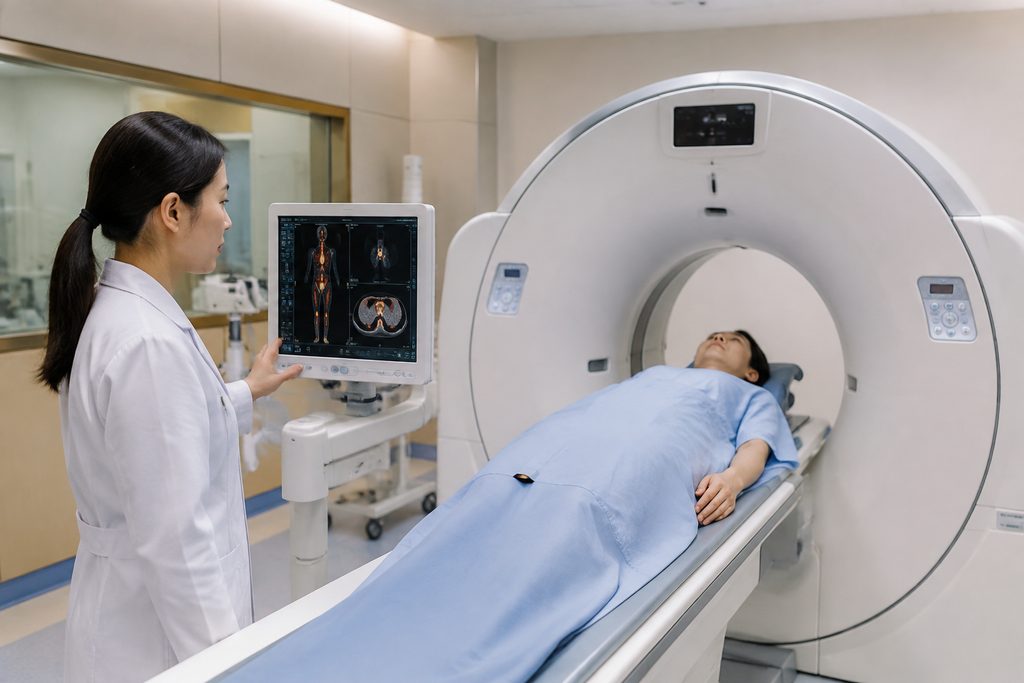
How Long Does a PET-CT Scan Take in China? The Short Answer
The scan itself takes 20 to 40 minutes on the table. But the total appointment runs 2 to 3 hours. That includes check-in, blood sugar testing, tracer injection, a 60-minute quiet uptake period, and the imaging itself. If you are traveling from abroad, the full process—from first contact with a hospital to receiving your report—typically spans 3 to 7 days.
That longer window matters. You are not just booking a slot. You are coordinating hospital registration, pre-scan preparation, the scan, and a radiologist’s written interpretation. Some hospitals deliver same-day preliminary findings. Others release the formal report within 24 to 48 hours. A lot depends on which hospital tier you use and whether you go through an international patient pathway.
Who This Is Right For — and Who It Isn’t
PET-CT combines positron emission tomography with computed tomography. It shows metabolic activity layered over anatomical structure. Oncologists use it for staging, restaging, and treatment response assessment. Cardiologists and neurologists use it in specific scenarios. A PET-CT scan in China is a serious diagnostic tool, not a routine screening test for healthy people.
Who typically benefits from traveling to China for this scan:
- Patients with a confirmed or suspected malignancy who need precise staging before surgery or systemic therapy
- Patients whose conventional imaging (CT, MRI, ultrasound) produced ambiguous results
- Patients who need a baseline study before starting expensive treatment, to later measure response
- Patients seeking a second opinion where a PET-CT from a high-volume Chinese hospital adds diagnostic clarity
Who should think twice:
- Healthy individuals with no clinical indication. Whole-body PET-CT “screening” is not recommended by any major oncology society, and the radiation dose is not trivial
- Pregnant or breastfeeding women, except in rare cases where the clinical need outweighs risk and after explicit discussion with a nuclear medicine physician
- Patients whose diabetes is poorly controlled. Blood glucose above 200 mg/dL (11.1 mmol/L) can significantly degrade image quality, and the scan may need rescheduling
- Patients who cannot lie flat and still for 20–40 minutes due to severe pain, claustrophobia, or neurological conditions
Being explicit about who should not pursue this scan is what makes the rest of this guide credible. If you are unsure whether PET-CT is indicated for your situation, a remote written second opinion from a Chinese oncology department can clarify that before you spend money on travel.
The Options, Compared
Where you get a PET-CT scan in China changes the cost, the language experience, and the wait time. The table below compares the three realistic pathways available to international patients.
| Pathway | Typical PET-CT scan cost China | Wait Time for Scan | Language Support | Insurance Handling |
|---|---|---|---|---|
| Public hospital, standard outpatient | $700 – $1,200 | 3–10 days | Limited; Chinese forms and signage | Pay upfront, claim later |
| Public hospital, international/VIP department | $1,000 – $1,800 | 1–3 days | English-speaking coordinators | Pay upfront, itemized receipt for claims |
| Private international hospital (JCI-accredited) | $1,500 – $2,500 | Same day to 48 hours | Full English service | Direct billing with many global insurers |
The standard outpatient route is cheapest but hardest to navigate without Chinese language skills. The international department route is the middle path—real access to top public hospital equipment and radiologists, with coordination support, at roughly 1.5 to 2 times the standard price. Private international hospitals are the most convenient and familiar for Western patients, but you pay for that comfort. Fuwai Hospital and Peking Union Medical College Hospital, both in Beijing, are examples of public institutions with established international patient services. In Shanghai, Zhongshan Hospital Fudan University runs a well-organized international medical center.
What a PET-CT Scan Procedure Is Like in Shanghai
Shanghai is the most common entry point for international patients seeking diagnostic imaging in China. The city has multiple hospitals with modern PET-CT equipment and international patient pathways. Knowing what a PET-CT scan procedure is like in Shanghai helps you plan realistically.
Here is the typical flow at a Shanghai hospital’s nuclear medicine department:
- Arrival and registration: You check in at the nuclear medicine reception. Staff verify your identity, your referral documents, and your fasting status.
- Blood glucose check: A finger-prick test confirms your glucose level is within the acceptable range. If it is too high, the scan is rescheduled—this is non-negotiable at every reputable facility.
- Tracer injection: A technologist injects the radioactive tracer, usually FDG (fluorodeoxyglucose), into a vein in your arm. The injection itself takes seconds.
- Uptake period: You sit or lie quietly in a private room for 45 to 60 minutes. No talking, no phone scrolling, no reading. Muscle activity and brain stimulation alter tracer distribution and can ruin the images. This is the longest single part of the appointment.
- Bladder emptying: You are asked to void your bladder before the scan. The tracer concentrates in urine, and a full bladder obscures pelvic structures.
- The scan: You lie on a motorized table that moves slowly through the PET-CT gantry. The CT portion takes under a minute. The PET portion takes 20 to 40 minutes depending on your height and whether the scan covers skull to mid-thigh or full body including extremities.
- Post-scan observation: You wait 15 to 30 minutes while the technologist confirms image quality. If any sequence is blurry, a repeat segment may be needed.
After the scan, you are free to leave. The tracer clears from your body through urine within 24 hours. Drink plenty of water. Avoid close contact with pregnant women and small children for the rest of the day.
Is PET-CT Scan Safe in China? Radiation, Protocols, and Quality Control
This question deserves a direct answer. Yes, a PET-CT scan at a properly licensed Chinese hospital is safe, but only if the facility follows standard radiation protection protocols. The key is choosing a hospital with modern equipment and trained nuclear medicine staff.
The effective radiation dose from a standard FDG PET-CT scan ranges from 8 to 25 mSv depending on the protocol. For context, that is roughly equivalent to 3 to 8 years of natural background radiation. It is not zero. It is not reckless. It is a calculated diagnostic exposure that oncologists order when the clinical benefit outweighs the small theoretical lifetime cancer risk increase.
What to verify before booking:
- The hospital’s nuclear medicine department is licensed by the National Health Commission and uses equipment from Siemens, GE, or Philips—the same manufacturers used in Europe and North America
- The facility performs PET-CT scans regularly, not occasionally. High-volume centers maintain tighter quality control
- Tracer doses are calculated by patient weight, not standardized for all adults
- The radiologist reading your scan is board-certified in nuclear medicine or has equivalent credentials
Our team has accompanied patients through scans at public hospital international departments where the protocols matched what they would receive at a major US academic center. The equipment is the same. The radiologists are trained in the same imaging literature. The difference is cost and coordination, not diagnostic rigor.
PET-CT Scan Price Beijing Hospital: What You Actually Pay
A PET-CT scan price Beijing hospital comparison shows a clear pattern. Standard outpatient pricing at top public hospitals like Peking Union Medical College Hospital or Beijing Hospital runs between $700 and $1,100. The international department at the same institutions adds $300 to $700 for English coordination, priority scheduling, and a dedicated waiting area. Private facilities like Beijing United Family Hospital charge $1,800 to $2,500 for the same diagnostic test.
What is included in the price:
- The tracer dose (FDG)
- The scan itself
- The radiologist’s written report
- A CD or USB with your images in DICOM format
What is not included:
- Consultation with the referring oncologist or specialist
- Any biopsy or additional imaging recommended after the PET-CT results come back
- Translation of the report into English (some international departments include this; standard outpatient departments usually do not)
- Transportation, accommodation, or visa fees
The price varies by hospital and case complexity. A whole-body scan costs more than a limited-region scan. A same-day priority slot at a private hospital costs more than a standard booking at a public department. None of these prices include treatment—this is diagnostics only.
Practical Considerations: Records, Visas, and Follow-Up
If you are flying to China for a PET-CT scan, the logistics start before you board the plane.
Medical records: Bring your full imaging history—previous CT, MRI, ultrasound, and pathology reports. Chinese nuclear medicine physicians want to see what prompted the PET-CT referral. If your records are not in English or Chinese, arrange professional translation before arrival. A radiologist reading a PET-CT without clinical context produces a less useful report.
Visa: Foreign nationals traveling to China for medical treatment apply for an S2 visa, which covers short-term private affairs including medical care. You will need supporting documents from the receiving hospital, typically an appointment confirmation or treatment invitation letter. Accompanying family members also apply for S2. The M visa is for commercial and trade activities and is not appropriate for medical travel. Processing times vary by consulate, so start at least 4 to 6 weeks before your intended travel date.
Payment: Chinese public hospitals require upfront payment. International departments accept major credit cards and sometimes international bank transfers. Private international hospitals may bill your insurer directly if they have an agreement. Check before you commit. If you plan to claim reimbursement from your home insurer, request an itemized invoice and the radiologist’s report in English.
Language: Standard outpatient departments operate in Chinese. Signage, consent forms, and reports are in Chinese. A bilingual medical companion can handle registration, payment, queueing, and translation so you are not stranded at a counter holding a paper you cannot read. This is a service, not a requirement—plenty of patients manage with translation apps. But a PET-CT appointment involves multiple steps, and missing one instruction (like the fasting requirement or the no-phone rule during uptake) can invalidate the scan.
Follow-up after returning home: The report you receive in China is a diagnostic document. It is not a treatment plan. Share the images and report with your home oncologist. If the Chinese radiologist’s interpretation differs from your local team’s understanding, a written second opinion from the Chinese hospital’s oncology department can bridge the gap. That service costs $300 to $500 and is credited toward on-the-ground coordination if you later return for treatment.
Frequently Asked Questions
Plan for 2 to 3 hours at the hospital. The actual imaging is 20 to 40 minutes. The rest is check-in, blood glucose testing, tracer injection, and the mandatory 45 to 60 minute quiet uptake period. If you are booking from overseas, the full process—from first contact to receiving your report—takes 3 to 7 days.
Yes, through a hospital’s international department or a private international hospital. You cannot book a standard outpatient slot at a public hospital from abroad—those require in-person registration. A PET-CT scan package through an international pathway typically includes the scan, English coordination, and report translation. Expect to pay 1.5 to 2 times the standard outpatient price for that convenience.
The radiologist’s report will describe the findings in detail. It will not tell you what to do next. You take that report to an oncologist or specialist—either in China or in your home country—who interprets it in the context of your full clinical picture. If you want a Chinese specialist’s view before leaving, you can request a video consultation with the relevant department. That is a separate service from the scan itself.
Depends on your policy. Many international health insurance plans cover diagnostic imaging abroad, but most require pre-authorization. Chinese public hospitals do not bill foreign insurers directly—you pay upfront and submit a claim. Some private international hospitals in China have direct billing agreements with major insurers. Check with your insurer before booking.
China Medical Services maintains a database of 340+ top-ranked hospitals across 37 cities, filtered by specialty and international patient capability. We do not perform scans. We do not interpret results. We connect you with the right department, coordinate your appointment, and make sure you understand what is happening at every step. If you are considering a PET-CT scan in China and want to know which hospital fits your case, start with a free consultation. We will ask about your clinical situation, your records, and your timeline—then give you an honest answer about whether this path makes sense for you.
Getting a PET-CT scan in China is a practical option for patients who need high-quality diagnostic imaging at a fraction of Western prices. The scan itself takes under an hour. The coordination takes longer. Know the process, choose the right hospital tier, and bring your records. That is the difference between a smooth diagnostic trip and a frustrating one.
For more medical information and treatment options in China, visit chinamedservices.com (China Medical Services).
