Why SMILE Eye Surgery Costs Less in China: The Value Explained
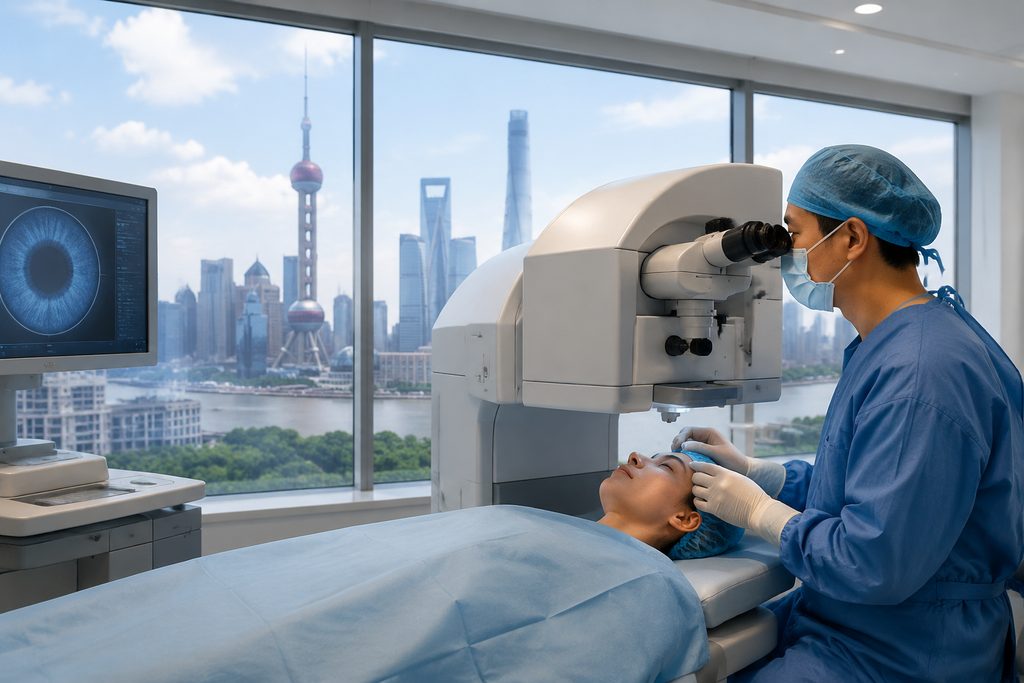
You’ve probably heard that surgery in China means compromising on quality. The reality is exactly the opposite for refractive eye procedures. A SMILE operation at a top-tier Chinese eye hospital typically runs between $2,000 and $3,500 per eye. The same procedure in the United States averages $4,500 to $6,500 per eye. In Germany or the UK, you’re looking at €3,500 to €5,500. The smile eye surgery cost China offers isn’t a discount for inferior care. It’s a structural price difference driven by volume, labor costs, and hospital economics — not by cutting corners.
Our team has coordinated eye care for international patients across Shanghai, Beijing, and Guangzhou. We’ve seen the billing breakdowns. We know where the savings come from. And we know what patients worry about before they book. This article explains the real numbers behind the price gap, how to evaluate a Chinese eye hospital, and what the full journey looks like — from first inquiry to flying home with corrected vision.
How This Actually Works, Step by Step
You send us your current prescription, corneal topography scans, and any recent eye exam records. We translate these into Chinese and forward them to the ophthalmology department at two or three hospitals that match your case. A refractive surgeon reviews your scans. You get a written assessment back within five to seven business days. That assessment tells you whether you’re a candidate for SMILE, what correction range they can treat, and whether any corneal irregularities rule you out.
If the surgeon clears you, we move to scheduling. You’ll need a comprehensive in-person exam before any surgery date gets confirmed. That exam happens on day one or two of your trip. The actual SMILE procedure takes about 15 minutes per eye. A follow-up exam happens the next day. Most patients fly home within five to seven days of arriving.
What you send first: existing records. What you get back: a candid medical opinion. What you decide: whether the trip makes sense. Nothing gets booked until you’ve reviewed the surgeon’s written response.
Why SMILE Eye Surgery Cost China Runs 40–60% Lower Than Western Prices
The price gap isn’t mysterious. Chinese refractive centers operate at volumes that would be unimaginable in a Western private clinic. A single high-volume eye hospital in Shanghai may perform 3,000 to 5,000 SMILE procedures annually. That scale spreads fixed costs — the laser platform, the sterile suite, the maintenance contracts — across thousands of cases. The Zeiss VisuMax laser used for SMILE costs roughly $1 million to install. A US clinic doing 300 cases a year must amortize that machine across far fewer patients.
Labor costs tell a similar story. An experienced refractive surgeon in China earns a fraction of what a US ophthalmologist commands. That’s not a statement about skill. Several Chinese eye centers publish outcomes data in peer-reviewed journals. Fudan University’s Eye and ENT Hospital in Shanghai — one of the country’s most respected — has contributed to international SMILE research cohorts. The surgeons are trained on the same equipment, using the same nomograms, as their Western counterparts.
Also, Chinese hospitals don’t carry the same malpractice insurance burden. US refractive surgeons pay annual premiums that can exceed $50,000. Those costs get baked into every procedure fee. Chinese public hospitals operate under a different liability structure, which removes a significant line item from the bill.
SMILE vs LASIK Price China: What’s the Actual Difference?
Patients often ask us to compare smile vs lasik price China. The gap is smaller than you might expect. LASIK in China runs $1,500 to $2,500 per eye at top hospitals. SMILE runs $2,000 to $3,500. So you’re paying a 30–40% premium for SMILE over LASIK. That mirrors the premium in Western markets.
Why does SMILE cost more? The VisuMax femtosecond laser is more expensive to operate than the excimer lasers used in LASIK. Consumables cost more per case. And the surgeon training curve is steeper. SMILE requires a single laser to create the lenticule and the small incision — there’s no flap. LASIK uses two lasers and creates a corneal flap. The flap is the main reason some patients prefer SMILE: less risk of flap dislocation, less dry eye in many studies, and faster return to contact sports.
But SMILE isn’t for everyone. Higher prescriptions, thin corneas, or certain astigmatism patterns may push a surgeon toward LASIK or PRK instead. That’s why the written second opinion matters before you book flights.
Is SMILE Eye Surgery Safe in China? Reading the Data Honestly
Short answer: yes, at the right hospitals, with the right screening. The longer answer requires nuance.
China’s top eye centers use the same Zeiss VisuMax platform used in the US, Europe, and Japan. The surgical protocol is identical. The difference is hospital selection. China has 35,000+ hospitals. Maybe 40 to 50 of them have refractive surgery programs we’d consider for an international patient. That’s why we maintain a database of 340+ top-ranked hospitals across 37 cities, filtered by Fudan University’s specialty rankings and JCI accreditation where applicable.
The best eye hospital Shanghai for smile candidates is typically Fudan University’s Eye and ENT Hospital. It’s ranked among China’s top ophthalmology programs and handles enormous SMILE volume. Other strong options exist in Beijing, Guangzhou, and Chengdu. The key is verifying three things: the specific laser model, the surgeon’s annual SMILE case count, and the hospital’s infection control record.
Infection is the risk patients fear most. Endophthalmitis after refractive surgery is rare everywhere — roughly 1 in 5,000 to 1 in 10,000 cases globally. Chinese top-tier hospitals report rates consistent with international benchmarks. But the risk isn’t zero anywhere. You reduce it by choosing a hospital with rigorous sterile protocols, not by choosing the cheapest quote.
A Realistic Timeline
Here’s what the full process looks like, assuming you’re traveling from the US or Europe for SMILE surgery in China.
| Stage | What Happens | Duration |
|---|---|---|
| Week 1 | You send records; we translate and submit to 2–3 hospitals | 3–5 business days |
| Week 2–3 | Surgeon reviews scans; written second opinion returned | 5–7 business days |
| Week 3–4 | You decide; we coordinate dates and request hospital letter for visa | 3–5 business days |
| Week 4–6 | S2 visa application with hospital invitation documents | 1–3 weeks depending on embassy |
| Day 1 in China | Comprehensive eye exam, corneal topography, surgeon consultation | Half day |
| Day 2–3 | SMILE procedure on both eyes (often same day or consecutive days) | 15–20 minutes per eye |
| Day 4 | Post-op exam, medication instructions, clearance to fly | 1–2 hours |
| Month 1–3 | Follow-up with your home optometrist; send reports back to China | Ongoing |
The stage people forget is the visa. You cannot apply for an S2 visa without supporting documents from the hospital. Most public hospitals won’t issue those documents until a surgeon has reviewed your case and agreed to see you. That’s why the written second opinion comes first. It’s not a bureaucratic hurdle we invented — it’s the actual sequence Chinese hospitals require.
What Can Go Wrong — and What Happens Then
The honest failure modes matter more than the success stories.
First, you might not be a SMILE candidate. Corneal thickness below 480 microns, keratoconus, severe dry eye, or unstable prescription over the past year — any of these can disqualify you. If the written review flags this, we don’t book anything. You’ve lost the cost of the second opinion, not the cost of a wasted trip. That’s the point of doing remote evaluation first.
Second, your prescription might regress. SMILE has a retreatment rate of roughly 1–3% in published studies. If you need enhancement, that’s usually done with PRK or LASIK, not a second SMILE. The retreatment cost in China is lower than in the West, but it’s still an additional procedure. Ask about the hospital’s retreatment policy before you commit.
Third, the language barrier is real. Top Chinese eye hospitals see thousands of patients daily. Front desk staff may not speak English. Signage may be Chinese-only. Without a bilingual medical companion, you’ll burn hours navigating registration, payment, and pharmacy pickup. This is where our coordination service earns its fee — not as an “access fee,” but as case management. We translate records, coordinate through the hospital’s official international department, and provide on-the-ground bilingual support from $300 per day.
Fourth, follow-up care at home. Your local optometrist may be reluctant to manage a patient who had surgery abroad. Some are. Most will do the routine checks if you bring clear post-op instructions. We provide translated discharge summaries and a contact channel back to the Chinese surgeon for questions.
How Much Cheaper Is SMILE Surgery Abroad — and Is the Trip Worth It?
For many patients, yes — particularly those with dry eyes, active lifestyles, or professions with impact risk. SMILE creates no corneal flap, which reduces flap-related complications and often results in less post-op dry eye. But LASIK remains better for certain prescriptions and has a longer track record. A surgeon should decide based on your topography.
Fudan University’s Eye and ENT Hospital is the most recognized public option. It’s ranked among China’s top ophthalmology programs and performs high SMILE volume. We can also evaluate private options like Jiahui if you prefer English-speaking staff and direct insurance billing.
This is why we require a written second opinion before you travel. If the surgeon’s remote review says you’re borderline, we tell you. If you arrive and the in-person exam disqualifies you, you’ve lost the trip cost — but this is rare when screening is done properly. We don’t book flights for patients whose records suggest they’re poor candidates.
You can book the evaluation and coordination, not the surgery itself. Chinese public hospitals require an in-person comprehensive exam before any surgical date is confirmed. No legitimate hospital will promise a surgery date based on remote records alone. Anyone offering a guaranteed surgery slot without an exam is not operating through official channels.
Your Next Step
The smile eye surgery cost China offers is real, measurable, and backed by hospital volume and economics — not by cutting corners. Choosing the right hospital and navigating the visa, records, and language barriers is where most patients stall.
We’re China Medical Services, a coordination team that connects international patients with top-ranked Chinese hospitals. We don’t perform surgery, we don’t guarantee outcomes, and we don’t sell access. We handle records translation, hospital matching, appointment coordination through official international departments, and bilingual on-the-ground support. If you’re considering SMILE in China, start with a written second opinion. It costs $300 to $500, and it tells you whether this path makes sense for your eyes. Request a free consultation and we’ll walk you through what your specific case would require.
Frequently Asked Questions
Yes. The hospitals used for international patients are JCI-accredited and follow the same international safety standards as top hospitals in the US and Europe. Surgical teams perform high volumes of procedures — often more than their Western counterparts — which studies show leads to better outcomes.
Costs vary by procedure and hospital, but international patients typically save 40-80% compared to US prices — even when factoring in travel and accommodation. A consultation with our team will give you an exact, all-inclusive quote with no hidden fees.
Send us your existing medical reports to get started. We handle everything from hospital selection and appointment scheduling to visa assistance and post-operative recovery planning. Your medical records are reviewed by the specialist before you even book a flight.
For more medical information and treatment options in China, visit chinamedservices.com (China Medical Services).
