China’s Best Post-Surgery Rehab Hospitals: Real Costs, Timelines & Quality
When 42-year-old Michael tore his ACL during a ski trip in Switzerland, the surgery went well. The recovery did not. Six weeks after the operation, his knee was still swollen, his quadriceps had atrophied, and his insurance-covered physiotherapy consisted of a 20-minute group session once a week. His surgeon told him the joint itself was fine. The problem was everything around it. That is when Michael started searching for something his home country could not offer at a price he could afford: intensive, one-on-one, inpatient rehabilitation. His search led him to a question many patients eventually ask: which hospital in China offers rehabilitation after surgery that is both structured and affordable?
The short answer is that China’s top-tier public hospitals, several JCI-accredited private international hospitals, and specialized TCM rehabilitation centers all run dedicated post-surgical rehabilitation departments. The best rehabilitation hospital in China for post surgery depends on your surgery type, your mobility goals, and your budget. But the system is navigable, and the quality at the top end rivals what you would find in Germany, the United States, or Singapore — often at a fraction of the cost.
This article explains how post-surgical rehabilitation actually works in China, what it costs, how long it takes, and what can go wrong. No marketing gloss. Just the operational reality, based on what our team at China Medical Services has coordinated for international patients across 37 cities.
How This Actually Works, Step by Step
Post-surgical rehabilitation in China is not a single standardized product. It is a pathway that varies by hospital tier, city, and the patient’s clinical documentation. Here is the sequence most of our patients follow.
First, you send us your surgical records: the operation report, discharge summary, imaging (MRI, CT, or X-ray), and any physiotherapy notes from your home country. This documentation gets translated into Chinese by our team. Translation matters more than people expect. A poorly translated operative note can delay the intake assessment by days.
Second, we match your case to a rehabilitation department. For orthopedic cases — knee replacement, ACL reconstruction, spinal fusion — we typically look at the orthopedics and rehabilitation medicine departments at Fudan-ranked hospitals in Beijing, Shanghai, and Guangzhou. For stroke or neurological rehab, the criteria shift toward hospitals with dedicated neurorehabilitation units and longer inpatient capacity. The specialty rankings across 45 departments are useful here, because a hospital that is excellent at cardiac surgery is not automatically the right choice for cardiac rehabilitation.
Third, the hospital’s rehabilitation team reviews your translated records and issues a written intake opinion. This is not a treatment plan yet. It is a preliminary assessment: whether you are a suitable candidate for inpatient rehab, what the likely duration would be, and what additional assessments you would need on arrival. This step usually costs between $300 and $500 as a written second opinion, depending on the hospital tier.
Fourth, if the intake opinion is positive, you decide whether to proceed. Some patients book a video consultation with the rehab physician before flying to China. That costs $500 to $800 for a top-specialist video consult. Others skip straight to travel planning once the written opinion confirms feasibility.
Fifth, you arrive in China. Your first week involves in-person assessments: gait analysis, range-of-motion testing, muscle strength grading, and sometimes a fresh MRI. The rehab team then finalizes your daily schedule. This is where the real work begins.
What “Rehabilitation After Surgery” Actually Looks Like in a Chinese Hospital
The term “rehabilitation” covers a wide range of clinical services, and hospitals in China organize these differently than Western patients might expect. A dedicated rehabilitation medicine department in a top Chinese hospital typically includes physiotherapy, occupational therapy, speech therapy, and — in many cases — integrated TCM modalities like acupuncture and tuina massage.
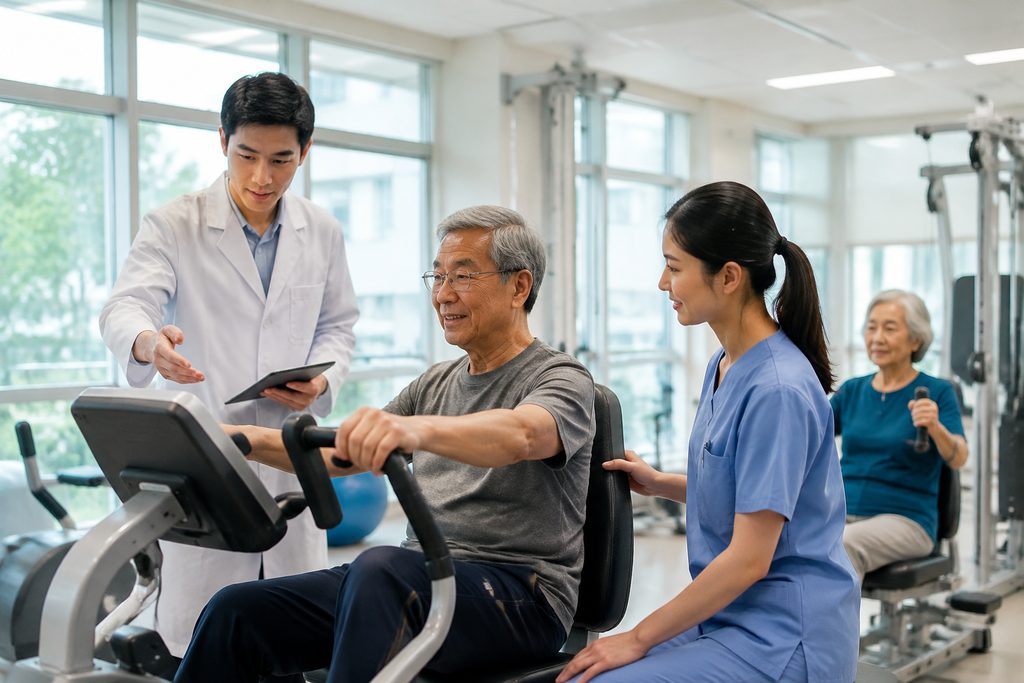
For a patient recovering from a total knee replacement, a typical inpatient day at a top rehabilitation hospital in Shanghai or Beijing looks like this: 45 minutes of one-on-one physiotherapy in the morning, focused on range of motion and gait retraining. A 30-minute session on a continuous passive motion machine. A 20-minute acupuncture session for pain and swelling. A 45-minute afternoon session with a different therapist working on strength and balance. That is roughly two to three hours of active therapy per day, five to six days per week.
Compare that to the standard outpatient model in many Western countries, where a patient might receive two or three 30-minute sessions per week. The intensity difference is the main reason international patients consider China for post-surgical rehab. It is not that Chinese therapists possess secret techniques. It is that the inpatient model allows for a volume of supervised therapy that is simply not reimbursed in most Western insurance systems.
But the intensity cuts both ways. Three hours of daily therapy is exhausting. Patients with significant comorbidities or poor baseline fitness often struggle in the first week. Good rehab departments adjust the schedule. Lesser ones do not. This is one area where hospital selection matters enormously, and where the Fudan-ranked top 100 hospitals tend to have more experienced therapy teams and better nurse-to-patient ratios.
A Realistic Timeline
Patients routinely underestimate how long the entire process takes, from first inquiry to walking into the rehab gym. Here is a realistic breakdown based on cases we have coordinated.
| Stage | Typical Duration | What Happens |
|---|---|---|
| Document collection and translation | 3–7 days | You gather surgical records, imaging, and physio notes. We translate them into Chinese and prepare a clinical summary. |
| Hospital matching and intake review | 5–14 days | We identify suitable rehabilitation departments, submit your records, and wait for the written intake opinion. Top hospitals can take two weeks. |
| Video consultation (optional) | 3–10 days lead time | If you want to speak with the rehab physician before committing, scheduling usually takes about a week. |
| Visa processing (S2) | 7–21 days | You apply for an S2 visa with supporting documents from the hospital. Processing times vary by embassy. Rush options are not guaranteed. |
| Travel and arrival | 1–3 days | Flights to Beijing, Shanghai, or Guangzhou. Airport pickup can be arranged. |
| In-person assessment and plan finalization | 2–5 days | Fresh imaging, physical assessment, and finalization of the daily rehab schedule. |
| Inpatient rehabilitation | 2–8 weeks | Depends on surgery type. Knee replacement: 2–4 weeks. Stroke: 4–8 weeks or longer. Spinal fusion: 3–6 weeks. |
| Discharge and home program | 1–2 days | You receive a written home exercise program, often with video instructions, and a summary for your home physician. |
Total time from first inquiry to starting rehab: usually three to six weeks. The longest variable is almost always the hospital’s intake review and the visa processing. If you are in a hurry, private international hospitals in Shanghai and Beijing can sometimes move faster, but their rehab programs are generally less intensive than the top public hospital departments.
One question patients often ask: how long is inpatient rehab after stroke in China? The honest answer is that a typical first admission for stroke rehabilitation runs four to eight weeks. Some patients stay longer if they are making measurable progress and their insurance or personal funds allow it. Chinese public hospitals are generally more willing to extend inpatient rehab stays than their Western counterparts, where length-of-stay is tightly controlled by insurers. But there is no guarantee of extension — it depends on the clinical team’s assessment and bed availability.
What Can Go Wrong — and What Happens Then
Post-surgical rehab in China is not risk-free, and pretending otherwise would be dishonest. The most common failure modes we see fall into a few categories.
The first is mismatched expectations about intensity. A patient who has been doing gentle home exercises for six weeks arrives expecting a spa-like recovery experience. Instead, they get a therapist pushing their knee flexion to 110 degrees while they sweat through the pain. Some patients find this exactly what they needed. Others find it overwhelming and want to reduce the schedule. Reducing the schedule is usually possible, but it means the value proposition — high-volume therapy — is diluted. If you are not prepared for two to three hours of daily physical work, inpatient rehab in China may not be the right choice.
The second failure mode is communication breakdown. Even in hospitals with English-speaking international departments, the day-to-day therapy is often delivered by Chinese-speaking physiotherapists. A bilingual medical companion can bridge this gap, but it adds cost and changes the dynamic of the therapy session. Some patients are comfortable with gesture-based instruction and demonstration. Others are not. Be honest with yourself about this before booking.
The third is medical complications unrelated to the rehab itself. A patient recovering from spinal surgery develops a urinary tract infection. A stroke patient’s blood pressure spikes. These things happen in any healthcare system. The question is how the hospital handles them. Top-tier Chinese hospitals have excellent acute care capacity — often better than many Western rehab facilities, because they are full general hospitals with emergency departments and ICU backup. A standalone rehab clinic, by contrast, may need to transfer you to another facility for acute issues. This is a strong argument for choosing a rehabilitation department inside a large general hospital rather than a boutique rehab center.
If things go wrong, the recourse depends on the hospital type. Public hospitals have formal complaint channels, but they are slow and bureaucratic. Private international hospitals are more responsive to patient feedback, partly because they rely on reputation and repeat business. Our role in these situations is to escalate through the hospital’s international department, document the issue, and — if necessary — facilitate a transfer to another facility. We cannot fix every problem, but we can usually get a faster response than a patient navigating the system alone.
Is Post Surgery Rehab in China Good Quality? How to Evaluate a Program
The question is post surgery rehab in China good quality deserves a direct answer. At the top end, yes — the quality is comparable to good rehab programs in Western Europe or North America. At the bottom end, no. The range is wide, and the burden of evaluation falls on the patient or their coordinator.
Here are the criteria we use when evaluating a rehabilitation program for an international patient.
First, look at therapist-to-patient ratio. In a good inpatient rehab department, one physiotherapist works with no more than four to six inpatients at a time. In a crowded public hospital department, that ratio can be one to fifteen or worse. The difference shows up in how much hands-on time you actually receive. Ask the hospital directly: how many minutes of one-on-one therapy will I receive per day? Get the answer in writing.
Second, check whether the rehab department has its own inpatient beds or shares beds with other specialties. Dedicated rehab wards are better equipped — they have parallel bars, therapy stairs, hydrotherapy pools in some cases, and nursing staff trained in mobility assistance. A shared ward on an orthopedics floor is less ideal.
Third, examine the integration of TCM. Many international patients are curious about acupuncture and tuina as part of their recovery. The evidence for acupuncture in post-surgical pain management is mixed but not negligible. The key is whether TCM is offered as an adjunct to evidence-based physiotherapy, or as a replacement for it. The former is fine. The latter is a red flag. You want a program where the physiotherapist and the TCM practitioner communicate with each other, not compete for your treatment hours. Some patients specifically seek out TCM-focused rehabilitation programs, which can work well for chronic pain and mobility issues, but for acute post-surgical recovery, the physiotherapy core is non-negotiable.
Fourth, look at outcome measurement. Good programs assess you on arrival and at discharge using standardized tools: the Functional Independence Measure, the Berg Balance Scale, gait speed tests, range-of-motion measurements. If a hospital cannot tell you how it measures progress, that is a warning sign. You want a program that can show you the numbers improving.
Practical Considerations: Costs, Visas, Insurance, and Records
Let us talk about money, because rehab after knee replacement China cost is one of the most searched phrases in this space. The honest answer is that costs vary widely by hospital tier and city, but here are realistic ranges based on recent cases.
Inpatient rehabilitation at a top public hospital in Beijing or Shanghai, including the hospital bed, nursing, physiotherapy, and basic TCM adjuncts, typically runs $150 to $400 per day. A two-week knee replacement rehab stay would land between $2,100 and $5,600. A four-week stroke rehab stay would be $4,200 to $11,200. These figures exclude the initial assessments, imaging, and any specialist consultations.
Private international hospitals are more expensive — typically $500 to $1,200 per day for inpatient rehab — but they offer English-speaking staff throughout, direct insurance billing with many international insurers, and a more Western-style care environment. If your insurance covers rehabilitation abroad, a private international hospital may be the path of least resistance. If you are paying out of pocket, the public hospital option is dramatically cheaper for comparable clinical quality.
For patients looking for affordable post operative rehab packages Shanghai, the city offers a useful middle ground. Shanghai has several public hospitals with strong rehabilitation departments, plus a cluster of private international facilities. Package deals that bundle assessment, a fixed number of therapy days, and accommodation are sometimes available through private providers, but read the fine print carefully — some “packages” exclude physician fees or imaging costs.
If you want to book surgical rehab program Beijing, the process is similar to Shanghai but with a different hospital landscape. Beijing has the highest concentration of Fudan-ranked top 100 hospitals in the country — 21 of them — including several with excellent rehabilitation medicine departments. The trade-off is that Beijing’s top hospitals are busier, and securing an inpatient rehab bed can take longer than in Shanghai or Guangzhou. Plan for a longer lead time if Beijing is your target.
On visas: foreign nationals coming to China specifically for medical treatment, including post-surgical rehabilitation, apply for an S2 visa. This is the short-stay visa category used for private affairs and medical treatment. The supporting documents from the hospital — the intake opinion, the admission confirmation, and a treatment plan — are essential for the application. Family members accompanying you also apply for S2 visas. Do not apply for an M visa; that is for commercial and trade activities, and it is not appropriate for medical travel. Visa processing times vary by embassy, so start the process as soon as you have hospital confirmation.
On insurance: Chinese public hospitals generally require prepayment or a deposit, and you settle the bill on discharge. You then submit the itemized invoice and medical records to your insurer for reimbursement. International private hospitals often have direct billing arrangements with major insurers, which means the hospital bills the insurer directly and you only pay any deductible or copay. Check with your insurer before booking anything. Some policies exclude rehabilitation services entirely, even if they cover the original surgery.
On records: bring everything. The operation report, the implant stickers if you have orthopedic hardware, the discharge summary, all imaging on CD or USB, and a list of current medications. Bring a summary of your pre-surgery functional status if you have it — what you could do before the operation matters for setting realistic rehab goals. If your records are not in English or Chinese, translation becomes an additional step.
Frequently Asked Questions
For orthopedic post-surgical rehab, look at hospitals with strong orthopedics and rehabilitation medicine departments in Beijing, Shanghai, and Guangzhou. The Fudan specialty rankings are a useful starting point — hospitals ranked among China’s top 10 for orthopedics or rehabilitation medicine are generally safe choices. The right hospital for you depends on your specific surgery, your age, and your mobility goals. A written intake opinion from the rehab department is the most reliable way to confirm fit before you travel.
Inpatient rehab at a top Chinese public hospital typically costs $150 to $400 per day, compared to $1,500 to $3,000 per day for comparable inpatient rehab in the United States. A two-week knee replacement rehab stay in China would cost roughly $2,100 to $5,600, versus $21,000 to $42,000 in the US. Private international hospitals in China are more expensive — $500 to $1,200 per day — but still well below US rates. All figures vary by hospital and case complexity.
Do I need a medical visa for rehabilitation in China?
You need an S2 visa for short-stay medical treatment, including post-surgical rehabilitation. The hospital’s confirmation documents are required for the application. Accompanying family members also apply for S2 visas. Processing takes one to three weeks depending on the embassy. The M visa is for commercial and trade activities and is
For more medical information and treatment options in China, visit chinamedservices.com (China Medical Services).
