Long-Stay Housing Near Chinese Hospitals: A Practical Guide for Medical Travelers
When 57-year-old Daniel from Manchester learned he needed a complex spinal fusion, his surgeon quoted a 14-month wait under the NHS. Private care in London would run upwards of £45,000. He started looking at options abroad. The surgery itself, he discovered, was one part of the equation. The other part was harder to pin down: where would his wife stay for the six weeks of recovery before he could fly home? What would long stay housing near hospital China price actually look like? Daniel’s question is the one we hear most often from patients considering treatment in China. The clinical data is available. The visa process is documented. But the practical reality of living near a hospital for a month or more remains a black box for most international patients.
This guide unpacks that black box. We cover the real options, what they cost, how they work, and the mistakes that cost patients thousands of dollars in unnecessary spending. No vague estimates. No marketing fluff. Just the operational details you need to plan a treatment stay in China without losing sleep over the logistics.
Key Takeaways
- Long-stay housing near top Chinese hospitals costs between $1,800 and $6,000 per month depending on city, proximity, and property type — roughly 40-60% less than comparable short-term options in Western medical hubs.
- Serviced apartments are the dominant choice for medical travelers, combining hotel-like services with kitchen facilities and weekly cleaning.
- Most public hospitals in China do not provide on-site family accommodation. You will need to arrange housing independently or through a coordination service.
- Booking a standard hotel for a 30+ day stay is almost always the most expensive and least comfortable option. The economics shift dramatically at the two-week mark.
The Problem: Hospital Stays End, but Recovery Continues
China’s top-tier hospitals discharge patients far earlier than Western patients expect. A cardiac bypass patient at Fuwai Hospital in Beijing typically leaves the hospital 5-7 days after surgery. A knee replacement at Shanghai’s Sixth People’s Hospital? Often 3-4 days. But the patient cannot fly home immediately. Surgeons want follow-up visits at the 2-week mark. Sutures need removal. Imaging needs to be repeated. The body needs time before a 10-hour flight is safe.
That gap between discharge and medical clearance to fly is where housing becomes critical. For most procedures, that gap runs 2 to 8 weeks. Cancer patients undergoing radiation or chemotherapy cycles may need housing for 3 to 6 months. Family members accompanying the patient need a place to sleep, cook, and decompress. A cramped hotel room with no kitchen and a $40 daily breakfast buffet is a fast path to exhaustion and overspending. Yet that is exactly what many patients default to, because nobody tells them there is a better way.
The numbers are stark. A mid-range hotel near Huashan Hospital in Shanghai runs $90-140 per night. Over 30 days, that is $2,700 to $4,200 — for a single room with no laundry, no kitchen, and no space for a family member to work or rest properly. A serviced apartment in the same district, with a kitchen and weekly housekeeping, starts around $2,200 per month. The gap widens the longer you stay.
Why Serviced Apartments Dominate Long-Stay Medical Housing in China
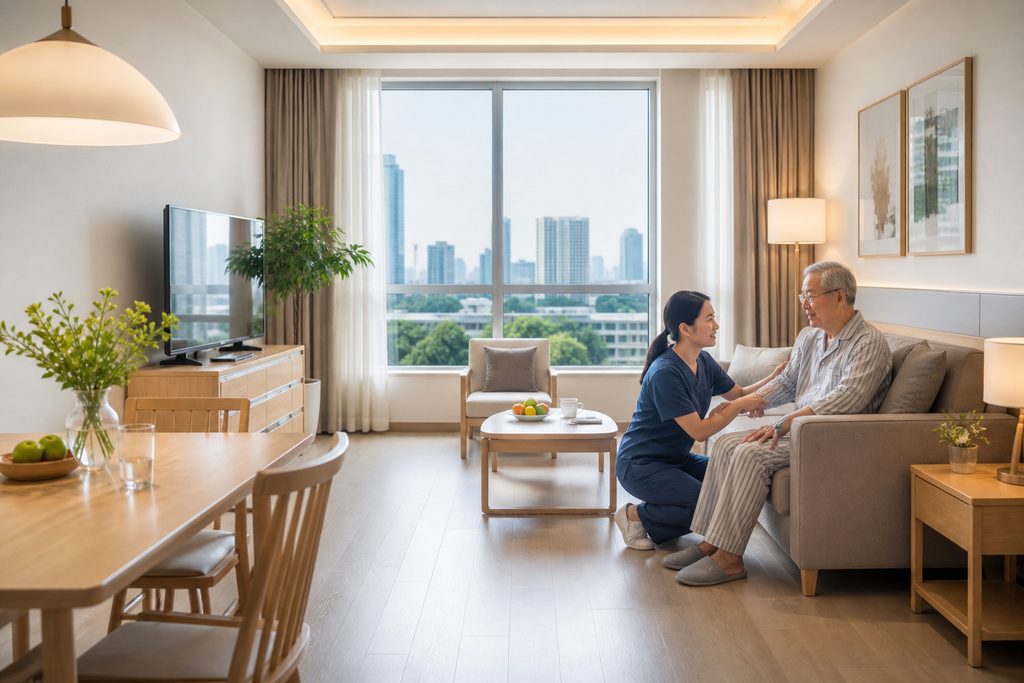
The concept of a “serviced apartment” is not unique to China, but the density of supply near major hospitals is. In Shanghai, Beijing, and Guangzhou, entire buildings within 1-3 kilometers of top hospitals cater specifically to domestic and international medical travelers. These are not luxury properties. They are functional, clean, and equipped for exactly the use case Daniel faced: a patient recovering from surgery, plus a family member who needs to cook, do laundry, and occasionally host a visiting relative.
What You Actually Get in a Serviced Apartment Near a Chinese Hospital
A typical one-bedroom serviced apartment in Shanghai’s Xuhui district, within walking distance of Zhongshan Hospital, includes a queen bed, a sofa that converts to a second bed, a small kitchen with a two-burner induction cooktop, a microwave, a refrigerator, a washing machine, and weekly housekeeping. Utilities and Wi-Fi are bundled into the monthly rate. The building has 24-hour front desk staff, and most have basic English support. That is the baseline. Prices rise with building quality, proximity to the hospital, and whether the property has an in-house gym or concierge.
For patients who need daily wound care or mobility assistance, some properties partner with local nursing agencies. This is not standard, but it is available in major medical districts. The key is to ask before booking.
Cheap Monthly Rentals for Hospital Visits Beijing: What the Budget Option Looks Like
Beijing’s medical district around Peking Union Medical College Hospital (PUMCH) and Beijing Hospital sits in Dongcheng district, one of the most expensive parts of the city. But cheap monthly rentals for hospital visits Beijing do exist — they just require trade-offs. A basic studio apartment 30-40 minutes by metro from PUMCH can rent for $1,500-2,000 per month. These are often older buildings, with no elevator, no English-speaking staff, and a landlord who expects a 2-month deposit plus one month’s rent upfront. For a patient who is mobile and has a family member handling logistics, this can work. For a patient in a wheelchair or with limited Chinese language support, it is a poor fit.
The deposit structure matters. Standard residential leases in China require a deposit equal to one or two months’ rent, returned only after a final inspection that can take 2-4 weeks. Serviced apartments, by contrast, typically require no deposit or a small one, and they accept payment by international credit card. For a foreign patient who needs to leave the country on a specific date, the serviced apartment’s flexibility is worth the premium.
Long Stay Housing Near Hospital China Price: Real Numbers by City and Property Type
Let us get specific. The table below reflects current market rates for long-stay housing near major Chinese hospitals, based on our team’s coordination experience and direct bookings for international patients. Prices are in USD per month and assume a 30-day minimum stay. All figures vary by hospital and case complexity, season, and specific property.
| City & Medical District | Budget Studio (30-40 min by metro) | Mid-Range Serviced Apartment (10-20 min walk) | Premium Serviced Apartment (5 min walk, English staff) |
|---|---|---|---|
| Beijing — Dongcheng (PUMCH, Beijing Hospital) | $1,500 – $2,000 | $2,500 – $3,800 | $4,500 – $6,500 |
| Shanghai — Xuhui (Zhongshan, Huashan) | $1,600 – $2,200 | $2,200 – $3,500 | $4,000 – $6,000 |
| Shanghai — Pudong (Renji, Shanghai East) | $1,400 – $1,900 | $2,000 – $3,000 | $3,500 – $5,000 |
| Guangzhou — Yuexiu (Sun Yat-sen Memorial) | $1,200 – $1,700 | $1,800 – $2,800 | $3,000 – $4,500 |
| Chengdu — Wuhou (West China Hospital) | $1,000 – $1,500 | $1,500 – $2,300 | $2,500 – $3,800 |
For comparison, a long-stay hotel near a major US medical center — say, the Texas Medical Center in Houston or Mayo Clinic in Rochester — runs $4,000 to $8,000 per month for a basic room with no kitchen. Medical tourism long term accommodation China cost is structurally lower because the underlying real estate and labor costs are lower. That is not a compromise on quality. It is a function of the market.
Serviced Apartments for Medical Patients Shanghai: What to Look For
Shanghai has the most developed supply of serviced apartments for medical patients Shanghai in all of China. The concentration around Xuhui and Jing’an districts means patients at Zhongshan Hospital, Huashan Hospital, and Ruijin Hospital can often walk to their follow-up appointments. But not every serviced apartment is suitable for a recovering patient. Here is what to check before committing.
Elevator access. Many older buildings in central Shanghai have no elevator or a single small one shared with delivery scooters. If the patient uses a wheelchair or crutches, confirm the elevator dimensions and whether the building has a ramp at the entrance. Ask for photos, not descriptions.
Kitchen equipment. A “kitchen” in a Chinese serviced apartment sometimes means a microwave and a kettle. If the patient needs a specific diet — soft foods after oral surgery, low-sodium meals after cardiac procedures — confirm there is a real cooktop and a refrigerator large enough for groceries. Some properties will add a rice cooker or blender on request.
Air quality. Beijing and, to a lesser extent, Shanghai have seasonal air pollution spikes. For a patient recovering from thoracic surgery or with respiratory conditions, a building with central air filtration or at least the ability to run a HEPA purifier in the unit is worth prioritizing. Many serviced apartments now include this as a standard feature. Ask.
How Do Family Members Stay Near Chinese Hospitals? The Accompanying Caregiver Problem
Most international patients do not travel alone. A spouse, adult child, or parent comes along. How do family members stay near Chinese hospitals without doubling the housing cost? The answer depends on the patient’s mobility and the length of stay.
For the first 7-10 days after surgery, most families prefer to stay in the same unit as the patient. A one-bedroom serviced apartment with a sofa bed handles this. The family member sleeps in the living area, cooks, and can respond quickly if the patient needs help at night. This is the standard arrangement we see for cardiac, orthopedic, and oncology patients.
For longer stays — cancer treatment cycles, rehabilitation after spinal surgery — some families split the arrangement. The patient stays in a serviced apartment near the hospital. The family member rents a cheaper room in a shared apartment or a budget hotel 20-30 minutes away, visiting daily. This can cut total housing costs by 30-40%. It works when the patient is stable enough to spend nights alone and has a phone or emergency button for urgent needs.
One option that is often overlooked: hospital-affiliated guesthouses. Some large public hospitals in China operate basic guesthouses for patients’ families on or adjacent to the hospital campus. These are spartan — think dormitory-style rooms with shared bathrooms — but they cost $30-60 per night and put the family member steps from the patient’s ward. Availability is unpredictable and almost never bookable online. It requires an in-person visit or a local coordinator to secure a room. For families on a tight budget, it is worth investigating.
Can I Rent an Apartment Near a Hospital in China for Treatment? The Legal and Practical Answer
The short answer is yes. Can I rent an apartment near a hospital in China for treatment is one of the most common questions we receive, and the answer is unambiguously yes — with conditions. Foreign nationals can legally rent residential property in China on a short-term basis. There is no special permit required for a 1-3 month rental. The barriers are practical, not legal.
The first barrier is the lease itself. Standard residential leases in China are written in Chinese and assume a 12-month term. Landlords are often reluctant to rent for 1-2 months because tenant turnover is costly. Some will accept a shorter term at a 20-30% premium. Others will refuse outright. Serviced apartments and aparthotels bypass this because they are licensed for short-term stays and operate on a nightly or weekly rate structure that discounts for monthly bookings.
The second barrier is payment. Most residential landlords want payment by domestic bank transfer or WeChat Pay. If you do not have a Chinese bank account — and most short-stay patients do not — this becomes a problem. Serviced apartments accept international credit cards and bank transfers. That alone makes them the default choice for most international patients.
The third barrier is communication. Negotiating a lease, understanding the utility setup, dealing with a broken water heater — all of this happens in Chinese. Without a bilingual coordinator, a residential rental can become a part-time job you did not sign up for.
Practical tip: If you are considering a residential rental rather than a serviced apartment, ask for a “short lease” (duǎn zū) specifically. Some landlords in medical districts now market short leases to patients’ families. Expect to pay a 20-30% premium over the listed long-term rate, and always get the deposit return terms in writing before paying anything.
What to Budget Beyond Rent: The Hidden Costs of a Long Medical Stay
Most public hospitals do not. A few large hospitals operate basic guesthouses for patients’ families, but these are rarely bookable in advance and almost never advertised in English. Private international hospitals like United Family and Jiahui sometimes have partnerships with nearby hotels, but the patient pays the full rate. Plan to arrange housing independently.
This is one of the strongest arguments for serviced apartments over residential rentals. Serviced apartments can usually extend your stay on a week-by-week basis, subject to availability. Residential leases are fixed-term; extending one is a negotiation. When you book, ask the property directly about extension policies and whether your rate is locked for the extension period.
Generally yes, in the areas around major hospitals in Beijing, Shanghai, Guangzhou, and Chengdu. These are dense, well-lit, heavily policed districts. The risks are practical rather than safety-related: a landlord who does not return the deposit, a building with no elevator, a unit that looks nothing like the photos. Serviced apartments carry less of this risk because they are professionally managed and reviewable online.
Serviced apartments and aparthotels almost always accept international Visa and Mastercard. Residential landlords typically do not. If you plan to use a card, confirm with the property before booking, and ask whether a foreign transaction fee applies. Some properties add 2-3% for card payments.
Your Next Step
Long-stay housing near a Chinese hospital is a solvable problem, but it rewards planning. The patients who struggle are the ones who assume a hotel will work fine and discover otherwise two weeks into a six-week recovery. The patients who
Frequently Asked Questions
Yes. The hospitals used for international patients are JCI-accredited and follow the same international safety standards as top hospitals in the US and Europe. Surgical teams perform high volumes of procedures — often more than their Western counterparts — which studies show leads to better outcomes.
Costs vary by procedure and hospital, but international patients typically save 40-80% compared to US prices — even when factoring in travel and accommodation. A consultation with our team will give you an exact, all-inclusive quote with no hidden fees.
Send us your existing medical reports to get started. We handle everything from hospital selection and appointment scheduling to visa assistance and post-operative recovery planning. Your medical records are reviewed by the specialist before you even book a flight.
For more medical information and treatment options in China, visit chinamedservices.com (China Medical Services).
