Is SMILE Eye Surgery Safe in China? A Complete 2025 Cost & Safety Guide
Is SMILE Eye Surgery Safe in China? What International Patients Must Know About Cost, Hospitals, and Outcomes in 2025
If you are considering vision correction abroad, the smile eye surgery cost China is likely one of the first numbers you have looked up. The second question is almost always harder: is it safe? The short answer is that SMILE (Small Incision Lenticule Extraction) has been performed in China since 2011, with clinical volume now among the highest in the world and complication rates comparable to international benchmarks. But safety is not a yes-or-no answer. It depends on where you go, who evaluates your corneas, and what happens in the first 72 hours after the laser stops firing.
Key Takeaways
- SMILE in China typically ranges from $2,200 to $4,500 per eye at top-tier hospitals, roughly 40-60% less than US private clinics.
- China performs more SMILE procedures annually than any other country, with several Shanghai and Beijing centers exceeding 10,000 cumulative cases.
- The biggest safety variable is not the Zeiss VisuMax laser itself — it is pre-operative screening quality, which varies significantly between budget clinics and university hospitals.
- International patients should expect a 3-4 day on-site protocol: evaluation day, surgery day, and a mandatory next-day follow-up before flying home.
The Problem: Vision Correction Costs Are Pushing Patients to Make Risky Trade-Offs
Laser vision correction in the United States now averages $2,200 to $3,200 per eye for LASIK, with SMILE often priced 20-30% higher. In the UK, private SMILE runs £2,500 to £3,500 per eye. Canada and Australia sit in similar ranges. For a procedure that takes under 15 minutes per eye, the math frustrates patients — and that frustration leads to dangerous shortcuts.
Some patients book with discount clinics overseas that advertise $800-per-eye SMILE. Those clinics exist. But they often cut costs by using older laser platforms, skipping corneal topography, or relying on technicians rather than refractive surgeons for screening. A 2023 review in the Journal of Refractive Surgery found that the most common cause of post-SMILE ectasia — a serious, sight-threatening complication — was undetected pre-existing corneal weakness, not the laser itself. Screening quality is everything.
China occupies a unique position here. The country has both ends of the spectrum: aggressive budget clinics and genuinely world-class university eye centers. The gap between them is wider than most Western patients expect. Navigating that gap is the real challenge.
Why China Has Become a Global Center for SMILE Eye Surgery
Clinical Volume That Exceeds Western Benchmarks
Volume matters in refractive surgery. A surgeon who has performed 5,000 SMILE procedures has encountered the anatomical variations, the awkward corneal curvatures, and the intraoperative surprises that a 500-case surgeon has only read about. At Fudan University’s Eye and ENT Hospital in Shanghai, the refractive surgery department has logged over 100,000 cumulative laser vision correction cases, with SMILE representing a substantial and growing share since its 2011 introduction. Zhongshan Ophthalmic Center at Sun Yat-sen University in Guangzhou reports similar scale. These are not small boutique practices — they are high-throughput centers where SMILE is performed dozens of times daily.
By comparison, a busy US refractive surgeon might perform 500-800 SMILE cases annually. A top Chinese center surgeon handles 1,500-2,500. That repetition builds procedural fluency that is hard to replicate in lower-volume settings.
Standardized Equipment and Protocol Adherence
SMILE is only performed on one platform: the Carl Zeiss VisuMax femtosecond laser. There is no generic alternative. That means the core technology is identical whether you are in Shanghai, Seoul, or San Diego. The variable is not the machine — it is the protocol around it.
Top Chinese eye hospitals follow the same pre-operative screening sequence used by international refractive surgery societies: corneal topography, pachymetry, dilated fundus examination, tear film assessment, and cycloplegic refraction. The best centers add anterior segment OCT and biomechanical assessment using Corvis ST or Pentacam. When you see a hospital that includes corneal biomechanics in its standard SMILE workup, you are looking at a center that takes ectasia prevention seriously.
Cost Structure Without Quality Compromise
The smile eye surgery cost China is lower than Western pricing for structural reasons, not because corners are cut. Chinese ophthalmologists earn less than their US counterparts — a senior refractive surgeon in Shanghai might earn $80,000-$150,000 annually versus $400,000-$700,000 in the US. Hospital overhead is lower. Malpractice insurance is a fraction of US rates. And the sheer patient volume spreads fixed equipment costs across far more procedures.
None of those factors affect the laser, the sterility protocols, or the surgical technique. They simply lower the price. That is why a procedure costing $6,400 for both eyes in California can cost $4,500 in Shanghai at a hospital with triple the case volume.
SMILE vs LASIK: What the Evidence Says for Patients Comparing Options
Patients searching for smile vs lasik China reviews are usually trying to answer one question: is the newer procedure actually better, or just more expensive? The evidence offers a nuanced answer.
SMILE uses a single femtosecond laser to create a lenticule inside the cornea, which is then removed through a 2-4 mm incision. LASIK creates a corneal flap — typically 20 mm in circumference — using either a femtosecond laser or a microkeratome blade, then reshapes the underlying tissue with an excimer laser. The flap is the key difference.
Because SMILE preserves more corneal biomechanical strength and avoids flap-related complications like dislocation or striae, it is often preferred for patients with thinner corneas, higher myopia, or occupations with contact risk — military personnel, martial artists, contact sport athletes. LASIK remains excellent for low to moderate myopia and generally offers slightly faster visual recovery in the first 24 hours.
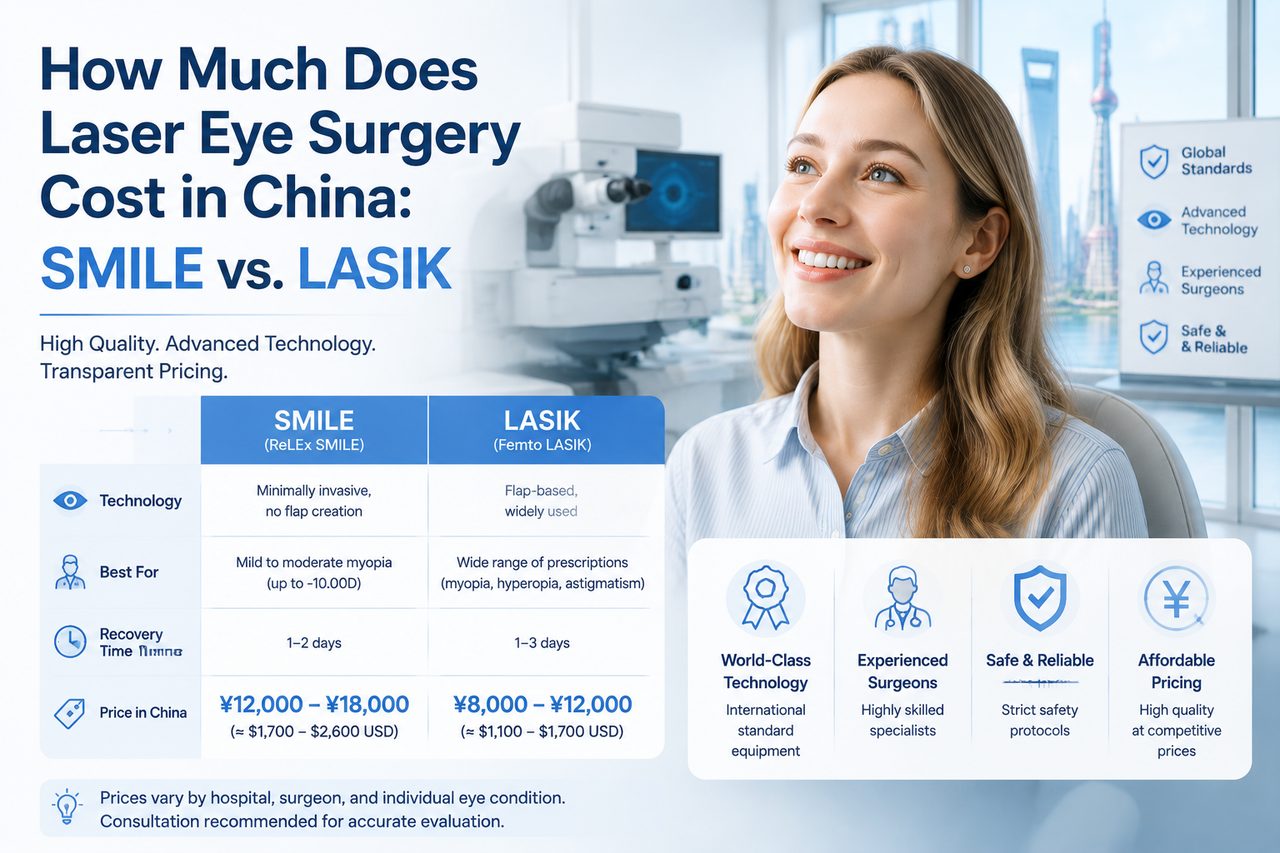
| Factor | SMILE | LASIK |
|---|---|---|
| Flap created | No — 2-4 mm incision only | Yes — 20 mm flap |
| Dry eye incidence at 6 months | Lower (reported 10-20%) | Higher (reported 20-40%) |
| Corneal strength preserved | Higher | Lower |
| Best for | Moderate to high myopia, thin corneas, contact sports | Low to moderate myopia, astigmatism, faster day-1 vision |
| Typical China price (both eyes) | $4,000-$7,500 | $2,500-$5,000 |
One caveat from clinical experience: SMILE does not currently treat hyperopia (farsightedness) in most centers, and astigmatism correction is approved up to 5 diopters. LASIK covers a broader prescription range. A thorough pre-operative evaluation will determine which procedure your corneas actually qualify for — and at the best centers, the surgeon will tell you if you are not a good candidate for either.
How Much Is SMILE Eye Surgery in Beijing and Shanghai? A Realistic Price Breakdown
The question how much is smile eye surgery in Beijing does not have a single answer. Pricing varies by hospital tier, surgeon seniority, and whether you go through the public outpatient route or the international/VIP department. Here is what international patients should expect in 2025.
At top public university hospitals — such as Peking Union Medical College Hospital or Beijing Tongren Hospital — SMILE through the standard outpatient channel typically ranges from $1,800 to $2,800 per eye. That price includes the pre-operative evaluation, the procedure, and standard post-operative medications. What it does not include is English-language coordination, expedited scheduling, or a bilingual companion to navigate the hospital. Public hospital ophthalmology departments in Beijing see thousands of patients daily. If you do not speak Mandarin, you will struggle.
International departments at the same hospitals, or private international eye centers like Beijing Aier Intech Eye Hospital or Shanghai New Vision Eye Clinic, price SMILE at $2,500 to $4,500 per eye. The higher fee buys English-speaking staff, direct scheduling, longer consultation times, and a more Western-style patient experience. Some package prices include hotel coordination and airport transfer.
So the realistic all-in range for both eyes is $4,000 to $9,000, depending on the channel you choose. Compare that to $6,000 to $9,000 for both eyes at US private clinics, and the savings are meaningful but not dramatic for the international-channel option. The value proposition is strongest when you prioritize surgeon volume and hospital reputation over rock-bottom pricing.
How to Evaluate a Chinese Hospital for SMILE: A Practical Checklist
If you are searching for the best smile eye surgery hospital Shanghai or Beijing, you will find dozens of clinics claiming excellence. Here is how to separate substance from marketing.
First, check whether the hospital is a university-affiliated tertiary center or a private chain. University centers — Fudan Eye and ENT Hospital, Zhongshan Ophthalmic Center, Beijing Tongren, West China Hospital in Chengdu — carry academic reputations that are publicly verifiable. Their refractive surgeons publish in peer-reviewed journals, present at international conferences, and are accountable to institutional standards. Private chains can be excellent, but quality varies more between branches.
Second, ask directly about the screening protocol. A legitimate center will describe corneal topography, pachymetry, and ideally biomechanical assessment. If the clinic cannot explain its ectasia screening process, walk away.
Third, verify the laser platform. SMILE requires the Zeiss VisuMax 800 or the newer VisuMax 800 with faster pulse rates. If a clinic advertises “SMILE” but uses a different platform, that is a red flag. Ask for the specific model.
Fourth, check how many SMILE cases the surgeon has personally completed. A senior refractive surgeon at a top Chinese center will have 3,000-10,000+ cases. Do not accept a vague answer like “our team has done many.”
Practical tip: Request a copy of your pre-operative corneal topography and pachymetry results before surgery day. A reputable center will provide these without hesitation. They are your medical records, and you will want them for future eye exams at home.
What the SMILE Procedure and Recovery Actually Look Like in China
If you decide to book smile eye surgery China package, here is the realistic timeline. Day one is evaluation: expect 2-3 hours of testing, including dilated pupils that will blur your near vision for several hours. Do not plan to drive or read afterward. The surgeon reviews your results and confirms candidacy. If you are approved, surgery is typically scheduled for the following day.
Surgery day takes about 20 minutes per eye, with the actual laser time under 30 seconds per eye. You will be awake, with numbing drops only. Most patients describe pressure rather than pain. Immediately after, vision is hazy — like looking through frosted glass. That is normal.
The mandatory next-day follow-up is non-negotiable. The surgeon checks the lenticule removal site, measures intraocular pressure, and confirms the corneal cap is seated correctly. Most patients see 20/40 or better at this visit, with continued improvement over the following weeks. You should plan to stay in Beijing or Shanghai for at least 3-4 days total.
Recovery milestones: 80% of visual clarity within the first week, 95% by one month, full stabilization by three months. Dry eye symptoms peak around week two and gradually improve. You will use antibiotic and steroid drops for the first week, then lubricating drops for one to three months. Flying home is generally safe 3-5 days after surgery, but keep lubricating drops handy — cabin air is dry.
Practical Considerations: Documentation, Payment, and Follow-Up for International SMILE Patients
International patients traveling to China for SMILE need an S2 visa, which covers short-term private affairs including medical treatment. The hospital will issue an invitation letter and treatment confirmation document, which you submit with your visa application. Processing typically takes 1-3 weeks, so plan accordingly. Do not book flights until the visa is approved.
Payment is almost always out-of-pocket upfront. Chinese hospitals — even international departments — generally require full payment before the procedure. US insurance rarely covers elective refractive surgery abroad, though some international health plans may reimburse if you submit itemized receipts. Check with your insurer before traveling. Most hospitals accept international credit cards, but transaction limits may apply — some patients split payment across cards or use wire transfer for larger amounts.
Language is the most underrated challenge. Even at international departments, you will encounter forms, pharmacy instructions, and post-op care sheets in Chinese. A bilingual companion who understands both the medical terminology and the hospital workflow can make the difference between a smooth experience and a stressful one. This is not a luxury — it is practical logistics.
After you return home, you will need follow-up care. Your local ophthalmologist should see you at one month, three months, and six months post-surgery. Bring your Chinese medical records, including corneal topography and the exact laser parameters used. A competent local ophthalmologist can manage post-SMILE follow-up without having performed the procedure themselves, but they need the records.
Frequently Asked Questions
At top university-affiliated centers, the safety profile is comparable to any Western center. The Zeiss VisuMax laser is identical worldwide, and screening protocols at leading Chinese hospitals follow international standards. The risk is not China-specific — it is clinic-specific. A thorough pre-operative evaluation at a reputable center is the single biggest safety factor, regardless of country.
Expect $4,000 to $9,000 for both eyes, depending on whether you use a public hospital outpatient channel or an international department. That includes evaluation, surgery, and standard medications. Add $500-$1,500 for flights, hotel, and visa fees. The public channel is cheaper but requires Mandarin or a companion; the international channel costs more but includes English support.
Serious complications from SMILE are rare — infection rates are below 0.1% at high-volume centers, and ectasia incidence is estimated at 0.02-0.05% with proper screening. If complications do occur, your local ophthalmologist can manage most issues, including dry eye, inflammation, and residual refractive error. For rare complications requiring the original surgeon’s input, Chinese hospitals increasingly offer video follow-up consultations. Keep all your records and maintain contact with the treating center.
Yes, many international departments and private eye centers in Shanghai and Beijing offer packages that bundle the procedure with hotel coordination, airport pickup, and interpreter services. Prices for these packages typically start around $5,500 for both eyes. Read the fine print carefully — some packages include only the surgery and basic follow-up, while others add concierge services. Confirm exactly what is covered before paying.
Your Next Step
SMILE eye surgery in China is safe when performed at a reputable, high-volume center with rigorous screening — and it costs significantly less than in the US or Europe. The challenge is not the procedure itself but the logistics: choosing the right hospital, navigating the visa process, managing language barriers, and ensuring proper follow-up. Our team at China Medical Services helps international patients connect with top-ranked Chinese eye centers and coordinates the practical details. We are not a hospital and we do not provide medical advice — we help you find the right doctors and make the journey manageable. If you are seriously considering SMILE in China, start with a conversation about your specific prescription and expectations.
For more medical information and treatment options in China, visit chinamedservices.com (China Medical Services).
