Is a Full Body MRI Safe in China? Our Diagnostics Safety Guide
Is a Full Body MRI Safe in China? Understanding the Full Body MRI Cost China and Screening Accuracy
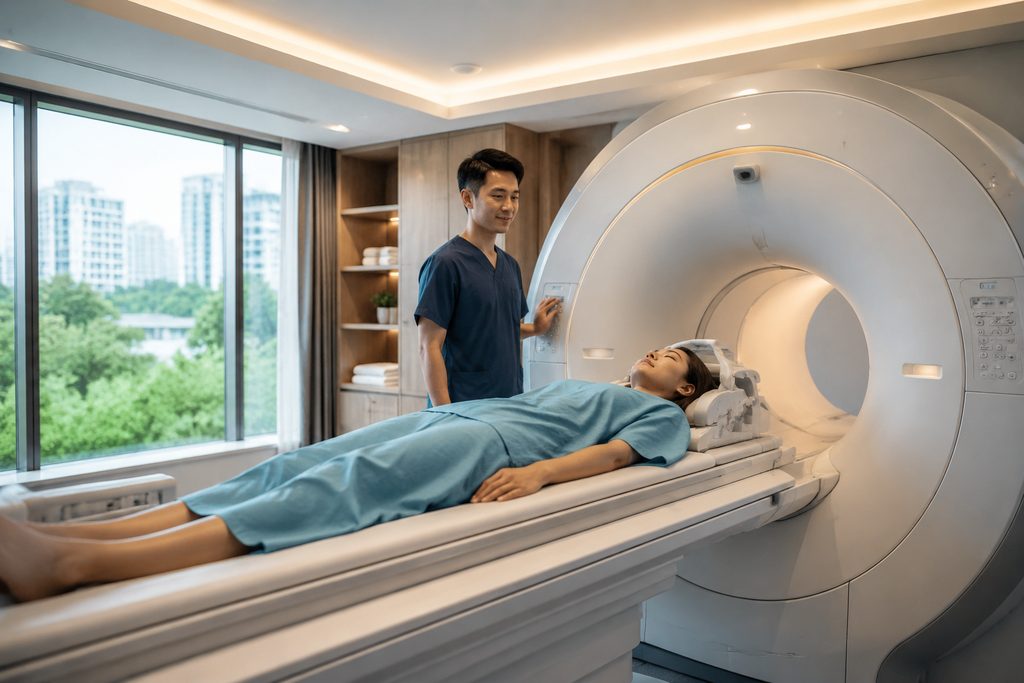
A full body MRI uses powerful magnetic fields and radio waves to create detailed images of your organs, soft tissues, and bones without ionizing radiation. No X-rays. No CT dose. Just a long tube, loud knocking sounds, and a radiologist reading hundreds of cross-sectional images. The full body mri cost China typically ranges from $800 to $2,500 depending on the hospital tier, magnet strength, and whether contrast agents are used. That compares to $3,000–$6,000 for equivalent private scans in the United States or Western Europe. But cost is only half the question. Safety depends on protocol, equipment, and who reads the images.
We coordinate diagnostics for international patients across 340+ top-ranked hospitals in 37 Chinese cities. Patients ask us about full body scans constantly. Most of them have the same worries: Is the machine maintained? Will the radiologist miss something? Am I getting a real clinical scan or a wellness gimmick? This guide answers those questions directly, using published data and what we see on the ground.
Key Takeaways
- A full body MRI at a top Chinese hospital costs $800–$2,500 — roughly one-third to one-half of US private pricing, with 3T magnet availability in major cities.
- Safety in China follows the same physics as anywhere else: no ionizing radiation, but strict metal screening and contrast-agent protocols matter enormously.
- The biggest risk is not the machine. It is overdiagnosis — incidental findings that lead to unnecessary biopsies and anxiety.
- Accuracy depends on the reader, not just the scanner. A 3T machine with a rushed general radiologist can miss what a focused specialist at Fudan or Peking Union would catch.
The Problem: Vague Symptoms, Long Waits, and the Anxiety of Not Knowing
A senior radiologist at a top Chinese hospital reads 50–100 cross-sectional studies per day. That is not a typo. The volume is staggering, and it produces pattern recognition that lower-volume Western radiologists simply cannot match. But raw volume alone is not enough. What matters is whether your full body scan is read by a generalist or by organ-specific specialists.
The best Chinese hospitals now split full body MRI reads by region: a neuroradiologist reviews the brain, an abdominal radiologist reviews the liver and pancreas, a musculoskeletal radiologist reviews the spine and joints. This is the standard at top-ranked specialty departments in Shanghai and Beijing. Cheaper wellness clinics, by contrast, often use one general radiologist to read everything in 20 minutes. That is where misses happen. That is also where the price difference shows up.
Cost Structure Without Quality Compromise
The full body mri cost China is lower for structural reasons, not quality reasons. Radiologist salaries in China run 30–50% lower than US equivalents. Hospital overhead per scan is lower because scanners run 16 hours a day, seven days a week. Malpractice insurance costs a fraction of what American radiologists pay. None of that touches image quality or diagnostic accuracy. A 3T Siemens Vida in Shanghai produces the same raw data as a 3T Siemens Vida in Houston.
What you do lose at the lower price point is hand-holding. The scan itself takes 60–90 minutes. The report may arrive in Chinese unless you go through an international department. Billing is prepaid. Insurance reimbursement is retrospective. Those are process frictions, not safety risks. We will cover them below.
Is Full Body MRI Safe in China: What the Safety Data Actually Shows
Yes — with conditions. The physics of MRI safety is identical in China, Germany, or the United States. Magnetic fields do not damage DNA. There is no cumulative radiation dose. The safety questions that matter are procedural, not theoretical.
The first risk is ferromagnetic metal. Before any scan, a Chinese hospital will screen you for pacemakers, aneurysm clips, cochlear implants, shrapnel, and certain tattoos. Top hospitals use the same screening questionnaires as ACR-accredited US facilities. The danger is real: an unsecured ferromagnetic object becomes a projectile in a 3T field. That is why screening is mandatory. It is also why we tell patients to bring translated medical records listing any implants.
The second risk is gadolinium-based contrast agents. Full body MRI without contrast is safer but less sensitive for detecting small tumors and inflammation. With contrast, you accept a small risk of allergic reaction (roughly 0.1–0.3% for modern macrocyclic agents) and the theoretical risk of gadolinium deposition in the brain. The European Medicines Agency restricted linear gadolinium agents in 2017. Chinese top hospitals now use macrocyclic agents (gadobutrol, gadoterate) almost exclusively. Ask which agent will be used before you consent. If a clinic cannot answer that question, leave.
The third risk is overdiagnosis. A 2023 cohort study in JAMA Internal Medicine followed 1,000 asymptomatic adults after whole-body MRI. Approximately 30% had at least one abnormality flagged. Of those, fewer than 2% represented clinically significant disease. The rest triggered follow-up scans, blood tests, and occasional biopsies — most of which found nothing. That is not a China problem. It is a full body MRI problem. But Chinese wellness clinics sometimes market these scans as “cancer screening,” which they are not. No major oncology guideline recommends whole-body MRI for asymptomatic cancer screening in average-risk adults. If someone tells you otherwise, be skeptical.
How Accurate Is Full Body MRI Screening: What the Scan Can and Cannot Do
Full body MRI is excellent at detecting structural abnormalities: brain aneurysms larger than 3 mm, liver lesions, spinal disc herniations, uterine fibroids, prostate enlargement. It is mediocre at detecting early-stage lung cancer (CT is superior), colon polyps (colonoscopy is superior), and breast microcalcifications (mammography is superior). It is useless for evaluating coronary artery disease — cardiac CT angiography or invasive angiography is required.
So how accurate is full body mri screening for the things it does detect? Sensitivity for liver metastases above 1 cm exceeds 90% on 3T systems with hepatobiliary contrast. Sensitivity for clinically significant prostate lesions is approximately 85–90% with multiparametric sequences. Sensitivity for pancreatic adenocarcinoma above 2 cm is roughly 80–85%. Those numbers come from meta-analyses published in European Radiology between 2018 and 2022. They are respectable. They are not perfect.
The bigger variable is the reader. A full body MRI produces 2,000–4,000 images. A focused abdominal radiologist reviewing the liver segment will catch subtle capsular retraction or diffusion restriction that a generalist skims past. At best full body scan hospitals Shanghai — Zhongshan, Ruijin, Changhai — the standard is subspecialty reading. At a private wellness center, it may be one radiologist rushing through 20 studies before lunch. Same machine. Different result. That is the hidden variable in every “how accurate” discussion.
Best Full Body Scan Hospitals Shanghai and Beijing: What to Look For
Shanghai and Beijing dominate the top tier of Chinese diagnostic imaging. The best full body scan hospitals Shanghai include:
| Hospital | MRI Systems | Full Body MRI Price Range (USD) | International Department |
|---|---|---|---|
| Zhongshan Hospital, Fudan University | Multiple 3T, dedicated liver/pancreas coils | $900–$1,800 | Yes, English-speaking staff |
| Ruijin Hospital, Shanghai Jiao Tong | 3T and 1.5T, strong endocrine imaging | $800–$1,500 | Yes |
| Peking Union Medical College Hospital (Beijing) | Multiple 3T, subspecialty reads | $1,000–$2,200 | Yes, established international patient program |
| United Family Healthcare (Private, multiple cities) | 3T, JCI-accredited | $1,500–$2,500 | Yes, native English radiologist reports |
The full body check up price Beijing runs slightly higher than Shanghai for equivalent public hospital international departments — typically $1,000–$2,200 versus $800–$1,800. Private international hospitals in both cities charge $1,500–$2,500 but include English reports, direct insurance billing, and Western-style patient navigation. Those numbers shift with contrast use, additional sequences (cardiac, breast, prostate), and whether a specialist consultation is bundled.
What should you look for? Three things. First, a 3T magnet — do not pay full body MRI prices for a 1.5T scan unless there is a specific clinical reason. Second, a named radiologist with a subspecialty. Third, a written report in English with actionable recommendations, not just a list of findings. If a clinic cannot tell you who will read your scan, that is a red flag.
Book Full Body MRI Package China: The Step-by-Step Process
Booking a full body MRI package in China as a foreign patient is not like booking a hotel room. You cannot simply call a public hospital’s general line and reserve a slot. Public hospitals in China operate on same-day registration for routine outpatient visits. For advanced imaging, you go through one of two channels: the hospital’s international medical department, or a coordination service like ours that handles scheduling, translation, and on-site support.
The process typically works like this:
Step 1: Pre-screening. You send your medical history, current symptoms, and any prior imaging. A clinical coordinator reviews it and recommends whether full body MRI is appropriate — or whether a targeted scan makes more sense. This step prevents wasted trips and unnecessary scans.
Step 2: Scheduling. The hospital confirms a scan slot, usually within 1–2 weeks for international patients. Same-week slots are sometimes available in Shanghai and Beijing.
Step 3: Preparation. You fast for 4–6 hours before the scan if contrast is planned. You complete a metal safety questionnaire. You change into a hospital gown. The scan itself takes 60–90 minutes. You lie still. You hear loud knocking. It is boring and loud, not painful.
Step 4: Reading and report. A subspecialty radiologist reads the images. The report is issued in Chinese, then translated to English if you booked through an international department or coordination service. Turnaround: 2–5 business days for a full body read.
Step 5: Follow-up. If findings require action, the hospital can arrange targeted follow-up — a dedicated liver MRI, a biopsy, a specialist consultation. This is where being in China becomes an advantage: you can go from incidental finding to definitive diagnosis within days, not months.
We have helped patients book full body mri package China through this exact pathway. The coordination fee starts at $300 for appointment scheduling and document translation. It does not include the hospital’s scan fee, which you pay directly to the hospital.
Practical Considerations: Visas, Payment, and Post-Scan Follow-Up
If you are traveling to China specifically for medical diagnostics, you need the right visa. The applicable category is the S2 visa, endorsed for medical treatment or private affairs. It is not the M visa — that is for commercial and trade activities, and it is not appropriate for medical travel. Your family members accompanying you also apply for S2 visas. Approval depends on supporting documents from the hospital: an invitation letter, a confirmed appointment, and sometimes proof of funds. Processing time varies by embassy, but 1–4 weeks is typical. We provide visa guidance as part of our coordination service, but final approval always rests with the Chinese embassy or consulate.
Payment is another friction point. Chinese public hospitals require prepayment for imaging. International departments accept major credit cards and sometimes international bank transfers. Private international hospitals like United Family accept direct insurance billing from major global insurers — AXA, Cigna, Allianz, Bupa. If you have a US-based PPO plan, you will likely pay upfront and file for reimbursement. Keep every receipt and the English report.
Language is the third friction. A public hospital’s general radiology department will not have English-speaking staff. The international department will, but you pay a premium for that access — typically 1.5–2 times the standard rate. A bilingual medical companion costs from $300 per day and handles registration, queue navigation, translation, and report pickup. Whether you need one depends on your comfort level and which hospital you choose.
After you return home, your scan images are yours. Chinese hospitals provide DICOM files on CD or via cloud link. Bring those to your home physician. A full body MRI report from a Chinese hospital is a legitimate clinical document, but your local doctor will want to review the raw images, not just the written summary. Make sure you leave with the DICOM files, not just a PDF.
Frequently Asked Questions
Is a full body MRI safe if I have dental implants or tattoos?
Most modern dental implants are titanium and MRI-safe. Tattoos containing iron oxide pigments can heat up or cause skin irritation during a scan. Inform the technologist about any tattoos before the exam. They may apply a cold compress or adjust sequences.
Will my insurance reimburse a full body MRI done in China?
It depends on your plan and whether the scan is deemed medically necessary. Many international insurers reimburse diagnostic imaging at accredited facilities — especially JCI-accredited private hospitals. Public hospital international departments also qualify with most major insurers. Check with your insurer before booking. We provide itemized receipts and English reports to support claims.
What happens if the scan finds something serious?
If a finding requires urgent attention, the hospital can typically arrange follow-up within days — a targeted MRI, a CT, a biopsy, or a specialist consultation. You are already in the system. That is a structural advantage of getting scanned at a major hospital rather than a standalone imaging center. If you return home before follow-up, you take the DICOM images and English report to your local physician.
Can I book a full body MRI without a doctor’s referral?
Yes, in most cases. Chinese hospitals do not require a referral for self-pay imaging through international departments. However, we strongly recommend a pre-screening review to determine whether full body MRI is clinically appropriate for your situation. Not everyone benefits
For more medical information and treatment options in China, visit chinamedservices.com (China Medical Services).
