Is Hair Restoration Safe in China? Our Cosmetic Safety Guide
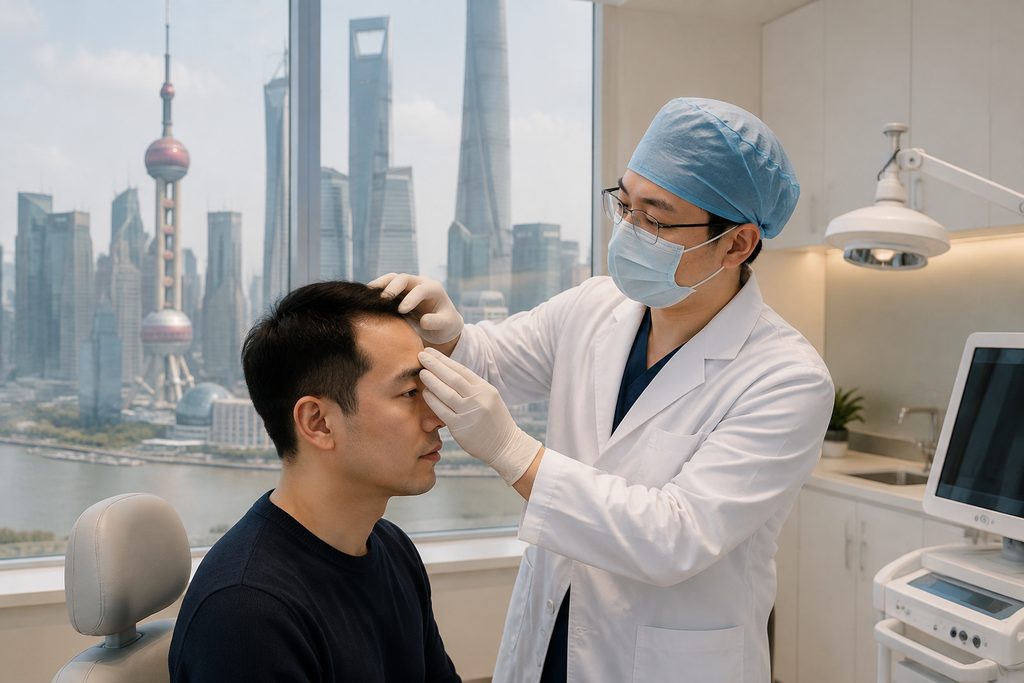
What if the biggest risk with a hair transplant in China isn’t the surgery itself, but choosing the wrong clinic from six thousand miles away? That question sits at the center of every inquiry our team receives about medical travel for cosmetic procedures. The short answer to “is hair restoration safe in China” is yes — at accredited hospitals and established specialty clinics. The longer answer depends on where you go, who operates, and how you verify both before you fly.
China performs an estimated 500,000 hair transplant procedures annually, concentrated in cities like Beijing, Shanghai, Guangzhou, and Chengdu. Volume creates experience. But volume also attracts operators who cut corners. This guide covers how to separate the two, what the procedure actually costs, and what safety checks matter most for international patients.
Is Hair Restoration Safe in China: The Short Answer
Yes, hair restoration is safe in China when performed at a licensed hospital dermatology department or a specialty clinic with board-certified surgeons. The complication rate for FUE (follicular unit extraction) procedures at reputable Chinese institutions runs below 2%, consistent with international benchmarks. Infection, poor graft survival, and unnatural hairline design account for most reported problems — and nearly all trace back to clinic selection, not the country.
The caveat: China’s regulatory landscape for cosmetic clinics is fragmented. Municipal health commissions license facilities, but enforcement varies. A clinic that looks polished online may operate with minimal oversight. Your safety depends on verifying credentials, not on national reputation.
Who This Is Right For — and Who It Isn’t
Hair transplantation works well for a specific profile. You’re a strong candidate if you have stable androgenetic alopecia (male or female pattern baldness), adequate donor hair density at the back of the scalp, and realistic expectations about density and hairline placement. Patients with hair loss from burns, scars, or traction alopecia can also see good results.
But this procedure is not for everyone. You should not pursue a hair transplant in China — or anywhere — if your hair loss is still actively progressing without medical stabilization. Transplanted follicles resist DHT, but native hair around them keeps thinning, creating a patchy result. Active scalp infections, uncontrolled diabetes, bleeding disorders, and unrealistic expectations about density are all disqualifiers. And if you cannot commit to finasteride or minoxidil afterward to preserve surrounding hair, the long-term outcome will disappoint.
The Options, Compared
International patients weighing hair restoration typically compare three destinations: China, Turkey, and the United States or Western Europe. Each has a distinct risk-reward profile.
| Factor | China (Top Public/Private) | Turkey (Istanbul Clinics) | US / Western Europe |
|---|---|---|---|
| Cost per graft (FUE) | $0.80–$2.50 | $1.50–$3.00 | $4.00–$10.00 |
| Typical 3,000-graft procedure | $2,400–$7,500 | $4,500–$9,000 | $12,000–$30,000 |
| Regulatory oversight | Municipal health commissions; JCI at private hospitals | Ministry of Health; variable clinic standards | FDA oversight; board certification required |
| Surgeon involvement | Varies — confirm who operates | Often technician-heavy | Surgeon-led by law |
| Language support for foreigners | Strong at international hospitals; weak at local clinics | Strong in medical tourism hubs | Native for English speakers |
| Follow-up access | Remote consultations; limited in-person | Remote; some complications require return | Easy in-person follow-up |
China’s price advantage is real — a full procedure often costs 60–80% less than the same graft count in the US. But the value proposition only holds at accredited facilities. If you’re comparing the cheapest option in each country, Turkey’s medical tourism infrastructure is more mature. If you’re comparing top-tier institutions, China’s dermatology departments at major teaching hospitals are world-class. The right column depends on whether you prioritize cost, oversight, or convenience.
How to Verify a Hair Transplant Clinic in Shanghai or Beijing
So you’ve decided China makes sense financially. The next question: how do you actually check a clinic’s safety record from abroad? This is where most international patients stall — and where a methodical approach pays off.
Start with the license. Every legitimate medical facility in China must display a Medical Institution Practice License issued by the local health commission. Request a copy and verify the registration number against the municipal health bureau’s public database. If a clinic hesitates to share this, stop. That’s a red flag you cannot ignore.
Check the surgeon. Chinese regulations require the operating physician to hold a Physician Practice Certificate with cosmetic surgery or dermatology scope. Ask for the surgeon’s name, certificate number, and procedure volume. A reputable clinic answers directly. A factory-style operation deflects to “our team of experts.”
Look for international accreditation. Private hospitals like United Family and Jiahui hold JCI accreditation, which requires documented safety protocols, infection control standards, and credentialing processes. These facilities appear in our directory of JCI-accredited private hospitals, where English-speaking staff and insurance billing are standard.
And read reviews with skepticism. Chinese platforms like Xiaohongshu and Dianping carry thousands of reviews, but paid promotion is rampant. Cross-reference patient experiences on independent forums and Reddit threads. When multiple reviews describe the same specific problem — poor graft survival, unexpected technician-led surgery — treat that as a pattern, not noise.
What Hair Transplant Cost China Actually Buys
The headline number for hair transplant cost China is $2,400 to $7,500 for a 3,000-graft FUE procedure at a reputable facility. That’s the surgical fee. What drives the variance?
Surgeon seniority is the biggest lever. A chief physician at a top teaching hospital charges more per graft than a mid-level surgeon at a private clinic. Technique matters too: FUE costs more than FUT (strip harvesting) because it’s more labor-intensive. And the facility tier shifts pricing — a JCI-accredited private hospital in Shanghai runs higher than a local specialty clinic in Chengdu.
What’s typically included: the consultation, the procedure itself, local anesthesia, basic post-op medications, and one or two follow-up visits within the first month. What’s usually not included: pre-operative blood work (budget $50–$150), PRP (platelet-rich plasma) add-ons (often $300–$800 per session), accommodation, and any revision work. Some clinics bundle PRP into a “hair transplant China package” — ask for an itemized breakdown before paying.
For international patients, the logistics layer adds cost. Flights, a 7–10 day stay, and a bilingual companion if you don’t speak Mandarin. A medical companion for a full day runs from $300, and for a procedure like this, having someone handle registration, payment, and post-op instructions in Chinese removes a significant source of stress. But the math still favors China for most patients: even with travel and support, the total usually lands at 40–50% below US pricing.
Practical Considerations: Records, Visa, Payment, and Follow-Up
Medical travel to China for hair restoration requires the S2 visa, which covers short-term private affairs including medical treatment. You’ll need supporting documents from the hospital — a treatment invitation letter and appointment confirmation — plus your passport, photo, and proof of funds. The S2 is typically issued for 30–90 days, sufficient for the procedure and initial healing. Family members accompanying you apply for their own S2 visas. Processing takes 1–3 weeks depending on your home country’s consulate.
Payment is straightforward but differs from Western norms. Public hospitals require prepayment — you deposit funds at admission and settle the balance at discharge. Most accept international credit cards at international patient departments, but smaller clinics may require cash, WeChat Pay, or Alipay, which need a Chinese bank account. Private international hospitals often bill insurance directly. If you’re using US or European insurance, expect to pay upfront and seek reimbursement; cosmetic procedures are rarely covered anyway.
Language is the friction point most patients underestimate. Outside international hospital wings, English is scarce. Registration forms, consent documents, and post-op instructions come in Chinese. A bilingual companion handles these interactions, but if you’re going solo, request English-language consent forms in advance and use a translation app for anything else.
Follow-up after you return home is mostly remote. Your clinic should provide photo-based check-ins at 1, 3, 6, and 12 months. Hair transplant results take 9–12 months to show fully, so most follow-up is documentation, not intervention. The risk: if you need revision surgery, you’re either flying back or finding a local surgeon. That’s the trade-off for the savings.
Frequently Asked Questions
Verify three things: the facility’s Medical Institution Practice License against the municipal health commission database, the operating surgeon’s Physician Practice Certificate and procedure volume, and any international accreditation like JCI. If a clinic cannot produce all three within a day of asking, walk away. No amount of before-and-after photos substitutes for verifiable credentials.
Remote follow-up handles most issues — your clinic reviews photos and adjusts medication or care instructions. But complications like poor graft survival, infection, or an unnatural hairline may require in-person treatment. You’d either return to China or see a local surgeon. Reputable Chinese clinics document everything and cooperate with your home physician, but the practical burden falls on you. This is the real cost of medical travel that price comparisons don’t show.
Packages can simplify logistics, but they also obscure pricing. Always request an itemized breakdown: surgical fee per graft, anesthesia, medications, accommodation, transfers, and any “coordination” charges. Compare the package total against booking each element separately. Some packages add 20–30% markup for convenience. Others bundle genuinely useful services like bilingual support. The package itself is neutral — the transparency is what matters.
Plan for 7–10 days. The first 48 hours are critical for graft survival — you’ll need to sleep elevated, avoid touching the recipient area, and follow a strict washing protocol. Most clinics schedule a day-3 wash and a day-7 check. After that, you can fly home. Some patients stay two weeks for a second follow-up and to let scabbing resolve before long-haul travel.
Your Next Step
Hair restoration in China is safe when you choose a verified facility and surgeon. The savings are substantial, the volume is high, and the top institutions meet international standards. But the verification work falls on you — and it’s harder from abroad than it sounds.
Our team at China Medical Services helps international patients navigate this process. We are not a hospital and we do not provide medical advice or diagnoses. What we do is coordinate: matching you with accredited facilities, arranging consultations, and providing bilingual support on the ground. If you’re weighing a hair transplant in China, start with a free consultation at our patient services page to discuss your specific situation. No pressure, no commitment — just a clear-eyed look at whether this path fits you.
The decision to have surgery in another country is never purely financial. It’s about trust. And trust is built on verification, not brochures.
For more medical information and treatment options in China, visit chinamedservices.com (China Medical Services).
