Knee Replacement in China: How It Works, Real Costs, and Top Hospitals
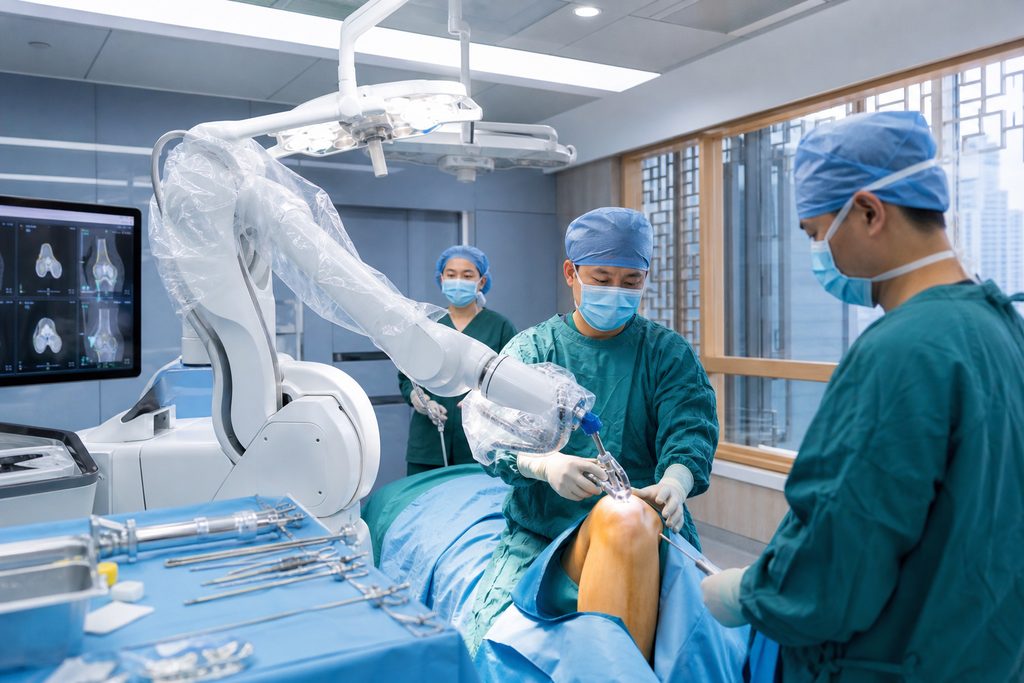
Knee Replacement in China: The Short Answer
A total knee replacement in China works much like it does in the US or Europe — the damaged cartilage and bone are removed and replaced with a metal and plastic implant. The difference is the price. The knee replacement cost China typically runs between $8,000 and $15,000 for a top-tier public hospital, compared to $35,000 to $70,000 in the United States. You get the same implant brands — Zimmer, Stryker, DePuy — and surgeons who perform hundreds of these procedures annually.
But the process is not as simple as booking a flight. Chinese public hospitals do not let overseas patients schedule surgery remotely. You must first attend an in-person consultation, get imaging done on-site, and only then receive a surgery date. That changes the timeline and the planning.
Who This Is Right For — and Who It Isn’t
Knee replacement is a major operation. It is not a first-line treatment. You should be exploring this only after conservative measures — physical therapy, corticosteroid injections, weight loss, activity modification — have stopped working.
Typically good candidates:
- Grade 4 osteoarthritis confirmed by MRI or X-ray, with bone-on-bone contact
- Pain that limits walking to under 500 meters or disrupts sleep
- Age 55 to 80, though younger patients with severe trauma or rheumatoid arthritis are considered
- BMI under 40 — higher BMI increases infection and implant failure risk
- Realistic expectations about recovery: 6 to 12 weeks before normal walking, up to 12 months for full function
Who should not pursue this in China specifically:
- Patients with uncontrolled diabetes (HbA1c above 8.0) — infection risk rises sharply
- Active smokers unwilling to quit 6 weeks before surgery — wound healing complications double
- Anyone needing complex revision surgery after multiple failed replacements — these cases are better managed close to home with long-term follow-up
- Patients who cannot commit to 3 to 4 weeks in China for surgery plus initial rehabilitation
If you fall into the second list, staying home is not a failure. It is the right call.
The Options, Compared
Not every knee replacement in China is the same. The hospital tier you choose changes the price, the language support, and the booking process. Here is the honest breakdown.
| Factor | Public Hospital (Standard Ward) | Public Hospital (International/VIP Department) | Private International Hospital |
|---|---|---|---|
| Cost for total knee replacement | $8,000 – $12,000 | $15,000 – $25,000 | $30,000 – $50,000 |
| English-speaking staff | Rare — bring your own interpreter | Available, sometimes limited | Standard |
| Remote booking before arrival | No — must attend outpatient clinic first | Often yes, via hospital international office | Yes |
| Implant brands used | Zimmer, Stryker, DePuy, domestic brands | Same as standard | Primarily imported brands |
| Insurance direct billing | No — pay upfront, claim later | Rarely | Common — JCI-accredited facilities |
| Wait time after in-person consult | 1 to 4 weeks typical | 3 to 10 days | Under 1 week |
The standard public ward is where the cost advantage is real. But you will need a bilingual companion for every step — registration, payment, pre-op tests, ward communication. The international department removes that friction at roughly double the price. The private hospital is the most convenient and the least “Chinese” in experience, but the savings versus the US shrink considerably.
Most of our patients choose the international department of a top public hospital. It balances cost, surgical volume, and language support.
How Does Knee Replacement Surgery Work in China: The Step-by-Step Reality
The medical procedure itself is identical to what you would get in any Western operating room. But the logistics around it follow Chinese hospital rules, and those rules surprise many first-time visitors.
Step 1: Remote evaluation (optional but recommended). You send your existing X-rays, MRI reports, and medical history. A Chinese orthopedic surgeon reviews them via written second opinion or video consultation. This step confirms you are a surgical candidate before you spend money on flights. It costs $100 to $800 depending on the seniority of the specialist.
Step 2: In-person outpatient consultation. You arrive in China and attend the orthopedic clinic. The surgeon examines your knee, orders fresh standing X-rays and possibly a CT scan, and reviews your blood work. This is non-negotiable. Chinese law and hospital policy require a face-to-face assessment before any surgery is scheduled. Bring all original imaging and a translated medication list.
Step 3: Pre-operative clearance. You will complete blood tests, an ECG, a chest X-ray, and possibly a cardiac evaluation if you are over 65. This typically takes 1 to 2 days. Any abnormal result — elevated blood sugar, untreated hypertension — can delay surgery until it is controlled.
Step 4: Surgery. The operation takes 60 to 90 minutes under spinal or general anesthesia. You will have a urinary catheter and a drain in the knee. Most patients stay in hospital 5 to 7 days, longer than the 2 to 3 days common in US outpatient-focused protocols. Chinese surgeons tend toward conservative discharge timelines.
Step 5: In-hospital rehabilitation. Physiotherapists start you on a CPM (continuous passive motion) machine within 24 hours. You will practice walking with a walker by day 2 or 3. Discharge happens when you can bend the knee to 90 degrees and walk 50 meters with assistance.
Step 6: Outpatient follow-up. Stitches come out at 10 to 14 days. You will have a follow-up X-ray at 4 to 6 weeks. If you return home before then, your local orthopedist handles this — Chinese hospitals will provide a discharge summary in English on request.
Best Hospital for Knee Replacement Shanghai and Beijing: Where the Volume Is
Shanghai and Beijing dominate the orthopedic rankings. The Fudan University Hospital Rankings — China’s most authoritative hospital evaluation — list these institutions among the top 10 nationally for orthopedics. Volume matters in joint replacement: surgeons doing 300+ knees per year have measurably lower complication rates than those doing 30.
In Shanghai:
- Shanghai Sixth People’s Hospital — the highest-volume joint replacement center in the city. Its orthopedic department is consistently ranked among China’s top 5. The international department accepts foreign patients with translated records.
- Zhongshan Hospital, Fudan University — strong general orthopedics and excellent internal medicine support for older patients with comorbidities. See our Shanghai hospital guide for more detail.
In Beijing:
- Peking University Third Hospital — widely considered the reference center for sports medicine and joint surgery in northern China. Its orthopedic surgeons perform over 1,000 knee replacements annually.
- Peking Union Medical College Hospital (PUMCH) — the most prestigious name in Chinese medicine. Smaller orthopedic volume than PUTH, but unmatched diagnostic rigor for complex cases. The orthopedics department rankings page lists all top-10 institutions by specialty.
For most international patients, the best hospital for knee replacement Shanghai is Shanghai Sixth People’s Hospital, while Beijing patients gravitate to PUTH. Both require either fluent Mandarin or an accompanying bilingual coordinator for the standard ward.
Total Knee Arthroplasty Price Beijing: What the Number Actually Includes
The quoted total knee arthroplasty price Beijing — typically $10,000 to $18,000 in a public hospital international department — covers the implant, surgeon fee, anesthesia, operating room, standard ward bed for 5 to 7 days, basic medications, and in-hospital physiotherapy. It does not include your flight, visa, accommodation after discharge, or outpatient rehabilitation.
What drives the variance:
- Implant choice. A standard cobalt-chromium implant costs less than a titanium or oxidized zirconium option. Custom cutting guides add $500 to $1,000.
- Surgeon seniority. A chief physician with 20 years of experience charges a higher surgical fee than an associate chief. The difference is typically $1,000 to $3,000.
- Ward type. A private room in the international department costs $150 to $400 per night. A shared standard ward bed is $30 to $60.
- Length of stay. Every extra day adds roughly $200 to $500 in ward, nursing, and medication fees.
For comparison, the same procedure in Singapore runs $25,000 to $40,000. In Thailand, $12,000 to $18,000. China’s advantage is the combination of price and the sheer surgical volume at top centers.
Is Knee Replacement in China Safe for Foreigners? The Honest Assessment
The short answer: yes, at the right hospital, with the right preparation. The longer answer requires looking at the data and the gaps.
Chinese top-tier orthopedic departments report infection rates for primary knee replacement of 0.5% to 1.5%, comparable to international benchmarks. Implant survival at 10 years is 95% or higher with imported prostheses. The surgeons at Fudan-ranked hospitals train internationally, publish in Western journals, and follow the same perioperative protocols — prophylactic antibiotics, tranexamic acid, early mobilization — used in the US and Europe.
So is knee replacement in China safe for foreigners? Medically, yes. Operationally, the risks are different. Communication failures happen. A patient who cannot explain their pain level, medication allergies, or post-op symptoms is at a real disadvantage. Hospital meals, visiting hours, and nursing ratios differ from Western norms. You will not have a dedicated nurse — Chinese wards operate on a shared-nursing model where family members often assist with basic care.
That is not a reason to avoid China. It is a reason to plan for language support and to choose a hospital with a functioning international department.
Practical Considerations: Records, Visa, Payment, and Follow-Up
Medical records. Bring original X-ray films or DICOM files on a USB drive, MRI reports, and a typed summary of your diagnosis, medications, and prior surgeries. Have it translated into Chinese by a professional medical translator — Google Translate is not sufficient for a surgeon making a decision.
Visa. You will apply for an S2 visa, the short-stay category used for private affairs including medical treatment. The hospital’s international office will issue an invitation letter confirming your consultation or admission. Your spouse or adult child accompanying you applies for the same S2 category. Processing typically takes 5 to 10 business days. No visa is guaranteed — the embassy decides based on your documents and circumstances.
Payment. Chinese public hospitals require a deposit before admission, typically 50% to 100% of the estimated cost. Payment is by cash, UnionPay, or international credit card at the international department. Standard wards often accept only Chinese payment methods — your coordinator can handle this. You pay the hospital directly; you never pay a middleman for treatment.
Insurance. Most Western insurers do not have direct billing arrangements with Chinese public hospitals. You pay upfront and submit an itemized invoice and discharge summary for reimbursement. Confirm coverage before you travel — some policies exclude treatment outside the US or Europe.
Follow-up after returning home. Your local orthopedist takes over at 6 weeks, 3 months, and 12 months. The Chinese surgeon will provide a detailed discharge summary and implant sticker identifying the exact prosthesis used. Keep that sticker — you will need it for any future revision surgery.
Frequently Asked Questions
Not at a public hospital. You can book a remote consultation, and the international department can tentatively reserve a surgery slot, but the surgeon must examine you in person before the operation is confirmed. Private international hospitals are the exception — some do offer book knee surgery package China arrangements with fixed pricing and confirmed dates before you fly.
Your local orthopedist manages it. The Chinese hospital’s responsibility ends at discharge, though most international departments will respond to follow-up emails from your doctor. If you need revision surgery, that is a separate procedure — and you should strongly consider having it done close to home where long-term follow-up is practical.
Usually, yes. Top Chinese hospitals stock Zimmer, Stryker, DePuy, and Smith & Nephew implants. Confirm the brand and model with your surgeon before admission. If you have a strong preference, say so — most international departments will accommodate it.
Plan for 3 to 4 weeks minimum. That includes the initial consultation, pre-op testing, 5 to 7 days in hospital, and 2 weeks of outpatient recovery before flying. Long-haul flights immediately after knee surgery increase blood clot risk. Most surgeons advise waiting at least 10 to 14 days post-op before flying, and you should wear compression stockings and move frequently during the flight.
Your Next Step
Knee replacement in China is a serious decision with real savings and real logistical complexity. The surgery itself matches international standards at top-ranked hospitals. The challenge is everything around it — language, scheduling, payment, and follow-up planning.
We are China Medical Services, a coordination team that connects international patients with top-tier Chinese hospitals. We are not a hospital, and we do not provide medical advice or diagnoses. What we do is handle the practical layer: hospital matching based on your records, remote consultations, bilingual accompaniment, visa documentation support, and scheduling coordination. If you are considering this path, start with a written second opinion before committing to travel. Our free consultation walks through your imaging, your goals, and whether China makes sense for your specific case.
That is the core message: the medical care is there. The preparation is on you — or on a team that does this every week.
For more medical information and treatment options in China, visit chinamedservices.com (China Medical Services).
