PET-CT Scan in China: How It Works, Costs, and Booking for Foreigners
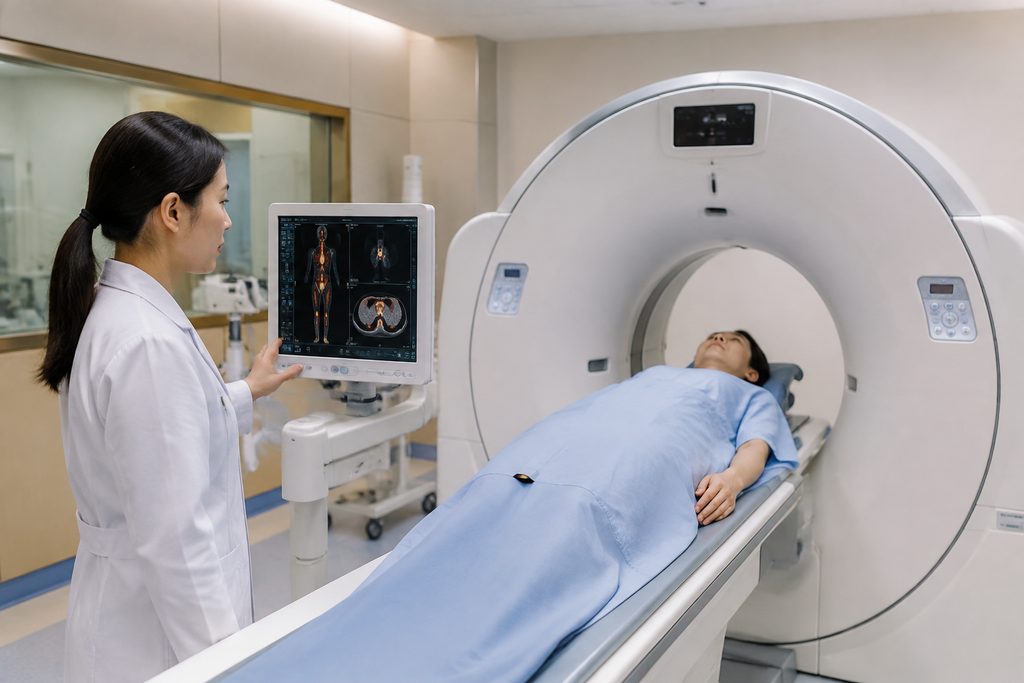
According to China’s National Cancer Center, the country performed over 4.8 million PET-CT examinations in 2023 alone. The PET-CT scan price China typically runs between $700 and $1,500 — roughly one-third to one-fifth of what the same scan costs in the United States, where bills routinely exceed $4,000. That price gap explains why thousands of international patients now schedule diagnostic imaging during medical trips to Chinese cities.
But a PET-CT scan is not a walk-in procedure. You need a clinical reason, a physician’s referral, and in most top-tier public hospitals, an in-person consultation before the radiology department will book you. Our team at China Medical Services coordinates this process daily for patients from Europe, the Middle East, and Southeast Asia.
PET-CT Scan in China: The Short Answer
A PET-CT scan combines two imaging technologies in one machine. The PET (positron emission tomography) component tracks a radioactive glucose tracer injected into your bloodstream. Cancer cells consume glucose faster than normal tissue, so they light up on the scan. The CT (computed tomography) component provides precise anatomical detail. Together they show both where abnormal activity is happening and exactly what it looks like structurally.
The entire procedure takes about two to three hours. The actual scan lasts 20 to 40 minutes. The rest is preparation: fasting, tracer injection, and a quiet waiting period while the tracer distributes through your body.
One caveat matters. A PET-CT scan in China requires a doctor’s order — you cannot simply book one as a screening test. Chinese hospitals follow strict clinical guidelines about when this imaging is appropriate.
Who This Is Right For — and Who It Isn’t
PET-CT is a powerful diagnostic tool. But it is not for everyone, and honest radiology departments will tell you that.
Typically appropriate for:
- Patients with a confirmed cancer diagnosis who need staging — determining whether the disease has spread
- Patients who have completed cancer treatment and need to check for recurrence
- Patients with suspicious findings on CT or MRI that require metabolic confirmation
- Patients with unexplained weight loss, fever, or elevated tumor markers where cancer is strongly suspected
- Cardiac patients being evaluated for myocardial viability before bypass surgery
Not appropriate for:
- Healthy individuals seeking a general “full-body cancer screening” with no symptoms or risk factors
- Pregnant women — the radiation and tracer pose risks to the fetus
- Patients with uncontrolled diabetes — high blood sugar interferes with tracer uptake and produces unreliable results
- Anyone with a recent acute infection or inflammation — these conditions also light up on PET and cause false positives
- Patients who cannot lie flat and still for 30 minutes
If you are in the second list, a different imaging modality or no imaging at all may be the better choice. A qualified oncologist or radiologist should make that call.
The Options, Compared
Not every hospital in China offers the same PET-CT experience. The table below compares what you can expect across the three main hospital categories.
| Factor | Top Public Hospital (International Dept.) | Private International Hospital | Standard Public Hospital (Chinese-speaking) |
|---|---|---|---|
| PET-CT scan price China | $800–$1,200 | $1,200–$2,000 | $700–$900 |
| English-speaking staff | Yes, in international department | Yes, throughout | Rarely |
| Appointment lead time | 3–7 days | 2–5 days | 1–3 days (in-person registration required) |
| Radiologist experience | Very high — often 5,000+ scans annually | High, varies by facility | High at major centers |
| Insurance direct billing | Usually no — pay upfront, claim later | Often yes | No |
| Foreigner booking before arrival | Yes, via international department | Yes | No — must register in person |
Most international patients choose either the international department of a top public hospital or a private international hospital. The public route offers the best combination of clinical expertise and price. The private route trades some cost for smoother logistics and direct insurance billing. Standard public hospital imaging is cheapest but nearly impossible to navigate without fluent Chinese or a bilingual medical companion.
How Does a PET-CT Scan Work for Cancer: What the Radiologist Actually Sees
Understanding how does a PET-CT scan work for cancer helps you read your own report. The process starts with an injection of fluorodeoxyglucose (FDG), a glucose molecule tagged with radioactive fluorine-18. The tracer has a half-life of about 110 minutes, which is why scans are scheduled precisely.
Cancer cells have upregulated glucose transporters — they pull in sugar at rates 10 to 50 times higher than normal tissue. The FDG gets trapped inside these cells. The PET scanner detects the gamma rays emitted as the fluorine-18 decays, creating a map of metabolic activity. The CT component then overlays anatomical structure.
What the radiologist looks for: focal areas of increased FDG uptake that do not correspond to normal physiological activity. Standardized uptake value (SUV) is the measurement. An SUVmax above 2.5 in a solid lesion is suspicious for malignancy, though inflammation can push numbers higher. Your report will list SUV values for any abnormal findings, along with the radiologist’s interpretation.
This is not a perfect test. False positives occur with infection, sarcoidosis, and post-surgical changes. False negatives happen with low-grade tumors, small lesions under 5mm, and certain cancers like mucinous adenocarcinoma that do not avidly take up glucose. A good radiologist knows these limitations and writes reports accordingly.
What It Costs: PET-CT Scan Price China and Regional Differences
The cost of PET-CT scan in Shanghai ranges from $750 to $1,400 depending on the hospital tier. Beijing prices are similar, typically $800 to $1,300. Second-tier cities like Chengdu, Hangzhou, and Wuhan often come in 15–20% lower. These figures cover the scan itself, the FDG tracer, and the radiologist’s written report.
What drives the variance:
- Hospital tier: Fudan-ranked top 100 hospitals charge more than provincial centers
- Department type: International department pricing runs 1.5–2x the standard Chinese patient rate
- Scan protocol: Whole-body scans cost more than limited-region scans
- Contrast: If iodinated CT contrast is added, expect $100–$200 more
- Report translation: Official English translation typically adds $50–$150
For comparison, the same whole-body FDG PET-CT costs $4,000–$6,500 in the US, $1,800–$3,000 in Germany, and $900–$1,800 in Thailand. China sits at the lower end of the global price spectrum while offering radiology teams that read more oncology scans per year than most Western departments.
Practical tip: Ask whether the quoted PET-CT price includes the radiology report in English. Some hospitals include it; others charge separately. Our coordination team always confirms this before you commit.
Practical Considerations: Booking, Safety, and What to Bring
Is PET-CT scan safe in China? The short answer: yes, when performed at an accredited hospital. The radiation dose from a whole-body PET-CT is approximately 8–14 mSv. For context, that is roughly three to five years of natural background radiation. Chinese hospitals follow the same international safety protocols as Western facilities — tracer quality control, scanner calibration, and radiologist credentialing are regulated by the National Health Commission.
What matters more is choosing the right facility. Look for hospitals that perform high PET-CT volumes — at least 3,000 scans per year. High-volume centers have seen more unusual presentations, more artifacts, and more tricky differential diagnoses. Their reports tend to be more accurate. Fudan-ranked oncology centers and large general hospitals in Beijing and Shanghai easily exceed this threshold.
If you want to book PET-CT scan hospital Beijing or Shanghai, here is what you need:
- Referral letter: From your home oncologist or primary physician, stating the clinical indication
- Previous imaging: CT, MRI, or ultrasound reports and the actual image files (DICOM format on CD or USB)
- Pathology reports: If you have a cancer diagnosis, bring biopsy results
- Blood sugar control: Fasting glucose should be under 200 mg/dL (11.1 mmol/L) on scan day; many hospitals require under 150 mg/dL
- Visa: Medical treatment in China falls under the S2 visa category, which covers short-term private affairs including medical care. Your hospital appointment confirmation supports the application
Payment is almost always upfront. Top public hospitals accept cash, Chinese bank cards, and major international credit cards at their international departments. Private international hospitals often accept direct insurance billing from major global insurers. If you are using insurance, confirm coverage before traveling — some policies require pre-authorization for PET-CT.
After the scan, expect the written report within 24 to 48 hours. Many hospitals now provide electronic copies. If you need the images for your home physician, request DICOM files on CD — most hospitals provide this for a small fee.
Frequently Asked Questions
No. Chinese hospitals require a clinical indication documented by a physician. Some private international hospitals offer “executive health screening” packages that include PET-CT, but these are controversial. Major academic centers will not perform PET-CT on asymptomatic individuals. If you do not have a referral, a video consultation with a Chinese oncologist can establish whether PET-CT is clinically appropriate before you travel.
At accredited high-volume hospitals, yes. The technology is identical — most Chinese hospitals use the same Siemens, GE, and Philips scanners found in US and European facilities. The FDG tracer is produced locally under pharmaceutical-grade quality control. The key variable is radiologist interpretation quality, which is why hospital selection matters. Fudan-ranked top 100 hospitals maintain standards comparable to major Western academic centers.
Medical tourism PET-CT scan China packages typically bundle the scan with airport pickup, hotel, translation, and sometimes a consultation with an oncologist. These packages run $2,000–$4,000 all-inclusive. A standalone PET-CT at a top public hospital costs $800–$1,200. The package premium buys convenience, not better imaging. If you are comfortable navigating logistics independently or with a companion service, the standalone route saves significant money.
In most cases, yes. Reports from Fudan-ranked hospitals and JCI-accredited international hospitals are generally accepted by Western physicians. Request the English-language report and DICOM image files. Some home institutions may want their own radiologist to re-read the images, which is standard practice and should not be taken as distrust of the Chinese report.
Plan for three to five days. Day one: consultation and scheduling confirmation. Day two: the scan itself, including the two-to-three-hour preparation period. Day three: report collection and, if needed, a follow-up consultation to discuss findings. This timeline assumes no complications and a hospital with efficient international patient services.
Your Next Step
A PET-CT scan in China offers world-class diagnostic imaging at a fraction of Western prices — but only if you choose the right hospital and arrive with proper documentation. The process is navigable, though the language barrier and registration requirements at top public hospitals can frustrate first-time visitors.
Our team at China Medical Services coordinates PET-CT appointments at Fudan-ranked oncology centers and international hospitals across 37 Chinese cities. We handle referral review, hospital selection, appointment booking, and on-the-ground bilingual support. We are not a hospital and we do not provide medical diagnoses — we connect you with the right clinical team and make sure the logistics work. If you are considering a PET-CT scan in China, start with a free consultation to discuss your situation and whether this imaging is the right next step for you.
Good imaging changes clinical decisions. Getting it at the right price, in the right facility, with the right support — that is the whole point.
For more medical information and treatment options in China, visit chinamedservices.com (China Medical Services).
