Gastroscopy in China: How Foreigners Arrange an Upper Endoscopy
Gastroscopy in China: The Short Answer
Yes, you can get a gastroscopy in China. The gastroscopy cost China hospitals charge typically ranges from $150 to $600 for the procedure itself, depending on whether you choose a public hospital international department or a private international hospital. That compares to $1,500 to $4,000 out-of-pocket in the United States for uninsured patients. The procedure is widely available at top-tier facilities in Beijing, Shanghai, Guangzhou, and Chengdu, often with same-week scheduling.
The catch is logistics. Public hospital walk-in registration works for locals, but as a foreign patient you cannot simply show up and expect a same-day scope. You need a coordinated pathway — which is where a medical concierge service changes the experience entirely.
Who This Is Right For — and Who It Isn’t
A gastroscopy in China makes strong sense for several types of patients. But it is not the right move for everyone. Let us be direct about both.
Good candidates include:
- Patients already planning travel to China for business, family, or tourism who want to add a diagnostic procedure
- Uninsured or high-deductible patients in the US, UK, or Australia facing steep out-of-pocket endoscopy bills
- Expats living in Southeast Asia or the Middle East where specialist wait times stretch for months
- Patients who need a second look at chronic reflux, persistent stomach pain, or unexplained weight loss
- Those comfortable with medical travel and able to spend 3–5 days in-country for the full process
Who should not pursue this:
- Patients with active GI bleeding requiring emergency intervention — go to the nearest emergency department, not an airport
- Anyone with unstable cardiovascular or respiratory conditions that make sedation riskier away from their home medical team
- Patients who need immediate biopsy results to guide urgent cancer treatment decisions
- Those expecting a Western-style private room and spa-like ambience at public hospital prices — that combination does not exist anywhere
If you need an endoscopy within 48 hours because of severe symptoms, stay home. If you have weeks of lead time and want quality care at a fraction of Western prices, China becomes genuinely attractive.
The Options, Compared
Not all gastroscopy experiences in China are equal. The facility type you choose shapes everything: price, language support, scheduling speed, and comfort level. Here is the honest breakdown.
| Factor | Public Hospital International Dept. | Private International Hospital | Standard Public Hospital |
|---|---|---|---|
| Gastroscopy cost (procedure only) | $150–$350 | $400–$600 | $80–$150 |
| English-speaking staff | Usually available | Always available | Rarely |
| Typical scheduling wait | 3–7 days | 1–3 days | Same day–2 days (local queue) |
| Insurance direct billing | Sometimes | Common (JCI-accredited) | No |
| Sedation included | Often extra ($50–$100) | Usually bundled | Often extra |
| Foreigner-friendly registration | Yes, with coordination | Yes, designed for expats | Difficult without Chinese |
For most international patients, the public hospital international department hits the sweet spot: senior specialists, reasonable prices, and enough English support to get through the process. Private international hospitals like United Family or Jiahui cost more but offer the smoothest experience — direct insurance billing, Western-trained gastroenterologists, and zero language friction. Standard public hospital queues are cheap but nearly impossible to navigate without fluent Chinese or a bilingual companion.
How Is an Upper GI Endoscopy Done in China?
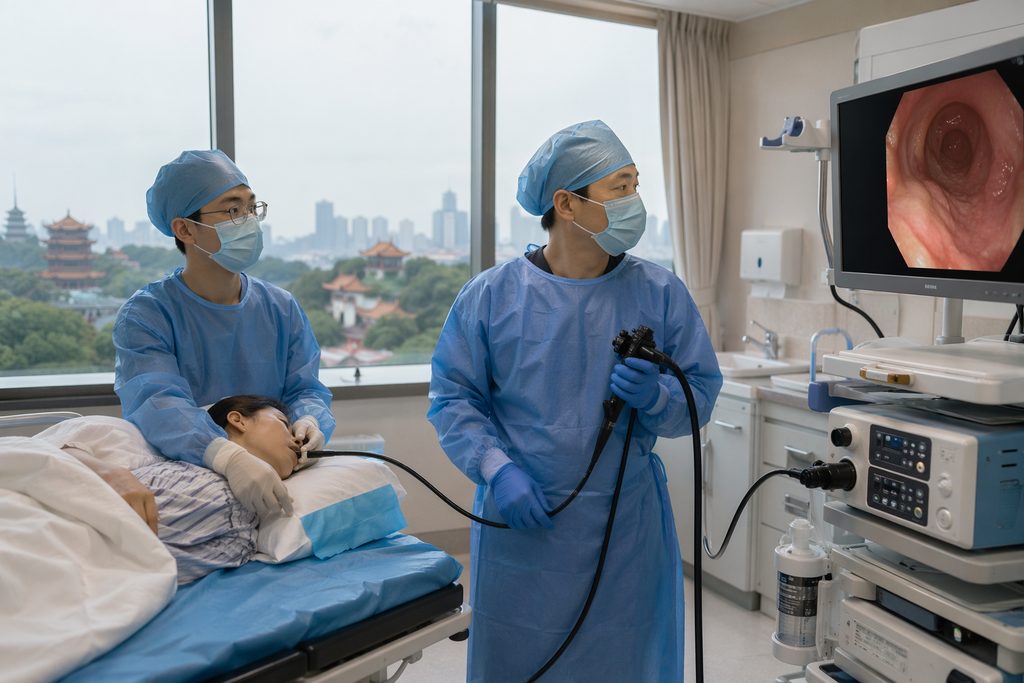
The clinical protocol in China follows the same standards as major Western centers. You fast for 6–8 hours before the procedure. A nurse places an IV line. You receive sedation — typically propofol administered by an anesthesiologist, which puts you in a light sleep. The gastroenterologist inserts a thin, flexible scope through your mouth, down the esophagus, into the stomach and duodenum. The camera transmits high-definition images to a monitor. If the doctor sees anything suspicious, they take biopsies immediately using tiny forceps passed through the scope.
The whole thing takes 10–20 minutes. You wake up in a recovery area within 30–45 minutes. Most hospitals require a companion to escort you back to your hotel because the sedation impairs judgment for several hours. Biopsy results for H. pylori testing or histology typically return in 3–7 days, depending on the hospital lab.
One difference from Western practice: Chinese gastroenterologists perform a very high volume of these procedures. A senior specialist at a top hospital like Zhongshan Hospital in Shanghai or Peking Union Medical College Hospital may do 20–30 gastroscopies in a single morning session. That volume translates to technical proficiency — but it also means the consultation before the procedure may feel briefer than you are used to. Prepare your questions in advance.
Is It Safe to Get an Endoscopy in Beijing?
In Singapore, a private gastroscopy costs SGD $1,200–$2,500. In Thailand, expect $400–$800 at international hospitals. In the UAE, $600–$1,200. China sits at the lower end of that range while offering higher procedure volumes at its top centers. The private endoscopy price abroad is almost always higher than China’s public hospital international departments and comparable to China’s private international hospitals.
If the gastroenterologist sees inflammation, ulcers, or suspicious lesions, they will take biopsies. Those results determine next steps. For H. pylori, treatment is straightforward antibiotics. For anything concerning, the hospital will recommend further imaging or follow-up endoscopy. You are never obligated to pursue treatment in China — you can take the pathology report and images back to your home doctor. The gastroscopy itself is diagnostic, not a commitment to further care.
Yes. Sedation impairs your judgment and coordination for several hours. Hospitals require a companion to escort you out and ensure you get back to your accommodation safely. If you are traveling alone, your coordination service can arrange a companion for the day — this is standard practice for solo medical travelers.
Look at three factors: gastroenterology department reputation, international patient infrastructure, and accreditation. For Shanghai, Zhongshan Hospital and Renji Hospital both have strong GI departments and international wings. For Beijing, Peking Union Medical College Hospital and Beijing Friendship Hospital are the standouts. Check our department rankings by specialty to compare. The best endoscopy hospital Shanghai patients often choose is Zhongshan for its combination of Fudan ranking and established international patient services — but the right choice depends on your specific case and budget.
Your Next Step
Getting a gastroscopy in China is straightforward once you understand the pathway: choose the right hospital tier, prepare your records, secure the S2 visa, and arrange on-the-ground support. The savings are real, and the clinical quality at top centers matches international standards.
We are China Medical Services, a coordination team that connects international patients with 340+ top-ranked hospitals across 37 Chinese cities. We are not a hospital, and we do not provide diagnoses or medical advice. What we do is handle the logistics — hospital matching, appointment booking, bilingual companions, and visa documentation — so you can focus on the procedure itself. If you want to explore whether a gastroscopy in China makes sense for your situation, request a free consultation and we will walk you through the options without pressure.
The decision to travel for medical care is personal. Get the facts, compare the numbers, and choose what serves your health best.
Frequently Asked Questions
Yes. The hospitals used for international patients are JCI-accredited and follow the same international safety standards as top hospitals in the US and Europe. Surgical teams perform high volumes of procedures — often more than their Western counterparts — which studies show leads to better outcomes.
Costs vary by procedure and hospital, but international patients typically save 40-80% compared to US prices — even when factoring in travel and accommodation. A consultation with our team will give you an exact, all-inclusive quote with no hidden fees.
Send us your existing medical reports to get started. We handle everything from hospital selection and appointment scheduling to visa assistance and post-operative recovery planning. Your medical records are reviewed by the specialist before you even book a flight.
For more medical information and treatment options in China, visit chinamedservices.com (China Medical Services).
