Dental Implants in China: Step-by-Step Treatment Process and Costs
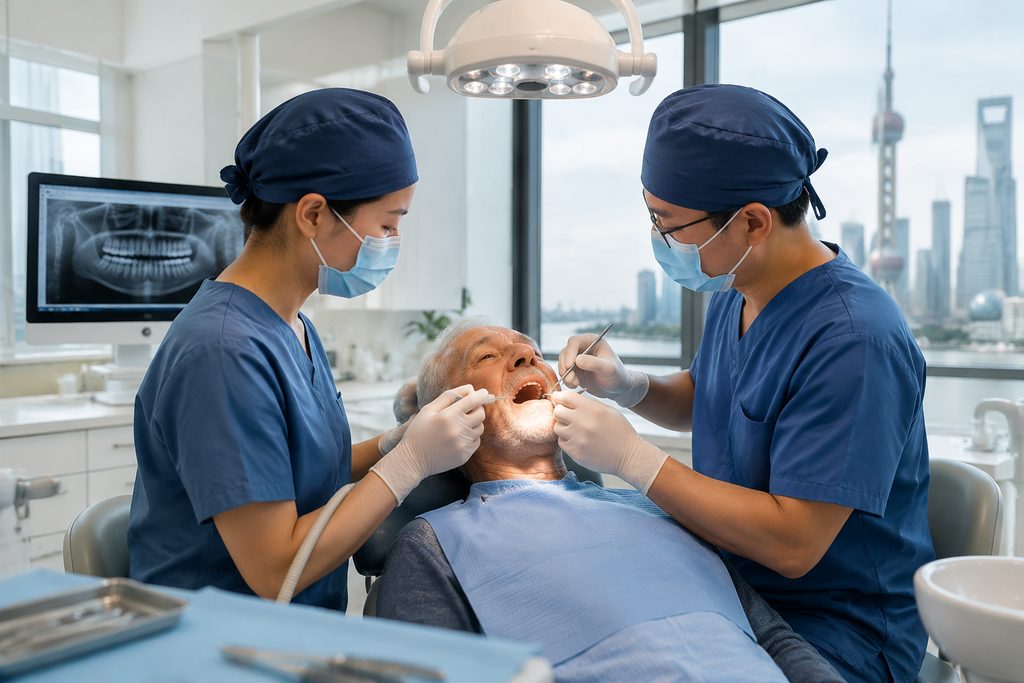
A dental implant is a titanium post that a surgeon places into your jawbone to replace a missing tooth root. A crown is then attached on top. That is the simple version. The full process takes months, involves multiple appointments, and requires careful planning. For international patients, the question is not just “how do dental implants work step by step” but how to manage that process in a foreign healthcare system.
Dental implants cost China significantly less than in the United States, Canada, or Western Europe. A single implant with crown in a top-tier Chinese dental hospital typically ranges from $1,200 to $3,500. The same procedure in the US averages $4,000 to $6,000 per tooth, and full-mouth reconstructions can exceed $60,000. That gap is real. But cost is only one part of the equation.
This guide explains the actual sequence: what happens at each stage, how long it takes, where things can go wrong, and what you should verify before booking a dental implant package abroad. We work with international patients navigating Chinese hospitals every day, and we will be direct about both the advantages and the friction points.
How This Actually Works, Step by Step
The dental implant procedure China price you see quoted usually covers only the surgical placement of the implant fixture. It rarely includes the abutment, the crown, bone grafting, or diagnostic imaging. Understanding the sequence helps you compare quotes accurately.
Step 1: Records review and remote consultation. You send panoramic X-rays or a CBCT scan, plus any recent dental records. A Chinese implant specialist reviews them. They assess bone density, gum health, and whether a sinus lift or bone graft is needed. This written second opinion typically costs $300 to $500 through our network. It tells you whether you are even a candidate before you spend money on flights.
Step 2: In-person examination and treatment plan. You travel to China. The hospital performs its own CBCT scan and clinical exam. The dentist finalizes the plan: implant brand, number of implants, need for extractions, grafting, and timeline. This appointment usually happens on day one or two of your trip.
Step 3: Surgical placement of the implant. The surgeon drills a small hole into the jawbone and screws in the titanium post. Local anesthesia is standard. The procedure takes 30 to 90 minutes for a single implant. Stitches close the gum over the implant. You go home the same day.
Step 4: Osseointegration. This is the waiting period. The bone grows around the implant and locks it in place. It takes 3 to 6 months for the lower jaw, 4 to 6 months for the upper jaw. Nothing visible happens. You return home during this phase.
Step 5: Abutment placement. You return to China. The surgeon reopens the gum, attaches a small connector piece called an abutment, and lets the gum heal around it for 2 to 4 weeks.
Step 6: Crown fabrication and fitting. Impressions are taken. The dental lab fabricates a custom crown matched to your adjacent teeth. You return for fitting and final adjustment. The crown is screwed or cemented onto the abutment.
Total appointments in China: usually three to four visits spread across 4 to 8 months. Some clinics offer same-day or immediate-load implants, but those carry higher risk and are not suitable for every patient.
Dental Implants Cost China: Real Numbers and What They Include
Let us talk about money directly. A single titanium implant with a porcelain crown at a reputable Chinese dental hospital costs between $1,200 and $3,500. That range covers the surgical fee, the implant fixture, the abutment, and the crown. Premium implant brands — Straumann, Nobel Biocare, Zimmer — sit at the higher end. Domestic Chinese brands like Bicon or local manufacturers cost less but have shorter clinical track records.
Here is what you are comparing against:
| Procedure | China (USD) | United States (USD) | Western Europe (USD) |
|---|---|---|---|
| Single implant + crown | $1,200 – $3,500 | $4,000 – $6,000 | $3,000 – $5,500 |
| Full arch (All-on-4/6) | $8,000 – $18,000 | $24,000 – $45,000 | $20,000 – $38,000 |
| Bone graft (if needed) | $300 – $1,200 | $800 – $3,000 | $700 – $2,500 |
| Sinus lift | $800 – $2,000 | $2,500 – $6,000 | $2,000 – $5,000 |
| CBCT scan + consultation | $50 – $200 | $150 – $500 | $100 – $400 |
These are ranges, not quotes. Final pricing varies by hospital, city, implant brand, and case complexity. A full-mouth reconstruction with bone grafting in a top Shanghai dental hospital will cost more than a single implant in a mid-tier Chengdu clinic. The dental implant procedure China price you are quoted should itemize every component. If a clinic gives you one lump sum without explaining what it covers, ask for a breakdown.
Also factor in travel. Two or three round-trip flights, accommodation, and local transport add $1,500 to $4,000 depending on where you are coming from. Even with travel costs, many patients save 40% to 60% compared to US prices.
Is Dental Implant Safe in China? What the Evidence Says
The honest answer: it depends on where you go. China has roughly 35,000 hospitals, and dental care quality spans the full spectrum from world-class to genuinely risky. The country’s top dental hospitals perform thousands of implant procedures annually. Peking University School of Stomatology and Shanghai Ninth People’s Hospital are internationally recognized. Their implant success rates are comparable to Western benchmarks — typically 95% to 98% over ten years for healthy patients.
But the average neighborhood dental clinic is a different story. Infection control, implant brand authenticity, and surgeon training vary widely. Counterfeit implant components have been documented in some low-cost clinics. That is not a reason to avoid China. It is a reason to be selective.
What should you verify? First, the surgeon’s credentials. Look for specialists with formal training in oral implantology, not general dentists who took a weekend course. Second, the implant system. Ask for the exact brand and model. Verify it is a genuine product from a recognized manufacturer. Third, the facility’s sterilization protocols. Autoclave logs, disposable instruments, and surgical-grade environments are non-negotiable.
Our team only works with hospitals in the top 5% of China’s 35,000+ institutions, ranked by Fudan and JCI standards. You can browse our top-ranked hospital database to see the caliber of facilities we coordinate with. That filtering is the difference between a safe procedure and a gamble.
A Realistic Timeline
People consistently underestimate how long this takes. Here is the actual sequence with realistic durations.
| Stage | What Happens | Duration |
|---|---|---|
| Week 1 | Remote records review, written second opinion | 5–10 business days |
| Week 2–4 | S2 visa application, flight booking, hospital appointment scheduling | 2–4 weeks |
| Day 1 in China | In-person exam, CBCT scan, treatment plan finalized | 1 day |
| Day 2–3 | Implant surgery (single or multiple implants) | 1–2 days |
| Day 4–7 | Post-op check, suture removal if needed, return home | 3–5 days |
| Month 3–6 | Osseointegration at home, no travel needed | 3–6 months |
| Second trip | Abutment placement, impressions, temporary crown | 3–5 days |
| Third trip | Final crown fitting and adjustment | 2–3 days |
Total elapsed time: 4 to 8 months from first contact to final crown. Total time in China: 10 to 14 days across three trips. The waiting periods are biological, not bureaucratic. Bone needs time to heal. No clinic can safely compress that timeline, and any that promises otherwise is cutting corners.
One thing people forget: document translation. If your dental records are not in English or Chinese, you need certified translation before the remote consultation. That adds 3 to 5 business days. Budget for it.
What Can Go Wrong — and What Happens Then
We want you to understand the failure modes before you commit. Implant dentistry has real risks, and being overseas adds logistical complications.
Implant failure. The implant fails to integrate with the bone. This happens in 2% to 5% of cases, more often in smokers, diabetics with poor glucose control, and patients with low bone density. Symptoms include mobility, pain, or infection. If it fails, the implant is removed, the site heals for 2 to 3 months, and a new implant can usually be placed. Most reputable Chinese hospitals include a warranty period — typically 1 to 5 years — covering implant replacement if failure occurs due to material defects.
Nerve damage. The inferior alveolar nerve runs through the lower jaw. If an implant is placed too deep, it can cause numbness in the lip, chin, or tongue. This is usually temporary but can be permanent in rare cases. A CBCT scan before surgery is essential to map nerve position. Top hospitals do this routinely. Low-cost clinics sometimes skip it.
Infection. Peri-implantitis is a bacterial infection around the implant. It develops months or years after placement. Treatment involves deep cleaning, antibiotics, or surgical debridement. Risk factors include poor oral hygiene and smoking. If you develop it after returning home, your local dentist can often manage early-stage cases. Advanced cases may require a return trip to China.
Crown fracture or loosening. The crown is the visible part. It can chip, crack, or come loose. If this happens within the warranty period, the Chinese clinic will usually replace it at no cost, but you need to travel back. Some clinics have international partner networks for warranty work. Ask about this before you pay.
Bone graft complications. If you need a sinus lift or bone graft, there is a small risk of graft failure or sinus membrane perforation. This adds healing time. It is not catastrophic but it extends the timeline.
None of these risks are unique to China. They exist everywhere. The difference is that when complications arise at home, you see the same dentist who placed the implant. When they arise after dental tourism, you need a plan. That plan should be in writing before you book anything.
Choosing the Best Dental Implant Clinic in Shanghai or Beyond
Shanghai is the most common destination for dental implant tourism in China. The city has internationally accredited dental hospitals, English-speaking staff, and direct flights from most major Western hubs. But “best dental implant clinic Shanghai” is a search phrase, not a guarantee. You need evaluation criteria.
First, look at surgical volume. A clinic that places 500 implants per year has a different skill level than one that places 50. Ask for the number. Top Chinese dental hospitals perform thousands annually.
Second, check the implant system. Straumann and Nobel Biocare are Swiss brands with decades of clinical data. They cost more but have the longest track records. Chinese brands like WEGO and Bicon are cheaper and improving, but the evidence base is thinner. For a procedure you will live with for decades, the implant brand matters.
Third, evaluate the facility. Is it a hospital-based dental department or a standalone clinic? Hospital-based departments have access to full medical support if something goes wrong — anesthesiologists, emergency rooms, infectious disease specialists. Standalone clinics may be more comfortable but have fewer backup resources.
Fourth, ask about the warranty. What is covered? For how long? What happens if you have a problem after returning home? A written warranty with clear terms is a sign of a serious provider. A verbal promise is not.
Fifth, consider the city. Shanghai and Beijing have the highest concentration of top-ranked dental hospitals. But Guangzhou and Chengdu offer comparable quality at lower prices. If cost is your primary driver, a tier-two city may be the better value. Our department rankings can help you compare dental and oral surgery programs across cities.
Finally, think about communication. You need a provider who can explain the procedure, risks, and aftercare in a language you understand. Many top Chinese dental hospitals have international departments with English-speaking coordinators. If yours does not, a bilingual medical companion is essential — not a luxury.
Practical Considerations: Visa, Payment, and Follow-Up
Foreign patients traveling to China for dental treatment use the S2 visa. This is the short-stay category for private affairs and medical treatment. It typically allows stays of up to 180 days, which covers the surgical phase and initial healing. Your accompanying family members apply for their own S2 visas. You will need supporting documents from the hospital — an invitation letter or treatment confirmation — to include with your application. Requirements vary by embassy, so check with the Chinese consulate in your country before applying.
Payment is straightforward. Chinese public hospitals require prepayment. You deposit funds at admission or before surgery, and the hospital deducts from that balance as services are provided. Private international clinics and dental specialty centers often accept credit cards and may bill insurance directly. Most international health insurance plans do not cover dental implants, so expect to pay out of pocket. Check with your insurer before you commit.
Language is the biggest practical barrier. Public hospital registration desks, payment windows, and pharmacy counters rarely have English-speaking staff. Even in top hospitals, the clinical team may speak limited English. A bilingual medical companion handles queueing, payment, translation, and navigation. Our service starts at $300 per day. It is not an upsell — it is the difference between a smooth process and a stressful one.
Follow-up at home is manageable. Your local dentist can perform routine monitoring and cleanings. Annual X-rays can be sent to the Chinese clinic for review. If a complication requires intervention, your local dentist can often handle it, with remote guidance from the Chinese team. This is not ideal, but it works for most patients.
Frequently Asked Questions
A single implant with crown costs $1,200 to $3,500. Full-arch restorations like All-on-4 range from $8,000 to $18,000. These figures exclude travel, accommodation, and any bone grafting or sinus lift procedures. Always request an itemized quote before committing.
At top-ranked hospitals, yes. Implant success rates at China’s leading dental institutions match Western benchmarks of 95% to 98%. The risk lies in low-cost, low-volume clinics with lax sterilization and unverified implant brands. Choose a hospital with documented surgical volume and internationally recognized implant systems.
Usually three. The first trip covers examination and implant placement. The second, three to six months later, covers abutment placement and impressions. The third covers final crown fitting. Total time in China is 10 to 14 days across those three visits.
Some clinics offer packages that bundle surgery, crown, accommodation, and airport transfers. These are convenient but often use lower-cost implant brands and may not include bone grafting. Read the fine print. A package that seems cheap may exclude the components that actually determine long-term success.
Most reputable Chinese dental hospitals offer a warranty of 1 to 5 years covering implant replacement due to material defects or surgical error. You would need to return to China for the replacement procedure. Some clinics have international partner networks for warranty work, but this is not standard. Confirm warranty terms in writing before treatment.
Your Next Step
Dental implants in China offer genuine savings
For more medical information and treatment options in China, visit chinamedservices.com (China Medical Services).
