Eye Surgery in China for Foreigners: Cataract, LASIK, Glaucoma, and Retina Hub
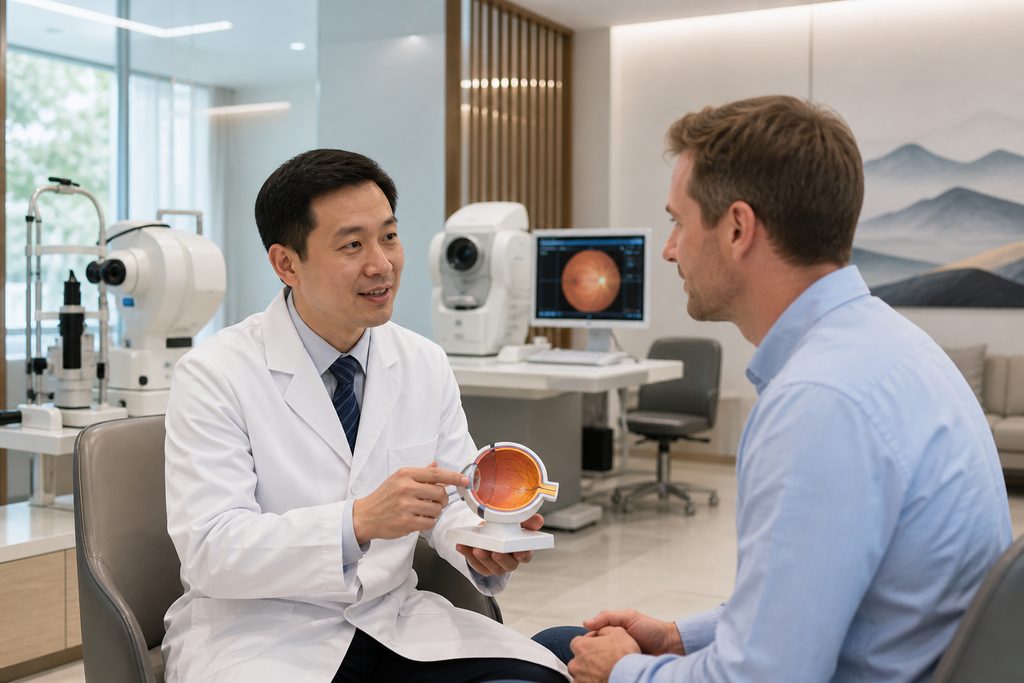
Have you ever stared at a quote for eye surgery and felt your stomach drop? A routine cataract procedure shouldn’t cost more than a luxury car. Yet for millions of patients in the US, UK, and Australia, that’s the reality. The cataract surgery cost China for foreigners often lands between $2,000 and $4,000 per eye at top-tier hospitals—roughly one-fifth of what you’d pay in California or London. That gap is why we built a service that handles the hard parts: matching you with the right surgeon, translating your records, and making sure you’re not lost in a system that speaks a different language.
How This Actually Works, Step by Step
Most people imagine a chaotic scramble through a foreign hospital. It doesn’t work that way with the right coordination. Here’s the sequence we see with patients who come for eye surgery.
First, you send us your existing eye examination reports. A glaucoma workup, a corneal topography map for LASIK, an OCT scan for retina issues—whatever you already have. Our team translates these into clinical Chinese and routes them to the ophthalmology department at a hospital that matches your condition. Not just any hospital. One where the surgeons handle a high volume of your specific procedure. A hospital like those ranked in the Fudan specialty reputation list for ophthalmology.
The department reviews your file. This takes three to five business days. You get back a written assessment: whether you’re a candidate, what the suggested approach is, and a preliminary cost range. No guesswork. If you want to speak with the surgeon before traveling, we arrange a video consultation. The fee for that runs from $100 to $800 depending on the specialist’s seniority. If you later proceed with surgery through us, that consultation cost is credited in full toward our coordination fee within 90 days.
Once you decide to move forward, we lock in the appointment, help you apply for the S2 visa with the hospital’s invitation letter, and arrange your arrival logistics. On the day of your preoperative exam, a bilingual medical companion meets you at the hospital entrance. They handle registration, queueing, payment, translation during the consultation, and walking you to every test. You focus on your eyes. We handle the friction.
What Each Procedure Actually Costs
Let’s address the question that drives most searches: what is the cataract surgery cost China for foreigners compared to other procedures? The numbers shift based on lens type, surgical technique, and whether you go through a public hospital’s international department or a private facility like United Family or Jiahui. But here are the ranges we see consistently.
| Procedure | China (International Dept.) | US Average | UK Private |
|---|---|---|---|
| Cataract (monofocal lens, one eye) | $2,000 – $4,000 | $3,500 – $7,000 | £2,500 – £4,500 |
| Cataract (multifocal/premium lens, one eye) | $4,500 – $7,000 | $5,500 – $10,000 | £4,000 – £6,500 |
| LASIK (both eyes, femtosecond) | $1,800 – $3,500 | $4,000 – $6,500 | £3,000 – £5,000 |
| Glaucoma (trabeculectomy, one eye) | $3,000 – $5,500 | $8,000 – $15,000 | £5,000 – £8,000 |
| Retina (vitrectomy, one eye) | $5,000 – $9,000 | $13,000 – $25,000 | £8,000 – £14,000 |
These figures include surgeon fees, operating theater costs, standard intraocular lenses or consumables, and a short hospital stay if needed. They do not include our coordination fee, your flight, accommodation, or the S2 visa application cost. Prices vary by hospital and case complexity. A retina detachment repair with silicone oil tamponade costs more than a straightforward macular hole closure. Always get a personalized quote after the department reviews your scans.
What about the glaucoma treatment package Shanghai price specifically? Shanghai’s top ophthalmology centers—like the Eye and ENT Hospital of Fudan University—often quote between $3,500 and $5,000 for a trabeculectomy through their international wing. That typically covers the preoperative workup, the surgery itself, and three to six months of follow-up visits. If you need a drainage implant instead, expect the upper end of that range. The key advantage in Shanghai isn’t just cost. It’s volume. Surgeons there perform more glaucoma procedures in a month than many Western specialists do in a year.
How to Choose the Right Hospital
Not all eye hospitals are built the same. If you’re searching for the best eye hospital China LASIK, you need to look past glossy websites and ask about refractive surgery volume, the laser platform they use, and how they screen candidates.
The Fudan University Hospital Ranking publishes a specialty reputation list for ophthalmology every year. The hospitals that consistently appear in the top ten include Zhongshan Ophthalmic Center at Sun Yat-sen University in Guangzhou, the Eye and ENT Hospital of Fudan University in Shanghai, and Beijing Tongren Hospital. These are public institutions with massive patient volumes. Their international departments handle foreign patients separately, with English-speaking coordinators, private consultation rooms, and expedited scheduling.
For LASIK specifically, you want a center running a femtosecond laser platform from Zeiss or Alcon—the same devices used in leading clinics in Germany or the US. Ask what percentage of their LASIK patients achieve 20/20 or better uncorrected vision at six months. A reputable center will tell you. The ones we work with report rates above 95% for suitable candidates.
Private international hospitals like Jiahui and United Family offer another path. They’re JCI-accredited, fully English-speaking, and handle direct insurance billing. The trade-off is a smaller surgical volume and sometimes a narrower range of subspecialists. For a straightforward LASIK or cataract case, they’re excellent. For a complex retinal detachment or advanced glaucoma requiring a combined procedure, a top public hospital’s international department gives you access to surgeons who see the rarest pathologies weekly.
A Realistic Timeline
People underestimate how long the non-surgical steps take. Here’s what a typical journey looks like from the moment you decide to explore eye surgery in China.
| Stage | Duration | What Happens |
|---|---|---|
| Document collection and translation | 3–5 days | You gather existing eye exam reports. We translate them into clinical Chinese. |
| Department review | 3–5 business days | The ophthalmology team assesses your case and returns a written opinion with a preliminary cost range. |
| Video consultation (optional) | Schedule within 1–2 weeks | You speak directly with the surgeon. Ask about approach, risks, recovery expectations. |
| Visa processing | 1–4 weeks | S2 visa application with the hospital invitation letter. Timing depends on your local Chinese embassy or consulate. |
| Travel and preoperative exam | 2–3 days in China | You arrive, have a comprehensive eye exam, and the surgeon confirms the surgical plan. |
| Surgery | 1 day | Most eye procedures are outpatient. Retina surgery may require a 1–3 day hospital stay. |
| Immediate postoperative observation | 1–7 days in China | LASIK: next-day check, then you can fly. Cataract: 3–5 days. Glaucoma/retina: 5–10 days minimum. |
| Follow-up at home | 1 month, 3 months, 6 months | You see your local ophthalmologist. We coordinate report sharing with your Chinese surgeon. |
Total time away from home: as short as four days for LASIK, up to two weeks for retina surgery. The visa is often the bottleneck. Apply early. Some embassies process S2 visas in under a week. Others take a month. We can’t control that, but we can give you the right documents on time.
What Can Go Wrong—and What Happens Then
Any honest discussion of medical travel must acknowledge what happens when things don’t go perfectly. Eye surgery carries risks regardless of where you have it. Infection, undercorrection or overcorrection, elevated intraocular pressure, retinal detachment, endophthalmitis—these are rare but real.
The question patients search for is: how safe is eye surgery in China for international patients? The answer depends on where you go. At the top-tier hospitals we work with, infection control protocols match or exceed JCI standards. Their endophthalmitis rates after cataract surgery are below 0.1%, consistent with benchmarks in the US and Europe. Their LASIK flap complication rates sit well under 1%. The safety profile isn’t inherently different from what you’d find at Moorfields in London or Bascom Palmer in Miami.
What is different is what happens if a complication occurs. You’re far from home. Your local ophthalmologist wasn’t the one who operated. That’s why we insist on a clear continuity-of-care plan before you travel. Your Chinese surgeon provides a detailed operative report and a postoperative care protocol that your home ophthalmologist can follow. We facilitate the handoff. If a complication requires re-intervention, the Chinese hospital’s international department prioritizes returning patients. But you should understand this: you will need to travel back. No remote consultation can replace a slit-lamp exam.
Also, not every patient is a candidate. Some people arrive hoping for LASIK and learn their corneas are too thin. Others want premium multifocal cataract lenses but have macular pathology that would undermine the result. A responsible surgeon will tell you no when it’s not in your interest. We’ve seen this happen. It’s disappointing, but it’s also a sign you’re dealing with an ethical team.
Recovery: What “Normal” Looks Like
If you’re searching for what is recovery time for retina surgery abroad, you’re probably weighing whether you can manage the logistics. The answer splits by procedure.
LASIK recovery is fastest. Most patients see 20/20 or better the next morning. Dry eye and light sensitivity persist for a few weeks. You can fly 24 hours after surgery, but you’ll want lubricating drops for the cabin air. No swimming or eye rubbing for a month.
Cataract surgery also heals quickly. Vision clears within days. The main restriction is avoiding heavy lifting and bending for the first week to prevent intraocular pressure spikes. You’ll need someone to drive you for the first few days. If you’re doing both eyes, surgeons typically space them one to two weeks apart.
Glaucoma surgery is slower. A trabeculectomy creates a new drainage channel. The eye needs weeks to stabilize. Intraocular pressure checks happen frequently in the first month. You’ll be on antibiotic and steroid drops with a tapering schedule. Flying is generally safe after one to two weeks, but you must have a local ophthalmologist lined up to monitor the bleb and pressure.
Retina surgery demands the most patience. After a vitrectomy with gas tamponade, you cannot fly until the gas bubble fully absorbs—this can take two to eight weeks depending on the gas type. Changing cabin pressure with gas in the eye can cause a catastrophic pressure spike. Your surgeon will clear you for flight only after confirming the bubble is gone. Vision recovery is gradual, often taking months. You’ll need multiple follow-up visits, some of which can happen with your home retina specialist.
Practical Considerations: Visa, Payment, and Follow-Up
The S2 visa is the correct category for medical treatment in China. It’s a short-term private affairs visa. You’ll need an invitation letter from the hospital, proof of accommodation, and a passport with at least six months of validity. The hospital’s international department issues the letter once your appointment is confirmed. Processing times vary by country. Plan for three to four weeks to be safe. Family members accompanying you also apply for S2 visas.
Payment works differently than what many Western patients expect. Public hospitals in China require prepayment. You deposit funds at registration, and the hospital draws down as services are rendered. Credit cards are accepted at international departments, but confirm with your bank about foreign transaction fees. Private international hospitals like United Family often bill insurance directly. If you have a PPO plan with out-of-network international coverage, you may be able to claim reimbursement. We provide itemized receipts and translated medical records for insurance submission. We do not guarantee reimbursement.
Language is the invisible barrier. Even at hospitals with English-speaking doctors, the nurses, technicians, cashiers, and pharmacy staff typically speak Mandarin. A bilingual companion who knows the hospital layout and workflow transforms the experience. They shave hours off the waiting time simply by knowing which window to visit in which order. That’s the practical value, not just translation.
Follow-up care at home is non-negotiable. Before you leave China, your surgeon gives you a written protocol: which drops, how often, for how long, warning signs to watch for. You take this to your local ophthalmologist. We help coordinate report sharing between the two teams. If your local doctor has questions, we facilitate communication. This continuity loop is what prevents a good surgical result from turning into a poorly managed recovery.
Frequently Asked Questions
No reputable center will schedule LASIK without a comprehensive preoperative exam. That exam must happen in person. Corneal topography, pachymetry, pupil size measurement, and a dilated fundus exam are all essential. We can arrange a video consultation beforehand so you understand your likely candidacy, but the final surgical decision happens after you arrive and undergo testing. Anyone offering to book LASIK surgery China medical tourism without an in-person preoperative exam is cutting corners you don’t want cut.
For LASIK, yes—both eyes are typically treated in the same session. For cataract surgery, surgeons usually space the two eyes one to two weeks apart. That means a two- to three-week stay. Some patients do one eye in China and the second at home. For glaucoma or retina surgery, bilateral simultaneous procedures are rare. You’d plan separate trips or an extended stay.
Ask about their annual surgical volume for your specific procedure. A cataract surgeon performing 1,000-plus cases per year has seen every variation. Ask about their complication rate and how it compares to published benchmarks. The hospitals we work with are ranked in the Fudan ophthalmology specialty top ten. Their surgeons train for years in subspecialty fellowships. Many have published in international peer-reviewed journals. We can provide surgeon backgrounds before you commit.
That depends on your financial situation and how much you value convenience. If you’re paying out of pocket for premium cataract lenses or a vitrectomy, the savings can exceed $15,000. For LASIK, the gap is smaller—maybe $2,000 to $3,000 after travel costs. The patients who benefit most are those needing complex retina or glaucoma procedures where the price difference is enormous. Run the numbers with the table above. Factor in flights, accommodation, and our coordination fee. Then decide.
Your Next Step
You’ve seen the cost ranges, the timeline, the risks, and the recovery expectations. The decision to travel for eye surgery isn’t one to make lightly. But for the right patient with the right condition, the combination of surgical expertise, volume, and cost makes China a serious option worth evaluating.
Our team at China Medical Services doesn’t perform surgery. We don’t give medical advice. What we do is connect you with ophthalmology departments at 340+ top-ranked hospitals across 37 cities, translate your records, arrange video consultations, and provide bilingual companions who make the hospital experience navigable. If you want to understand whether your case is suitable and what the numbers would look like, send us your eye exam reports. We’ll get you a straight answer. No pressure. Just information. For more medical information and treatment options in China, visit chinamedservices.com (China Medical Services).
