How Does Rhinoplasty Work in China? Costs, Surgeons, and Recovery Explained
Key Takeaways
- Rhinoplasty cost China typically runs $3,000–$12,000 at top-tier public and private international hospitals — roughly 30–50% of typical US or UK prices.
- China’s leading plastic surgery departments perform thousands of rhinoplasties annually, with senior surgeons completing 300–500 cases per year.
- Foreign patients cannot book surgery remotely through standard public hospital channels. You must either attend an in-person consultation first or use an international/VIP department.
- Plan for 14–21 days in China for surgery plus initial recovery, and understand follow-up limitations before you fly home.
The Problem: Rhinoplasty at Home Often Means High Prices and Long Waits
According to the American Society of Plastic Surgeons, the average rhinoplasty cost in the United States reached $5,483 in 2023 — and that figure excludes anesthesia, operating room fees, and post-surgical care. Add those in, and most patients pay between $8,000 and $15,000 out of pocket. In the UK, private rhinoplasty typically runs £6,000–£9,000, with NHS coverage reserved almost exclusively for functional breathing problems rather than cosmetic concerns.
Wait times compound the frustration. In Canada, patients referred for functional rhinoplasty can wait 12 to 24 months for a surgical consultation, then another 6 to 12 months for the procedure itself. Private clinics in London and New York move faster, but the cost jumps accordingly.
That reality pushes many patients to look abroad. Turkey, South Korea, and increasingly China have become destinations for nose surgery. But how does rhinoplasty work in China, specifically? The answer involves a different hospital system, different booking rules, and a cost structure that can save you thousands — if you understand how to navigate it.
Why China Delivers Results for Rhinoplasty Patients
Clinical Volume Drives Surgical Skill
Chinese plastic surgery departments operate at a scale that most Western clinics cannot match. A senior rhinoplasty surgeon at a top Shanghai or Beijing hospital typically performs 300–500 nose procedures per year. Compare that to the average US plastic surgeon, who completes roughly 30–50 rhinoplasties annually, according to data from the American Academy of Facial Plastic and Reconstructive Surgery.
Volume matters in rhinoplasty more than in almost any other cosmetic procedure. The nose is a three-dimensional structure where millimeter-level changes alter breathing function, facial harmony, and long-term stability. Surgeons who see hundreds of cases annually develop an instinct for cartilage behavior, skin thickness variations, and revision challenges that lower-volume surgeons simply cannot accumulate.
Technology and Technique at Scale
China’s top hospitals have invested heavily in 3D imaging, computer-assisted surgical planning, and endoscopic techniques. At institutions like Shanghai Ninth People’s Hospital — widely regarded as one of China’s leading centers for craniofacial and nasal surgery — patients routinely receive preoperative 3D simulation to preview expected outcomes.
But the real structural advantage is integration. Many large Chinese hospitals house plastic surgery, otolaryngology (ENT), and anesthesiology under one roof with immediate access to CT imaging and laboratory services. That means a patient with both cosmetic and functional nasal issues can be evaluated by a combined team in a single visit — no bouncing between separate clinics.
Cost Advantage Without Quality Compromise
Rhinoplasty cost China averages $3,000–$8,000 at public tertiary hospitals, and $6,000–$12,000 at private international hospitals like United Family or Jiahui. That includes surgeon fees, anesthesia, operating room, and a short hospital stay where applicable. In the US, the same all-in package would typically cost $12,000–$20,000.
Why the gap? Lower labor costs, higher patient throughput, and hospital-owned operating facilities all contribute. But lower cost does not mean lower standards. The top-ranked Chinese hospitals follow international sterilization protocols, use FDA-approved or CE-marked implants, and many hold JCI accreditation — the same standard used by leading hospitals in the US, Europe, and Singapore.
How Rhinoplasty Actually Works in China: The Step-by-Step Process
If you are considering traveling to China for nose surgery, the process differs significantly from what you might expect at home. Here is the real sequence, based on how public and international hospitals actually operate.
Step 1: Remote Consultation and Record Review
You cannot simply email a top Shanghai surgeon and book a surgery date. Public hospital rules require an in-person consultation before any surgical scheduling. What you can do remotely is submit photos, medical history, and any prior imaging for a preliminary review. Some international departments offer video consultations for $100–$300, where a surgeon assesses whether you are a suitable candidate and discusses realistic expectations.
Step 2: In-Person Consultation and Surgical Planning
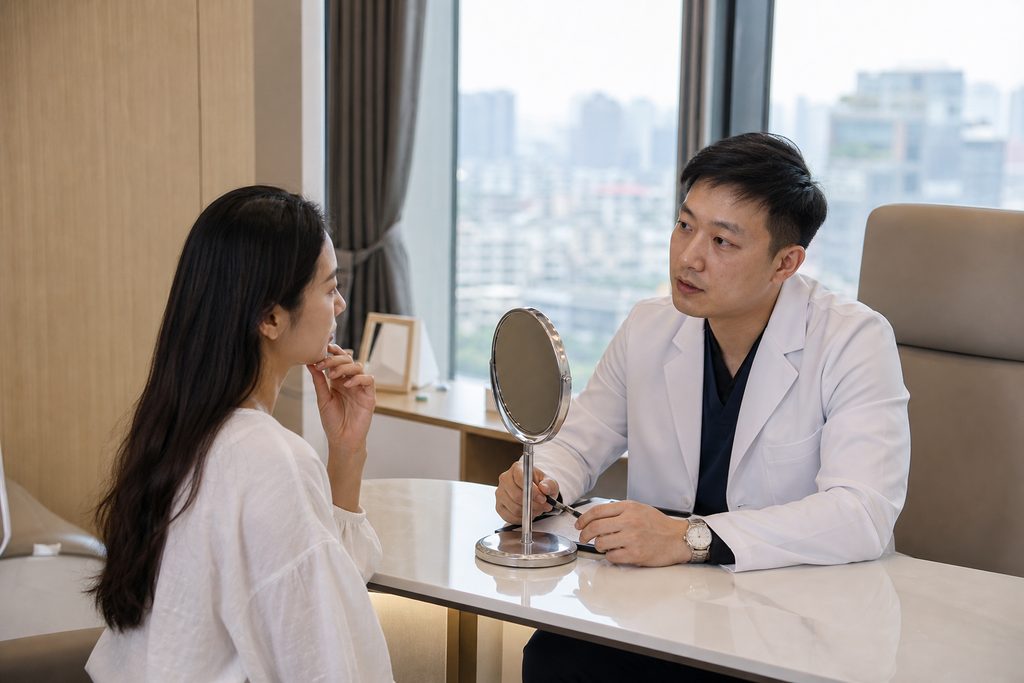
You will need to travel to China for the formal consultation. This typically happens 1–3 days before surgery. The surgeon examines your nasal structure, skin thickness, cartilage availability, and breathing function. Expect a CT scan or 3D imaging. The surgeon then presents a surgical plan — open versus closed approach, implant versus autologous cartilage, tip refinement versus dorsal augmentation.
Step 3: Preoperative Testing
Blood work, ECG, and sometimes chest X-ray are required within days before surgery. These are done at the hospital. Results typically clear within 24 hours. If any abnormality appears, surgery is postponed — this is standard safety protocol, not a bureaucratic hurdle.
Step 4: The Procedure Itself
Rhinoplasty in China typically takes 2–4 hours depending on complexity. Most cases use general anesthesia. The two main approaches are identical to Western practice: open rhinoplasty (small incision across the columella) for complex reshaping, or closed rhinoplasty (incisions inside the nostrils) for more limited changes. Implant materials include silicone, ePTFE (Gore-Tex), and autologous rib or ear cartilage. Chinese surgeons have extensive experience with autologous rib cartilage for revision cases and Asian nasal augmentation.
Step 5: Immediate Recovery and Hospital Stay
Most patients stay 1–2 nights in the hospital. You will have a nasal splint, possibly internal packing, and significant swelling. Pain is generally manageable with oral medication. The splint comes off at day 5–7. Sutures are removed around the same time.
Step 6: Postoperative Follow-Up Before Departure
You should plan to stay in China for at least 10–14 days after surgery. This allows for splint removal, suture removal, and at least one follow-up examination. Some patients stay 21 days for more complete early healing. Your surgeon will assess whether it is safe for you to fly home.
Is Rhinoplasty Safe in China? What the Data and Systems Actually Show
The question “is rhinoplasty safe in China” deserves a direct answer. The short version: yes, at accredited top-tier hospitals with experienced surgeons — and no, at unregulated small clinics that market aggressively to foreigners. The safety gap between these two tiers is enormous.
China’s top hospitals operate under the National Health Commission’s hospital grading system. Grade III Class A (三甲) hospitals are the highest tier — roughly 1,400 institutions nationwide, subject to regular inspections, mandatory reporting of surgical complications, and strict credentialing requirements for surgeons. The Fudan-ranked top 100 hospitals represent the top 5% of China’s 35,000+ hospitals. These are the institutions you want for rhinoplasty.
Infection rates at these hospitals are comparable to Western benchmarks — typically under 1% for clean elective procedures. Anesthesia is administered by board-certified anesthesiologists, not nurse anesthetists. And because these hospitals handle enormous surgical volumes, their emergency response systems are well-rehearsed.
But there are real risks to acknowledge. Language barriers can complicate postoperative care if you do not have translation support. Follow-up after you return home is limited — your local doctor may not be familiar with the specific implant or technique used. And if a complication arises months later, coordinating care across borders adds friction.
Safety warning: Avoid clinics that offer “surgery tomorrow” without a proper consultation, quote prices dramatically below market rates, or communicate only through social media. These are red flags for unlicensed or under-qualified operators.
Rhinoplasty Cost China: A Realistic Breakdown
Rhinoplasty cost China varies significantly by hospital type, surgeon seniority, and surgical complexity. Here is what international patients should actually expect to pay, based on current market ranges at top-tier institutions.
| Cost Component | Public Tertiary Hospital (International Dept.) | Private International Hospital | Typical US Benchmark |
|---|---|---|---|
| Surgeon fee | $1,500–$4,000 | $3,000–$6,000 | $4,000–$8,000 |
| Anesthesia | $500–$1,000 | $800–$1,500 | $1,500–$2,500 |
| Operating room & hospital stay (1–2 nights) | $800–$1,500 | $1,200–$2,500 | $3,000–$6,000 |
| Implant/materials (if applicable) | $300–$1,000 | $500–$1,500 | $500–$1,500 |
| Total all-in range | $3,100–$7,500 | $5,500–$11,500 | $9,000–$18,000 |
These figures are estimates based on current market conditions and vary by hospital and case complexity. Revision rhinoplasty, rib cartilage harvesting, and combined functional-cosmetic procedures all push costs toward the higher end. The best nose job surgeon Shanghai patients seek will typically command fees at or above these ranges — senior surgeons at Shanghai Ninth People’s Hospital or Huashan Hospital‘s plastic surgery department are in high demand.
Booking a nose surgery China package through an international department often bundles consultation, surgery, hospital stay, and basic follow-up into one price. These packages range from $5,000 to $15,000 depending on the hospital and surgeon. Always confirm exactly what is included — some packages exclude preoperative testing or postoperative medications.
Finding the Right Surgeon: What to Look For
The best nose job surgeon Shanghai has to offer will not necessarily be the one with the most polished Instagram presence. Here is what actually matters when evaluating a rhinoplasty surgeon in China.
First, verify hospital affiliation. The surgeon should hold a full-time position at a Grade III Class A hospital or an accredited international hospital. Check the hospital’s official website — not a third-party agency site. Look for surgeons listed in the plastic surgery or otolaryngology department rosters.
Second, ask about case volume and revision rates. A credible surgeon should be able to tell you approximately how many rhinoplasties they perform annually and their revision rate. A revision rate under 5% is considered good; under 3% is excellent. If a surgeon cannot or will not answer this question, walk away.
Third, review before-and-after photos of patients with similar nasal anatomy to yours. This matters enormously. A surgeon who excels at dorsal augmentation for Asian patients may not be the right choice for a patient seeking hump reduction. Ask specifically for cases that match your ethnicity and nasal structure.
Fourth, confirm who will actually perform the surgery. At large teaching hospitals, residents and fellows may participate in portions of the procedure. This is standard practice globally, but you should know in advance and confirm that the senior surgeon you consulted will be the primary operator.
For a deeper look at hospital selection across specialties, our department rankings by specialty page breaks down which Chinese hospitals lead in plastic surgery, ENT, and related fields.
Rhinoplasty Recovery Time Abroad: What to Plan For
Rhinoplasty recovery time abroad requires more planning than a local procedure. You are not just healing — you are healing in a foreign country, then traveling home, then continuing recovery without direct access to your surgeon.
Week one is the most intensive. You will have a splint, significant swelling, and possibly bruising around the eyes. You will see your surgeon at days 5–7 for splint and suture removal. Flying during this period is not recommended — cabin pressure changes can worsen swelling and discomfort.
Weeks two and three: most patients feel well enough to fly home by day 10–14. Swelling has reduced substantially, though the nose still looks noticeably swollen. You can resume light activities but should avoid anything that raises blood pressure — no heavy lifting, no bending over, no vigorous exercise.
Months one to three: swelling continues to subside. About 70% of visible swelling resolves in the first month, but the remaining 30% can take up to a year to fully settle. The nasal tip is always the last area to refine. You should arrange a local follow-up with a qualified ENT or plastic surgeon in your home country around the one-month mark.
One year: final results are generally visible at 12 months. If a revision is needed, most surgeons recommend waiting at least 9–12 months before considering it.
Practical tip: Before you leave China, ask your surgeon for a complete operative report, implant documentation (if applicable), and postoperative care instructions in English. Your home-country doctor will need these records for any follow-up care.
Practical Considerations: Visas, Payment, and Documentation
Foreign patients traveling to China for rhinoplasty need an S2 visa, which covers short-term private affairs including medical treatment. The S2 visa typically allows stays of up to 180 days, which is more than sufficient for rhinoplasty recovery. You will need supporting documentation from the hospital — usually an invitation letter or treatment confirmation — to include with your visa application. A family member accompanying you also applies for an S2 visa. Requirements vary by embassy, so confirm current rules with your nearest Chinese consulate before booking flights.
Payment is another practical hurdle. Chinese public hospitals require prepayment before surgery. Most accept international credit cards (Visa, Mastercard) at their international departments, but daily transaction limits on foreign cards can complicate large payments. Wire transfer is often the most reliable option for amounts over $5,000. Private international hospitals are more flexible and frequently accept direct insurance billing from major international insurers.
Insurance reimbursement depends entirely on your policy. Most cosmetic procedures are excluded from coverage — this is true worldwide, not just in China. If your rhinoplasty includes a functional component (septoplasty, turbinate reduction), some insurers may reimburse that portion. Request an itemized invoice that separates functional and cosmetic charges. Submit claims yourself; Chinese hospitals rarely bill international insurers directly except at private international facilities.
Language is the final consideration. Even at top-tier hospitals, many nurses and administrative staff speak limited English. Surgeons often read English well but may prefer to communicate through an interpreter for complex discussions. If you do not speak Mandarin, arrange for translation support before you arrive — not after you are sitting in a consultation room trying to explain your aesthetic goals.
Frequently Asked Questions
No. Public hospital rules require an in-person consultation before any surgery can be scheduled. Some international departments offer video consultations for preliminary assessment, but you must still travel to China for the formal surgical consultation. Any service claiming to book a specific surgery date without an in-person consultation is not operating through legitimate hospital channels.
Most surgeons recommend waiting 9–12 months before any revision. If a revision is needed, you have two options: return to China for the same surgeon to perform it, or find a local surgeon qualified in revision rhinoplasty. Returning to China is often preferable if the original surgeon used specific implant materials or cartilage techniques. Ask about revision policies and fees before your initial surgery.
No. The cost difference stems from lower labor costs, higher surgical volumes, and hospital-owned facilities — not from lower standards. Top-tier Chinese hospitals follow international sterilization and safety protocols, and many hold JCI accreditation. However, quality varies dramatically between top-ranked institutions and small private clinics. Hospital selection is the single most important factor in both safety and outcome.
Plan for a minimum of 14 days. This covers the in-person consultation, surgery, hospital stay, splint removal at days 5–7, and at least one follow-up examination. Some patients stay 21 days for additional healing before flying. Your surgeon will clear you for travel based on your specific healing progress.
Your Next
For more medical information and treatment options in China, visit chinamedservices.com (China Medical Services).
