Same-Day Cancer Screening in China: How We Arrange Rapid Testing
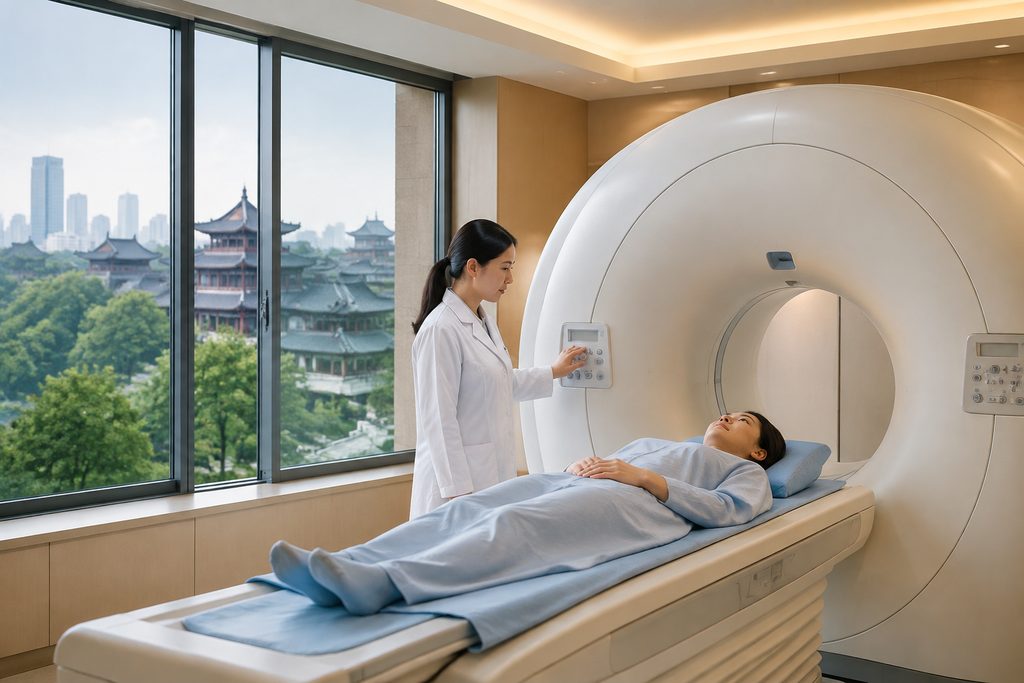
You have probably heard that getting medical tests in a foreign country means waiting weeks and drowning in paperwork. The reality in China’s top-tier hospitals is quite different. A patient can land in Shanghai on a Monday morning, complete a comprehensive cancer screening panel by Monday afternoon, and review preliminary results with a specialist before dinner. That is not marketing language. It is how the operational tempo of Chinese public hospitals actually works — and it is a major reason international patients now consider China for rapid diagnostics. The cancer screening cost China offers, combined with this speed, changes the calculus for people who have been told to wait months back home.
Key Takeaways
- Same-day cancer screening in China is feasible at major public and private hospitals, with blood work, ultrasound, and low-dose CT often completed within 4 to 6 hours.
- Out-of-pocket cancer screening cost China packages typically run from $300 to $1,200 depending on depth, hospital tier, and imaging included.
- Language and navigation are the biggest barriers for foreigners — not scheduling speed. A bilingual companion changes the entire experience.
- Accuracy at top-ranked Chinese hospitals is on par with Western benchmarks, provided you choose a Fudan-ranked or JCI-accredited facility.
The Problem: Cancer Screening Delays Are a Silent Risk
In Canada, the median wait time between a general practitioner referral and a specialist consultation reached 27.7 weeks in 2023, according to the Fraser Institute. In the United Kingdom, the National Health Service has repeatedly missed its own target of 75% of urgent cancer referrals being seen within two weeks. For a patient with a suspicious symptom or a strong family history, those numbers are not abstract. They are months of anxiety. And for some cancers, they are months that matter.
Private options in Western countries are faster, but the cost is punishing. A full-body MRI screening in the United States can exceed $2,500. A low-dose CT lung screening without insurance typically runs $300 to $500. Add a colonoscopy or a PET-CT and you are looking at five figures. Patients in the Gulf states, Southeast Asia, and even Europe increasingly ask a blunt question: how fast can I get cancer screening in China, and what will it actually cost?
The answer is faster than almost anywhere else, at a fraction of Western private pricing. But speed alone means nothing if the equipment is outdated or the radiologists are inexperienced. That is where understanding the Chinese hospital tier system becomes essential.
Why China’s Hospital System Delivers Same-Day Results
China has more than 35,000 hospitals. The top 5% — roughly 1,700 institutions — includes the 340+ top-ranked hospitals we work with across 37 cities, ranked by the Fudan University hospital rankings and JCI accreditation standards. These are not small clinics. They are massive, high-throughput medical centers where a single radiology department might process 1,000 CT scans per day.
Clinical Volume Creates Speed and Competence
A radiologist at a major Shanghai hospital reads more chest CTs in one month than many Western radiologists read in a year. That volume produces two things: operational efficiency and diagnostic pattern recognition. When a hospital performs 14,000 cardiac surgeries annually — as Fuwai Hospital in Beijing does — the imaging, lab, and pathology departments supporting those cases operate at a scale that makes same-day turnaround routine, not exceptional.
For cancer screening specifically, the workflow is designed around throughput. Blood draws happen in centralized phlebotomy centers that process hundreds of patients hourly. Ultrasound rooms run back-to-back appointments every 15 minutes. Low-dose CT machines operate continuously. The bottleneck in Western systems — scheduling — barely exists in the Chinese public hospital model because the default is walk-in registration and same-day testing.
Technology Without the Waitlist
Chinese top-tier hospitals have invested heavily in imaging hardware over the past decade. PET-CT machines, 3T MRI units, and low-dose spiral CT scanners are standard equipment in Fudan-ranked oncology departments. The difference from Western hospitals is not the machine brand — it is the queue in front of it. A patient seeking rapid cancer screening packages China can often book a PET-CT within 48 hours, whereas the same scan in Toronto or London might take weeks through public channels.
Private international hospitals in China — United Family, Jiahui, Parkway, Raffles — offer a Western-style experience with English-speaking staff, JCI accreditation, and direct insurance billing. They are more expensive than public hospitals but still typically 30–50% cheaper than equivalent private care in the US or UK. And they can often match the same-day testing speed of public facilities.
Cost Structure: Why Lower Price Does Not Mean Lower Quality
The cancer screening cost China offers reflects structural economics, not clinical shortcuts. Chinese physician salaries are lower than Western counterparts, but the training pipeline is rigorous — top hospital specialists typically complete 10+ years of medical education and residency. Hospital construction costs are lower. Malpractice insurance is a fraction of US levels. And the sheer patient volume spreads fixed equipment costs across thousands more procedures annually.
A comprehensive cancer screening panel at a top public hospital in Shanghai — including tumor markers, abdominal ultrasound, chest low-dose CT, and specialist review — typically runs $300 to $800. The same panel at a private international hospital in Shanghai might cost $800 to $1,500. In the US, without insurance, expect $2,000 to $4,000. The gap is real, and it is not because anyone is cutting corners.
What Same-Day Cancer Screening Actually Looks Like in Shanghai
The phrase “same day cancer test Shanghai” gets searched a lot. Here is what the real process involves, step by step, based on how we coordinate these cases.
You arrive at the hospital international department or VIP clinic at 7:30 AM. A bilingual coordinator registers you, creates your hospital medical card, and escorts you to the first station. Blood is drawn for tumor markers — CEA, CA19-9, CA125, AFP, and others depending on your age, sex, and risk profile. That takes 10 minutes.
Next comes imaging. A low-dose chest CT takes 5 minutes of scan time. An abdominal ultrasound takes 15 minutes. If your package includes a breast ultrasound or thyroid ultrasound, add another 15 minutes each. By 10:30 AM, most patients have completed all imaging.
Lab results for standard tumor markers return in 2 to 4 hours at major hospitals. CT images are read by a radiologist within hours — often the same afternoon. By 3:00 PM, you can sit with a specialist who reviews every result and gives you a preliminary interpretation. If something suspicious appears, the same hospital can schedule a follow-up biopsy or contrast-enhanced scan within days, not months.
This is not a special privilege reserved for VIPs. It is the standard operational tempo of a high-volume Chinese public hospital. The challenge for foreigners is navigating it without Chinese language skills — which is exactly where a bilingual medical companion from $300 per day changes everything.
How to Book Cancer Screening in China: The Real Pathways
You cannot simply email a Chinese public hospital from overseas and book a same-day screening slot. The system does not work that way. Public hospital outpatient departments operate on walk-in registration and same-day queuing. That means someone physically present must register you, pay the deposit, and guide you through the process.
There are three practical pathways to book cancer screening China:
| Pathway | Speed | Cost Range (USD) | Language Support | Best For |
|---|---|---|---|---|
| Public hospital, self-navigated | Same day possible | $300 – $800 | Minimal English | Mandarin speakers, budget-focused |
| Public hospital international department | Same day, pre-arranged | $500 – $1,200 | English-speaking staff | Foreigners wanting public hospital quality with support |
| Private international hospital (JCI) | Same day or next day | $800 – $1,500 | Full English service | Insurance-covered patients, Western-style experience |
The international department route is the sweet spot for most foreign patients. You get access to the same specialists and equipment as the public hospital, but with English-speaking coordinators, priority scheduling, and a quieter environment. The price premium is roughly 1.5 to 2 times the standard public rate — still far below Western private pricing.
Remote consultation is another option worth considering before you travel. A written second opinion from a top-tier specialist costs $300 to $500. A video consultation with a specialist runs $500 to $800. These services let you send existing records, discuss your risk factors and goals, and get a recommended screening protocol before you book a flight. Any consultation fee is credited in full toward on-the-ground coordination if you proceed within 90 days.
Is Cancer Screening Accurate in China? What the Data Shows
Is cancer screening accurate in China? The honest answer is: it depends on where you go. Accuracy is not uniform across 35,000 hospitals. But at the 340+ top-ranked institutions we work with, the diagnostic quality is comparable to leading Western centers.
Fudan University’s hospital rankings — the most authoritative in China — evaluate hospitals on clinical reputation, research output, and specialty strength. Hospitals in the oncology top 10, such as those listed on our specialty department pages, perform at a level that matches or exceeds many Western academic medical centers in terms of case volume and diagnostic experience.
One structural advantage: Chinese radiologists and pathologists see rare and advanced cases constantly because patients often present later. That exposure builds pattern recognition that generalist Western radiologists may not have. For cancer screening, that means subtle findings are less likely to be missed.
But accuracy also depends on protocol. A cheap “screening package” at an unranked hospital may use outdated equipment or skip critical views. That is why hospital selection matters more than price. We direct patients toward Fudan-ranked public hospitals or JCI-accredited private international hospitals, never toward unverified facilities.
Practical Considerations: Visas, Payment, and Follow-Up
If you are coming from abroad for screening, the logistics matter as much as the medicine.
Visa: Foreign nationals traveling to China for medical treatment apply for an S2 visa, which covers short-term private affairs including medical purposes. Stays exceeding 180 days require an S1 visa. Family members accompanying you also apply for S2. The hospital’s international department will provide supporting documents — an invitation letter and treatment plan confirmation — that you submit with your application. Approval is not guaranteed and requirements vary by embassy, so check with your local Chinese consulate before booking flights.
Payment: Public hospitals in China require prepayment — you deposit funds at registration and charges are deducted as services are rendered. Most accept international credit cards at international department counters, but cash and Chinese mobile payment (WeChat Pay, Alipay) are more reliable. Private international hospitals often bill insurance directly. If you have international health insurance, confirm coverage before traveling; many policies reimburse Chinese hospital charges but do not pay upfront.
Records: Bring all prior imaging, pathology reports, and lab results. Digital copies on a USB drive are ideal. Chinese specialists will want to compare new findings against your baseline, and having prior scans available can prevent unnecessary repeat testing.
Language: Even at top public hospitals, most signage and staff communication is in Mandarin. The international department mitigates this, but a bilingual medical companion ensures nothing gets lost between registration, testing, and specialist review. It is not a luxury — it is the difference between a smooth half-day screening and a frustrating full-day ordeal.
Follow-up: If your screening finds something requiring further investigation, the same hospital can usually schedule a biopsy, contrast imaging, or specialist consultation within days. If you return home, you will leave with a full written report in English (request this explicitly) and can arrange follow-up video consultations.
Frequently Asked Questions
If you arrive with a pre-arranged plan through a hospital international department, same-day completion is realistic. Blood work, ultrasound, and low-dose CT are typically finished within 4 to 6 hours. Preliminary results are often available the same afternoon. If you walk in without coordination, expect the process to take a full day or spill into a second day due to language barriers and unfamiliarity with the registration system.
Standard packages include tumor marker blood panels, abdominal ultrasound, chest low-dose CT, and a specialist review. More comprehensive packages add breast ultrasound or mammography, thyroid ultrasound, colonoscopy, or PET-CT depending on age, sex, and risk profile. Prices range from $300 for basic panels at public hospitals to $1,500 for comprehensive screening at private international hospitals. All prices vary by hospital and case complexity.
Results from Fudan-ranked or JCI-accredited hospitals are generally accepted by Western physicians, especially when reports are provided in English. Imaging files are typically shared in DICOM format, which any radiologist worldwide can open. We recommend requesting both the written report and the raw image files before leaving China. If a finding requires treatment, your home physician may want to repeat certain scans, but baseline screening results from top Chinese hospitals are credible and usable.
The same hospital can usually schedule follow-up testing — contrast-enhanced CT, biopsy, or specialist consultation — within days. You are not obligated to pursue treatment in China. Many patients choose to return home with a complete diagnostic workup and a clear treatment recommendation, then decide where to receive care. The value of rapid screening is that you get answers quickly, not that you are locked into any particular treatment path.
Your Next Step
Same-day cancer screening in China is not a myth or a marketing gimmick. It is the operational reality of a hospital system built for volume, speed, and clinical competence. The hard part for foreign patients is not the testing — it is the navigation. We are China Medical Services, a coordination team that connects international patients with 340+ top-ranked hospitals across 37 cities. We are not a hospital and we do not provide diagnoses. What we do is handle the logistics — hospital matching, appointment coordination, bilingual companionship, and visa guidance — so you can focus on getting answers. If you want to understand your options, request a free consultation and we will help you map out a plan that fits your timeline and budget.
For more medical information and treatment options in China, visit chinamedservices.com (China Medical Services).
