Stroke Rehabilitation in China: Costs, Top Hospitals, and What Recovery Really Looks Like
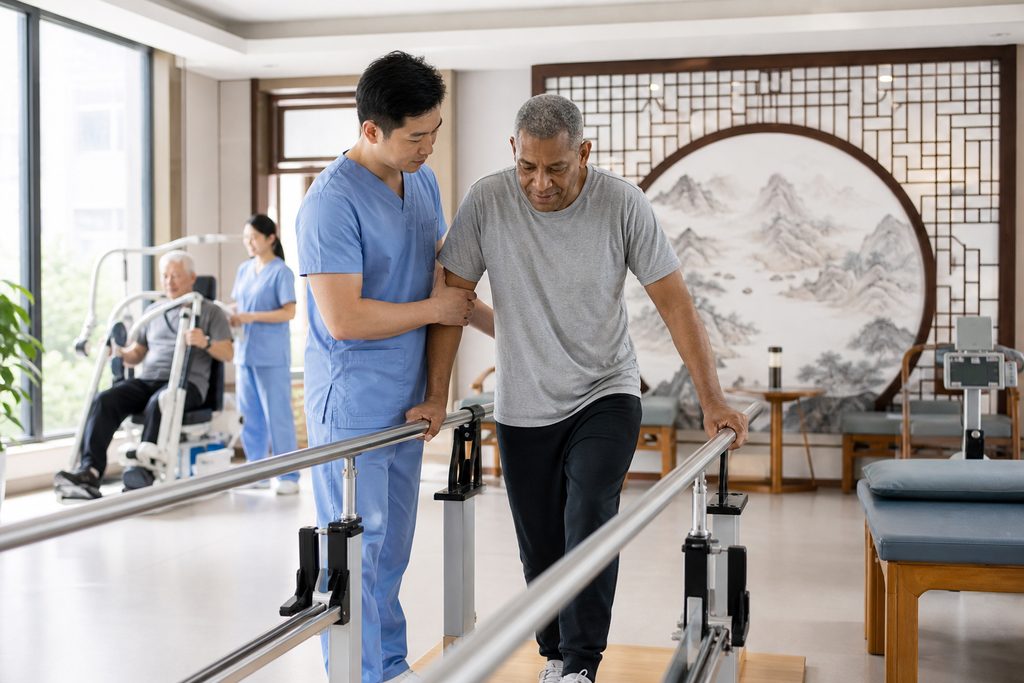
You might assume that traveling abroad for stroke rehabilitation means settling for a lower standard of care. That assumption gets the economics backwards. The same evidence-based protocols—constraint-induced movement therapy, robotic gait training, intensive speech-language pathology—are delivered in China’s top-ranked rehabilitation centers at a fraction of Western prices. A comprehensive inpatient stroke rehab program in a major Chinese city typically runs $8,000 to $15,000 per month, compared to $30,000 to $60,000 in the United States. The question is not whether quality exists. It is whether you know how to find it, structure it, and sustain it.
Key Takeaways
- Inpatient stroke rehabilitation in China costs roughly 70–80% less than comparable programs in the US, with monthly fees from $8,000 at top public hospital international departments.
- Beijing and Shanghai host the country’s highest-ranked rehabilitation and neurology departments, per the Fudan University hospital rankings.
- The hardest part is not clinical quality—it is the administrative layer: language, medical records translation, visa paperwork, and scheduling.
- Recovery timelines depend on stroke severity, age, comorbidities, and how early intensive therapy begins. No hospital can guarantee a specific functional outcome.
The Problem: Rehab at Home Is Often Too Slow, Too Fragmented, and Too Expensive
Stroke remains a leading cause of long-term disability worldwide. The World Health Organization reports that 15 million people suffer a stroke each year; of those, approximately 5 million die and another 5 million are left permanently disabled. In the United States, someone has a stroke every 40 seconds, according to the CDC. The survivors face a rehabilitation system that is excellent in pockets but structurally fragmented.
Here is what that fragmentation looks like in practice. A patient discharged from a US hospital might receive 45 minutes of physical therapy three times a week—if insurance approves it. The American Heart Association recommends at least three hours of therapy per day, five days a week, for patients who can tolerate it. Very few outpatient programs in the West deliver that intensity. Wait times for specialized neuro-rehab slots in the UK’s NHS can stretch to weeks, even months. Meanwhile, every week without intensive therapy is a week of lost neuroplastic potential.
The financial pressure compounds the clinical problem. In the US, a single month of inpatient rehab can exceed $50,000. Even with insurance, copays and out-of-network charges routinely reach five figures. Many families drain savings or skip recommended therapy altogether. That is the quiet tragedy of stroke recovery: the evidence for what works is strong, but access to it is rationed by geography and money.
Why Stroke Rehab in China Delivers Results
Clinical Volume Creates Rehab Expertise
China treats stroke at a scale that Western systems rarely see. Stroke is the leading cause of death and disability in China, with an estimated 2.8 million new cases annually. Top rehabilitation departments in Beijing and Shanghai manage thousands of stroke patients per year. That volume matters for rehab, where therapist experience with varied presentations—hemiplegia, aphasia, dysphagia, neglect syndromes—translates directly into better clinical judgment.
The Fudan University hospital rankings place several Chinese rehabilitation departments among the country’s best. Hospitals like Huashan Hospital in Shanghai and Xuanwu Hospital in Beijing run dedicated neuro-rehabilitation wards with integrated teams: physiatrists, physical therapists, occupational therapists, speech-language pathologists, and TCM practitioners. The staffing ratios in these wards often exceed what a typical Western outpatient clinic can offer.
Technology and Integration at Scale
Chinese rehabilitation hospitals have invested heavily in robotic and computer-assisted therapy systems. Lokomat robotic gait trainers, Armeo upper-limb robots, and virtual reality balance systems are standard equipment in major centers. These devices enable high-repetition, task-specific training—exactly what drives motor recovery after stroke.
But the structural advantage runs deeper than machines. In a Chinese inpatient rehab ward, the patient stays in one place. The therapy comes to them. Daily schedules commonly include two to three hours of one-on-one PT, one hour of OT, 30 minutes of speech therapy, and adjunctive acupuncture or massage. That intensity is hard to replicate in a Western outpatient model where the patient travels between appointments.
Cost Advantage Without Quality Compromise
The lower stroke rehab cost China offers is not a sign of lower quality. It reflects structural economics. Labor costs for skilled therapists are lower. Hospitals operate at higher occupancy. Equipment is manufactured domestically. Administrative overhead is leaner. The result: a month of intensive inpatient rehab at a top Chinese hospital costs $8,000 to $15,000, versus $30,000 to $60,000 in the US for a similar level of intensity.
Does that price difference hold up when you add travel, visa, and accommodation? For a three-month rehab stay, the total cost in China—including flights, S2 visa fees, hospital fees, and a modest apartment—often lands between $35,000 and $55,000. The same three months in a US inpatient facility could exceed $150,000. The gap remains substantial even with full logistics included.
How Stroke Recovery Actually Works in a Chinese Rehab Hospital
A reader searching “how long does stroke recovery take in China” deserves a straight answer: it depends on the stroke, the patient, and the timing. But the structure of a Chinese inpatient rehab program is fairly consistent across top hospitals.
Week one is assessment. The patient undergoes a full evaluation: Fugl-Meyer motor assessment, Barthel Index for activities of daily living, speech and swallow evaluations, cognitive screening. The rehab team sets functional goals. Week two through six is the intensive phase. Daily therapy blocks start at 8:00 or 9:00 AM and run until mid-afternoon, with rest periods built in. Week six onward is consolidation and discharge planning. The team adjusts the plan based on progress, and the patient transitions to a home exercise program or a lower-intensity outpatient schedule.
Realistic milestones matter. A patient with mild hemiparesis may regain independent walking within four to eight weeks of intensive therapy. A patient with severe hemiplegia and aphasia may need three to six months to achieve basic transfers and single-word speech. No honest clinician will promise a specific outcome. What they will promise is structured, daily, evidence-based therapy—which is more than many patients get at home.
Choosing the Right Hospital: What the Numbers Actually Mean
The phrase “best stroke rehabilitation hospital Beijing” leads many patients to assume there is one clear winner. The reality is more nuanced. Beijing and Shanghai both have excellent options, and the right choice depends on the patient’s specific deficits.
For patients with complex neurological presentations—severe aphasia, cognitive impairment, multiple comorbidities—a hospital with a dedicated neuro-rehabilitation ward and an integrated neurology department makes sense. Huashan Hospital in Shanghai and Xuanwu Hospital in Beijing both fit that profile. For patients whose primary need is intensive physical and occupational therapy without major cognitive involvement, a rehabilitation-focused hospital like China Rehabilitation Research Center in Beijing offers concentrated therapy resources.
Here is a comparison of typical program structures:
| Factor | Public Hospital International Department | Private International Hospital |
|---|---|---|
| Monthly cost (inpatient rehab) | $8,000 – $15,000 | $12,000 – $20,000 |
| Daily therapy intensity | 2–3 hours PT + 1 hour OT + speech | 2–4 hours, more flexible scheduling |
| English-speaking staff | Limited; translator often needed | Standard |
| Insurance direct billing | Rarely; pay upfront, claim later | Common with international insurers |
| Wait time for admission | 1–4 weeks | Days to 1 week |
Is stroke rehab in China good? The honest answer is that quality varies by hospital. The top tier—the Fudan-ranked rehabilitation and neurology departments—delivers care comparable to good Western centers. The bottom tier does not. That is why hospital selection matters more than country selection. A patient who books the cheapest rehab package without verifying the hospital’s ranking and therapist credentials is taking a real risk.
Practical Considerations: Visas, Records, and Payment for Stroke Rehab in China
Coming to China for rehabilitation requires more than a plane ticket. The medical visa category is S2, which covers short-term private affairs including medical treatment. Stays under 180 days use S2. Longer stays require S1. The Chinese embassy or consulate will ask for supporting documents: a hospital invitation letter, medical records, proof of funds. Processing typically takes one to three weeks. We do not guarantee approval—the embassy decides each case on its merits—but a complete application package speeds things up.
Medical records are the foundation of the entire process. Chinese rehab hospitals will not admit a stroke patient without a full history: imaging reports (CT, MRI), discharge summaries, medication lists, and any prior therapy notes. These must be translated into Chinese. A professional medical translation is worth the cost; a mistranslated medication name or allergy note can cause real harm.
Payment works differently than in the West. Public hospitals in China require prepayment—you deposit funds at admission, and the hospital draws down the balance as services are delivered. International insurance is usually reimbursement-based: you pay the hospital, then claim from your insurer. Private international hospitals like United Family or Jiahui often bill insurers directly. Confirm this before you commit.
Language is the daily friction point. Even in international departments, nursing staff and junior therapists may speak limited English. A bilingual companion who can translate during therapy sessions, clarify medication instructions, and handle administrative tasks removes a layer of stress that stroke patients and their families do not need.
Frequently Asked Questions
A month of intensive inpatient stroke rehab at a top Chinese hospital typically costs $8,000 to $15,000. The same month in the US runs $30,000 to $60,000. Even after adding travel and accommodation, a three-month program in China usually costs less than half the US price. Final pricing varies by hospital, case complexity, and length of stay.
At top-ranked hospitals, yes. The best rehabilitation departments in Beijing and Shanghai follow the same evidence-based protocols used in the US and Europe, and they treat far higher patient volumes. But quality drops sharply outside the top tier. Hospital selection is the single most important decision you will make.
Most patients stay for one to three months of intensive inpatient rehab. Mild deficits may resolve enough for independent function in four to eight weeks. Severe strokes with aphasia or dense hemiplegia often need three to six months or longer. The greatest gains come in the first three to six months post-stroke, which is why starting intensive therapy early matters so much.
You can start the process remotely, but you cannot book a specific bed without going through the hospital’s admission process. The typical path: submit translated medical records for review, get a preliminary treatment plan and cost estimate, then travel to China for an in-person evaluation before admission is confirmed. International departments and VIP channels can streamline this, but no legitimate hospital will guarantee admission without seeing the patient.
Top Chinese hospitals have emergency departments and can manage medical complications. But you should understand the limits: if a patient has an unstable cardiac condition, uncontrolled seizures, or other acute issues, they are not a good candidate for international rehab travel. Patients should be medically stable before flying. Travel insurance with medical evacuation coverage is strongly recommended—standard health insurance rarely covers treatment abroad.
Your Next Step
Stroke rehabilitation in China is a serious option for patients who need intensive, structured therapy at a cost their home system cannot match. The clinical quality at top hospitals is real. The administrative complexity is also real. Our team at China Medical Services helps international patients navigate that complexity—hospital matching, records translation, S2 visa guidance, and bilingual companion support. We are not a hospital and we do not provide medical advice or diagnoses. If you are weighing your options, start with a free consultation to understand what is realistic for your specific situation.
You do not need to decide today. But every week of delay is a week of recovery potential that does not come back. Get the facts, then decide.
For more medical information and treatment options in China, visit chinamedservices.com (China Medical Services).
