Stroke Rehab in China: Safety Guide, Real Costs & Recovery Timeline
Key Takeaways
- Stroke rehabilitation in China costs roughly 70–85% less than comparable inpatient programs in the United States, with intensive daily therapy sessions often priced from $150–$400 per day at top-tier public hospitals.
- China’s leading rehabilitation centers, including Huashan Hospital in Shanghai and China Rehabilitation Research Center in Beijing, run some of the highest-volume stroke recovery programs in the world — volume that translates into refined protocols and experienced therapy teams.
- The biggest safety concern is not clinical quality but logistics: language barriers, documentation gaps, and unrealistic expectations about fast-track admission can derail a recovery plan before it starts.
- Stroke recovery is measured in months, not weeks. Anyone considering travel for rehabilitation should plan for a minimum stay of 4–8 weeks and understand that outcomes depend heavily on the stroke’s severity, timing of intervention, and the patient’s overall health.
The Problem: Stroke Recovery at Home Is Slow, Expensive, and Often Incomplete
Every year, approximately 15 million people worldwide suffer a stroke. Of those who survive, roughly two-thirds leave the hospital with some degree of disability — impaired mobility, speech deficits, cognitive changes, or difficulty swallowing. The rehabilitation phase that follows is where function is rebuilt or lost permanently. Yet in many Western healthcare systems, that phase is precisely where the system fails.
In the United States, the average cost of inpatient stroke rehabilitation runs between $1,800 and $2,500 per day. A typical 30-day residential program can easily exceed $60,000 — and that is before outpatient follow-up, home modifications, or lost income. In the United Kingdom, NHS stroke rehabilitation is free at the point of care, but access is rationed by waiting lists. Patients can wait 6–12 weeks for a community rehabilitation bed after discharge from an acute stroke unit. During that window, neuroplasticity is at its peak. Every week of delay is a week of lost recovery potential.
So families face a brutal equation: pay enormous sums for private inpatient rehab at home, wait months for public rehab, or do nothing and watch function decline.
That is why a growing number of international patients now ask a different question: is stroke rehab safe in China? The answer, based on published clinical data and the operational reality of China’s top rehabilitation hospitals, is more nuanced — and more encouraging — than most Western patients expect.
Why China’s Stroke Rehabilitation System Delivers Results
China treats more stroke patients than any other country on earth. The China Stroke Statistics report, published in Stroke and Vascular Neurology, documented over 2.8 million new stroke cases in a single year. That staggering caseload has forced the country’s top hospitals to build rehabilitation departments that operate at a scale unmatched in the West. Scale, in rehabilitation, is not just a number. It means therapists who see the same pattern of impairment hundreds of times per year. It means protocols that have been refined across tens of thousands of patients. It means a culture where aggressive, early mobilization is the default, not the exception.
Clinical Volume That Translates Into Protocol Refinement
Consider Huashan Hospital in Shanghai, affiliated with Fudan University. Its rehabilitation medicine department is consistently ranked among China’s top programs and handles thousands of stroke patients annually. The hospital’s stroke unit and rehab department work in the same building, often on the same floor. That physical proximity matters. In many Western hospitals, acute stroke care and rehabilitation are separate silos — different buildings, different teams, different electronic records. At Huashan and similar top-tier Chinese centers, the handoff from neurologist to physiatrist happens within hours, not days.
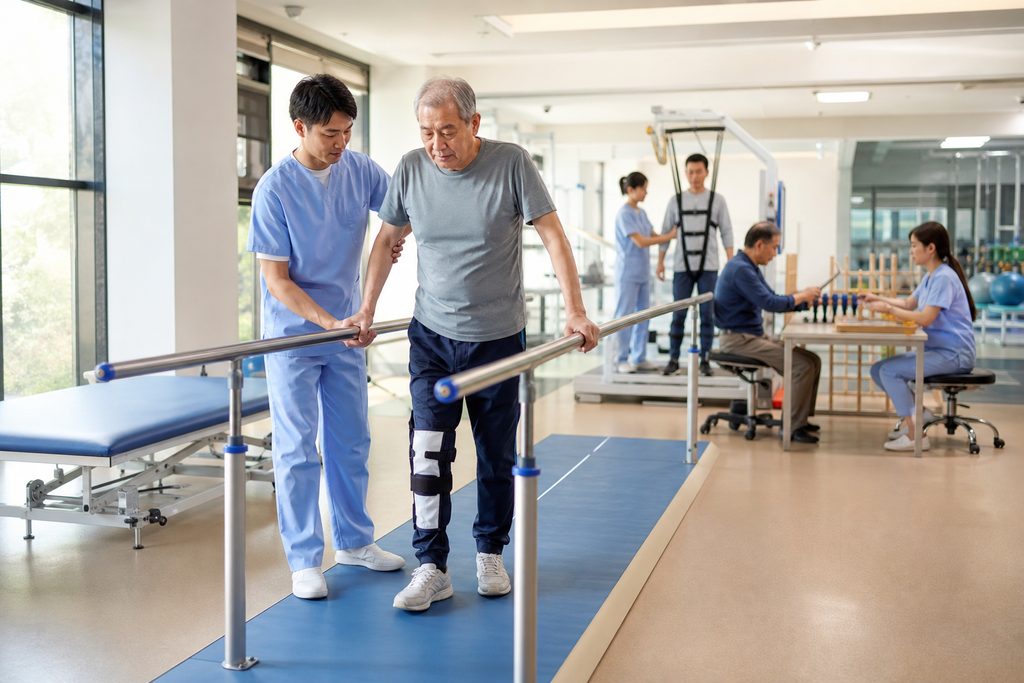
That structural integration is one reason why early rehabilitation rates in Chinese stroke units are high. The China Rehabilitation Research Center in Beijing, one of the country’s largest dedicated rehabilitation hospitals, operates hundreds of inpatient rehab beds and treats a high proportion of post-stroke patients. Its therapists routinely deliver 2–3 hours of combined physical, occupational, and speech therapy per day — a frequency that exceeds what many Western outpatient programs can offer.
Technology Adoption Without the Marketing Hype
Chinese rehabilitation hospitals have invested heavily in robotic-assisted gait training, functional electrical stimulation, virtual reality balance training, and transcranial magnetic stimulation. But the real differentiator is not the machines. It is how they are deployed. At centers like West China Hospital in Chengdu and Ruijin Hospital in Shanghai, robotic gait trainers are used as an adjunct to hands-on therapy, not a replacement for it. A patient might spend 30 minutes on a Lokomat or similar device in the morning, then work with a human therapist on sit-to-stand transfers and stair negotiation in the afternoon.
This combination of high-tech and high-touch therapy is standard at the top 5% of Chinese hospitals — the 340+ institutions that China Medical Services works with across 37 cities. It is not experimental. It is the daily workflow.
Cost Advantage Without Quality Compromise
Stroke rehab cost China figures are dramatically lower than Western benchmarks, and the reasons are structural, not cosmetic. Chinese rehabilitation hospitals employ therapists at lower salary levels than their US or European counterparts. Hospital construction and operational costs are lower. Malpractice insurance costs are a fraction of Western levels. None of these factors affect the quality of the clinical interaction. They simply mean the same hour of physical therapy costs less to deliver.
The result: a comprehensive inpatient stroke rehabilitation program at a top Chinese public hospital typically runs from $150 to $400 per day, depending on the hospital tier, room type, and therapy intensity. A comparable program in the US costs $1,800 to $2,500 per day. That is a 70–85% reduction. Even when you add international patient coordination fees, flights, and accommodation for a family member, the total cost of an 8-week program in China often comes in below the cost of 2 weeks of private inpatient rehab in the United States.
What a Stroke Rehab Stay in China Actually Looks Like
A reader searching for “stroke recovery packages abroad price” usually wants one thing: a concrete picture of what they are buying. Here is what a typical 6-week inpatient rehabilitation stay at a top Chinese hospital involves.
Week 1 is assessment and baseline. The patient undergoes a comprehensive evaluation — Fugl-Meyer Assessment for motor function, Berg Balance Scale, speech and swallowing evaluations, cognitive screening. The rehabilitation physician then designs an individualized program. This is not a one-size-fits-all package. A patient with left hemiplegia and aphasia gets a different program than a patient with right hemiplegia and dysphagia.
Weeks 2–5 are the intensive core. A typical daily schedule includes 45–60 minutes of physical therapy, 45–60 minutes of occupational therapy, 30–45 minutes of speech therapy if indicated, and 30 minutes of adjunctive therapy — acupuncture, robotic training, or hydrotherapy depending on the hospital and patient needs. Family members are trained in transfer techniques and home exercise programs. Weekly team meetings adjust the plan based on progress.
Week 6 is discharge planning. The team produces a written home program, video recordings of key exercises, and a follow-up schedule for tele-rehabilitation if the patient returns home. Some patients extend their stay. Others transition to outpatient therapy at the same hospital for several more weeks.
| Cost Component | China (Top Public Hospital) | United States (Private Inpatient Rehab) | United Kingdom (Private Rehab) |
|---|---|---|---|
| Daily inpatient rehab rate | $150–$400 | $1,800–$2,500 | $900–$1,400 |
| 30-day program total | $4,500–$12,000 | $54,000–$75,000 | $27,000–$42,000 |
| Bilingual companion (per day) | from $300 | N/A | N/A |
| Written second opinion | $300–$500 | $500–$1,500 | $400–$1,200 |
These figures vary by hospital and case complexity. A private international hospital in Shanghai will cost more than a public tertiary hospital in Chengdu. But the range holds: stroke rehab cost China is structurally lower, and the clinical quality at the top tier is comparable to what you would find at a major Western academic medical center.
How Long Does Stroke Recovery Take in Beijing and Shanghai?
The honest answer: longer than most families expect, and the timeline is set by neurobiology, not by geography. The brain’s peak period of spontaneous recovery is the first 3–6 months after a stroke. During this window, intensive therapy produces the greatest gains. After 6 months, progress continues but at a slower pace. After 12 months, meaningful recovery is still possible, particularly for language and cognitive function, but motor recovery plateaus for many patients.
For a patient traveling to China, the practical implication is clear. A 2-week visit is almost never worth the effort. The assessment alone takes several days. By the time therapy is ramping up, the patient is packing to leave. That is why most international patients who pursue rehabilitation in China plan for a minimum of 4 weeks, and more commonly 6–8 weeks. Some stay for 3 months.
In Beijing, the China Rehabilitation Research Center and Peking University Third Hospital both run high-volume stroke rehab programs. In Shanghai, Huashan Hospital and Ruijin Hospital are the anchors. Each city has its own character. Beijing’s programs tend to be more research-oriented, with earlier adoption of robotic and neuromodulation technologies. Shanghai’s programs are more internationally oriented, with more English-speaking staff and more experience managing foreign patients. The best stroke rehabilitation hospital Shanghai has to offer depends on the patient’s specific deficits — a patient with severe aphasia may benefit more from a program with strong speech-language pathology, while a patient with gait impairment may prioritize a center with extensive robotic gait training.
Is Stroke Rehab Safe in China? A Straight Answer
Safety has three dimensions: clinical safety, infection control, and operational safety for a foreign patient navigating an unfamiliar system.
Clinical safety at top-tier Chinese rehabilitation hospitals is not a serious concern. The hospitals that appear on the Fudan University hospital rankings — the ones China Medical Services works with — operate under the same Joint Commission International (JCI) standards or domestic equivalents as major Western hospitals. Their rehabilitation physicians are board-certified. Their therapy teams are licensed. Their adverse event rates are tracked and audited. A 2023 review published in The Lancet Regional Health – Western Pacific found that stroke care quality in China’s top-tier hospitals, measured by adherence to evidence-based protocols, has improved dramatically over the past decade and now approaches international benchmarks at leading centers.
Infection control deserves attention. Chinese hospitals are crowded. A stroke patient with compromised mobility and possible swallowing difficulties is at elevated risk for pneumonia and urinary tract infections anywhere in the world. In China, the risk is not higher at top-tier hospitals, but the environment feels different — more patients, more activity, less privacy. Families should ask about single-room availability and the hospital’s infection control protocols before committing.
The operational risks are the ones that catch people off guard. Language barriers in Chinese rehabilitation hospitals are real. Outside the international departments of major hospitals, few staff speak fluent English. Medical records from home need professional translation. Discharge summaries and therapy instructions need to be translated back. Payment is typically required upfront, and foreign insurance reimbursement is the patient’s responsibility to arrange. These are not safety risks in the clinical sense, but they can ruin a rehabilitation stay if unmanaged.
Hard truth: You cannot simply book a stroke rehab bed in China from overseas like you would a hotel room. Public hospitals require an in-person outpatient consultation before admission can be arranged. The only way to lock in a rehabilitation stay before traveling is to go through a hospital’s international department or VIP channel — and even then, admission is subject to the hospital’s medical review and bed availability.
Practical Considerations: Documentation, Visas, and Payment
If you are seriously considering stroke rehabilitation in China, the logistics matter as much as the hospital choice.
Documentation comes first. You will need the complete medical record from the acute stroke hospitalization: imaging reports (CT, MRI), discharge summary, medication list, laboratory results, and any prior rehabilitation notes. All of it must be translated into Chinese for review by the receiving hospital. This is not optional. Chinese rehabilitation physicians will not accept a foreign patient without a complete, translated record. China Medical Services handles this translation as part of the coordination process, but patients who attempt to navigate it alone often underestimate the volume of paperwork.
Visa category is S2. This is the short-stay visa used for private affairs, including medical treatment, and it is the correct category for a rehabilitation stay of up to 180 days. For longer stays, an S1 visa applies. The M visa is for commercial and trade activities only — it is not a medical visa and should never be used for treatment purposes. The hospital will need to provide supporting documentation confirming the treatment arrangement. Visa approval is always at the discretion of the Chinese embassy or consulate, and no one can guarantee approval. But with complete documentation from a recognized hospital, S2 applications for medical treatment are routinely processed.
Payment is upfront. Chinese public hospitals operate on a prepayment model. You deposit funds at admission, and the hospital draws down against the deposit as services are delivered. Foreign patients typically pay by international credit card, wire transfer, or cash. Insurance reimbursement is retrospective — you pay the hospital, then submit claims to your insurer. Some private international hospitals in China, such as United Family and Jiahui, offer direct insurance billing. But their rehabilitation programs are smaller and more expensive than those at top public hospitals.
Language support is the final piece. A bilingual medical companion — someone who can translate during therapy sessions, explain the treatment plan, manage pharmacy pickups, and advocate for the patient — costs from $300 per day. For a 6-week stay, that is a significant line item. But for a stroke patient who cannot speak Chinese, it is the difference between a coherent rehabilitation experience and a confusing, stressful one.
Frequently Asked Questions
At the top tier, yes. Hospitals like Huashan, Ruijin, and the China Rehabilitation Research Center follow evidence-based protocols comparable to major Western academic centers, and their therapy volume is often higher. The key is choosing a top-ranked hospital — not a mid-tier or community facility. The quality gap between China’s best hospitals and its average hospitals is wider than in most Western countries.
A 6-week inpatient program at a top public hospital typically costs $6,300 to $16,800 for the hospital stay and therapy itself. Add $12,600 for a daily bilingual companion over 42 days, plus flights, accommodation for a family member, and coordination fees, and a realistic all-in budget for 6 weeks is $25,000 to $45,000. That compares to $54,000 to $75,000 for the hospital stay alone at a US private rehab facility.
Top-tier Chinese rehabilitation hospitals have emergency response systems and are attached to full-service acute care hospitals. If a patient develops a medical complication — pneumonia, a recurrent stroke, a fall — they are transferred to the acute neurology or internal medicine service in the same hospital. The medical standard is high. The practical challenge is communication and family involvement, which is why a bilingual companion is strongly recommended for any patient who cannot speak Chinese.
Yes, but only through a hospital’s international department or VIP channel. Standard outpatient registration cannot be done from overseas. The process involves submitting translated medical records, receiving a preliminary acceptance from the rehabilitation department, and then arranging the S2 visa with the hospital’s supporting letter. This is the “fast track” that international patients use, and it is the only reliable way to secure a rehabilitation bed before arriving. It does not guarantee admission — the hospital must still review the records and confirm medical appropriateness — but it eliminates the risk of arriving without a plan.
Your Next Step
Stroke rehabilitation in China is safe, evidence-based, and dramatically less expensive than comparable Western programs — but only if you choose the right hospital and manage the logistics properly. China Medical Services maintains a database of 340+ top-ranked hospitals across 37 cities, including the leading stroke rehabilitation centers in Beijing, Shanghai, and Chengdu. We are not a hospital and we do not provide diagnoses or treatment. What we do is coordinate the process: translating records, arranging video consultations with rehabilitation specialists, coordinating hospital admission through official international departments, and providing bilingual companions who stay with the patient throughout the recovery stay. If you are weighing options for stroke rehabilitation abroad, start with a conversation. A free consultation is available on our patient services page, and you can explore our hospital database to see which centers match your specific needs. The first 3–6 months after a stroke are the most important of a patient’s life. Spend them wisely.
For more medical information and treatment options in China, visit chinamedservices.com (China Medical Services).
