Spinal Fusion in China: 2026 Costs, Top Hospitals & Recovery Timeline
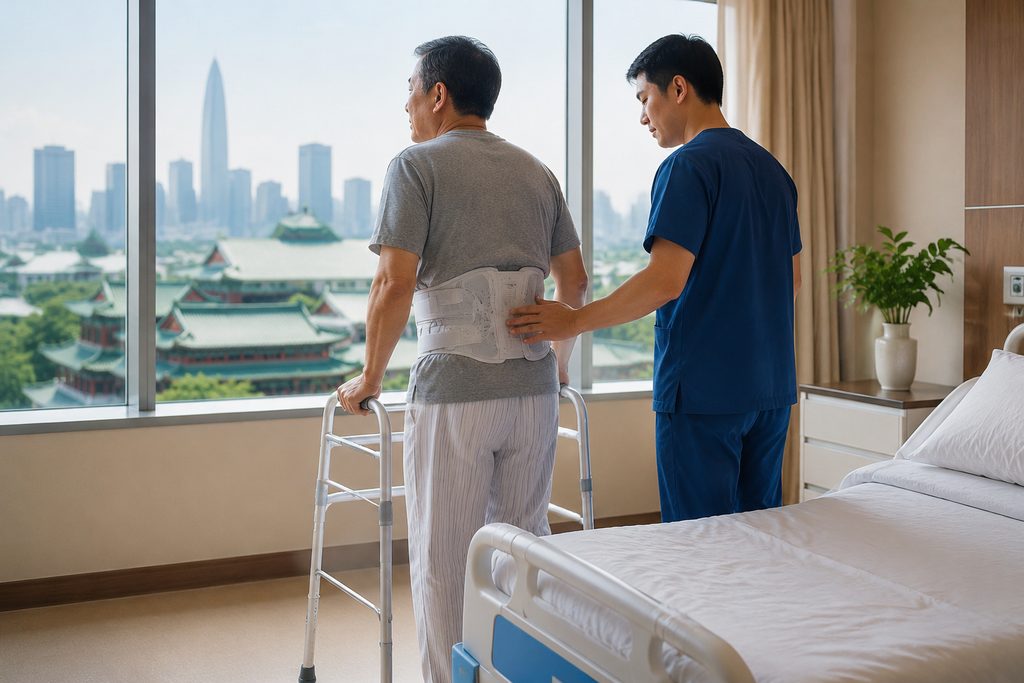
When 42-year-old Michael from Manchester finally got his lumbar MRI results back, the radiologist’s report mentioned “severe disc degeneration at L4-L5 with instability.” His local NHS consultant explained that conservative treatments had failed and that a spinal fusion was likely the next step. But the waiting list stretched past 14 months. The private quote in London came back at £38,000. That was the moment Michael started typing a different kind of search into Google: “can you get spinal fusion in China?”
The short answer is yes. China performs thousands of spinal fusion procedures every year across its top-tier orthopedic and neurosurgery departments. The country’s best hospitals handle complex multi-level fusions, revision surgeries, and minimally invasive techniques that many Western patients assume are only available in the US or Germany. But the real question isn’t whether it’s possible. It’s whether it’s the right choice for your specific spine, your budget, and your tolerance for traveling abroad for major surgery. Let’s walk through exactly what that looks like in practice.
How This Actually Works, Step by Step
You don’t just book a flight and show up at a Chinese hospital expecting surgery. The process is methodical, and for good reason. Spine surgery is not something any reputable hospital will schedule blind.
Step 1: You send your existing records. This means your MRI or CT scan images (the actual DICOM files, not just the printed report), your X-rays, and any clinical notes from your referring physician. If you’ve had previous spine surgery, operative reports matter enormously. A revision fusion is a different procedure than a first-time fusion, and the surgical team needs to know exactly what hardware is already in your back.
Step 2: A spine specialist reviews everything. At top Chinese hospitals, this is typically a senior orthopedic spine surgeon or a neurosurgeon who specializes in spinal disorders. They look at the images, assess the instability, check for nerve compression, and form an opinion on whether fusion is indicated at all. Sometimes the answer is no — a good surgeon will tell you if a less invasive option like a microdiscectomy or artificial disc replacement might serve you better.
Step 3: You get a written treatment proposal. This includes the recommended surgical approach (PLIF, TLIF, ALIF, or minimally invasive fusion), the number of levels to fuse, the estimated hospital stay, and a cost range. At this stage, you can also request a video consultation to speak directly with the surgical team. Many patients find this conversation is what tips them from “considering it” to “committed.”
Step 4: You decide, then we handle logistics. If you proceed, the next phase involves visa documentation, appointment confirmation, and travel planning. You’ll need an S2 visa, which is the short-stay category used for private medical treatment in China. Your accompanying family member applies for the same S2 visa. The hospital’s international department issues an invitation letter and treatment confirmation that supports the application.
Step 5: You arrive, get evaluated in person, and then surgery happens. This is the part people often misunderstand. Even with a written proposal, the surgeon will conduct a face-to-face evaluation before scheduling the operation. That’s not bureaucracy — it’s safety. The in-person exam, repeat imaging if needed, and pre-operative clearance all happen in the first few days after you arrive.
Spinal Fusion Surgery Cost China: The Numbers That Matter
Let’s talk about the figure that drives most international patients to consider China in the first place. The spinal fusion surgery cost China ranges widely depending on the hospital tier, the number of levels fused, the surgical technique, and whether you go through the standard public channel or the international/VIP department.
For a single-level lumbar fusion at a top-tier public hospital’s international department, expect a range of $18,000 to $35,000. That typically covers the surgeon’s fee, the implant hardware (screws, rods, and cage), the operating room, anesthesia, and a hospital stay of 5 to 10 days. A two-level fusion pushes the range to $25,000 to $45,000. Complex revision cases or multi-level fusions with significant deformity correction can exceed $50,000.
Compare that to the United States, where a single-level lumbar fusion averages $110,000 to $150,000 before insurance. Even with good insurance, your out-of-pocket maximum could easily reach $10,000 to $20,000. In the UK, private single-level fusion typically runs £25,000 to £45,000. In Australia, AUD $40,000 to $70,000. The savings in China are real, but they come with trade-offs: travel costs, time away from home, and the need to manage follow-up care back in your home country.
| Procedure | China (International Dept.) | United States | United Kingdom (Private) |
|---|---|---|---|
| Single-level lumbar fusion | $18,000 – $35,000 | $110,000 – $150,000 | £25,000 – £45,000 |
| Two-level lumbar fusion | $25,000 – $45,000 | $150,000 – $200,000 | £35,000 – £60,000 |
| Cervical fusion (single-level) | $16,000 – $28,000 | $80,000 – $120,000 | £20,000 – £35,000 |
| Revision fusion (complex) | $35,000 – $55,000+ | $180,000 – $300,000+ | £50,000 – £80,000+ |
These are reference ranges, not quotes. The final price depends on your specific anatomy, the implant system the surgeon chooses, and the hospital’s current fee schedule. Always request a written cost breakdown before committing.
Is Spinal Fusion Safe in China? Evaluating the Evidence
The honest answer: safety depends entirely on which hospital you choose. China’s healthcare system spans an enormous quality range. At the bottom are small county hospitals performing occasional spine surgeries with limited experience. At the top are academic medical centers performing thousands of fusions annually with outcomes that rival any Western institution.
The safety question really becomes: how do you identify the top tier? Look for hospitals ranked in the Fudan University Hospital Rankings — the most respected hospital evaluation system in China. The Fudan rankings don’t assign specific numerical positions for overall hospital quality, but they do publish specialty reputation rankings. For spine surgery, you want a hospital whose orthopedic surgery or neurosurgery department appears in the Fudan specialty top 10 list. You can browse these rankings on our specialty-specific hospital database.
Also check for JCI accreditation. Joint Commission International certification means the hospital has passed rigorous international patient safety standards. Several Chinese hospitals hold JCI accreditation, and most top-tier public hospitals with active international departments operate under protocols designed for foreign patients.
Infection rates for spinal fusion at top Chinese academic centers are comparable to international benchmarks — typically under 1% for uncomplicated single-level procedures. But you should ask directly about the specific hospital’s infection rate, revision rate, and surgeon volume. A surgeon performing 200+ fusions per year is a different risk profile than one performing 30.
Best Hospital for Spine Surgery in Beijing and Shanghai
If you’re specifically asking about the best hospital for spine surgery in Beijing, the conversation almost always starts with Peking University Third Hospital. Its orthopedics department is widely regarded as one of China’s strongest for spinal disorders. The hospital handles complex deformity corrections, cervical spine surgeries, and revision cases that other centers decline.
Beijing Jishuitan Hospital is another heavyweight. Known for orthopedic trauma and spine surgery, it performs a massive volume of procedures annually. For patients with complex or unusual spinal pathology, volume matters — surgeons who see rare cases regularly develop pattern recognition that textbook knowledge can’t replace.
In Shanghai, the question “can I get lumbar fusion in Shanghai” leads most often to Shanghai Changzheng Hospital, whose spine center is one of the busiest in the country, or to Huashan Hospital affiliated with Fudan University, which has a strong neurosurgery-spine program. Shanghai Sixth People’s Hospital also runs a high-volume orthopedic spine service.
You can explore our Shanghai hospital listings and Beijing hospital listings to compare options side by side. Remember that the “best” hospital is the one with the right surgeon for your specific condition, not just the most famous name.
A Realistic Timeline
People consistently underestimate how long the full process takes. Here’s an honest breakdown based on what we see with international spine patients:
| Phase | What Happens | Typical Duration |
|---|---|---|
| Week 1–2 | You gather and send medical records, imaging files, and clinical history | 1–2 weeks (depends on how quickly you can obtain DICOM files) |
| Week 2–4 | Specialist review and written treatment proposal | 3–10 business days |
| Week 3–5 | Optional video consultation with the surgical team | Scheduling depends on surgeon availability |
| Week 4–8 | S2 visa application with hospital invitation letter | 2–4 weeks (varies by embassy/consulate) |
| Week 6–10 | Travel to China, in-person evaluation, pre-operative testing | 3–5 days before surgery |
| Surgery day | The fusion procedure itself | 3–6 hours for single-level; longer for multi-level |
| Post-op | Hospital stay, initial mobilization, wound care | 5–10 days in hospital |
| Recovery in China | Optional: stay near the hospital for early follow-up | 2–4 weeks (recommended for international patients) |
| Return home | Flight home with medical clearance | Usually 3–6 weeks after surgery |
The waiting steps people forget are document translation and visa processing. If your records are in a language other than English or Chinese, they need professional translation before the specialist review. Budget time for that. Also, some embassies require an in-person visa interview, which adds days to the timeline.
What Can Go Wrong — and What Happens Then
Let’s be direct about the failure modes. They exist, and you should know them before you commit.
1. The surgeon reviews your case and says no. This happens more often than people expect. Maybe your bone quality is too poor for fusion. Maybe your cardiac clearance fails. Maybe the surgeon believes a different procedure would serve you better. The recourse: you’ve paid for a written second opinion or video consultation, and you’ve learned something valuable before spending $30,000 on surgery. That’s not a loss — it’s the system working.
2. You arrive and the face-to-face evaluation changes the plan. The in-person exam might reveal that your pain pattern doesn’t match the imaging as cleanly as the records suggested. The surgeon might recommend an additional diagnostic injection before committing to fusion. This delays surgery by a few days but prevents operating on the wrong problem.
3. Post-operative complications occur. Infection, hardware failure, adjacent segment disease, nerve irritation — these are real risks of any spinal fusion, in any country. The difference is how the hospital responds. Top Chinese academic centers have dedicated spine infection protocols, revision surgery teams, and rehabilitation departments. Before choosing a hospital, ask directly: “What is your fusion infection rate? What is your 90-day revision rate? Who manages complications?”
4. Follow-up care at home becomes complicated. Your local orthopedic surgeon may be reluctant to manage a fusion performed abroad. This is a legitimate concern. The solution is to plan follow-up before you travel. Ask the Chinese hospital for a detailed discharge summary, post-operative imaging, and a written rehabilitation protocol. Some hospitals offer remote video follow-up at 6 weeks, 3 months, and 6 months. Bring all of this to your local physician before you leave for China, so they know what to expect.
How Long Is Recovery After Spinal Fusion? Planning Around the Answer
The question how long is recovery after spinal fusion doesn’t have a single answer. It depends on the number of levels fused, the surgical approach, your age, your pre-operative fitness, and whether you follow the rehabilitation protocol.
For a single-level minimally invasive lumbar fusion, here’s what most patients experience:
- Hospital discharge: 5–7 days after surgery, walking with assistance
- Driving: 2–4 weeks, once off narcotic pain medication and cleared by the surgeon
- Return to desk work: 4–6 weeks
- Return to physical work: 3–6 months
- Fusion solidification on imaging: 6–12 months
- Full activity, including sports: 6–12 months, depending on the sport
The first 6 weeks are the critical window for bone healing. You’ll wear a brace, avoid bending and twisting, and follow strict lifting restrictions. Most surgeons recommend staying near the hospital for at least 2–3 weeks after discharge if you’re an international patient, so that early wound checks and any unexpected issues can be managed in person.
Flying home after spinal fusion requires medical clearance. Most surgeons will approve a flight 3–6 weeks after an uncomplicated single-level fusion, provided you can sit for the duration, walk periodically, and manage pain with oral medication. Long-haul flights (over 8 hours) may require a longer wait.
Practical Considerations: Records, Visa, Payment, and Follow-Up
Medical records. You need DICOM files from your MRI and CT scans, not just the radiology reports. Request these from your imaging center on a USB drive or through a secure file-sharing link. Bring all previous operative notes if you’ve had prior spine surgery. Bring a current medication list, allergy list, and any cardiac or pulmonary clearance letters if you have relevant comorbidities.
Visa. You’ll apply for an S2 visa with the hospital’s invitation letter and treatment confirmation. Your spouse or adult child accompanying you applies for the same S2 category. Processing times vary by country — budget 2 to 4 weeks. The hospital’s international department typically provides the supporting documents after you’ve confirmed your intent to proceed.
Payment. Public hospitals in China require pre-payment before admission. You’ll typically pay a deposit that covers the estimated surgery cost, with a final settlement at discharge. Most international departments accept bank transfers and major credit cards. Private international hospitals may offer direct insurance billing, but public hospital international departments usually require you to pay upfront and claim reimbursement from your insurer later. Check with your insurance provider before traveling.
Language. Top-tier international departments have English-speaking coordinators and often English-speaking surgeons. But the moment you step outside that department — to radiology, to the pharmacy, to the billing office — English disappears. A bilingual medical companion who handles registration, queuing, payment, and translation is not a luxury. It’s the difference between a smooth experience and a stressful one.
Follow-up at home. Before you leave China, get a comprehensive discharge package: operative report, implant card (with the exact hardware model numbers), post-operative X-rays, medication list, and a written rehab protocol. Share all of this with your local physician. Some Chinese hospitals offer remote follow-up video consultations, which can be invaluable when your local doctor has questions about the surgical approach.
Frequently Asked Questions
Some medical travel agencies market “all-inclusive surgery packages” that bundle hospital fees, hotel, and transfers. At China Medical Services, we take a different approach. We coordinate the hospital appointment, records review, visa documentation, and on-the-ground support, but the hospital bill is always paid directly to the hospital. This keeps pricing transparent and ensures the medical decisions stay between you and your surgeon, not a middleman.
Is spinal fusion safe in China compared to having it done in the US or Europe?
At top-tier Chinese academic hospitals with high surgical volumes, outcomes for spinal fusion are comparable to Western benchmarks. The key is choosing the right hospital. Look for Fudan specialty rankings in orthopedics or neuros
For more medical information and treatment options in China, visit chinamedservices.com (China Medical Services).
