Kidney Stone Treatment in China: Laser Lithotripsy and PCNL Surgery Coordination
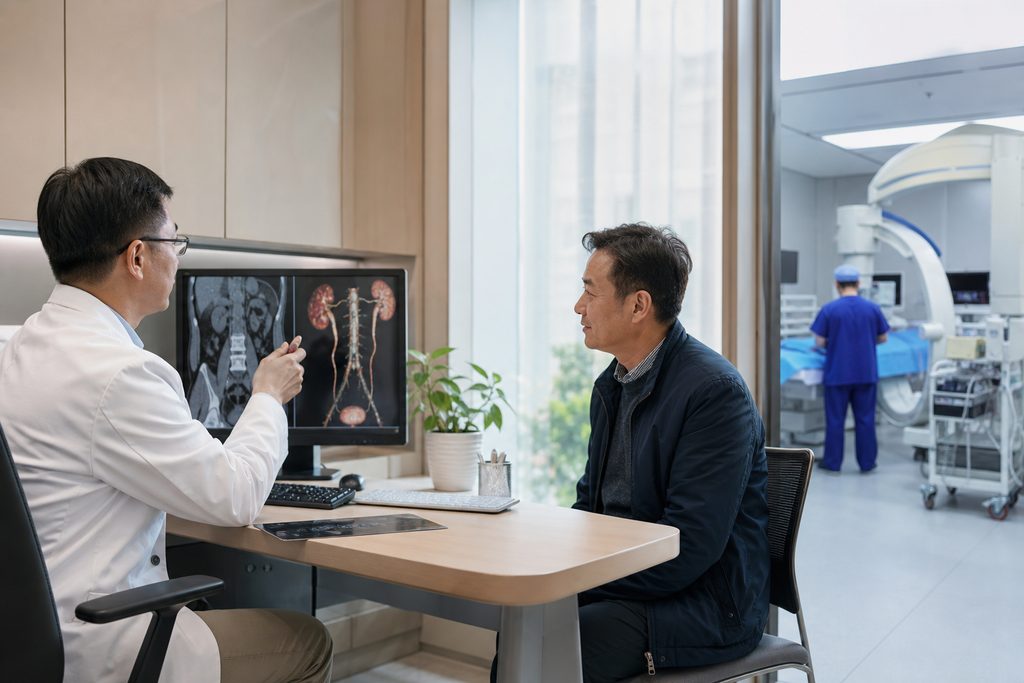
When 54-year-old David from Manchester passed a kidney stone in his bathroom at 3 a.m., he assumed the worst was over. His NHS urologist showed him the CT scan two weeks later. A silent 2.3 cm staghorn stone was still lodged in his left kidney. It was too large for shock wave lithotripsy. He needed percutaneous nephrolithotomy — PCNL surgery. The quoted wait time was 7 to 9 months. The private quote in London came back at £12,000. David started searching for alternatives. That search eventually led him to a question many patients are now asking: what does coordinated kidney stone treatment service in China actually look like, and is it safe?
This article answers that question directly. No vague promises. No marketing fluff. Just the operational reality of arranging laser lithotripsy or PCNL surgery in China — the costs, the hospitals, the recovery expectations, and the logistical machinery required to make it work.
Key Takeaways
- PCNL surgery at a top-tier Chinese public hospital typically ranges from $6,000 to $10,000 — approximately 50-70% less than private UK or US rates, with comparable clinical outcomes.
- China’s high-volume urology centers perform hundreds of PCNL procedures annually. Surgical teams at hospitals like Peking University First Hospital handle more complex stone cases in a month than many Western centers see in a year.
- Language barriers, visa requirements, and hospital registration systems make independent coordination extremely difficult. The S2 medical visa requires specific documentation that most hospitals will not provide directly to international patients without a local coordinator.
- Recovery time for laser lithotripsy abroad is typically 5-7 days before air travel is safe. For PCNL, plan for 10-14 days in-country. Never book a return flight based on optimistic assumptions.
The Problem: Kidney Stones Are Getting More Common — and Treatment Delays Are Getting Longer
Kidney stone prevalence has risen sharply across Western countries over the past two decades. Approximately 1 in 10 people in the United States will develop a kidney stone at some point. In the UK, NHS hospital admissions for kidney stones increased by 48% between 2008 and 2019. The numbers keep climbing.
That would be manageable if treatment access kept pace. It has not.
A 2023 survey by the British Association of Urological Surgeons found that over 35% of NHS urology departments reported waiting times exceeding 18 weeks for non-urgent stone surgery. Some patients wait more than a year. For a condition that can cause recurrent pain, urinary tract infections, and progressive kidney damage, waiting is not a neutral option. Stones grow. Infections develop. Renal function can decline silently.
Private treatment eliminates the queue. But the cost is brutal. In the United States, uninsured PCNL surgery runs between $25,000 and $55,000 depending on the facility and geographic region. Even insured patients can face out-of-pocket costs exceeding $8,000 after deductibles and co-insurance. In Australia, private PCNL costs routinely exceed AUD $15,000. In the UK, self-pay rates at private London hospitals cluster around £10,000 to £14,000.
The math is unforgiving. And it pushes thousands of patients each year to look beyond their borders.
Who We Are
We are not a hospital. We do not provide medical treatment, clinical diagnoses, or surgical care. Our team functions as your logistical architects — we bridge the gap between you and China’s top-tier urology departments. We handle hospital identification, appointment coordination through official international patient channels, bilingual medical companion services, visa documentation support, and on-the-ground logistics from airport pickup to post-operative recovery. We connect you with the right surgical team. We do not perform the surgery. That distinction matters.
Why Coordinated Kidney Stone Treatment in China Delivers Results
Clinical Volume Creates Surgical Expertise
Kidney stone surgery is a volume game. The more PCNL procedures a surgeon performs annually, the better the outcomes. This is well-established in urological literature. A 2020 study in the Journal of Endourology found that surgeons performing more than 100 PCNL cases per year had significantly lower complication rates and higher stone-free rates compared to lower-volume operators.
China’s top urology centers operate at a scale that is difficult to match elsewhere. The Department of Urology at Peking University First Hospital performs over 800 PCNL procedures annually. Shanghai Changhai Hospital‘s urology team handles more than 600 complex stone cases each year. These are not outliers. Multiple centers across Beijing, Shanghai, and Guangzhou maintain similar volumes.
Compare this with the average urologist in the United States, who performs roughly 15 to 25 PCNL procedures per year. The gap is structural, not anecdotal.
Does volume guarantee a perfect outcome? No. Surgery always carries risk. But when you are choosing where to have a stone removed from your kidney, the number of times the surgeon has done it before matters. A lot.
Technology Without Compromise
Chinese urology departments have invested heavily in endoscopic and laser technology over the past decade. Holmium laser lithotripsy — the gold standard for ureteroscopic stone fragmentation — is standard equipment in any hospital that would appear on our recommended list. For PCNL, pneumatic and ultrasonic lithotripters are used alongside laser systems depending on stone composition and size.
Flexible ureteroscopy with laser lithotripsy (fURS) is widely available for stones under 2 cm. For larger or more complex stones, PCNL remains the first-line approach. The decision between these two methods is made by the treating urologist after reviewing your CT scan — not by a coordinator or a website.
The equipment is comparable to what you would find in a major Western teaching hospital. The difference is not in the machines. It is in how many patients flow through them each week.
kidney stone removal cost China laser: The Numbers
Let us address the question that brings most patients to this page. What does kidney stone removal cost China laser and PCNL surgery actually run?
Here is a realistic breakdown based on data from our coordinated cases at top-tier public hospital international departments:
| Procedure | China (Public Hospital International Dept) | US (Uninsured) | UK (Private Self-Pay) | Australia (Private) |
|---|---|---|---|---|
| Flexible Ureteroscopy + Laser Lithotripsy | $4,500 – $7,000 | $12,000 – $20,000 | £5,000 – £8,000 | AUD $8,000 – $12,000 |
| PCNL Surgery | $6,000 – $10,000 | $25,000 – $55,000 | £10,000 – £14,000 | AUD $15,000 – $22,000 |
| Bilateral PCNL (Both Kidneys) | $10,000 – $15,000 | $40,000 – $80,000 | £18,000 – £25,000 | AUD $25,000 – $35,000 |
These figures include the hospital surgical fee, anesthesia, standard ward stay (typically 3-5 days for PCNL, 1-2 days for fURS), basic medications, and routine post-operative imaging. They do not include airfare, accommodation outside the hospital, our coordination fee, or any complications that extend the stay.
Prices vary by hospital and case complexity. A straightforward 2 cm stone in a healthy 40-year-old costs less than a complex staghorn calculus in a patient with diabetes and hypertension. This should be obvious. But it is worth stating because no honest coordinator will quote you a fixed price without reviewing your imaging and medical history first.
What You Need to Know Before Going Alone
The cost advantage is real. So are the barriers. Anyone who tells you this is easy is either naive or dishonest.
- S2 Medical Visa Requirements: You cannot enter China for treatment on a tourist visa. The S2 visa requires an invitation letter from the Chinese hospital, a treatment plan, proof of financial means, and a confirmed appointment. Hospitals do not issue these documents to patients who email them directly from abroad. The international patient department requires a local coordinator to initiate the process. This is not an optional step.
- Hospital Registration and Payment: Chinese public hospitals operate on a prepaid deposit system. You load money onto a hospital card at admission. If the balance runs low, services stop. There is no post-treatment billing. Deposits for PCNL surgery typically start at $5,000 and may need to be topped up. International credit cards are sometimes accepted at international departments, but not always. WeChat Pay and Alipay dominate. Cash works. But walking in with a Visa card and expecting smooth sailing is a mistake.
- Language and Navigation: A top urology department in Shanghai might see 8,000 outpatients a day across all specialties. Signage in English exists in international wards. It does not exist in the CT scan queue, the blood draw station, or the pharmacy. Even finding the right building on a sprawling hospital campus requires local knowledge. This is not a language barrier you overcome with a translation app.
How We Help You Navigate This
These barriers exist for structural reasons. They are not designed to exclude international patients. They exist because China’s hospital system evolved to serve a domestic population of 1.4 billion people. International patients are an afterthought in the system architecture. Our entire operation exists to bridge that gap.
The process begins before you book a flight. You send us your CT scan, medical history, and a brief description of your situation. Our team translates the relevant clinical information into Chinese and submits it to the international patient departments at hospitals we have identified as appropriate for your case. We do not choose the hospital for you. We present options based on stone complexity, surgeon availability, and your budget — and you decide.
Once a hospital confirms they can treat you, we handle the invitation letter for your S2 visa. We coordinate the appointment date. We arrange airport pickup. A bilingual medical companion meets you at the hospital on admission day and stays with you through registration, pre-operative testing, the surgery itself, and discharge. They translate conversations with your surgeon. They explain the medication schedule. They make sure you do not get lost between the inpatient tower and the CT building.
After discharge, we arrange follow-up imaging and a final consultation before you fly home. We also coordinate the transfer of your medical records back to your home urologist — in English.
What is recovery time for laser lithotripsy abroad? For flexible ureteroscopy with laser, most patients can fly home 5 to 7 days after the procedure. The stent placed during surgery may cause some discomfort and urinary urgency. Your surgeon will advise on stent removal timing — sometimes it stays in for 1-2 weeks and is removed back home. For PCNL, plan for 10 to 14 days in-country. The nephrostomy tube is typically removed before discharge, but you need time to recover from the access tract before sitting on a long-haul flight.
Do not book a tight itinerary. Complications happen. A post-operative fever or a small bleed can add 3-5 days to your stay. Build buffer into your plans.
Is Kidney Stone Surgery Safe in China? The Evidence
Safety is the question every patient asks. It is the right question.
The short answer: at the hospitals we coordinate with, clinical outcomes for PCNL and laser lithotripsy are comparable to international benchmarks. A 2019 study published in Urolithiasis examining PCNL outcomes at a major Chinese teaching hospital reported a stone-free rate of 84.2% and a major complication rate (Clavien grade III or above) of 3.1%. These numbers align closely with outcomes reported in European and North American PCNL registries.
The key variable is hospital selection. China has over 35,000 hospitals. The top 5% — roughly 1,700 institutions — include the 340+ top-ranked hospitals in our database, selected based on Fudan University hospital rankings and JCI accreditation status. These are the only hospitals we work with.
A county-level hospital in a third-tier city is not the same as the urology department at Ruijin Hospital in Shanghai. This should be obvious. But patients searching for the best hospital for PCNL surgery China sometimes underestimate how much variation exists within the system. Hospital selection is the single most important decision in this entire process.
Frequently Asked Questions
Can I book kidney stone treatment medical tourism China without a local coordinator?
Technically, yes. Practically, it is extremely difficult. The hospital international department will not issue an S2 visa invitation letter to an individual patient with no local contact. You would need to arrive on a different visa, register in person, wait for an available appointment, and navigate the entire process in Chinese. Some patients have done this successfully. Most give up or end up paying far more than they expected in time and stress. The question is not whether it is possible. It is whether the savings from skipping coordination are worth the friction.
Do hospitals offer PCNL surgery packages China price bundles for international patients?
Some international departments provide bundled pricing that includes the surgery, standard ward stay, basic medications, and routine imaging. These bundles typically range from $6,000 to $10,000 for unilateral PCNL. Bundles do not cover complications, extended stays, or premium ward upgrades. Always ask what is included and what is not before committing. A bundle that looks cheap but excludes anesthesia or post-operative imaging is not a bargain.
What happens if something goes wrong during or after surgery?
The hospitals we coordinate with have full intensive care capabilities, interventional radiology for managing bleeding complications, and infectious disease specialists for managing post-operative sepsis. Complication management follows the same clinical protocols used internationally. The difference is that you are far from home. This is not a trivial consideration. We recommend that all patients have a contingency fund of at least $3,000 to $5,000 available for unexpected extended stays or additional interventions. Most patients never need it. Those who do are grateful it exists.
How do I know which hospital is right for my specific stone?
Stone size, location, composition, and your overall health determine whether flexible ureteroscopy or PCNL is appropriate. A 1.5 cm lower pole stone might be managed with fURS. A 3 cm staghorn calculus requires PCNL. The decision belongs to the treating urologist after reviewing your CT. Our role is to present you with hospitals that have strong urology departments and confirmed availability. If you want to research independently, our specialty rankings page provides Fudan Hospital Ranking data for urology departments across China.
Your Next Step
Kidney stones do not resolve themselves. Waiting months for surgery while a stone sits in your kidney is not a neutral choice — it is a gamble that nothing will go wrong in the interim. For many patients, that gamble pays off. For some, it results in emergency room visits, infections, or permanent loss of renal function.
Coordinated treatment in China is not the right answer for everyone. It requires travel, trust in an unfamiliar system, and a willingness to navigate logistical complexity. But for patients facing long wait times or prohibitive costs at home, it offers a viable pathway to high-quality surgical care at a fraction of the price.
If you want to understand your options, get a free consultation with our coordination team. Send your CT scan. Ask your questions. There is no cost and no commitment. We will tell you honestly whether this path makes sense for your specific situation — and if it does not, we will tell you that too.
For more medical information and treatment options in China, visit chinamedservices.com (China Medical Services).
