Will My Hair Restoration Look Natural? What FUE Results Actually Show
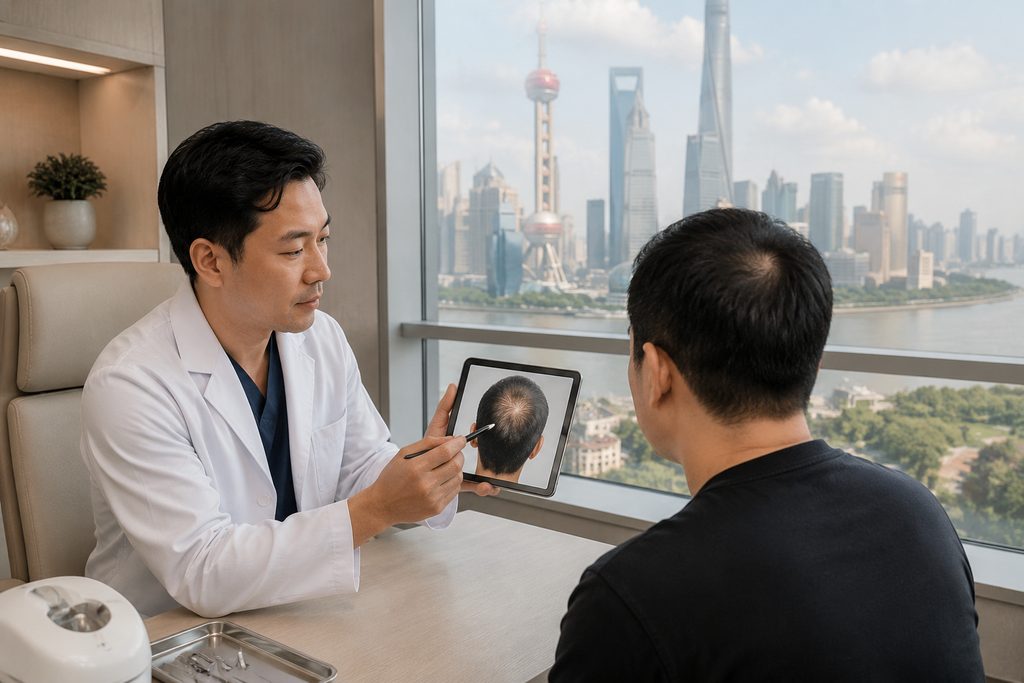
According to the International Society of Hair Restoration Surgery, over 700,000 surgical hair restoration procedures were performed worldwide in 2021, with the Asia-Pacific region seeing the fastest growth. Yet the question patients ask us most has nothing to do with graft counts or punch sizes. It’s simpler and more personal: will anyone be able to tell?
The short answer is yes, a well-execised modern hair transplant should look natural. But “should” carries weight. The gap between a natural result and a detectable one comes down to surgical technique, graft placement artistry, and how your scalp heals over the following 12 to 18 months. Understanding the natural hair transplant China cost is part of that — because pricing pressure can push patients toward clinics that cut corners on exactly the details that make results look real.
Our team has coordinated hair restoration journeys for international patients across China’s top-tier hospital departments and specialized clinics. We’ve seen what works. We’ve also seen what patients wish they had known before booking. This article walks through the realistic picture: how results heal, what “natural” actually requires, and what you should ask before committing.
How This Actually Works, Step by Step
You send photos of your scalp from multiple angles — hairline, crown, donor area at the back. A brief medical history follows: age, hair loss pattern, any prior transplants, medications like finasteride or minoxidil, and chronic conditions that affect healing or bleeding.
A hair restoration team reviews the images. They assess your donor density, the stability of your hair loss, and whether your expectations match what your scalp can realistically deliver. Within a few days, you receive a written assessment: estimated graft count, recommended technique (FUE or FUT), and a candid note on whether you’re a good candidate at all. Some patients are not, and a responsible clinic will say so.
If you decide to proceed, the next step is usually a video consultation. You speak directly with the surgical team. They explain the hairline design philosophy, how they handle graft angles, and what the donor area will look like after healing. This is also where you discuss the natural hair transplant China cost — which varies by graft count, clinic tier, and whether you choose a hospital department or a private specialty clinic.
After that, scheduling. International patients typically need 3 to 6 weeks of lead time. You arrange an S2 visa for private medical treatment, send flight details, and our team coordinates the procedure date, pre-operative instructions, and a bilingual companion if you want one.
What “Natural” Actually Depends On
Three things determine whether a hair transplant looks natural. Miss any of them and even a high graft count won’t save the result.
Hairline design. A natural hairline is never a straight line. It has micro-irregularities — slight asymmetry, a few single-hair grafts at the very front, gradual density transition. Clinics that produce “pluggy” or “doll hair” results often place multi-hair grafts at the hairline, which is the single most common giveaway. The best surgeons build the first 1-2 millimeters using only single-follicle units, angled to match your native hair direction.
Angulation and direction. Hair doesn’t grow straight up. It exits the scalp at specific angles that change across the scalp — flatter at the temples, more vertical at the crown. A surgeon who places grafts without respecting these angles creates a result that looks acceptable in photos but wrong in person, especially under different lighting.
Donor management. FUE extraction should be spread evenly across the safe donor zone. Over-harvesting one area creates visible thinning or a moth-eaten appearance at the back of the head. This is why FUE hair transplant natural results abroad depend as much on restraint as on skill.
So when patients ask us does hair transplant look fake, the honest answer is: a poorly planned one does, and a well-planned one doesn’t. The difference is rarely the equipment. It’s the time the surgical team spends on design and placement.
A Realistic Timeline
Most patients underestimate how long a “final result” takes. Here’s what the healing arc actually looks like.
| Stage | What Happens | What It Looks Like |
|---|---|---|
| Day 1–3 | Procedure completed. Tiny scabs form around each graft. | Redness, small crusts at recipient and donor sites. |
| Week 1–2 | Scabs shed. Transplanted hairs begin to fall out. | Patchy, sparse. Looks worse than before surgery. |
| Week 3–8 | “Shock loss” phase. Most transplanted hairs shed. | Recipient area looks thin or bare. Normal and expected. |
| Month 3–4 | New hair begins to emerge from transplanted follicles. | Fine, wispy, often colorless at first. Early growth. |
| Month 6–8 | Hair thickens and gains pigment. Density increases. | Visible improvement. About 50–60% of final result. |
| Month 12–18 | Full maturation. Hair shafts reach natural caliber. | Final density, texture, and natural appearance. |
Document translation for your medical records takes 2 to 5 days. Visa processing for an S2 typically runs 1 to 3 weeks depending on your home country’s Chinese embassy or consulate. Appointment lead time at a reputable clinic is usually 2 to 4 weeks. Add it together and a realistic total from first inquiry to surgery date is 4 to 8 weeks — longer if you need a written second opinion first.
And here’s the part most overseas patients forget: the result you see at month 4 is not the result you’ll have at month 14. Judging a transplant too early is the most common source of regret we hear.
What Can Go Wrong — and What Happens Then
No surgery is risk-free, and hair restoration has specific failure modes. Knowing them in advance changes how you evaluate clinics.
Poor graft survival. If a clinic rushes extraction or leaves grafts outside the body too long, a percentage die. Survival below 85% produces visibly thin results. Recourse: a second procedure after 12 months, often at a different clinic. This is why the cheapest quote is rarely the cheapest outcome.
Unnatural hairline. Too straight, too low, or built with multi-hair grafts. Correcting this requires removing or camouflaging the offending grafts — a repair procedure that is more complex and more expensive than the original transplant. Some clinics in China now specialize in repair work, and we’ve coordinated several such cases.
Over-harvested donor area. If too many grafts are taken from too small an area, the back of the head shows visible thinning that doesn’t recover. Options include scalp micropigmentation to camouflage the area or a second FUE session using body hair, which is technically demanding and not offered everywhere.
Infection or poor healing. Rare in modern FUE but not zero. Signs include persistent redness, pus, or fever. Any reputable clinic in China has protocols for post-operative infection management, and hospital-based departments have infectious disease specialists on call. If you’re traveling home after surgery, ask for a written post-op care plan and a direct line to the surgical team for the first 30 days.
What happens if you’re unhappy with the result? You wait. Full assessment isn’t possible before month 12. After that, a repair consultation is the standard path. Some clinics offer a partial revision at reduced cost if graft survival was clearly below the quoted estimate — but this varies, and no clinic guarantees a specific percentage. Get any such commitment in writing before surgery.
How to Evaluate a Clinic Before You Book
Most patients focus on price. That’s understandable, but it’s the wrong first filter. Here’s what actually separates clinics that produce natural results from those that don’t.
Ask to see healed results, not immediate post-op photos. Any clinic can show you a photo of 3,000 freshly placed grafts. That tells you nothing about survival or naturalness. Ask for photos of patients at month 12 or later, ideally with similar hair characteristics to yours — same ethnicity, similar hair caliber, similar loss pattern. If a clinic hesitates to show healed cases, that’s information.
Ask who does the extraction and who does the placement. In some clinics, technicians perform most of the procedure while the surgeon supervises multiple rooms. That’s not automatically disqualifying — experienced technician teams can be excellent — but you deserve to know. In China, top-tier hospital departments and reputable private clinics typically have a named surgeon performing or directly overseeing the critical steps.
Check how they handle the hairline. Ask the surgeon to describe their hairline design approach. If they talk about single-hair grafts at the front, irregularity, and matching your facial proportions, that’s a good sign. If they say “we’ll make it look good” without specifics, keep looking.
Understand the cost structure. The natural hair transplant China cost typically runs from $2,500 to $8,000 depending on graft count and clinic tier. Public hospital departments trend lower; private specialty clinics in Shanghai or Beijing trend higher. The best hair restoration clinic Shanghai price is often quoted per graft, with FUE ranging from $1.50 to $4.00 per graft depending on the clinic’s reputation and the surgeon’s seniority. A 2,500-graft procedure therefore spans roughly $3,750 to $10,000. Prices vary by hospital and case complexity, and any quote should specify graft count, technique, and what’s included — anesthesia, post-op medications, follow-up consultations.
For patients considering multiple locations, you can compare Shanghai’s top medical institutions or explore Beijing’s hospital network to understand the landscape before narrowing your options. Some patients also ask about specialized departments when researching which hospital tier fits their needs.
Practical Considerations: Records, Visa, Payment, and Follow-Up
Traveling to China for a hair transplant is straightforward, but a few logistics matter more than patients expect.
Records. Bring any prior hair loss treatment history, especially if you’ve used finasteride, dutasteride, or minoxidil. The surgical team needs to know your current regimen because stopping finasteride abruptly before surgery can trigger shedding. Also bring photos of your hairline from your 20s if you have them — they help the surgeon understand your natural hairline shape.
Visa. Medical treatment falls under the S2 visa category for short stays under 180 days. The hospital or clinic provides an invitation letter and treatment confirmation, which you submit with your application. Processing times vary by country, so start at least 3 to 4 weeks before your target date. A companion traveling with you applies for the same S2 category.
Payment. Public hospital departments generally require prepayment — either a deposit before surgery or full payment on admission. Private international clinics may accept international insurance or direct billing, but most hair restoration is self-pay. Bring a payment method that works in China: international credit cards are accepted at major private clinics, while public hospitals may require UnionPay, Alipay, or WeChat Pay. Our team can advise on this before you arrive.
Language. Top-tier public hospitals see thousands of patients daily. Even in international departments, the flow between registration, lab work, and consultation can be confusing without Chinese language ability. A bilingual medical companion — from $300 per day — handles queueing, translation, and navigation so you’re not stranded between departments.
Follow-up at home. You’ll leave China with a written post-op protocol: when to resume washing normally, when to restart finasteride, what to avoid in the first month. Most clinics offer video follow-up at month 1, month 3, and month 6. If a concern arises after you return home, send photos through the clinic’s patient portal and they’ll advise whether a local dermatologist visit is needed.
Frequently Asked Questions
At 12 to 18 months post-surgery, a well-executed FUE transplant should be undetectable to anyone who doesn’t know you had the procedure. The transplanted hair grows at the same rate and with the same texture as your native hair because it is your native hair — just relocated from the back of your scalp. The hairline should have natural irregularity, and the donor area should show no visible scarring beyond tiny dot marks that are hidden by surrounding hair.
Only if the transplant was poorly designed or poorly executed. The giveaways are a too-perfect hairline, multi-hair grafts at the front, wrong angulation, or an over-harvested donor area. None of these are inevitable. They’re the result of specific choices — usually made to save time or money. Choosing a clinic that prioritizes hairline artistry and donor management eliminates most of the risk.
In the United States, FUE typically costs $6 to $12 per graft, putting a 2,500-graft procedure at $15,000 to $30,000. In Western Europe, expect $4 to $8 per graft. In China, the same procedure at a reputable clinic typically runs $1.50 to $4.00 per graft — $3,750 to $10,000 for 2,500 grafts. The savings are real, but they should not be the only factor. A repair procedure costs more than the savings from a bad first transplant.
For many patients, yes — if you choose carefully. China’s top hair restoration centers perform high volumes of FUE procedures, and the combination of experienced surgical teams and lower operating costs makes the value proposition strong. But the same caution applies as anywhere: research the specific clinic, see healed results, and understand who performs the surgery. A consultation with our coordination team can help you evaluate options without committing to travel.
Realistically, 4 to 8 weeks from first contact to surgery date. That includes document translation, video consultation, visa processing, and clinic scheduling. If you want to book hair transplant package Beijing, start with a written assessment — send photos and history first. That step alone often saves patients from traveling for a procedure they’re not actually a good candidate for.
Your Next Step
A natural-looking hair transplant is not luck. It’s the product of specific decisions: who designs your hairline, how grafts are placed, and whether the clinic has healed results that match your hair type. The natural hair transplant China cost is part of that equation, but the cheapest option rarely produces the most natural outcome.
We help international patients navigate China’s medical landscape — matching you with reputable departments and clinics, coordinating consultations, and providing bilingual support on the ground. We don’t perform surgery, and we don’t push any single provider. What we do is help you make an informed decision, then handle the logistics if you choose to proceed. If you’re considering hair restoration in China, start with a conversation. It costs nothing, and it might save you from an expensive mistake.
Send us your photos and a brief history. We’ll help you understand what’s realistic, what it should cost, and whether China is the right choice for you.
For more medical information and treatment options in China, visit chinamedservices.com (China Medical Services).
