How Many Hair Follicles Do I Need? Understanding Graft Counts for a Hair Transplant in China
When 34-year-old Daniel from Manchester first searched “how many hair follicles do I need,” he had a photo of his receding hairline on his phone and a spreadsheet of clinic prices from three countries. His confusion was not about the procedure itself. It was about the arithmetic. A clinic in Turkey quoted 4,500 grafts. A clinic in London suggested 2,800. A clinic in Shanghai, after reviewing the same photos, said 3,200. Daniel asked us a fair question: who is right? The answer matters more than the hair transplant cost China, because paying for the wrong number of grafts means either a thin result or wasted donor hair. We will break down how surgeons actually calculate graft counts, what changes the number, and how Chinese clinics approach the math differently from Western ones.
How Many Hair Follicles Do I Need? The Short Answer
Most men with moderate androgenetic alopecia need between 2,000 and 3,500 grafts in a single session. A graft is not the same as a hair. One graft contains 1 to 4 hair follicles. So 3,000 grafts can mean anywhere from 6,000 to 12,000 individual hairs. The number depends on your Norwood stage, donor density, hair caliber, and the size of your head. Daniel’s 3,200-graft estimate from the Shanghai clinic was not a compromise between London and Istanbul. It was a different reading of his donor area and his facial proportions. The honest answer: no one can give you an exact number from photos alone. An in-person or high-resolution video assessment is required. But you can get close enough to compare quotes intelligently.
Who This Is Right For — and Who It Isn’t
Hair transplantation works well for a specific profile. You have stable hair loss, meaning you have been on finasteride or minoxidil for at least 12 months and your shedding has plateaued. Your donor area at the back of the scalp has good density — at least 80 follicular units per cm². You are over 25, because transplanting before the pattern fully reveals itself leads to an unnatural island of hair behind a receding frontal line. And you accept that a transplant redistributes hair; it does not create new hair.
- Good candidates: men with Norwood III–V, women with female pattern hair loss and preserved donor area, patients with traction alopecia or stable scarring alopecia, and those revising a previous poor transplant.
- Poor candidates: men under 25 with aggressive early loss, anyone with diffuse unpatterned alopecia, patients with insufficient donor density, active scalp infections, uncontrolled diabetes, or bleeding disorders. Also, anyone who expects a full teenage hairline. That is not surgically possible or aesthetically wise.
The Options, Compared
Not every clinic calculates grafts the same way. Some quote high numbers to justify high prices. Some quote low numbers to look affordable, then add grafts later. The table below compares how different markets approach the same patient profile — a 35-year-old man with Norwood III vertex, average donor density, and a goal of restoring the frontal third and mid-scalp.
| Factor | UK / US Clinic | Turkey (Istanbul) | China (Shanghai / Beijing) |
|---|---|---|---|
| Typical graft estimate | 2,500–3,000 | 4,000–4,500 | 2,800–3,500 |
| Graft extraction method | FUE, 0.8–1.0 mm punch | FUE, often 0.7–0.9 mm | FUE, 0.7–0.9 mm; some clinics offer long-hair FUE |
| Price per graft | $4–8 | $1.5–2.5 | $1.8–3.5 |
| Total cost for 3,000 grafts | $12,000–24,000 | $4,500–7,500 | $5,400–10,500 |
| Surgeon involvement | High — surgeon performs most steps | Variable — technician-heavy, surgeon oversight | High in top hospitals — surgeon performs extraction and implantation |
| Follow-up protocol | 1–3 in-person visits | Often none after departure | Video follow-up at 1, 3, 6, 12 months standard in international departments |
Which column fits you? If your priority is long-term surgical oversight and you have a flexible budget, the UK or US route is solid. If you are chasing the lowest absolute price and accept limited follow-up, Istanbul is the volume leader. But if you want the price advantage of a competitive Asian market without sacrificing surgeon-led procedures and structured aftercare, the Chinese option deserves a closer look. Many of our readers start by comparing top-ranked Chinese hospitals with what they have been quoted at home.
How Chinese Clinics Calculate Graft Counts Differently
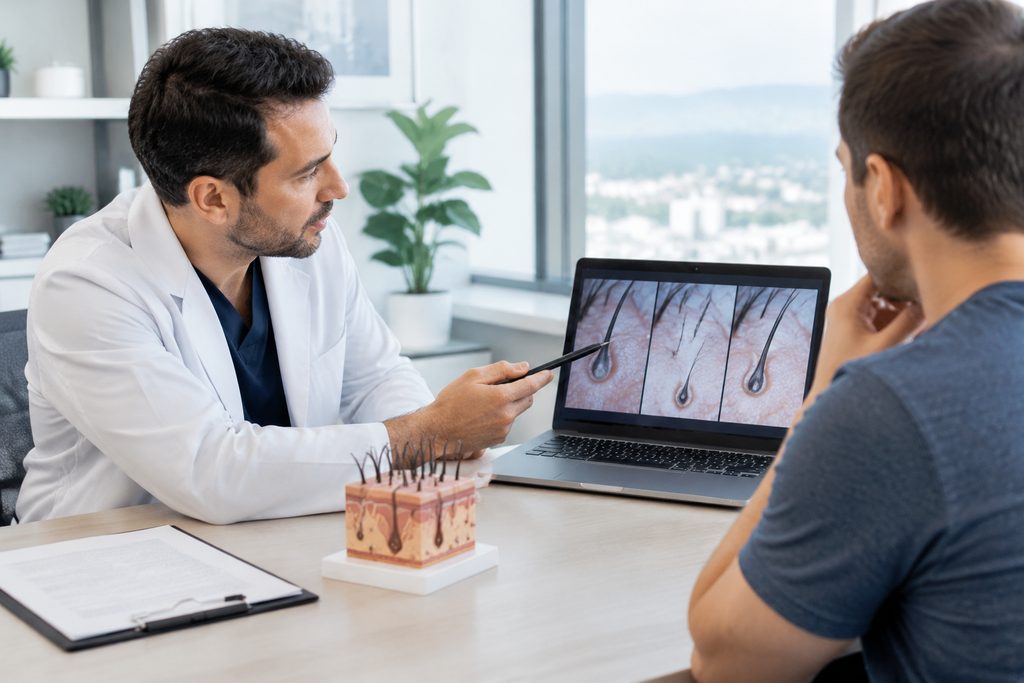
This is the part that surprises Western patients. In most Chinese hair restoration departments, the consultation includes a digital trichoscopy scan that measures donor density per cm², hair shaft diameter, and the exact bald area in square centimeters. The surgeon then calculates the graft count using a formula: bald area × target density ÷ average hairs per graft. Daniel’s Shanghai clinic sent him a one-page worksheet showing the math. His London clinic did not. That transparency is not universal in China — private cosmetic clinics vary in quality — but the top hospital-affiliated departments tend to be more protocol-driven because they are training centers.
Another difference: Chinese surgeons often recommend slightly lower density than Western surgeons for the first session. The reasoning is donor preservation. If you are 35 and may need a second transplant at 50, extracting 4,500 grafts now leaves less for later. A plan of 3,000 grafts now with a conservative hairline, and another 1,500–2,000 later if needed, protects your donor bank. That is not a sales tactic. It is a risk-management philosophy. It also explains why some Chinese quotes come in lower than Turkish ones — not because the clinics are less capable, but because they are staging the work.
What Drives the Hair Transplant Cost China
The hair transplant cost China varies more by hospital tier than by city. A private cosmetic clinic in a second-tier city may charge $1.5 per graft. A university-affiliated hospital in Shanghai with a named senior surgeon may charge $3.5 per graft. The range for a 3,000-graft FUE session is roughly $5,400 to $10,500, excluding travel and accommodation. What is included varies. Some clinics bundle the consultation, trichoscopy, local anesthesia, PRP injection, and one year of video follow-up into the per-graft price. Others charge separately for PRP or post-op medications. Always ask for a written breakdown.
For patients researching follicular unit extraction price Shanghai, the city’s top hospital departments typically fall between $2.2 and $3.2 per graft. Beijing is similar, though some international departments in Beijing hair transplant packages run higher because they include English-speaking coordinators and hotel-adjacent recovery suites. The key number to remember: China is not the cheapest market in the world, but it sits far below US and UK pricing while offering surgeon-led procedures that budget markets often do not.
Is Hair Transplant in China Safe?
Yes, through the hospital’s international department. You cannot book a regular public outpatient slot from overseas, but international and VIP departments do accept overseas bookings with a deposit. That is the channel our coordination service uses. You schedule the surgery date, pay a deposit, and the hospital issues the visa invitation letter. The balance is paid on arrival. Do not send full payment to anyone before you have a written contract and a verified hospital license.
Poor growth happens in a small percentage of cases, even with good surgeons. The most common causes are undiagnosed scalp conditions, smoking in the first month, or a clinic that over-harvested the donor area. If growth is below the quoted estimate, the clinic’s contract should specify a touch-up policy. Many top Chinese departments offer a free or reduced-cost touch-up within 12–18 months. If the clinic offers no written policy, that is a red flag. Also, be realistic about the hairline. A transplant restores coverage; it does not recreate a teenage hairline. The best results look age-appropriate.
Not usually at hospital-affiliated departments. Prices are set by the hospital and published. Private cosmetic clinics may offer package discounts, but those discounts often come with less surgeon involvement. If a price seems too low, ask who is doing the surgery. A technician-heavy procedure at $1.2 per graft may cost you more in the long run than a surgeon-led procedure at $2.5 per graft.
Your Next Step
The number of hair follicles you need is not a guess. It is a calculation based on your donor density, your bald area, and your long-term plan. Get the math right and you can compare clinics across countries with confidence. Our team at China Medical Services helps international patients navigate this process — we are not a hospital, we do not diagnose, and we never promise outcomes. What we do is connect you with verified departments, translate your records, and coordinate the logistics so you can make an informed decision. If you want to know what a Chinese clinic would quote for your specific case, request a free consultation and we will walk you through the options.
Daniel ended up with 3,200 grafts in Shanghai. His donor area was preserved, his follow-up schedule was written into the contract, and he paid roughly a third of what London quoted. The right graft count is the one that matches your head, your age, and your future — not the one that matches a clinic’s marketing budget.
Frequently Asked Questions
Yes. The hospitals used for international patients are JCI-accredited and follow the same international safety standards as top hospitals in the US and Europe. Surgical teams perform high volumes of procedures — often more than their Western counterparts — which studies show leads to better outcomes.
Costs vary by procedure and hospital, but international patients typically save 40-80% compared to US prices — even when factoring in travel and accommodation. A consultation with our team will give you an exact, all-inclusive quote with no hidden fees.
Send us your existing medical reports to get started. We handle everything from hospital selection and appointment scheduling to visa assistance and post-operative recovery planning. Your medical records are reviewed by the specialist before you even book a flight.
For more medical information and treatment options in China, visit chinamedservices.com (China Medical Services).
