Tummy Tuck Scars: What to Expect, How They Heal, and China Options
Key Takeaways
- A tummy tuck always leaves a scar — but a well-executed incision heals into a thin, low, concealable line that fades significantly over 12-24 months.
- Scar quality depends more on surgical technique, tension control, and aftercare than on geography. Chinese plastic surgeons at top-tier hospitals perform high volumes of abdominoplasties annually.
- The tummy tuck cost China patients pay at leading public hospitals typically ranges from $4,500 to $9,500 — roughly one-fifth to one-quarter of the $20,000-$35,000 charged in the United States.
- No surgeon anywhere can honestly promise a “scarless” tummy tuck. Anyone who does is selling something other than good medicine.
The Problem: Living With a Scar You Never Wanted
A tummy tuck — abdominoplasty in medical terms — removes loose skin and tightens abdominal muscles after pregnancy, major weight loss, or aging. It is one of the most transformative body contouring procedures available. But every patient asks the same question before booking: will I have a scar after a tummy tuck?
The honest answer is yes. Always. The procedure requires an incision, and incisions leave marks. The American Society of Plastic Surgeons reports that over 120,000 abdominoplasties were performed in the United States in 2023 alone. Every single one of those patients woke up with a scar.
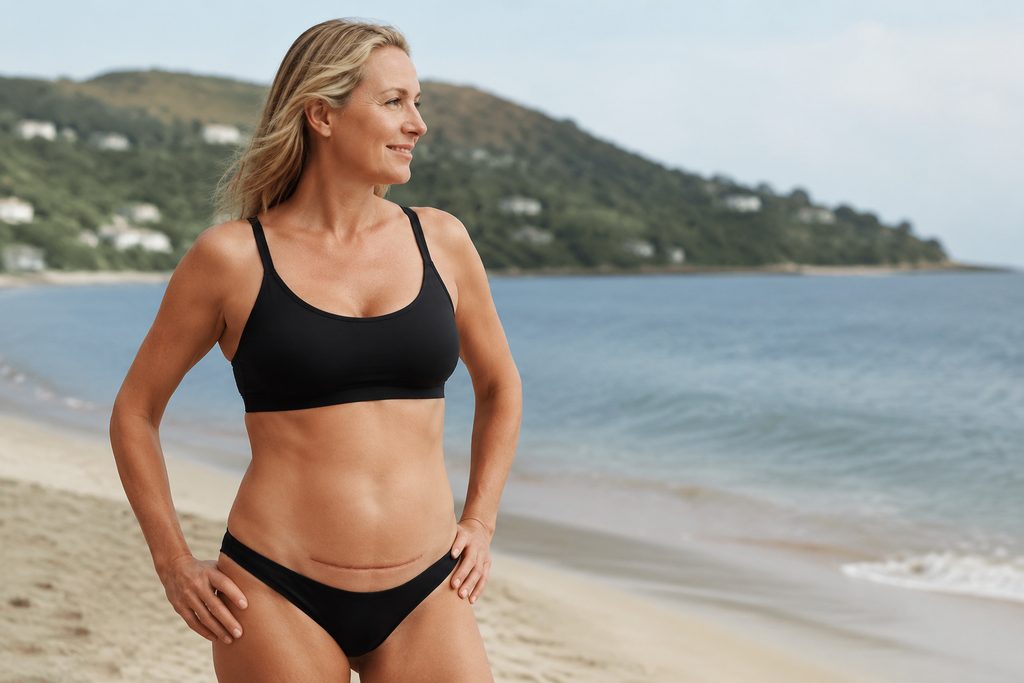
That does not mean you will be disfigured. Far from it. A well-planned tummy tuck scar sits low on the abdomen, hidden beneath underwear or a bikini line. It fades from red to pink to a pale silver-white over time. But the fear of a bad scar keeps many people from pursuing a procedure that could genuinely improve their quality of life.
So the real question is not whether you will have a scar. The real question is how good that scar will look, how long it will take to fade, and who is best qualified to create the cleanest possible result.
Why Surgical Technique Determines Your Scar Outcome
Scar quality is not random. It is the direct result of decisions made before, during, and after surgery. Understanding these factors gives you more control than you might think.
Incision Placement and Tension Control
The standard tummy tuck incision runs horizontally across the lower abdomen, just above the pubic area. Its exact height depends on your anatomy and the amount of skin to be removed. A skilled surgeon places the incision low enough to be hidden by underwear or swimwear.
But placement is only half the story. Tension is the enemy of good scarring. If the surgeon pulls the skin too tight when closing the incision, the scar will widen and thicken. Chinese plastic surgeons at high-volume centers understand this well. They routinely perform layered closures that distribute tension across deep tissue, not just the surface skin. That technique — closing the underlying fascia and dermis before the epidermis — is what separates a thin, flat scar from a raised, rope-like one.
Volume, Volume, Volume
Plastic surgery is a craft. And like any craft, repetition builds skill. A surgeon who performs 100 abdominoplasties a year has seen every anatomical variation and complication. A surgeon who performs 10 a year has not.
This is where China’s top-tier hospitals stand out. Major plastic surgery departments in Shanghai and Beijing handle caseloads that dwarf most Western private practices. A single department at a leading Chinese hospital may complete several hundred body contouring procedures annually. That volume translates directly into refined technique and predictable scar outcomes. You can explore rankings of China’s top plastic surgery departments to see which hospitals carry the highest caseloads.
Scar Management Protocols
The scar you see at six weeks is not the scar you will have at one year. But how you care for that scar in the first months matters enormously. Silicone sheets, scar massage, sun avoidance, and compression garments all influence final scar appearance. Chinese hospitals increasingly provide structured scar management programs, often integrating silicone gel therapy and fractional laser treatments to optimize healing.
How Long Does a Tummy Tuck Scar Take to Fade?
Patients want a timeline. Fair enough. Scar maturation follows a predictable arc, though individual results vary.
Weeks one through six: the scar is red, slightly raised, and may feel firm. This is normal inflammation and collagen deposition. The incision is healing beneath the surface.
Months two through six: the redness begins to fade. The scar flattens. You may notice itching as nerve endings regenerate. Silicone therapy is most effective during this window.
Months six through twelve: the scar transitions from pink to pale. It softens and becomes less visible. Most patients can comfortably wear a swimsuit by this point.
Twelve to twenty-four months: final maturation. The scar reaches its permanent appearance — typically a thin, flat, silvery line.
Is tummy tuck scar permanent? Yes, in the sense that it never disappears entirely. But a mature scar is often barely noticeable. Many patients report that partners and even close friends do not notice it unless it is pointed out.
Can I Get a Scarless Tummy Tuck in China?
Let us address this directly, because the question comes up frequently. Can I get a scarless tummy tuck in China?
No. Not in China. Not anywhere. Any surgeon who uses the word “scarless” to describe a tummy tuck is being dishonest. The procedure requires removing skin. Removing skin requires an incision. An incision leaves a scar. This is surgical reality, not a limitation of any particular country or technique.
What does exist is the minimal-scar tummy tuck. In this variation, the incision is shorter than in a full abdominoplasty, and the surgeon limits undermining of the tissue. It works well for patients with mild to moderate skin laxity confined to the lower abdomen. But it is not scarless. It is scar-minimized.
Some clinics market “endoscopic” or “mini” tummy tucks with smaller incisions. These are legitimate options for the right candidate. But they trade scar length for less dramatic results. A shorter scar means less skin removed and less muscle tightening. If you need significant correction, a full tummy tuck with its longer scar is the honest recommendation.
Tummy Tuck Cost China vs. the United States: A Real Comparison
Cost is a major driver for patients considering China. Let us look at the numbers honestly.
| Procedure | China (Top Public Hospital) | United States (Board-Certified Surgeon) |
|---|---|---|
| Full abdominoplasty | $4,500 – $9,500 | $20,000 – $35,000 |
| Mini tummy tuck | $3,000 – $6,000 | $8,000 – $15,000 |
| Extended abdominoplasty | $6,000 – $12,000 | $25,000 – $40,000 |
| Scar revision (if needed) | $800 – $2,500 | $3,000 – $7,000 |
These figures vary by hospital and case complexity. A straightforward abdominoplasty on a patient with good skin elasticity costs less than a complex revision after massive weight loss. But the structural gap is real. The abdominoplasty price Beijing and Shanghai hospitals charge reflects China’s lower labor costs, efficient hospital operations, and high surgical volumes — not a compromise in quality.
Does lower cost mean lower quality? Not at China’s top-ranked institutions. The best plastic surgery hospital Shanghai offers is typically a large public teaching hospital affiliated with a major medical university. These hospitals are ranked by the Fudan University hospital ranking system and carry international accreditations. Their plastic surgery departments are staffed by surgeons who trained in China and often abroad, who publish in international journals, and who perform procedures at volumes that most Western surgeons never approach.
You can review China’s top-ranked public hospitals to see which institutions carry the strongest reputations in plastic and reconstructive surgery.
Choosing a Surgeon: What Actually Matters for Your Scar
If you are considering a tummy tuck in China, the scar outcome depends on the surgeon you choose. Here is what to evaluate.
Ask about annual abdominoplasty volume. A surgeon who performs 80 to 150 tummy tucks per year has refined the technique. Do not be shy about asking for this number. Any reputable surgeon will share it.
Ask to see before-and-after photos of scars, not just results. Photos that show the abdomen at three months, six months, and one year post-surgery tell you more than a single image. Look specifically at scar placement, width, and flatness.
Ask about their tension-reduction technique. A surgeon who mentions layered closure, deep fascial plication, and progressive tension sutures understands scar minimization. A surgeon who gives vague answers does not.
Ask about scar management protocols. The best programs include silicone sheeting, compression, and follow-up laser treatments when needed. This is not an add-on. It is part of the surgery.
Practical Considerations: Documentation, Visa, and Recovery Logistics
Traveling to China for a tummy tuck requires planning. Here is what you need to know.
You will need a valid passport and a visa. For medical treatment in China, the applicable short-stay category is the S2 visa, which covers private affairs including medical treatment. You will need supporting documents from the hospital confirming your scheduled procedure. Visa requirements change, so confirm the latest rules with your nearest Chinese embassy or consulate before booking flights.
Bring your complete medical history. This includes any prior abdominal surgeries, pregnancies, weight fluctuations, and current medications. If you have had bariatric surgery, bring documentation of your weight stability. Most surgeons require patients to be at a stable weight for six to twelve months before abdominoplasty.
Plan for recovery time. A full tummy tuck requires seven to ten days in China before you can comfortably fly home. During that time, you will have drains removed, sutures checked, and your first follow-up visit. You will need help with daily activities for the first week. Some patients arrange for a bilingual companion to assist with hospital visits and communication — China Medical Services provides coordination for exactly this purpose.
Payment is typically required upfront at Chinese public hospitals. Most international patients pay by credit card or wire transfer. Insurance rarely covers elective cosmetic procedures, so plan for out-of-pocket payment. After returning home, arrange for a local physician to monitor your healing and remove any remaining sutures if needed.
Frequently Asked Questions
In most cases, no. A properly placed tummy tuck incision sits low enough to be covered by standard bikini bottoms or underwear. The exact position depends on your anatomy and the amount of skin removed, but hiding the scar within the natural bikini line is a standard goal of the procedure.
Scar revision is always possible. If a scar widens, thickens, or becomes hypertrophic, a revision procedure can excise the old scar and re-close the incision under better tension control. Laser treatments and steroid injections can also improve raised scars. Chinese plastic surgery departments routinely perform these revisions, often at a fraction of Western prices.
Yes, significantly. Nicotine constricts blood vessels and reduces oxygen delivery to healing tissue. Smokers have measurably higher rates of wound complications and worse scar outcomes after abdominoplasty. Most surgeons require patients to stop smoking at least four weeks before and four weeks after surgery. If you smoke, be honest with your surgeon and commit to quitting for the surgical period.
Most surgeons recommend waiting seven to ten days after surgery before flying internationally. This allows time for drain removal, initial healing, and a follow-up visit. Long flights increase the risk of blood clots, so your surgeon may recommend compression stockings and early ambulation during the flight. Always follow your surgeon’s specific clearance before booking your return.
Your Next Step
A tummy tuck scar is permanent, but a good scar is nothing to fear. The right surgeon, the right technique, and the right aftercare produce a thin, low, concealable line that fades into the background of your life. China’s top plastic surgery departments offer that expertise at a cost that makes the procedure accessible to far more patients.
We help international patients navigate the Chinese healthcare system — from hospital matching to appointment coordination and bilingual support. We are not a hospital and do not provide medical advice. But if you are weighing your options for abdominoplasty, we can help you understand what is realistic and connect you with the right department. When you are ready to explore further, reach out for a free consultation.
For more medical information and treatment options in China, visit chinamedservices.com (China Medical Services).
