When Should I Get a Prostate Biopsy? Key Signs, Costs, and China Options
When Should I Get a Prostate Biopsy? Reading the Signs Before You Decide
You have probably been told that a rising PSA means you need a biopsy right away. That is not always true. The decision to get a prostate biopsy hinges on a combination of factors — your PSA velocity, MRI findings, family history, and your own risk tolerance. For many men, the real question is not just “when” but “where” and “at what cost.” Understanding the prostate biopsy cost China offers can change how you approach the entire diagnostic journey, especially if you are weighing options across borders.
We have guided hundreds of international patients through urological evaluations at top-tier Chinese hospitals. What we see consistently is that men delay biopsies out of fear — fear of pain, fear of complications, fear of a cancer diagnosis, and fear of an inflated medical bill. But delay often narrows your options later. This article explains the clinical triggers for biopsy, the different biopsy methods, what the procedure actually feels like, and what you should expect to pay — including a realistic look at prostate biopsy pricing in China versus the United States and Europe.
Key Takeaways
- PSA alone rarely justifies a biopsy — a combination of PSA density, MRI findings (PI-RADS 3 or higher), and digital rectal exam results drives the decision.
- Transperineal biopsy has largely replaced transrectal biopsy in leading Chinese hospitals due to a sepsis rate near 0% versus 1-3% for transrectal approaches.
- Prostate biopsy cost in China typically ranges from $800 to $2,500 for the procedure itself, compared to $3,000 to $8,000+ in the United States.
- Language barriers and hospital navigation are real challenges in Chinese public hospitals — but international departments and bilingual coordination services mitigate this.
The Problem: Too Many Men Get Biopsied Too Late — Or Too Early
Prostate cancer affects approximately 1 in 8 men during their lifetime. But the pathway to diagnosis is riddled with confusion. A 2023 study in European Urology found that up to 40% of prostate biopsies performed for PSA levels between 4 and 10 ng/mL return negative results. That means a significant number of men undergo an invasive procedure they did not strictly need. On the flip side, other men ignore persistent PSA rises for years and present with locally advanced disease that could have been caught earlier.
The financial burden compounds the problem. In the United States, a standard transrectal ultrasound-guided biopsy costs between $3,000 and $8,000 depending on the facility and whether MRI fusion is used. In the United Kingdom, NHS wait times for a prostate biopsy after an abnormal MRI can stretch to 6-8 weeks in some trusts. Private options cut the wait but not the price. Men in Canada, Australia, and parts of the Middle East face similar bottlenecks. The result is a dangerous limbo: knowing something might be wrong, but hesitating because of cost, scheduling friction, or simple dread of the procedure.
Why China Delivers Results for Prostate Diagnostics
China’s urology departments operate at a scale that is hard to grasp until you see it. A single top-tier hospital in Shanghai or Beijing may perform 800 to 1,200 prostate biopsies per year. That volume creates a level of procedural fluency that directly affects complication rates and diagnostic accuracy. When you are deciding when is a prostate biopsy necessary, the quality of the team performing it matters as much as the clinical indication.
Clinical Volume and MRI-Fusion Expertise
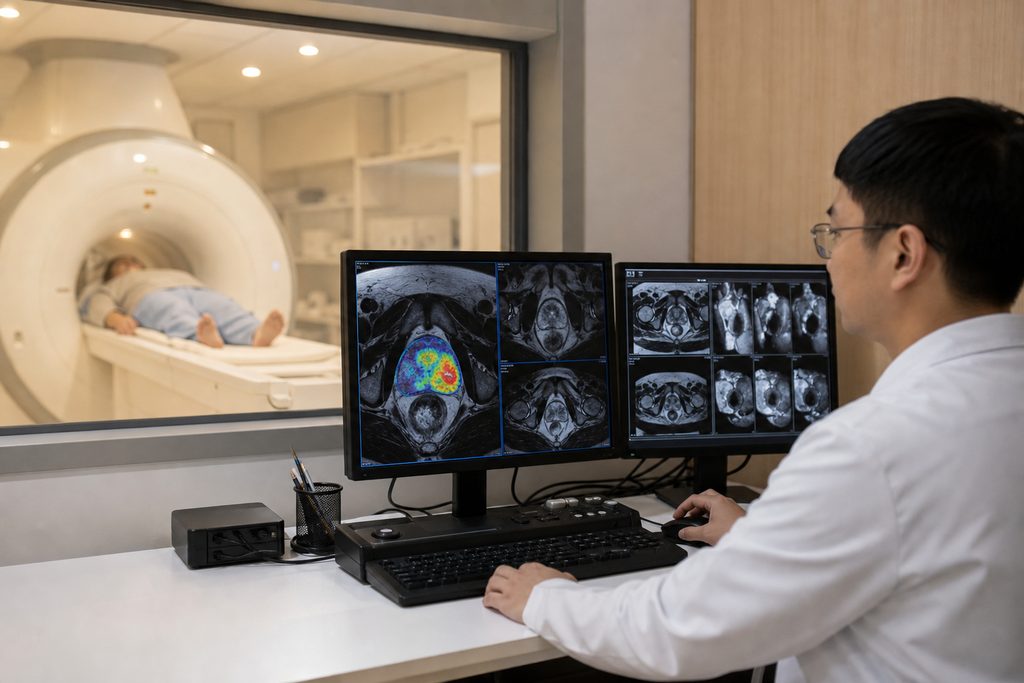
Hospitals like Fudan University Shanghai Cancer Center and Peking University First Hospital run dedicated prostate cancer diagnostic pathways. Their urologists routinely use multiparametric MRI fused with real-time ultrasound to target suspicious lesions. The PI-RADS scoring system — which grades lesions from 1 (benign) to 5 (highly suspicious) — is standard practice. A PI-RADS 4 or 5 lesion generally warrants biopsy regardless of PSA. A PI-RADS 3 lesion requires judgment based on PSA density and clinical history. Chinese specialists see enough of these borderline cases to make nuanced calls.
But volume is not just about numbers. It is about the biopsy technique itself. Transperineal biopsy, where the needle passes through the perineum rather than the rectal wall, has become the default at leading Chinese centers. This approach nearly eliminates the risk of post-biopsy sepsis — a complication that sends roughly 1-3% of transrectal biopsy patients to the emergency department in Western settings. The transperineal method also samples the anterior prostate more effectively, where up to 20% of clinically significant cancers hide.
Technology Without the Wait
In many Western systems, the pathway from elevated PSA to biopsy involves multiple appointments spread over months: a urology consult, then an MRI, then a separate biopsy booking. Chinese international departments compress this timeline. A patient can often complete PSA re-testing, multiparametric MRI, and a biopsy within 5 to 7 business days. That compression matters because prostate cancer progression, while generally slow, does not follow a predictable schedule for every man. Aggressive Gleason 8-10 disease can advance quickly.
For international patients, the practical workflow at a hospital like Ruijin Hospital in Shanghai or West China Hospital in Chengdu typically looks like this: initial video consultation to review existing records, arrival and same-day blood work, MRI the following morning, and biopsy scheduled within 48 hours if indicated. The coordination is handled through the hospital’s international medical department, which assigns English-speaking staff to guide you through registration, imaging, and the procedure itself.
Cost Advantage Without Quality Compromise
The prostate biopsy cost China hospitals quote is not low because of shortcuts. It is low because of structural economics. Chinese surgeons earn far less than their American counterparts — a senior urologist in Shanghai might earn $60,000 to $100,000 annually versus $400,000 to $600,000 in the US. Hospital infrastructure costs are lower. Malpractice insurance premiums are a fraction of Western levels. None of that affects the quality of the biopsy or the pathology read.
What you pay for a prostate biopsy in China depends on the hospital tier and the technique used. A standard transrectal biopsy at a top public hospital’s international department runs $800 to $1,500. A transperineal MRI-fusion biopsy costs $1,500 to $2,500. Pathology interpretation by an experienced genitourinary pathologist adds $200 to $500. Compare that to the $3,000 to $8,000 American price tag, and the math becomes compelling — especially for uninsured or underinsured patients. The question is prostate biopsy safe in China deserves a direct answer: at accredited top-tier hospitals, the infection rate for transperineal biopsy is below 0.5%, and the procedure is performed under local anesthesia with ultrasound guidance, identical to Western standards.
When Is a Prostate Biopsy Actually Necessary? The Decision Framework
No single number dictates a biopsy. Urologists weigh at least five factors. First, the absolute PSA level. A PSA above 10 ng/mL almost always prompts biopsy. Between 4 and 10, the decision hinges on other variables. Second, PSA velocity — a rise of more than 0.75 ng/mL per year, even within the “normal” range, raises suspicion. Third, PSA density, calculated by dividing PSA by prostate volume. A density above 0.15 ng/mL² suggests meaningful risk. Fourth, the digital rectal exam. A palpable nodule or asymmetry warrants biopsy regardless of PSA. Fifth, the MRI result. A PI-RADS 4 or 5 lesion is a strong indication. A PI-RADS 1 or 2 lesion usually means biopsy can be deferred.
Family history shifts the threshold. Men with a first-degree relative diagnosed with prostate cancer before age 65, or with a family history of BRCA2 mutations, should consider biopsy at lower PSA levels. Ethnicity matters too. Men of African descent face roughly double the risk of aggressive prostate cancer compared to Caucasian men. If you fall into a high-risk category, the calculus changes — and the temptation to watch and wait becomes riskier.
But here is the honest truth: many men get biopsied who do not need it, and many men who need it avoid it. The key is not to fixate on a single PSA reading. It is to assemble the full picture — PSA trend, MRI findings, exam results, and family history — and then make a decision with a urologist who sees enough prostate cases to calibrate risk accurately.
Prostate Biopsy Methods Compared: Transrectal vs. Transperineal vs. Fusion
Not all prostate biopsies are equal. The method affects your infection risk, your comfort, and the accuracy of the sampling. Knowing the differences helps you ask the right questions when evaluating a hospital — whether in Shanghai, Berlin, or Boston.
| Method | Infection Risk | Anesthesia | Typical Cost (China) | Typical Cost (US) | Best For |
|---|---|---|---|---|---|
| Transrectal (TRUS) | 1-3% | Local | $800-$1,500 | $3,000-$5,500 | Standard 12-core sampling |
| Transperineal (TP) | <0.5% | Local or sedation | $1,200-$2,000 | $4,000-$7,000 | Lower infection risk, anterior sampling |
| MRI-Fusion (TP or TR) | 0.5-2% | Local or sedation | $1,500-$2,500 | $5,000-$8,000+ | Targeted biopsy of PI-RADS 3+ lesions |
The transperineal approach has gained ground rapidly in China because it sidesteps the rectal flora that cause post-biopsy infections. You will feel some pressure and brief discomfort during the needle insertion, but the procedure typically takes 15 to 25 minutes. Most men return to normal activities within 24 to 48 hours. Blood in the urine, semen, or stool is common for a few days to a few weeks — that is normal, not a complication. Fever, chills, or inability to urinate are red flags that require immediate attention.
If you are traveling to China specifically for a biopsy, the transperineal MRI-fusion option at a hospital like Fudan University Shanghai Cancer Center or Peking University First Hospital offers the best balance of safety and diagnostic precision. The best hospital for prostate biopsy Shanghai depends on your specific case, but both institutions run high-volume prostate diagnostic programs with dedicated genitourinary pathologists on site. You can explore the full list of ranked urology and oncology departments on our specialty rankings page.
Practical Considerations: Documentation, Visa, and Logistics for a Biopsy in China
In the United States, expect $3,000 to $8,000 depending on technique and facility. In the UK, private biopsies run £2,000 to £4,000. In China, the same procedure costs $800 to $2,500 at top-tier hospitals. Pathology interpretation is usually included in Chinese quotes, whereas Western facilities often bill it separately. The price difference reflects lower labor and facility costs, not lower quality.
At accredited top-tier hospitals with dedicated international departments, yes. The transperineal technique used at leading centers carries a sepsis risk below 0.5%. You should verify that the hospital performs a high volume of biopsies annually and has a genitourinary pathologist on staff. Ask about their infection control protocols and complication rates before committing.
You cannot lock in a specific biopsy date from overseas through the standard public registration system. What you can do is arrange a video consultation first, submit your records for review, and have the hospital’s international department pre-schedule your imaging and biopsy once the specialist confirms the indication. This is the practical pathway for medical travelers — remote evaluation first, then a compressed in-person timeline. Our team coordinates this process for patients who want to book prostate biopsy China medical tourism logistics without the guesswork.
If the pathology report confirms prostate cancer, the next step is staging and treatment planning. Chinese hospitals offer the full range of options: active surveillance for low-risk disease, robotic-assisted radical prostatectomy for localized cancer, and radiation therapy including brachytherapy. The same international department that handled your biopsy can coordinate a multidisciplinary consultation to review your case. You are not locked into treatment in China — the pathology report and imaging are yours to take to any specialist worldwide.
Your Next Step
The decision to get a prostate biopsy should never be driven by fear or by a single lab value. It should be driven by a clear-eyed assessment of your PSA trend, your MRI findings, your family history, and your personal priorities. If cost or access is what has been holding you back, know that options exist beyond your home country’s pricing. We help international patients navigate Chinese urology departments — from remote video consultations to on-the-ground coordination for biopsy and follow-up. We are not a hospital and we do not provide diagnoses; we connect you with the specialists who do. When you are ready to understand your options, request a free consultation and we will walk you through the process step by step.
Frequently Asked Questions
Yes. The hospitals used for international patients are JCI-accredited and follow the same international safety standards as top hospitals in the US and Europe. Surgical teams perform high volumes of procedures — often more than their Western counterparts — which studies show leads to better outcomes.
Costs vary by procedure and hospital, but international patients typically save 40-80% compared to US prices — even when factoring in travel and accommodation. A consultation with our team will give you an exact, all-inclusive quote with no hidden fees.
Send us your existing medical reports to get started. We handle everything from hospital selection and appointment scheduling to visa assistance and post-operative recovery planning. Your medical records are reviewed by the specialist before you even book a flight.
For more medical information and treatment options in China, visit chinamedservices.com (China Medical Services).
