What Does a Sleep Study Diagnose? Conditions, Costs, and Booking in China
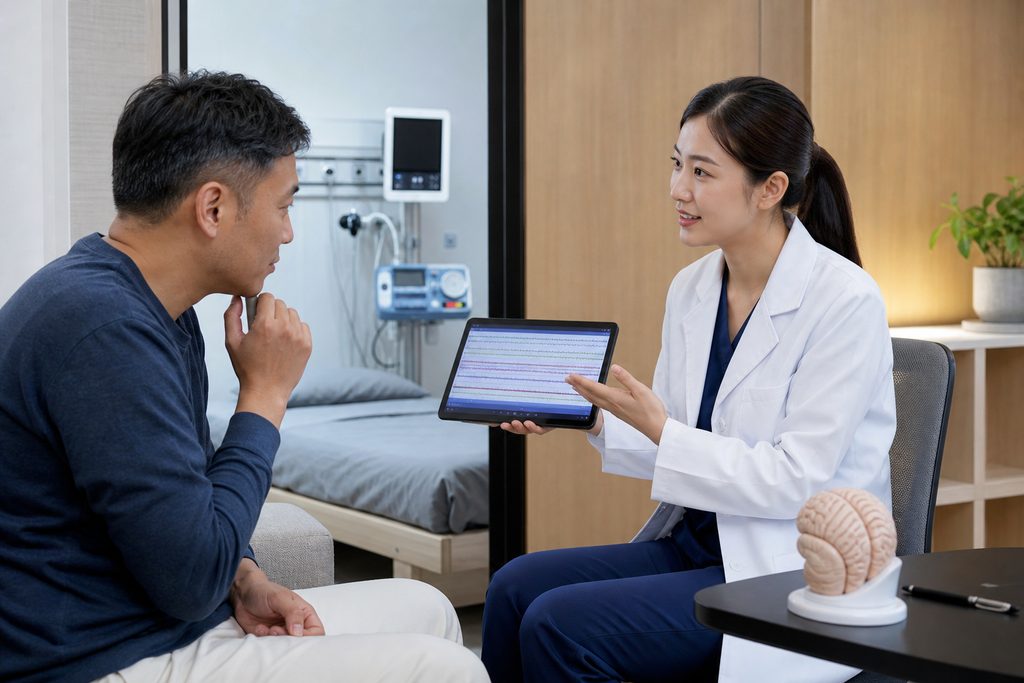
When 42-year-old Michael from Manchester finally booked a sleep study, he had spent two years blaming his exhaustion on work stress. His wife had recorded him gasping at night. His smartwatch showed oxygen dips. But he still did not know what the test would actually find, or whether the results would be trustworthy. The answer matters more than most patients realize.
What Does a Sleep Study Diagnose? The Short Answer
A sleep study—formally called polysomnography—diagnoses disorders that disrupt breathing, brain activity, or movement during sleep. The core conditions it detects are obstructive sleep apnea (OSA), central sleep apnea, narcolepsy, restless legs syndrome, periodic limb movement disorder, REM sleep behavior disorder, and certain parasomnias. It can also identify unexplained chronic insomnia when a physiological cause is suspected. That is the direct answer.
But here is the caveat. A sleep study does not diagnose every sleep problem. It will not tell you that you are simply stressed, overworked, or depressed. It measures physiology, not psychology. And the quality of the diagnosis depends heavily on the lab, the scoring technician, and the equipment. A poorly run study produces a report that looks official but means little. That distinction is why where you get tested matters as much as whether you get tested.
Who This Is Right For — and Who It Isn’t
Not everyone with poor sleep needs a polysomnography. Doctors typically recommend one when specific red flags appear. You are probably a good candidate if you match any of these patterns:
- You snore loudly and someone has witnessed you stop breathing during sleep
- You wake up gasping or choking, especially with morning headaches
- You feel severe daytime sleepiness despite 7–9 hours in bed
- You have treatment-resistant hypertension or atrial fibrillation with no clear cause
- You experience sudden muscle weakness triggered by strong emotions, suggesting possible narcolepsy
- You kick or thrash violently during sleep, sometimes injuring yourself or a partner
On the other hand, a sleep study is probably not the right first step if your only issue is occasional difficulty falling asleep during stressful periods, if you have already been diagnosed with OSA and are simply checking CPAP pressure settings (a home titration study may suffice), or if you are looking for a test to validate general fatigue without any specific nocturnal symptoms. A good sleep physician will tell you this before you spend money.
The Options, Compared
Sleep testing is not one-size-fits-all. The table below compares the main formats available to international patients considering where to get tested.
| Option | What It Measures | Typical Cost (USD) | Best For |
|---|---|---|---|
| In-lab polysomnography (Level I) — China, public hospital international department | EEG, EOG, EMG, ECG, airflow, respiratory effort, oxygen saturation, body position, video | $150–400 per night | Complex cases, suspected narcolepsy, REM behavior disorder, central apnea |
| In-lab polysomnography — United States | Same comprehensive parameters | $1,000–5,000 per night | Patients with US insurance covering the test |
| Home sleep apnea test (HSAT) — China | Airflow, respiratory effort, oxygen saturation, heart rate (no EEG) | $80–200 | High pre-test probability of moderate-to-severe OSA, no other suspected disorders |
| Home sleep apnea test — United States | Same limited parameters | $150–500 | Same as above, but often with longer wait times |
| Private international hospital sleep study — Shanghai or Beijing | Full polysomnography with English-speaking staff and direct insurance billing | $500–900 per night | Patients wanting Western-style service, English reporting, and minimal coordination hassle |
If you suspect straightforward OSA and want the cheapest, fastest route, a home sleep test in China is hard to beat on price. But if your symptoms are unusual—cataplexy, violent dream enactment, or suspected central apnea—an in-lab study at a hospital with a dedicated sleep disorders center is the only defensible choice. The private international option costs more but removes the language barrier entirely.
Is Sleep Apnea Test Accurate in China? What the Data Shows
This is the question most Western patients actually worry about. Can you trust a result from a hospital you have never visited, in a country whose language you do not speak?
The short answer: yes, when you choose the right facility. China has invested heavily in sleep medicine over the past decade. Major centers in Beijing, Shanghai, and Guangzhou now run accredited sleep labs using the same equipment brands found in US and European hospitals—Philips Respironics, ResMed, Natus, and Compumedics. The scoring criteria follow the American Academy of Sleep Medicine (AASM) standards, which China formally adopted as its national guideline in 2017. That means the apnea-hypopnea index (AHI) threshold of 5 or more events per hour for mild OSA, 15 for moderate, and 30 for severe is the same classification your doctor at home would use.
But accuracy depends on three variables: technician experience, scoring consistency, and patient preparation. A lab that runs 20 studies a night with one technician will produce lower-quality data than one running five studies with two technicians. This is not unique to China—the same variance exists everywhere. The difference is that in China, you can access top-tier sleep labs for a fraction of the Western price. The key is selecting a hospital with a dedicated respiratory sleep medicine department or neurology sleep disorders unit, not a general ward that happens to own a used polysomnograph.
How to Book a Sleep Study at a Beijing Hospital — and What Shanghai Offers
Booking a polysomnography as a foreigner involves more steps than simply walking in. Public hospital sleep labs in China typically require an initial outpatient consultation before scheduling the overnight test. That first visit confirms the clinical need and screens for contraindications. You cannot book the sleep study slot directly from overseas through the standard public registration system—the hospital systems are designed for domestic patients with local ID numbers and payment methods.
Three practical routes exist. The first is to use a hospital’s international medical department or VIP wing. Many top hospitals, including those listed on our top-ranked hospital database, operate separate international departments with English-speaking coordinators who can pre-arrange consultations and sleep study slots before you travel. Expect to pay 1.5 to 2 times the standard rate for this service. The second route is a private international hospital such as United Family or Jiahui in Shanghai, where the entire process—consultation, study, follow-up—happens in English with direct insurance billing. The third route is to work with a bilingual coordinator who handles registration, the initial consultation, and scheduling on your behalf.
Sleep Study Cost China: What You Actually Pay
Let us talk numbers, because the sleep study cost China comparison is the main reason international patients look east. A full in-lab polysomnography at a top public hospital’s standard department in Shanghai or Beijing runs approximately $150–400 per night. The same test at a private international hospital in those cities costs $500–900. In the United States, the identical study bills at $1,000–5,000, and that is before considering whether your insurance deductible leaves you paying most of it out of pocket.
What drives the variance in China? Hospital tier matters. A Fudan-ranked top-100 hospital with a dedicated sleep disorders center will charge more than a mid-tier municipal hospital. The room type matters too—some labs offer private rooms, others use shared ward space with privacy curtains. Whether you need a full montage (with EEG for brain activity) or a simpler respiratory montage changes the price. And if you require an English-language report or a translated summary for your home physician, some hospitals add a documentation fee of $30–80.
What is not included? The initial consultation fee (typically $20–60 at public hospitals, $100–200 at private international hospitals). Any additional testing ordered during the study, such as a multiple sleep latency test (MSLT) for narcolepsy, which adds another $150–300. CPAP titration, if you need pressure calibration, is usually a second night and costs the same as the first. And if you are booking through a coordination service, the coordination fee is separate from the hospital charges.
For comparison, the polysomnography price Shanghai patients typically quote after their trip lands between $250 and $700 all-in, depending on hospital class and whether they used the international department. That is the number to budget around.
Practical Considerations: Records, Visas, Payment, and Follow-Up
Before you book anything, gather your documentation. Bring any prior sleep-related records: previous home sleep test results, CPAP usage reports, ENT evaluations, and relevant blood work. If you have a suspected cardiac component—arrhythmias, heart failure—bring echocardiogram and Holter monitor results. A sleep physician needs context to interpret your study correctly.
For the visa, medical travel to China falls under the S2 visa category, which covers short-term private affairs including medical treatment. The hospital or your coordination service can provide an invitation letter and medical appointment confirmation to support your application. Family members accompanying you apply for the same S2 category. Processing typically takes one to two weeks, though this varies by consulate and your home country. Check current requirements with the nearest Chinese embassy or consulate before booking flights.
Payment at public hospitals is prepaid—you deposit funds at registration and settle after services. Most public hospital international departments accept international credit cards, but standard departments often require Chinese payment platforms like WeChat Pay or Alipay, or cash. Private international hospitals accept major credit cards and frequently bill insurance directly. If you carry international health insurance, confirm reimbursement terms before the study, and request itemized invoices in English.
Language is the practical hurdle most patients underestimate. A standard public hospital sleep lab will operate entirely in Chinese. The technician will explain the hookup process in Chinese. The morning-after debrief will be in Chinese. If you do not have a bilingual companion, you are relying on translation apps at 11 PM while electrodes are being glued to your scalp. This is not a criticism of the hospitals—it is simply the reality of a system designed for 1.4 billion domestic patients. You can manage it alone, but a bilingual medical companion removes the friction entirely. Our team provides exactly this service—bilingual medical companions who handle registration, translation, and navigation throughout the process.
After you return home, the follow-up matters. Ask the lab for the raw scored data, not just the summary report. A good sleep physician in your home country can review the full hypnogram and respiratory event log. Some Chinese hospitals provide reports in both Chinese and English; if yours does not, arrange a professional medical translation rather than relying on machine translation for a document your home doctor will use to make treatment decisions.
Frequently Asked Questions
Directly through the standard public registration system, no. The system requires an in-person initial consultation before scheduling the overnight study. Through a hospital’s international department or a coordination service, yes—the consultation and study slot can be pre-arranged before you fly. Expect to pay the international department rate for this convenience.
In most cases, yes, provided the report follows AASM scoring standards and includes the raw data, not just a one-page summary. China’s major sleep centers use the same scoring criteria as US and European labs. If your home doctor has concerns, ask the Chinese lab for the full scored record and a technician’s note on equipment and calibration. A professional medical translation helps if the report is in Chinese only.
This is a real possibility. A normal polysomnography rules out physiological sleep disorders but does not explain your symptoms. The next steps depend on your presentation: a psychiatrist or psychologist for insomnia or anxiety, a neurologist for atypical symptoms, or a cardiologist if nocturnal symptoms suggest a cardiac cause. A negative result is still valuable information—it narrows the diagnostic field. But do not expect the sleep lab to solve the mystery on its own.
The overnight recording itself runs roughly 8 hours. The scoring and report typically take 1–3 days at major centers. If you need a multiple sleep latency test for narcolepsy, that adds a full daytime session the following day. Realistically, budget 3–5 days in the city from arrival to holding your final report.
Your Next Step
A sleep study is a diagnostic tool, not a treatment. It tells you what is happening during the night so that a physician can decide what to do about it. China offers high-quality polysomnography at a fraction of Western prices, but the logistics—booking, language, documentation—require planning. That is where we come in.
China Medical Services is not a hospital and does not diagnose or treat any condition. We connect international patients with China’s 340+ top-ranked hospitals across 37 cities, handling appointment coordination, bilingual accompaniment, and the practical details that make a medical trip feasible. If you are considering a sleep study in China, start with a conversation. Tell us your symptoms, your timeline, and your budget. We will help you determine whether this route makes sense for you—honestly, even if the answer is that staying home is the better choice. Request a free consultation and we will map out your options.
The right test at the right facility can change the trajectory of your health. Knowing what a sleep study actually diagnoses—and what it cannot—is the first step toward using it well.
For more medical information and treatment options in China, visit chinamedservices.com (China Medical Services).
