Remote Joint Replacement Review: X-Ray & MRI to Chinese Orthopedic Surgeons
Key Takeaways
- A remote orthopedic case review lets a top Chinese joint replacement surgeon analyze your existing X-rays and MRI without you traveling, typically costing from $300.
- China’s high-volume orthopedic centers perform thousands of replacements yearly, offering a depth of clinical experience that can provide a valuable perspective on complex or revision cases.
- This is a written or video analysis, not a treatment prescription. It clarifies your options but does not replace an in-person physical examination required before any surgery.
- You must prepare high-quality digital imaging files and a translated medical summary. The quality of the review depends entirely on the quality of the records you send.
The Problem: When Your Joint Pain Plan Hits a Wall
Living with end-stage hip or knee arthritis grinds you down. The stiffness in the morning. The ache that dictates how far you can walk. You finally see a surgeon, get the X-ray and MRI, and then hear words that stop you cold: a 14-month wait for a consultation, a quote for surgery that exceeds $40,000 out-of-pocket, or the unsettling news that your case is “complex” and the local team only does a handful of these specific revisions each year. You have the images. They show the problem clearly. But the path to a solution is blocked by time, money, or limited local expertise. The cost of inaction is measured in lost mobility and escalating pain. Approximately 1 in 4 adults in the US has doctor-diagnosed arthritis, and for many, the gap between diagnosis and definitive treatment is where hope starts to fade.
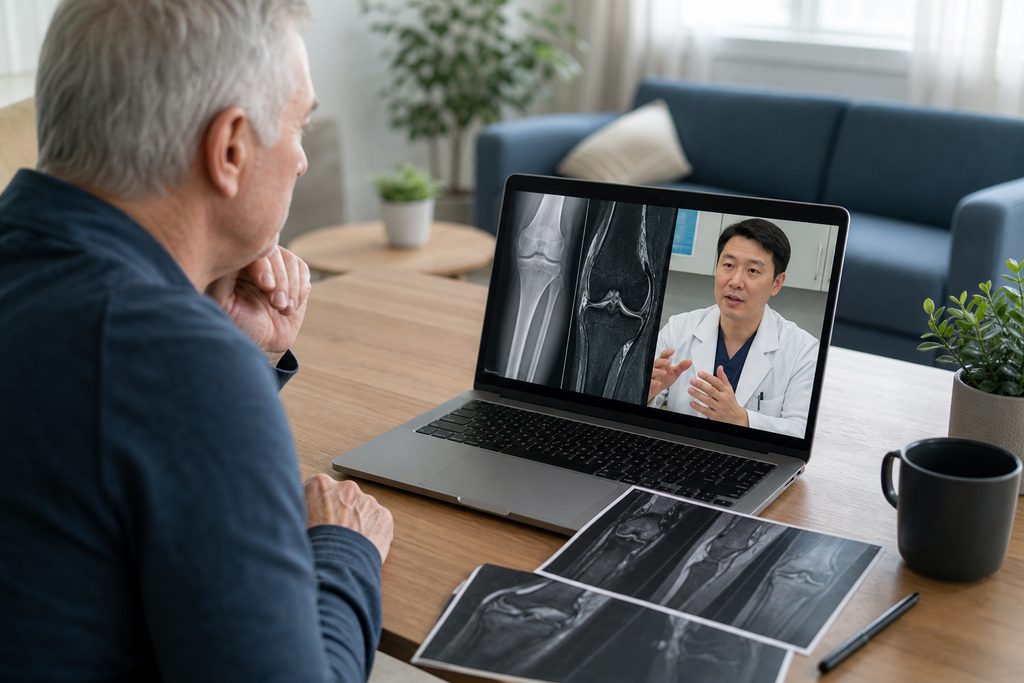
That stack of imaging on your CD or hard drive holds the key. A remote orthopedic case review for joint replacement—getting your X-ray and MRI to Chinese surgeons—is a way to unlock a second opinion from a system that operates at a different scale. You do not need to pack a bag, book a flight, or navigate a foreign hospital lobby. Not yet.
Why a Remote Orthopedic Case Review for Joint Replacement Delivers Results
The logic is straightforward. Joint replacement surgery is, in many ways, a volume-driven specialty. The more a surgeon sees, the more patterns they recognize, and the more refined their surgical judgment becomes. This is where China’s top orthopedic centers operate in a different league.
Clinical Volume That Shapes Surgical Judgment
Consider the raw numbers. A busy orthopedic surgeon in a top-tier Chinese public hospital may perform 400 to 600 joint replacements annually. The average US orthopedic surgeon performs roughly 65 per year, according to data from the Journal of Arthroplasty. This is not a statement about individual skill. It is a statement about system design. Chinese hospitals in major cities like Beijing and Shanghai run dedicated joint replacement wards with streamlined surgical teams. A surgeon there sees more failed implants, more unusual anatomies, and more revision cases in one year than many Western surgeons encounter in half a decade. When you send your MRI for a remote joint replacement consultation, you are tapping into that pattern-recognition engine. The radiologist’s report you already have describes the cartilage loss. A high-volume surgeon looks at the same images and sees the specific implant strategy—the stem length, the cup position, the bone stock quality—because they have planned thousands of those cases.
This matters especially for revision surgery. A failed hip implant with bone loss is a puzzle. A surgeon who sees 100 such puzzles a year will see solutions that a surgeon who sees 10 might not. The remote review gives you access to that perspective without committing to anything more than sending your files.
Technology and Efficiency at Scale
The process of getting an online second opinion for joint replacement abroad relies on a simple technological pipeline that Chinese hospitals have embraced. Most large orthopedic departments now use advanced 3D reconstruction software and digital templating as a standard pre-operative step. When your DICOM files arrive, they are not just viewed on a screen. The surgical team can load them into planning software, measure the exact dimensions of your acetabulum or tibial plateau, and simulate implant positioning. This is the same pre-operative planning they perform for their own patients. The difference is that you are 7,000 kilometers away, and the output is a detailed written report and a video conversation, not an incision.
And the turnaround is fast. A standard written second opinion, once all records are received and translated, can often be delivered within 5 to 7 business days. The bottleneck is rarely the hospital. It is usually the completeness of the records you send.
Cost Advantage Without Quality Compromise
Let us address the elephant in the room. The remote joint replacement consultation China cost is a fraction of what a comparable service costs in the US or Europe. A written second opinion from a top-tier Chinese specialist typically starts from $300. A video consultation with that same specialist, where you can ask questions directly, ranges from $500 to $800. Compare that to cash-pay second opinion programs at major US academic centers, which frequently run from $1,500 to over $3,000. The reason for this gap is structural: lower labor costs in China’s healthcare system, higher patient throughput that distributes overhead differently, and a pricing model designed for a domestic population where out-of-pocket costs are the norm. You are not paying a premium for a “medical tourism” package. You are paying the rate for expert time in a system where expert time costs less, without any compromise on the quality of the imaging analysis.
This does not mean the care is inferior. Outcomes data from China’s top orthopedics departments, published in journals like the Chinese Journal of Orthopaedics, show infection rates and revision rates for primary hip and knee replacements that are statistically comparable to international benchmarks. The tools are the same. The implants are the same global brands. The expertise is real. The price is different because the economic context is different.
How Does Remote Hip Surgery Review Work: The Step-by-Step Pipeline
This happens more often than you might think, and it is not a sign that one surgeon is wrong. Different training backgrounds and different patient populations lead to different practice patterns. A Chinese surgeon might recommend a posterior approach for a hip replacement where a US surgeon might favor an anterior approach. Neither is incorrect. The value of the remote review is that it gives you a second data point. You can take the Chinese surgeon’s report back to your local surgeon and discuss the differences. A good local surgeon will welcome the input. If the recommendations are radically different—one says surgery is urgent, the other says wait—you need to ask both surgeons to explain their reasoning until you understand the divergence.
Then the remote review has done its job and saved you a trip. You will have spent a few hundred dollars instead of several thousand. The report should explain why surgery is not recommended—perhaps your bone stock is inadequate, your medical comorbidities are too high-risk, or a different treatment like physical therapy or injections should be tried first. This is not a failure. It is clarity. You can then redirect your energy toward the recommended alternative.
You should ask for the surgeon’s credentials before committing. A qualified joint replacement specialist will be board-certified in orthopedics, will have completed a fellowship in arthroplasty or joint reconstruction, and will be practicing at a hospital ranked in the Fudan University Hospital Ranking for orthopedics. Many of the top orthopedic hospitals in China are included in our specialty departments directory. You can and should verify these details. Reputable coordination services will provide this information transparently before you pay.
Data security is a legitimate concern. Reputable hospitals use encrypted transmission portals and store data on secure servers. However, China’s data privacy regulations differ from HIPAA in the US or GDPR in Europe. You should ask specifically how your data will be stored, who will have access to it, and how long it will be retained. If you are not satisfied with the answers, do not send your records. Most large international coordination teams have clear data-handling protocols they can share with you.
Your Next Step
A remote joint replacement consultation turns your existing X-ray and MRI from a source of frustration into a tool for clarity. It lets you test the waters with a Chinese orthopedic team before committing to the cost and complexity of travel. If the review confirms that surgery is indicated and that the proposed plan makes sense for your life, you can move forward with confidence. If it does not, you have saved yourself a great deal of time and money. At China Medical Services, we connect patients with top-tier orthopedic departments for remote case reviews. We are not a hospital and we do not provide medical advice. We handle the logistics—records translation, secure transmission, appointment coordination—so you can focus on the decision in front of you. When you are ready to explore what a remote review could reveal, request a free consultation to discuss your case. No pressure. Just a clear path forward.
Frequently Asked Questions
Yes. The hospitals used for international patients are JCI-accredited and follow the same international safety standards as top hospitals in the US and Europe. Surgical teams perform high volumes of procedures — often more than their Western counterparts — which studies show leads to better outcomes.
Costs vary by procedure and hospital, but international patients typically save 40-80% compared to US prices — even when factoring in travel and accommodation. A consultation with our team will give you an exact, all-inclusive quote with no hidden fees.
Send us your existing medical reports to get started. We handle everything from hospital selection and appointment scheduling to visa assistance and post-operative recovery planning. Your medical records are reviewed by the specialist before you even book a flight.
For more medical information and treatment options in China, visit chinamedservices.com (China Medical Services).
