What Is a Colposcopy and Do I Need One? Understanding Costs and Care
While a routine Pap smear in the United States can cost upwards of $250 without insurance and often involves weeks of anxious waiting for results, a comprehensive gynecological evaluation including colposcopy at a top-tier Chinese hospital typically runs between $150 and $400. The gap widens when you add biopsy and pathology. This stark difference pushes many women to ask a harder question: what exactly happens during this procedure, and is traveling for it a rational choice?
We answer that here. Our team at China Medical Services has coordinated gynecological care for international patients across 37 cities. We have seen the confusion firsthand. A colposcopy is not surgery. It is a diagnostic look at your cervix, vagina, and vulva using a magnifying instrument. You might need one if a Pap smear returns abnormal cells or if HPV testing flags high-risk strains. The goal is to find precancerous changes early, when treatment is simplest.
This guide explains the procedure, the realistic costs, the safety landscape in China, and how to think about booking care abroad. No hype. Just the facts we share with patients every week.
How This Actually Works, Step by Step
You start with a reason. Maybe your last Pap smear showed ASC-US (atypical squamous cells of undetermined significance). Maybe you tested positive for HPV 16 or 18. Your local gynecologist recommends a colposcopy, but the wait is six weeks and the quote is $1,800. You start searching for alternatives.
Here is the sequence we walk patients through when they contact us about gynecological diagnostics in China:
- Send your records. You email us your Pap smear report, HPV test results, any prior colposcopy or biopsy notes, and a brief medical history. We translate these into Chinese for the reviewing gynecologist. This takes one to two business days.
- We match you with a hospital. Based on your records and your preferences — public top-tier, private international, or a specific city — we identify appropriate departments. For gynecology, this often means hospitals ranked among China’s top 10 for obstetrics and gynecology on the Fudan specialty reputation list. We share options with you, including estimated costs.
- You choose a path. Some patients book a video consultation first ($100–$300) to speak with the Chinese gynecologist before traveling. Others proceed directly to scheduling the colposcopy. Both are valid. The choice depends on how complex your case is and how much certainty you need before booking a flight.
- We coordinate the appointment. For public hospitals, the international medical department handles scheduling. We arrange the date, confirm the doctor, and prepare your hospital medical card. You do not need to queue at a registration window at 6 a.m. We handle that.
- You travel and attend. On the day of the procedure, a bilingual medical companion meets you at the hospital. They translate every conversation, stay with you during the exam, and make sure you understand the doctor’s instructions. The colposcopy itself takes 10 to 20 minutes.
- Results and follow-up. If the doctor takes a biopsy, pathology results typically return in 3 to 7 days. We translate the report into English. If further treatment is needed — a LEEP procedure, for example — we coordinate that separately.
That is the full arc. The longest wait is usually not the hospital. It is getting your home country records in order and deciding on dates.
What Happens During a Colposcopy Procedure
Let us be precise about what happens during a colposcopy procedure, because the unknown is often scarier than the reality.
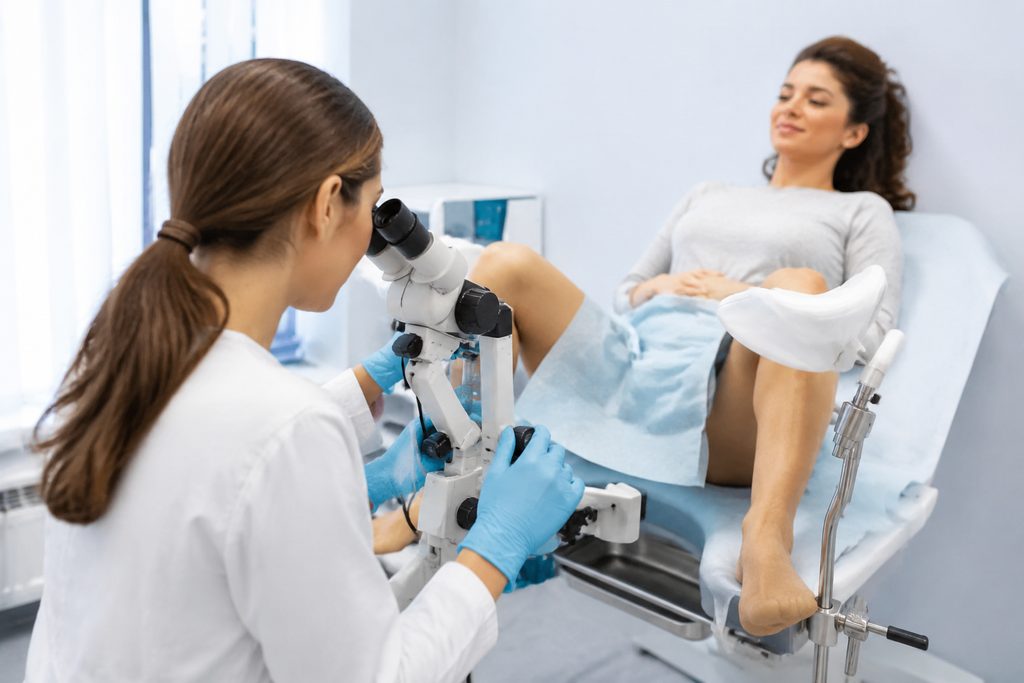
You lie on a gynecological exam table, same position as a Pap smear. The doctor inserts a speculum to hold the vaginal walls open. Then they position a colposcope — a large magnifying lens with a light — a few inches from your vulva. The colposcope does not enter your body. It stays outside, like a pair of binoculars on a stand.
The doctor applies a dilute acetic acid solution (essentially vinegar) to your cervix with a cotton swab. This stings briefly. The acid makes abnormal areas turn white, which the doctor can see through the lens. Sometimes they apply an iodine solution instead; healthy cervical cells stain brown, while abnormal cells stay pale. If the doctor sees a suspicious area, they take a small biopsy — a pinch of tissue, about the size of a grain of rice. Most women feel a sharp cramp for a few seconds, then it passes.
You can drive yourself home afterward. You may have light spotting for a day or two. You should avoid intercourse, tampons, and swimming for about a week, especially if a biopsy was taken. That is the whole procedure. No anesthesia, no stitches, no recovery room.
One thing surprises many Western patients: in Chinese hospitals, the colposcopy is often performed by a senior gynecologist rather than a nurse practitioner or physician assistant. This is partly due to volume — top Chinese gynecology departments see enormous caseloads — and partly due to how care is structured. The doctor doing your colposcopy has likely performed thousands of them.
Colposcopy Cost China: A Transparent Breakdown
So how much does a colposcopy actually cost in China? The answer depends on three things: hospital tier, whether a biopsy is taken, and whether you go through the public channel or the international medical department.
Here is what we tell patients, based on current pricing at major hospitals in Beijing, Shanghai, and Guangzhou:
| Item | Public Hospital, Standard Channel | Public Hospital, International Department | Private International Hospital |
|---|---|---|---|
| Gynecologist consultation | $20–$50 | $80–$150 | $100–$200 |
| Colposcopy (no biopsy) | $50–$100 | $150–$250 | $200–$350 |
| Cervical biopsy (if needed) | $30–$60 | $80–$120 | $100–$150 |
| Pathology report | $20–$40 | $40–$80 | $50–$100 |
| Bilingual companion (per day) | — | Included or from $300 | Included |
| Typical total | $120–$250 | $350–$600 | $450–$800 |
Compare that to the United States, where a colposcopy without insurance commonly bills at $500 to $2,500, and with biopsy can exceed $3,000. In the UK, private colposcopy runs £300 to £800. In Australia, expect AUD $400 to $1,200. The colposcopy cost China advantage is real, even when you add flights and a hotel.
But be honest with yourself: if your total travel cost is $2,500 and you save $1,500 on the procedure, you have not saved money. You have bought something else — speed, access to a high-volume specialist, or a second opinion in a system that sees enormous numbers of cervical dysplasia cases. That may be worth it. Just do the math with your eyes open.
Prices vary by hospital and case complexity. Always confirm the final quote before you book travel.
A Realistic Timeline
People underestimate how long the logistics take. Here is a realistic schedule, from first contact to having a biopsy result in your hand:
| Stage | What Happens | Typical Duration |
|---|---|---|
| Week 1 | You send records; we translate and review them; hospital options presented | 2–4 business days |
| Week 1–2 | Optional video consultation with the gynecologist | 3–7 days to schedule |
| Week 2–3 | Appointment confirmed; we advise on visa documents and travel dates | 3–5 days |
| Week 3–4 | S2 visa application (if required for your nationality) | 5–10 business days |
| Week 4–5 | Travel to China; colposcopy performed | 1 day at hospital |
| Week 5–6 | Biopsy pathology results returned and translated | 3–7 days |
So plan on roughly four to six weeks from first message to final report. Can it be faster? Sometimes. If your nationality enjoys visa-free entry to China and the hospital has an open slot, you could compress the timeline to ten days. But do not book non-refundable flights on that assumption.
The step people forget is document translation. Chinese hospitals need your records in Chinese. A poor translation can delay review or lead to miscommunication. We handle this internally, but if you are arranging things yourself, budget a few days and use a certified medical translator.
What Can Go Wrong — and What Happens Then
We would rather tell you the failure modes now than have you discover them in a foreign country. Here are the honest ones.
The biopsy result is unclear. Sometimes the pathologist cannot determine whether the abnormal cells are high-grade or low-grade. This happens everywhere, not just in China. What happens then: the hospital may recommend a repeat colposcopy in 6 to 12 months, or an HPV test, or a LEEP procedure to remove the abnormal area entirely. You would need to decide whether to do that in China or at home. We help patients weigh the cost and continuity of care.
You need treatment, not just diagnosis. A colposcopy sometimes reveals CIN 2 or CIN 3 — moderate to severe dysplasia. That requires treatment, typically a LEEP or cone biopsy. If you are already in China, you can often schedule this within days. But it means extending your stay and budgeting for a procedure that costs $800 to $2,500 at a top public hospital, depending on complexity. If you cannot stay, you return home with a translated pathology report and a clear recommendation for your local gynecologist.
Language friction despite preparation. Even in international departments, not every nurse or lab technician speaks English. A bilingual companion solves most of this, but there will be moments — a pharmacy window, a billing counter — where you feel the gap. Our companions handle these. If you go without one, expect some frustration.
Your home doctor rejects the foreign report. Some Western gynecologists are reluctant to act on pathology reports from unfamiliar labs. This is less common with top-tier Chinese hospitals, whose pathology departments process enormous volumes and follow international standards. But it happens. Ask your home doctor before you travel whether they will accept a Chinese pathology report. If they will not, you may need a repeat biopsy at home, which defeats the purpose.
None of these are reasons to avoid China. They are reasons to plan carefully.
Is It Safe to Have a Colposcopy in China?
The short answer: yes, at the right hospitals. The longer answer requires context.
China’s top gynecology departments handle patient volumes that dwarf most Western centers. A single major obstetrics and gynecology hospital in Shanghai may perform over 10,000 colposcopies per year. That repetition builds competence. The best gynecology hospital Shanghai for colposcopy is typically one affiliated with Fudan University or Shanghai Jiao Tong University — institutions whose pathology labs and infection control protocols meet international accreditation standards.
But “China” is not one standard. A county-level hospital in a small city is not the same as a Fudan-ranked teaching hospital in Shanghai or Beijing. This is why we limit our database to the top 5% of China’s 35,000+ hospitals, ranked by Fudan and JCI. For a procedure as routine as colposcopy, the risk of complication is low everywhere. The risk of misdiagnosis or poor biopsy technique is higher at low-volume, low-resource facilities.
So is it safe to have a colposcopy in China? Yes, if you choose a hospital with a high-volume gynecology department and verified quality indicators. Ask about biopsy volume. Ask whether the pathology lab participates in external quality assessment. A good hospital will answer. A weak one will not.
Infection control deserves a mention. Single-use speculums and biopsy forceps are standard at top-tier Chinese hospitals. If you have concerns, ask directly. The answer should be immediate and unambiguous.
Practical Considerations: Records, Visa, Payment, and Follow-Up
These are the details that determine whether your trip goes smoothly or becomes a headache.
Records. Bring your original Pap smear and HPV reports, not just summaries. Chinese gynecologists want to see the actual cytology description and HPV genotype. If you have had a prior colposcopy, bring those images or reports too. We translate everything before your appointment.
Visa. For medical treatment in China, the applicable short-stay category is the S2 visa, endorsed for medical purposes. You will need a supporting letter from the hospital confirming your appointment. We provide guidance on this, but approval is always at the discretion of the Chinese embassy or consulate. Apply early. Do not book flights until the visa is in your passport, unless your nationality qualifies for visa-free entry.
Payment. Public hospitals in China require prepayment. You deposit funds at the hospital cashier, and services are deducted as you use them. International departments accept major credit cards; standard public channels often require cash or Chinese mobile payment. Private international hospitals like United Family or Jiahui accept international insurance directly. If you have insurance, check whether your policy covers treatment abroad before you travel.
Language. Even a simple colposcopy involves registration, payment, lab specimen drop-off, and result collection. Each step has a counter, a queue number, and a Chinese-speaking staff member. A bilingual medical companion from $300 per day removes this friction entirely. It is the single highest-value service we offer for short diagnostic visits.
Follow-up at home. Before you leave, ask the Chinese gynecologist to write a follow-up plan in English: when to repeat the Pap smear, what HPV testing schedule to follow, and what symptoms should trigger an immediate visit. Bring this to your home gynecologist. Good documentation makes continuity of care much easier.
Frequently Asked Questions
In the United States, a colposcopy without insurance typically costs $500 to $2,500, and with a biopsy it can exceed $3,000. In China, the same procedure at a top-tier public hospital runs $120 to $250 on the standard channel, or $350 to $600 through an international medical department. In Thailand, expect $200 to $500. In Turkey, $150 to $400. China is among the most affordable options for high-quality gynecological diagnostics, though travel costs must be factored in.
You lie on an exam table with your feet in stirrups. The doctor inserts a speculum, then views your cervix through a magnifying colposcope that stays outside your body. A vinegar solution is applied to highlight abnormal areas. If the doctor sees something suspicious, they take a small biopsy, which feels like a brief pinch or cramp. The entire process takes 10 to 20 minutes. You can return to normal activities the same day, with light spotting for a day or two.
At a top-tier hospital with an international medical department, yes. The gynecologist will typically speak some English, and a bilingual companion can handle all other communication. At a standard public hospital without language support, the procedure itself is safe, but navigating registration, payment, and results without Chinese is very difficult. We recommend either the international department or a companion — ideally both.
Can I book a colposcopy medical tourism package in Beijing?
Yes, but “package” is the wrong frame. What we arrange is a coordinated appointment: hospital matching, record translation, scheduling, and on-the-ground support. You pay the hospital directly for the colposcopy; you pay us for coordination and companion services. There is no bundled price that includes flights and hotels, because those depend on your dates and preferences. If you want to book colposcopy medical tourism package Beijing, start by sending your records and we will give you a clear cost breakdown before you commit to anything.For more medical information and treatment options in China, visit chinamedservices.com (China Medical Services).
