Glaucoma Screening in China: How to Arrange It as a Foreigner
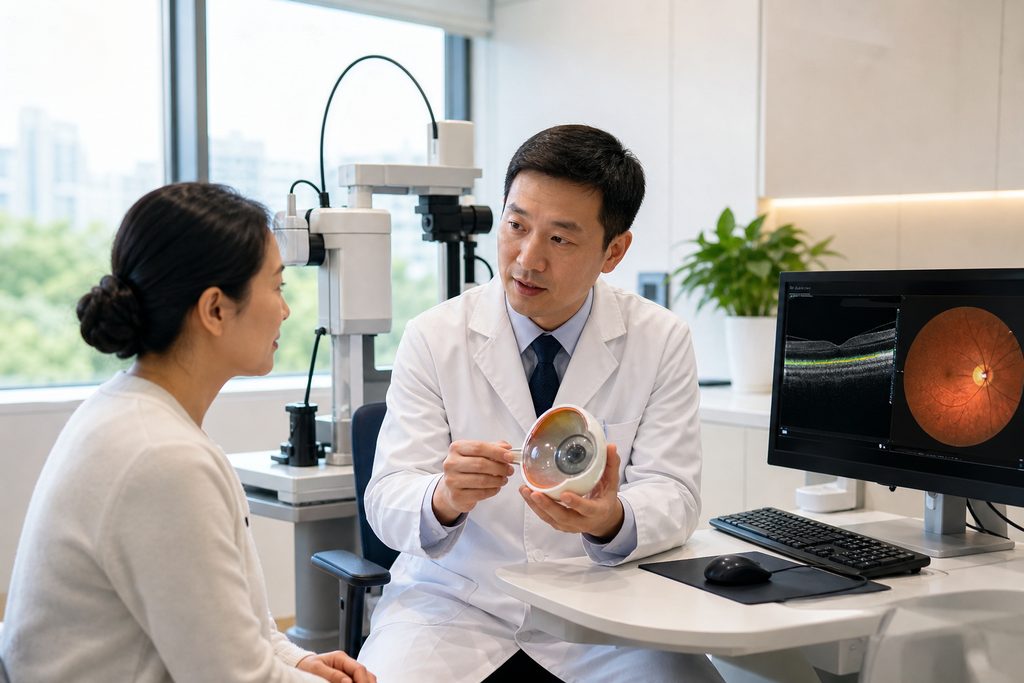
Glaucoma Screening in China: How to Arrange It
Glaucoma is a group of eye diseases that quietly damage the optic nerve, usually because fluid pressure inside the eye builds up over time. It is one of the leading causes of irreversible blindness worldwide, and it rarely announces itself. There is no pain, no blurring, no obvious warning in the early stages. That is exactly why screening matters, and why so many people search for glaucoma screening in China each year — often because they are already in the region, or because a routine eye check at home raised a flag and they want a thorough, affordable follow-up.
Here is the short answer before we go further. Yes, you can arrange glaucoma screening in China as a foreigner. The tests themselves are fast — most take under two hours. The hard part is not the medicine. It is the logistics: choosing the right hospital, securing an appointment without a Chinese ID, and having someone beside you who can translate results on the spot. This guide walks through all of it, honestly.
What Glaucoma Screening Actually Involves
Before you book anything, it helps to know what you are booking. A proper glaucoma workup is not one test. It is a small bundle, and each piece answers a different question.
- Tonometry — measures intraocular pressure (IOP). Quick, painless, a few seconds per eye.
- Ophthalmoscopy — the doctor looks directly at your optic nerve to check for cupping or damage.
- Perimetry (visual field test) — maps your peripheral vision. This is the one that catches functional loss early, and it takes 10–20 minutes.
- Optical coherence tomography (OCT) — a scan that measures the thickness of the retinal nerve fiber layer. Modern Chinese tertiary hospitals have this equipment widely available.
- Gonioscopy — examines the drainage angle to determine whether you have open-angle or angle-closure glaucoma. This distinction changes treatment entirely.
- Pachymetry — measures corneal thickness, because a thin cornea can make pressure readings falsely low.
Not every patient needs every test on the first visit. A good ophthalmologist triages. Someone with a family history and mildly elevated pressure may only need tonometry, fundoscopy and a baseline visual field. Someone with suspicious optic discs will get the full panel. Expect the initial consultation to run 30–60 minutes, with testing adding another 30–90 minutes depending on the hospital’s queue.
How This Actually Works, Step by Step
Here is the real sequence, from your first inquiry to walking out with results in hand.
Step one — you send us your existing records. That means your last eye exam, any pressure readings, a list of medications (especially steroids, which can raise IOP), and a short note on why you want screening. Family history of glaucoma? Recent eye pain? A borderline result back home? All of it helps.
Step two — a Chinese ophthalmology department reviews the file. Not a call center. The relevant specialty looks at what you sent and advises which tests are appropriate and which hospital fits your case. For routine screening, a major tertiary hospital’s ophthalmology department is more than sufficient. For complex or suspected cases, we route toward higher-volume centers with subspecialty glaucoma clinics.
Step three — you choose a format. You can do a written second opinion (from $300–500), a video consultation with the eye team (from $100–300 for a standard international department, $500–800 for a top specialist), or proceed directly to an in-person appointment. For straightforward screening, most patients skip straight to the in-person visit.
Step four — appointment coordination. This is where foreigners usually hit a wall. Public hospital ophthalmology departments in China typically do not accept overseas online booking for standard outpatient slots. You show up, you queue, you take a number. Our hospital appointment coordination service (from $300) handles registration, medical card creation, and scheduling through the hospital’s international or VIP channel where available. If we cannot secure the appointment you requested, the coordination fee is refunded in full.
Step five — the visit itself. You arrive, a bilingual companion meets you, and you move through registration, testing, and consultation without navigating a Chinese-only queue system alone. Results are explained in English. If follow-up testing or treatment is recommended, you leave with a clear written plan.
What Glaucoma Screening Costs in China
This is the question most patients ask first, so let’s put real numbers on it. Glaucoma screening cost in China varies by hospital tier and by how many tests are included, but the range is genuinely modest compared with Western pricing.
| Service | Typical Cost in China (USD) | Comparable US Cost (USD) |
|---|---|---|
| Basic screening (tonometry + fundoscopy) | $30–80 | $150–300 |
| Full glaucoma workup (adds visual field, OCT, gonioscopy) | $150–400 | $600–1,200 |
| Ophthalmology specialist consultation | $20–60 (standard) / $100–250 (international dept.) | $200–400 |
| Visual field test alone | $25–60 | $150–250 |
| OCT scan alone | $40–100 | $200–400 |
These are reference ranges. Final pricing varies by hospital and case complexity, and private international hospitals sit at the upper end because they offer English-speaking staff, shorter waits, and direct insurance billing. For a general sense of how Chinese tertiary hospital pricing compares across specialties, our directory of top-ranked Chinese hospitals is a useful starting point.
One thing worth flagging: the 1.5–2x premium for international department access is not a scam. It buys you an English-speaking specialist, a scheduled slot instead of a queue, and administrative support. For a first screening visit, many patients find it worth it.
Which Hospitals Are Best for Glaucoma Screening?
China has over 35,000 hospitals. The top 5% — ranked by the Fudan University Hospital Rankings and JCI accreditation — are where you want to be for anything eye-related. Major ophthalmology centers in Beijing, Shanghai, and Guangzhou handle enormous volumes, which means their specialists see far more glaucoma in a month than many Western clinics see in a year.
For routine screening, you do not need the single most famous eye hospital in the country. You need a tertiary hospital with a functioning glaucoma subspecialty, modern OCT and perimetry equipment, and an international department that can register a foreign passport. That last point matters more than prestige.
If you are searching for the best eye hospital in China for glaucoma, the honest answer is that several institutions are genuinely excellent, and the right one depends on your city, your timeline, and whether you need an English-speaking team. Our specialty rankings by department list the top hospitals for ophthalmology, and city pages like Shanghai break down what is available locally.
Book Glaucoma Screening in Shanghai: A Practical Note
Shanghai is the most common entry point for international patients seeking eye care, largely because of flight connections and the concentration of international hospitals. If your goal is to book glaucoma screening in Shanghai, you have two realistic paths.
The first is a public tertiary hospital ophthalmology department. Excellent clinical quality, low cost, but you will queue, and English support is limited outside the international wing. The second is a private international hospital — English-speaking staff, JCI accreditation, direct insurance billing, and appointment times that actually hold. You pay more, but the experience is closer to what a Western patient expects.
Most patients we work with choose based on urgency and comfort level rather than cost alone. A routine annual check? Public hospital is fine. A suspicious finding that needs same-week evaluation and a clear English explanation? The private route often saves stress.
A Realistic Timeline
Here is what the calendar actually looks like, including the steps people forget.
| Stage | Time Required | Notes |
|---|---|---|
| Records gathering and translation | 2–5 days | Longer if records are in a non-English language |
| Specialist file review | 1–3 business days | Faster for straightforward screening cases |
| Appointment coordination | 3–10 days | International departments book faster than standard outpatient |
| Visa processing (S2) | 4–10 business days | Requires hospital invitation documents; varies by consulate |
| The screening visit itself | Half a day | Allow extra if dilation drops are used — vision stays blurry 3–4 hours |
| Written results and plan | Same day to 3 days | OCT and visual field reports are usually ready within hours |
Total, from first contact to sitting in the exam chair: roughly two to four weeks for a planned trip. If you are already in China, you can compress this to under a week.
Is Glaucoma Screening in China Safe?
Yes, with context. Is glaucoma screening in China safe? The equipment in tertiary hospitals is the same technology used in Europe and North America — OCT machines from the same manufacturers, perimeters with the same protocols. The specialists are trained to international standards, and many have done fellowships abroad.
The real safety considerations are not about the medicine. They are about communication. If you do not speak Mandarin and you are in a standard public hospital queue, you may not fully understand what is being measured or what the results mean. That gap is where mistakes and anxiety live. A bilingual companion closes it.
Second consideration: screening is not diagnosis. If your results are abnormal, you will need a follow-up plan — possibly medication, possibly laser treatment, possibly long-term monitoring. Make sure you leave with that plan in writing, in English, before you fly home.
Practical Considerations for Foreign Patients
Visa. Medical travel to China uses the S2 visa, which covers short-stay visits for medical treatment and private affairs. It requires supporting documents from the hospital. Stays beyond 180 days fall under S1. Accompanying family members apply for S2 as well. The M visa is for commercial and trade activity and has nothing to do with medical treatment — if anyone tells you otherwise, they are wrong. Always confirm current requirements with your nearest Chinese embassy or consulate, as rules are updated periodically.
Payment. Public hospitals require prepayment. International insurance is typically reimbursed after the fact, not billed directly. Private international hospitals often bill insurers directly — check before you book.
Language. Assume you will need help unless you are going to a private international facility. Registration systems, payment kiosks, and pharmacy counters are in Chinese.
Follow-up at home. Glaucoma is managed over years, not weeks. Ask for your OCT and visual field reports in a format your home ophthalmologist can read. Digital copies plus a short English summary is ideal.
Frequently Asked Questions
Technically yes, at private international hospitals that accept online or phone booking. At public tertiary hospitals, walk-in registration is possible but requires navigating a Chinese-language system, and same-day specialist slots are not guaranteed. Most foreign patients use a coordination service for exactly this reason.
Pressure readings and fundoscopy results are immediate. Visual field and OCT reports are usually ready within a few hours. A written summary from the specialist may take one to three business days depending on the hospital.
Often, yes, for a thorough optic nerve exam. Dilation makes your vision blurry for three to four hours and increases light sensitivity. Bring sunglasses, and do not plan to drive yourself afterward.
Then you have caught it early, which is the entire point. Follow-up may involve pressure-lowering drops, laser therapy, or a monitoring schedule. The specific path depends on your diagnosis and should be discussed with a qualified ophthalmologist — we do not provide medical advice, only the logistics that get you in front of the right specialist.
For a single screening, a package is rarely necessary — the tests are inexpensive individually. Packages make more sense if you are combining a comprehensive health checkup with eye screening, which some international departments offer as a bundled service. Compare the itemized list against what you actually need before committing.
Your Next Step
Glaucoma screening in China is fast, affordable, and clinically solid — the barrier is almost never the medicine, it is the navigation. Get the records together, pick a hospital tier that matches your comfort level, and plan for the visa and appointment lead time.
We are China Medical Services. We connect international patients with 340+ top-ranked hospitals across 37 cities, and we handle the parts that trip people up: record review, appointment coordination through official international departments, bilingual accompaniment, and visa guidance. We do not diagnose, we do not treat, and we never promise a specific clinical outcome. If you would like a straightforward conversation about whether screening in China makes sense for your situation, you can start with a free consultation — no pressure, no obligation.
This article is for general information only and does not constitute medical advice. Always consult a qualified ophthalmologist about your individual eye health.
For more medical information and treatment options in China, visit chinamedservices.com (China Medical Services).
