Can a Varicocele Cause Infertility? The Evidence and Your Options
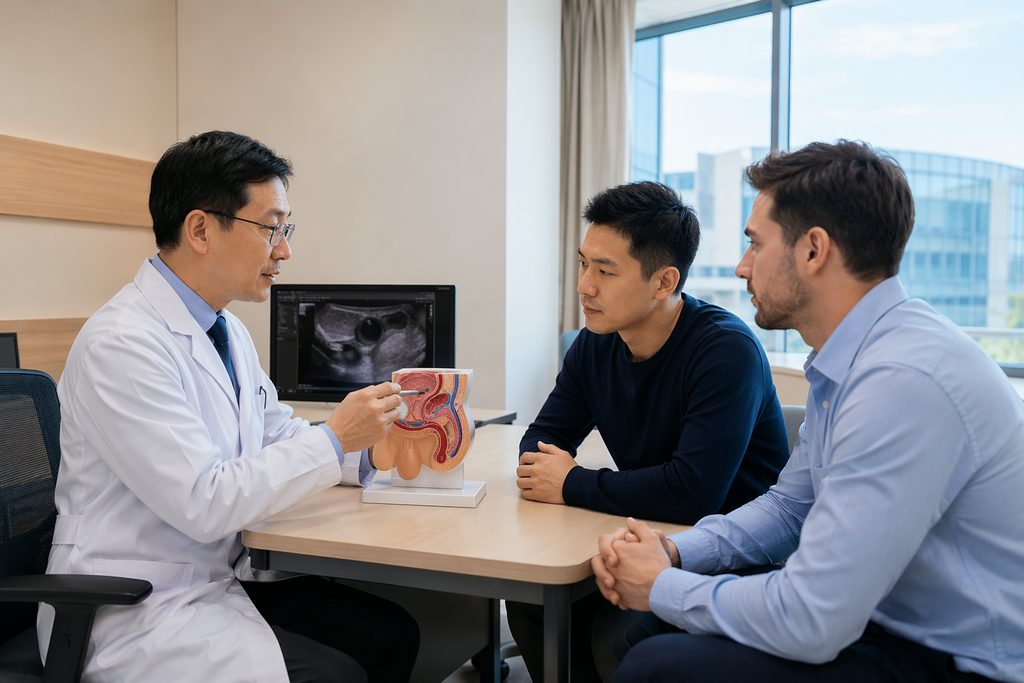
Can a Varicocele Cause Infertility? The Short Answer
Yes. A varicocele can cause infertility. The numbers are stark: varicoceles show up in roughly 15% of all men, but in 40% of men evaluated for primary infertility and up to 80% of men with secondary infertility, according to data from the American Urological Association. That gap is not a coincidence. The mechanism matters here, so let us be precise about what is happening inside the scrotum.
Varicoceles are enlarged veins in the pampiniform plexus, the network that drains blood from the testicle. Faulty valves let blood pool. Pooled blood raises scrotal temperature by 1 to 2°C. Sperm production is exquisitely temperature-sensitive. Sustained heat damages sperm DNA, lowers sperm count, and reduces motility. The result is measurable on a semen analysis. But here is the caveat that makes this more complicated than a one-liner: not every varicocele impairs fertility. Many men with varicoceles father children without intervention. The clinical question is never just “do you have a varicocele?” It is “is this varicocele affecting your sperm parameters, and if so, is repair likely to help?”
Who This Is Right For — and Who It Isn’t
Surgical repair of a varicocele, called varicocelectomy, is not for every man with a visible vein. Urological guidelines are fairly consistent. A repair is typically considered when all three of these are true: the varicocele is palpable on physical exam, the couple has documented infertility, and the semen analysis shows abnormal parameters. If those boxes are checked, repair can improve sperm count, motility, and DNA integrity in a significant portion of men.
Good candidates for varicocele surgery usually fit this profile:
- Palpable varicocele (grade 2 or 3) confirmed by scrotal ultrasound with Doppler
- Abnormal semen analysis on at least two separate samples taken weeks apart
- Female partner with normal or treatable fertility status, or planned use of assisted reproduction
- Testicular atrophy on the affected side, especially in adolescents
- Persistent scrotal pain or heaviness that interferes with daily activity
Who should not rush into surgery?
- Men with a subclinical varicocele detected only on ultrasound, with normal semen parameters
- Men with normal semen analysis and no pain — observation is standard
- Men with azoospermia (zero sperm) who have not had genetic testing and hormonal evaluation first
- Men whose female partner has severe tubal factor or ovarian reserve issues that would require IVF regardless
That last group deserves a longer conversation. If IVF with intracytoplasmic sperm injection (ICSI) is already planned, the added benefit of varicocele repair is debated. Some studies show improved IVF outcomes after repair; others show no difference. A reproductive urologist should weigh in before you commit to an operation.
The Options, Compared
You have three realistic paths when a varicocele is confirmed and fertility is the concern: observation with lifestyle changes, surgical repair, or assisted reproduction without repair. The table below lays out the concrete differences.
| Option | Typical Cost Range (USD) | Time to Sperm Improvement | Success Rate for Sperm Improvement | Invasiveness |
|---|---|---|---|---|
| Observation + lifestyle changes | $0–500 | 3–6 months | Unpredictable; limited data | None |
| Microsurgical varicocelectomy (China) | $2,500–6,000 | 3–6 months | 60–70% show improved parameters | Open microsurgery, 1–2 inch incision |
| Microsurgical varicocelectomy (USA) | $8,000–20,000 | 3–6 months | 60–70% show improved parameters | Same procedure |
| Laparoscopic varicocelectomy (China) | $3,000–7,000 | 3–6 months | Comparable to microsurgical | Keyhole, 3 small incisions |
| Assisted reproduction (IVF/ICSI) without repair | $12,000–25,000 per cycle (China: $5,000–10,000) | Immediate cycle start | Live birth rate per cycle: 30–45% depending on age | Female partner undergoes ovarian stimulation |
Which column suits you depends on timing and the female partner’s age. If she is under 32 and you have 6 to 12 months, surgical repair makes economic and biological sense. If she is 38 and the clock is loud, going straight to IVF may be the more rational move. A reproductive urologist and a fertility specialist should be in the same room, metaphorically speaking.
Why Men Travel to China for Varicocele Surgery Cost and Expertise
The search phrase “varicocele surgery cost China” gets typed into Google thousands of times a month. The reason is straightforward: the same microsurgical technique performed in Houston or London costs a fraction in Shanghai or Beijing. And the surgeons doing it are not trainees. Urology departments at top Chinese hospitals perform thousands of microsurgical varicocelectomies annually. Volume builds skill. That is not marketing language; it is how surgical proficiency works.
But cost is not the only driver. Wait times matter. In Canada and the UK, a non-urgent varicocelectomy can mean waiting 6 to 18 months. In China, once you have a confirmed diagnosis and a consultation, surgery can often be scheduled within 2 to 4 weeks through a hospital’s international department. That timeline matters when every cycle counts.
One more factor: the microsurgical approach itself. Chinese urology departments have adopted the operating microscope widely. The microsurgical technique uses a surgical microscope to identify and ligate only the dilated veins while sparing the testicular artery and lymphatics. The result is a lower recurrence rate (under 5% versus up to 15% for non-microsurgical techniques) and a lower risk of hydrocele formation, according to a meta-analysis published in the Asian Journal of Andrology. When you compare varicocele surgery price Shanghai against the same procedure in New York, the savings are real, but the quality bar is what makes it worth considering.
What It Costs: Varicocele Surgery Price Shanghai, Beijing, and Beyond
Let us talk numbers without pretending they are fixed. The varicocele surgery price Shanghai varies by hospital tier. At a top-tier public hospital’s international department, expect $2,500 to $5,000 for a microsurgical varicocelectomy, including surgeon fees, anesthesia, operating room, and a 1 to 2 night hospital stay. At a private international hospital like United Family or Jiahui, the same procedure runs $5,000 to $8,000. Beijing prices are similar, perhaps 10 to 15% higher at the very top institutions.
For comparison, the same microsurgical varicocelectomy in the United States typically lands between $8,000 and $20,000 depending on the facility and your insurance. In the UK, private pay is £4,000 to £7,000. In Australia, AUD $6,000 to $12,000. The savings are not marginal. A patient from the US can often fly to Shanghai, have the surgery, recover in a hotel for a week, and fly home for less than the out-of-pocket cost at a US hospital.
What is included in the Chinese hospital quote? Usually the procedure itself, the operating room, anesthesia, basic lab work, and the hospital bed. What is not included: pre-operative imaging if not already done, the initial consultation fee, post-operative medications, your flight, hotel, and meals. Airfare from the US runs $800 to $1,500 round trip. A decent hotel near the hospital costs $60 to $120 per night. Budget another $1,500 to $2,500 for travel and lodging. The total still lands well below Western prices.
Is Varicocele Surgery Safe in China? What the Data Shows
This is the question behind the question. Cost savings mean nothing if safety is compromised. So let us address it directly: is varicocele surgery safe in China? The short answer is yes, at the right hospitals. The longer answer requires understanding the two-tier system.
China has over 35,000 hospitals. The top 5% are ranked by the Fudan University Hospital Ranking and include institutions with international accreditation from JCI. These hospitals — Peking Union Medical College Hospital in Beijing, Zhongshan Hospital in Shanghai, West China Hospital in Chengdu — perform varicocelectomies at volumes that dwarf most Western centers. Complication rates for microsurgical varicocelectomy at these institutions are published in peer-reviewed Chinese and international journals and are comparable to rates reported in US and European literature: recurrence under 5%, hydrocele under 1%, testicular artery injury rare.
That said, safety is not uniform across all 35,000 hospitals. A patient who walks into a random county hospital without research is making a different bet than one who goes through a vetted international department. The distinction matters. Our team maintains a database of 340+ top-ranked hospitals across 37 cities, filtered by Fudan ranking and JCI accreditation, precisely because the range in quality is real.
What about surgical technique? Microsurgical varicocelectomy is the gold standard globally. It is the approach recommended by the American Urological Association and the European Association of Urology. The same guidelines apply in China. When you book through a hospital’s international department, you are not getting a different operation; you are getting the same operation with English-speaking coordination and a private recovery room.
Practical Considerations: Records, Visa, and Follow-Up
If you are serious about booking varicocele treatment China medical tourism, the logistics are manageable but not trivial. Start with your records. You need a recent scrotal ultrasound with Doppler confirming the varicocele and grading it, plus at least one semen analysis performed within the last 3 months. If you have had prior scrotal surgery, bring the operative note. These documents let the Chinese urologist evaluate you remotely before you commit to travel.
Visa. Foreign nationals seeking medical treatment in China apply for an S2 visa, which covers short-term private affairs including medical treatment. The hospital’s international department will issue an invitation letter and treatment confirmation. Your accompanying family member also applies for an S2. Processing takes 1 to 3 weeks depending on your home country’s Chinese embassy. Do not book flights until the visa is approved.
Payment. Public hospital international departments generally require prepayment or a deposit before surgery. Credit cards are accepted at most international departments, but verify with your bank. Private international hospitals like United Family often have direct billing arrangements with major insurers. If you have international health insurance, check whether varicocelectomy is covered and whether the Chinese hospital is in-network.
Language. Top public hospitals are enormous. Daily outpatient volume can exceed 10,000 patients. Signage is increasingly bilingual, but the flow is chaotic if you do not read Chinese. A bilingual medical companion who handles registration, payment, queueing, and translation turns a stressful day into a manageable one. This is not a luxury; it is a practical tool.
Follow-up after returning home. You will need a semen analysis at 3 months and 6 months post-surgery. Any urologist can order this. Send the results to your Chinese surgeon for review by email. Most international departments provide post-operative follow-up correspondence as part of the package.
Frequently Asked Questions
Sperm parameters do not improve overnight. Spermatogenesis takes about 74 days, so the first meaningful semen analysis is at 3 months post-surgery, with the peak improvement typically seen at 6 months. Studies show that 60 to 70% of men have improved sperm count, motility, or morphology by 6 months. Pregnancy rates after repair range from 30 to 50% within one to two years, depending on the female partner’s age and other factors.
It can, but the risk depends on technique. Microsurgical varicocelectomy has a recurrence rate of under 5% in most series. Non-microsurgical techniques, including laparoscopic and open non-microsurgical approaches, carry recurrence rates of 10 to 15%. This is one reason the microsurgical approach is worth seeking out specifically. If a varicocele recurs, a repeat procedure is possible but more technically demanding.
There is no single “best” hospital, but several institutions have strong reproductive urology departments. Peking Union Medical College Hospital in Beijing, Renji Hospital in Shanghai, and West China Hospital in Chengdu are consistently ranked among China’s top 10 for urology in the Fudan specialty reputation rankings. Our urology department rankings break down the top institutions by specialty so you can compare them side by side. For international patients, the international department of any of these hospitals provides English-language coordination.
It depends entirely on your policy. Many international health insurance plans cover treatment at JCI-accredited hospitals in China. Public hospital international departments are less likely to have direct billing arrangements, meaning you pay upfront and submit for reimbursement. Check with your insurer before booking. Ask specifically about coverage for varicocelectomy and whether the hospital you are considering is in-network. Some private international hospitals in Shanghai and Beijing have direct billing with major insurers like Cigna, Aetna, and Allianz.
Yes, and the evidence is consistent. Multiple randomized controlled trials and meta-analyses show that microsurgical varicocelectomy has lower recurrence rates, lower hydrocele rates, and better sperm improvement compared to non-microsurgical open or laparoscopic techniques. The operating microscope allows the surgeon to see and spare the testicular artery and lymphatics, which reduces complications. The trade-off is that the procedure takes longer and requires specialized training, which is why it is more commonly offered at high-volume academic centers.
Your Next Step
The evidence is clear: a varicocele can cause infertility, and surgical repair can reverse the damage in a majority of carefully selected men. Whether you pursue treatment at home or abroad, the key is acting on data, not anxiety. Get the semen analysis. Get the ultrasound. Then make a decision with a reproductive urologist who can look at your specific numbers.
We are China Medical Services, a coordination team that connects international patients with top-ranked Chinese hospitals. We are not a hospital and we do not diagnose or treat. What we do is handle the logistics — hospital matching, appointment coordination, bilingual accompaniment, and visa guidance — so you can focus on the medical decision in front of you. If you want to explore whether varicocele surgery in China makes sense for your situation, request a free consultation and we will walk you through the options without pressure.
For more medical information and treatment options in China, visit chinamedservices.com (China Medical Services).
