Lung Cancer Surgery: Can It Cure You? Costs, Timelines & China Options
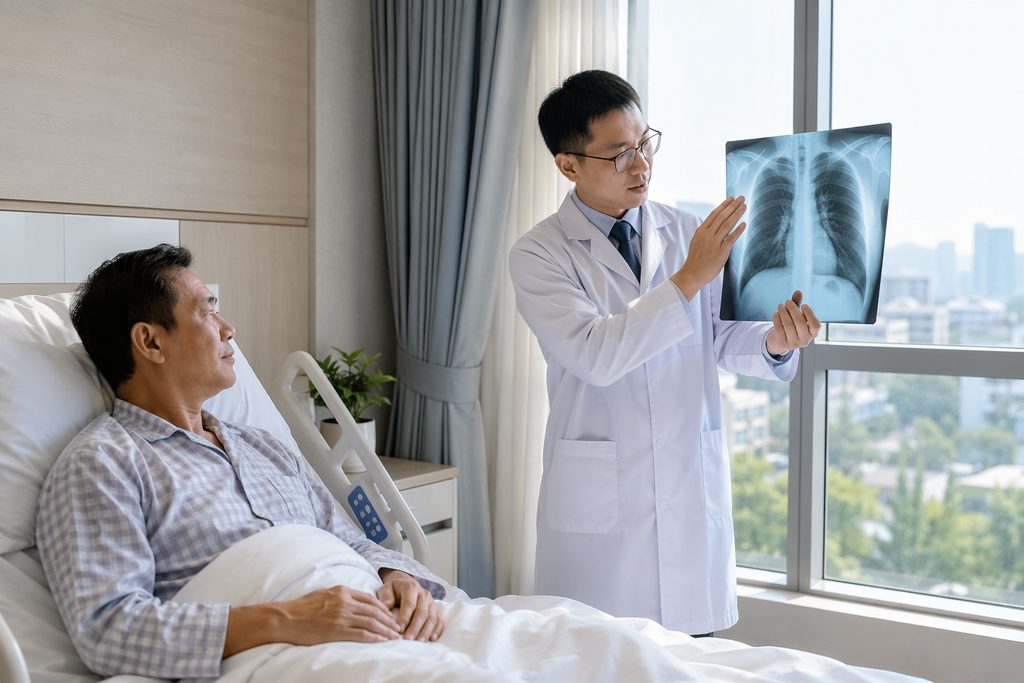
While a patient in the United States might wait three to four weeks just to schedule a diagnostic PET-CT scan, a thoracic oncology team at Shanghai Chest Hospital can often complete staging, multidisciplinary review, and a surgical plan within seven to ten days. The median time from diagnosis to lobectomy in some Western systems stretches past 60 days. At high-volume Chinese centers, that interval frequently falls under three weeks. The question isn’t just whether surgery can cure your lung cancer. It’s whether the system you choose can move fast enough to give surgery its best chance.
Lung cancer kills more people worldwide than any other malignancy — approximately 1.8 million deaths annually. But that grim statistic hides a more hopeful one: for patients diagnosed at an early stage, surgical resection offers a genuine shot at long-term survival. Five-year survival after complete resection of Stage IA non-small cell lung cancer (NSCLC) runs between 80% and 90% in most modern series. The challenge is getting to the operating room while the tumor is still resectable. That’s where system speed, surgical volume, and cost all collide — and where China Medical Services helps international patients navigate the landscape.
How This Actually Works, Step by Step
You have a CT scan showing a suspicious lung nodule. Maybe you already have a biopsy confirming NSCLC. What happens next? The sequence matters more than most patients realize.
First, you send us your existing records — CT images in DICOM format, pathology slides or reports, pulmonary function tests, and any prior treatment summaries. Our team translates these into Chinese medical terminology and forwards them to the thoracic surgery department at one or more of the hospitals in our network. A senior thoracic surgeon reviews the case. Within three to five business days, you receive a written assessment: Is the tumor resectable? What procedure is recommended — lobectomy, segmentectomy, or wedge resection? What additional staging is needed before surgery?
If surgery looks viable, the next step is a video consultation. You speak directly with the surgical team. They explain the approach, the risks, the expected recovery. You ask questions. No commitment required. The consultation fee runs $100–300 for a standard international department video visit, or $500–800 for a top-specialist session. If you later proceed to on-the-ground coordination within 90 days, that fee is credited in full toward the coordination service.
After you decide to proceed, we coordinate the appointment. You travel to China on an S2 visa, issued for private affairs including medical treatment. You undergo final pre-operative evaluation — contrast-enhanced CT, brain MRI if indicated, cardiac clearance, pulmonary function testing. Surgery is scheduled. A bilingual medical companion from our team accompanies you through registration, pre-op testing, and admission.
Post-operatively, you stay in the hospital for five to ten days depending on the procedure and your recovery. Follow-up imaging happens at one month, three months, six months, then annually. We can arrange those follow-ups in China or help translate your Chinese records for your home oncologist.
Lung Cancer Surgery Cost China: The Numbers That Matter
You can’t book surgery sight-unseen at a public hospital — no legitimate hospital will schedule an operation without first evaluating you in person. What you can do is request a written second opinion and video consultation before traveling. The surgical team reviews your scans, confirms resectability, and provides a preliminary plan and cost estimate. You then travel for final pre-operative evaluation and surgery. This staged approach protects you from flying across the world for a surgery that turns out not to be indicated.
At top-tier Chinese hospitals, operative mortality for lobectomy is under 1% — comparable to major Western centers. The language barrier is real but manageable. International departments employ English-speaking coordinators. A bilingual medical companion handles translation during rounds, pre-op testing, and discharge. The medical care itself follows international guidelines. The risk isn’t the surgery. It’s miscommunication. Mitigate that with a companion and you’ve addressed the main vulnerability.
If final pathology shows nodal involvement or other upstaging, the tumor board reconvenes and recommends adjuvant therapy — chemotherapy, targeted therapy, immunotherapy, or radiation, depending on the molecular profile. Chinese centers follow the same NCCN and CSCO guidelines used internationally. You can receive adjuvant therapy in China or return home with translated records for your local oncologist. The surgical finding doesn’t strand you.
Shanghai Chest Hospital and Fudan University Shanghai Cancer Center are the two highest-volume thoracic oncology centers in China. Beijing offers Peking University Cancer Hospital and Cancer Hospital Chinese Academy of Medical Sciences. Guangzhou has Sun Yat-sen University Cancer Center. All are excellent. The choice often comes down to flight connections, visa processing speed at your local consulate, and which surgical team you connect with during the video consultation. Our Shanghai hospital guide and oncology department rankings can help you compare.
Your Next Step
Lung cancer surgery can cure early-stage disease and selected Stage III cases — but only if you reach a high-volume surgical team before the tumor advances. The lung cancer surgery cost China advantage is real: $12,000–$22,000 versus $45,000–$80,000 for equivalent care. The bigger advantage is speed and volume.
We are China Medical Services, a coordination team that connects international patients with China’s top-ranked thoracic surgery programs. We don’t perform surgery. We don’t guarantee outcomes. We handle records translation, hospital matching, appointment coordination, visa guidance, and bilingual accompaniment — so you can focus on recovery instead of logistics. If you’re considering surgery for lung cancer, start with a free consultation. Send your scans. Get an honest assessment. Then decide.
Frequently Asked Questions
Yes. The hospitals used for international patients are JCI-accredited and follow the same international safety standards as top hospitals in the US and Europe. Surgical teams perform high volumes of procedures — often more than their Western counterparts — which studies show leads to better outcomes.
Costs vary by procedure and hospital, but international patients typically save 40-80% compared to US prices — even when factoring in travel and accommodation. A consultation with our team will give you an exact, all-inclusive quote with no hidden fees.
Send us your existing medical reports to get started. We handle everything from hospital selection and appointment scheduling to visa assistance and post-operative recovery planning. Your medical records are reviewed by the specialist before you even book a flight.
For more medical information and treatment options in China, visit chinamedservices.com (China Medical Services).
